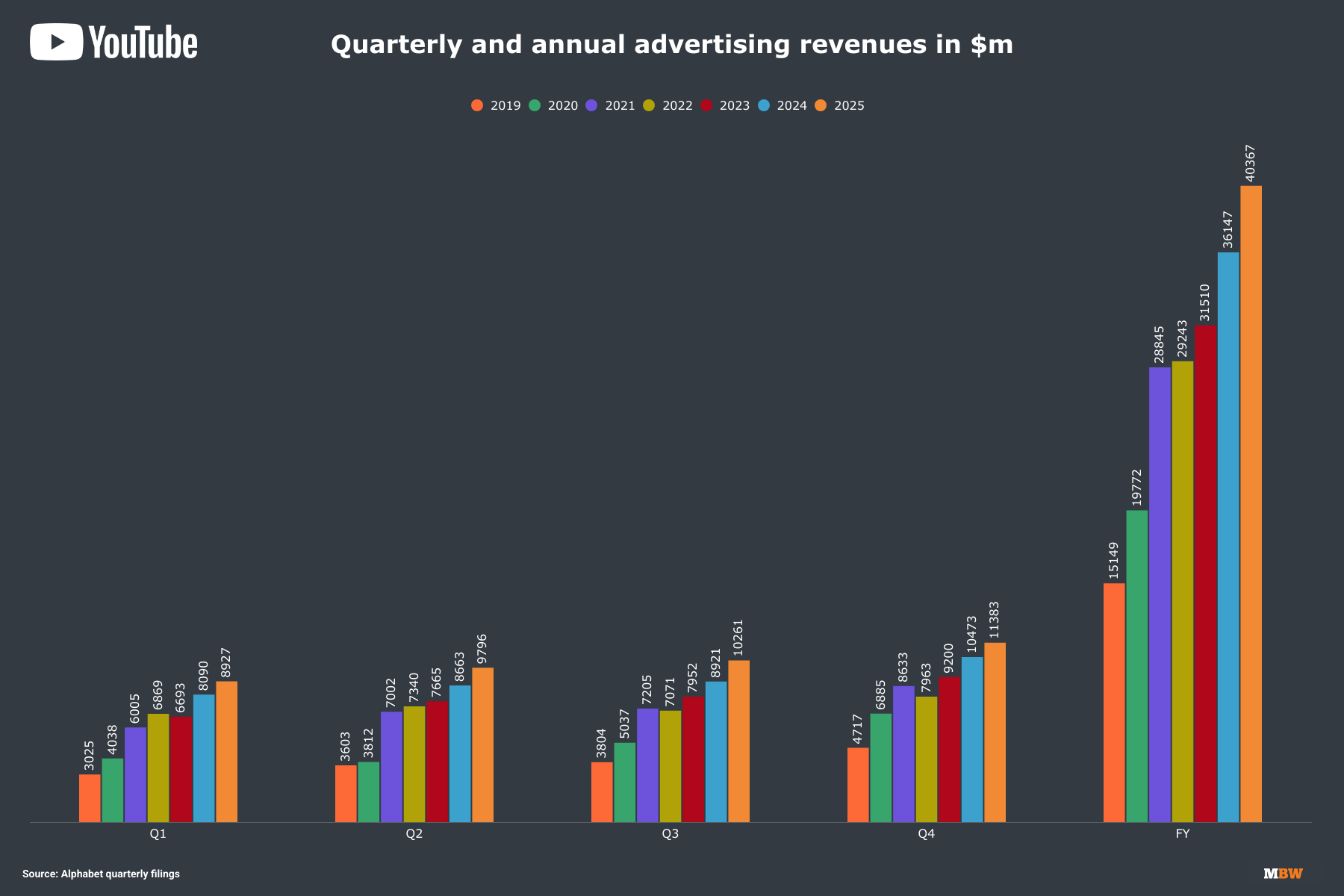
For the full year, YouTube’s advertising business generated $40.37 billion – up 11.7%on 2024’s $36.1 billion haul.
But here’s where it gets interesting: during the earnings call, Alphabet revealed that YouTube’s combined advertising and subscription revenues exceeded $60 billion for 2025.
Simple math implies YouTube’s subscription business, spanning YouTube Music, YouTube Premium, YouTube TV and NFL Sunday Ticket, is now generating approximately $20 billion annually.
YouTube Music has been repeatedly cited by executives as a major contributor to that subscription growth.
Alphabet, YouTube’s parent company, exceeded $400 billion in annual revenues for the first time in 2025.
During the earnings call, Alphabet Chief Business Officer Philipp Schindler explained the dynamic between YouTube’s ad and subscription businesses.
“When a user shifts from being an ad-supported user to a YouTube Music and Premium customer, it has a slightly negative impact on YouTube ads revenues, but a positive impact on our business. And we had strong revenue growth in YouTube subscriptions this quarter, particularly in the YouTube Music and premium category.”
Alphabet doesn’t break out subscription revenue specifically for YouTube, but the company’s subscriptions, platforms and devices segment recorded a 17% YoYincrease in revenue to $13.6 billion.
Alphabet CFO Anat Ashkenazi said during the call: “Subscription platforms and devices revenues increased 17% this quarter to $13.6 billion due to strong growth in YouTube subscriptions, particularly YouTube Music and Premium, and growth in Google One, which benefited from increased demand for AI plans.”
Overall, the Google Services division, which includes YouTube, reported a 14% YoYrevenue growth to $95.9 billion, which the company attributed to the 17% YoYgrowth in “Google Search & other,” a 17% increase in revenue from Google subscriptions, platforms, and devices, and the single-digit growth in YouTube ads revenue.
Despite the advertising growth slowdown, YouTube saw strong momentum across its business, with combined revenues from ads and subscriptions exceeding $60 billion for the full year 2025.
Ashkenazi also explained during the earnings call that YouTube’s ad revenue growth slowed due to a high comparison base from the previous year amid the 2024 US elections. “Results were negatively affected from the lapping of the strong spend on US election in 2024.”
Elsewhere in the company’s earnings report, Alphabet reported a 30% YoY jump in Q4 2025 net income to $34.5 billion. Ashkenazi said Alphabet generated record operating cash flow of $52.4 billion in Q4 2025 and $164.7 billion for the full year.
Full-year revenues at Alphabet grew 15% YoY to $402.8 billion, with net income rising 32% YoY to $132.2 billion.
In a statement accompanying the company’s earnings report, Alphabet and Google CEO Sundar Pichai said: “It was a tremendous quarter for Alphabet and annual revenues exceeded $400 billion for the first time.”
“We continue to drive strong growth across the business. YouTube’s annual revenues surpassed $60 billion across ads and subscriptions; we now have over 325 million paid subscriptions across consumer services, led by strong adoption for Google One and YouTube Premium.”
YouTube/Google
“We continue to drive strong growth across the business. YouTube’s annual revenues surpassed $60 billion across ads and subscriptions; we now have over 325 million paid subscriptions across consumer services, led by strong adoption for Google One and YouTube Premium.”
Sundar Pichai
The company doesn’t provide a breakdown of subscriber numbers specifically for YouTube Music, YouTube Premium and YouTube TV.
In March 2025, YouTube’s Global Head of Music Lyor Cohenannounced that YouTube Music and Premium had hit 125 million paid subscribers worldwide (including trials) – up from 100 million in February 2024. That means the platform added around 25 million subscribers in 12 months, or approximately 2 million per month on average.
Cohen said at the time that the subscriber milestone was “critical to our goal of becoming the No.1 contributor of revenue to the industry”.
YouTube reported in October that it paid more than $8 billion during the 12 months from July 2024 to June 2025 — up from $6 billion for the 12 months from July 2021 to June 2022, the last time it publicly shared the figure.
For comparison, Spotifysaid last week that it paid out more than $11 billion to the music industry in 2025.
During an investor presentation, Pichai also highlighted subscription revenue from YouTube Music Premium as the main driver behind the company’s subscription revenue growth. “We continue to see strong subscription revenue growth across YouTube, particularly YouTube Music Premium.”
YouTube’s short-form video format also continues to gain traction. Chief Business Officer Philipp Schindler said: “Shorts now averages over 200 billion daily views. And as we’ve shared before, in a number of countries, Shorts earns more revenue per watch hour than traditional in-stream on YouTube, including the U.S.”
Pichai hinted at Alphabet’s plans to beef up its AI investments in 2026. “To meet customer demand and capitalize on the growing opportunities we have ahead of us, our 2026 CapEx investments are anticipated to be in the range of $175 to $185 billion.”
Over the past year, YouTube rolled out a number of AI products and experimented with more AI use on its platform including a detection tool for AI-generated likenesses of people developed in partnership with Creative Artists Agency; a new AI music tool that can generate copyright-free soundtracks for video; and tools that can turn speech into songs for Shorts, powered by Google DeepMind’s Lyria 2 music model. The company is also testing an AI music host feature to rival Spotify’s AI DJ.Music Business Worldwide