The share of the world’s ‘Superstar’ artists who hail from the United States has fallen from 45.1% to 33.1% since 2021.

Over the same period, the UK‘s share dropped from 10.6% to 7.6%.
Added together, the two markets accounted for 40.7% of that tier in 2026, down from 55.7% five years earlier.
The figures come from Global Music Pulse, a new report from music data platform Chartmetric, which tracks 14 million artists across streaming and social services.
Chartmetric counts an artist as a ‘Superstar’ if they sit in the top 0.02% of its database by Chartmetric Score.
That works out at around two artists in every 10,000 the company tracks.
This weighted measure of performance is based on artist popularity data across 16 social and streaming platforms, including Spotify, YouTube, Apple Music, and TikTok.
(Legacy acts with at least 7% of their catalog released before 1991 are filed under a separate ‘Legendary’ tier, and are not counted in the ‘Superstar’ category.)
Why are American and British artists losing ground?
It’s not because the US and UK are producing fewer Superstars. It’s because the rest of the world is filling up the top 0.02%-of-artists category faster.
Chartmetric‘s ‘Superstar’ tier grew from 972 artists in 2021 to 2,539 in 2026, says the company.
Applying Chartmetric‘s percentages to those totals, MBW calculates that the US went from around 438 ‘Superstar’ artists in 2021 to around 840 in 2026. On the same basis, the UK‘s count rose from roughly 103 to roughly 193.
US and UK Superstar numbers, in other words, have nearly doubled in five years.
They lost share anyway, because other nations added… more Superstars.
Where are the new Superstars coming from?
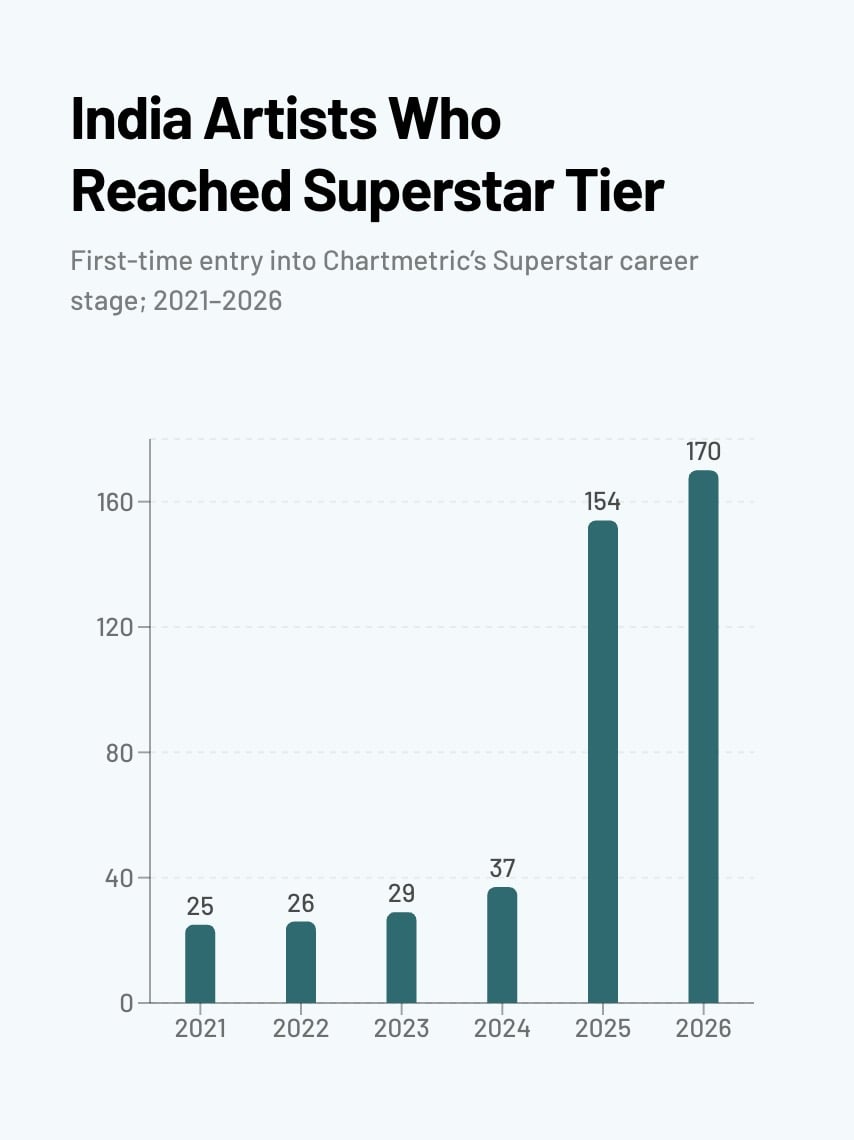
According to Chartmetric, no market in the study has expanded its ‘Superstar’ pipeline in the 2021-2026 period faster than India.
The number of Indian artists entering the tier for the first time rose from 25 in 2021 to 37 in 2024, then to 154 in 2025 and 170 so far in 2026.
Brazil has produced 127 Superstar artists so far this year, up from 50 in 2021, while Nigeria‘s annual count rose from 4 in 2021 to 27 in 2025.
One trend sits behind all these numbers: India, Brazil, and Nigeria are markets in which the streaming audience itself is still expanding.
Does that mean music is globalizing?
Not in the way those headline percentages perhaps suggest.
To see why, it helps to separate the two things Chartmetric measures, because they point in different directions.
The first is chart entries: how often a country’s tracks turn up on Spotify‘s daily charts in other countries.
The second is audience location: where an artist’s YouTube subscribers actually live.
A market can move forward on the first while going backward on the second, and India is the clearest example.
Indian artists’ Spotify chart entries in non-India territories grew from 1,593 in 2021 to 7,736 in 2025.
Yet on YouTube, the home-country audience share rose for nine of the 10 Indian artists the report analyzed.
Arijit Singh‘s India share climbed from 68.7% to 77.5% between 2020 and 2025, while A.R. Rahman‘s moved from 68.1% to 72%.
“This reflects India’s massive smartphone and internet expansion: domestic audiences are growing faster than international audiences,” says Chartmetric.
Put plainly: India‘s music is traveling further, while its audience is concentrating at home.
Brazil arrives at the same place by a different route – it is going backward on both measures at once.
Brazilian artists’ foreign Spotify chart entries fell 44.8%, from 1,622 in 2021 to 895 in 2025.
Brazilian entries on YouTube‘s Global Artist Chart fell from 257 to 75 over the same years.
“This growing count reflects success within Brazil’s market, where artists can reach elite status without building a large or durable audience abroad,” the report says of Brazil‘s ‘Superstar’ total.
Not every Brazilian measure is down: the number of distinct Brazilian tracks charting abroad rose from 26 to 44 across the period, spread across more artists.
But 82.4% of subscribers to Brazil’s top-10 artists on YouTube were based in Brazil in 2025.
That compares with 36.2% in Japan, 33.7% in Mexico, and 11.5% in Nigeria.
The pattern in India and Brazil amounts to the same thing: the home market is now big enough – especially in terms of streaming volume – to make a Superstar on its own.Music Business Worldwide