Credit: PressTaylor Swift's 'The Life of a Showgirl' was the biggest-selling vinyl release in the US last year, with over 1.6m sales according to Luminate stats published in January
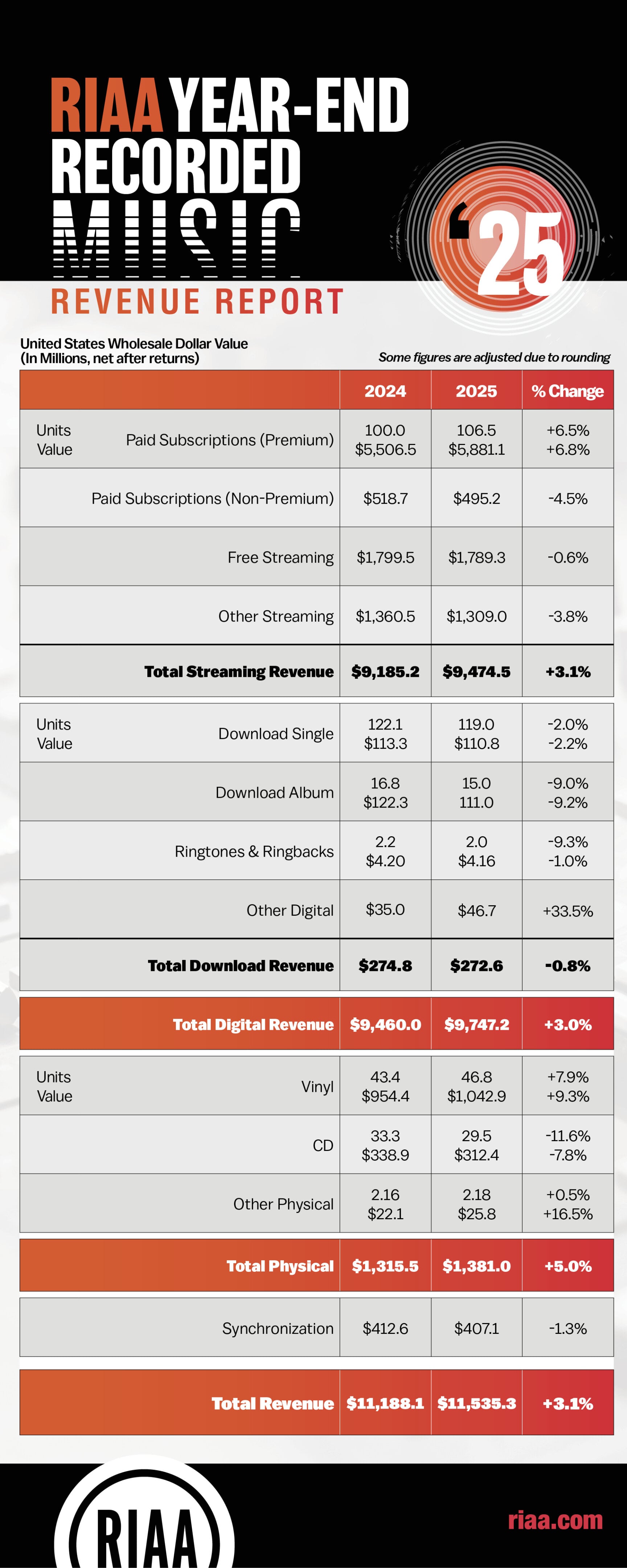
The United States’ recorded music industry generated USD $11.535 billion in wholesale revenue in 2025, up 3.1% YoY.
That’s according to the RIAA’s new year-end report, published today (March 16).
(This is the RIAA’s first full-year report issued exclusively on a wholesale basis, following its shift to the new methodology in its H1 2025 midyear report. The change aligns the RIAA’s reporting with international standards like IFPI‘s Global Music Report, which is expected to be published later this week. The 2024 full-year figures have been restated on a wholesale basis for comparison. The RIAA has also launched an updated interactive database with historic revenue figures converted to wholesale).
That 3.1% growth rate narrowly outpaced US inflation, which sat at 2.7% across the 12 months of 2025. That’s an improvement on 2024, when MBW reported that the US market’s wholesale revenue growth of 2.7% actually trailed the rate of inflation.
The US recorded music industry’s total wholesale revenue of $11.535 billion in 2025 was up by +$347 million vs. the equivalent wholesale figure from 2024 ($11.188 billion).
That $347 million YoY wholesale revenue growth was an improvement on the approximately +$200 million added in 2024, but was less than half the size of the equivalent growth (+$700 million) seen in 2023.
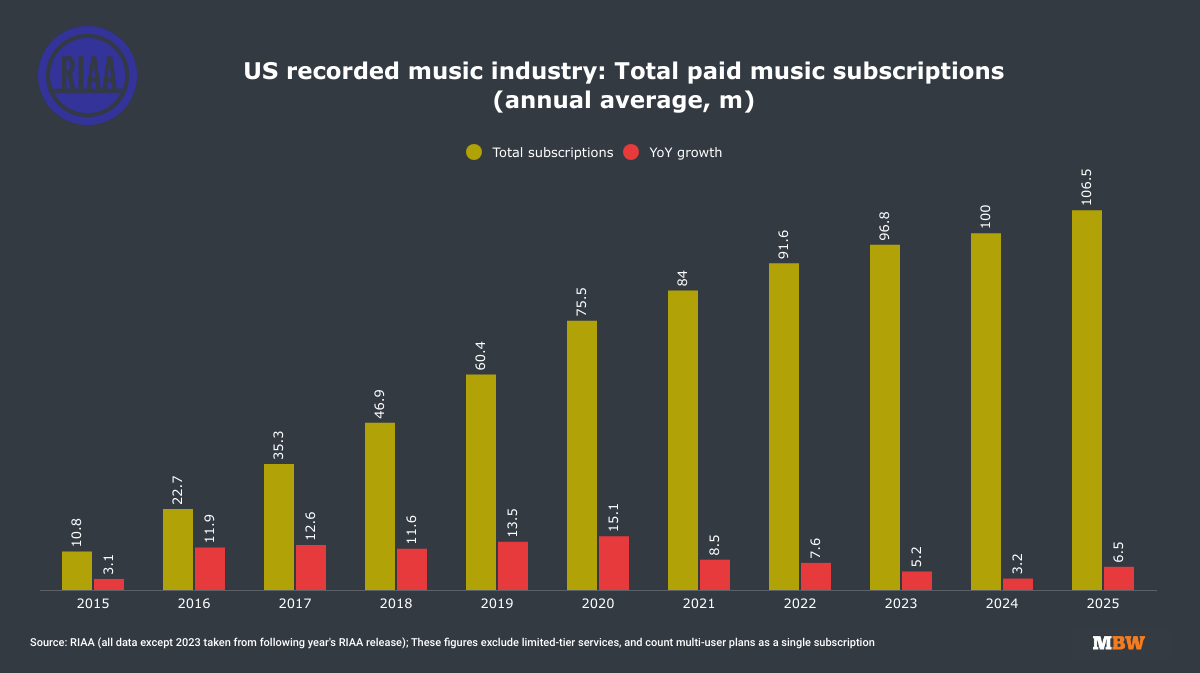
One of the headline stats within the report is this: There were 106.5 million total paid premium music subscription accounts in the US in 2025, up 6.5 million YoY.
That +6.5 million YoYnet increase represents the first reversal in a multi-year pattern of decelerating subscription account growth in the United States – though the figure remains well below the levels seen earlier in the decade.
As you can see from the chart below, full-year net additions had been declining steadily: from +15.1 million in 2020, to +8.5 millionin 2021, +7.6 million in 2022, +5.2 million in 2023, and just +3.2 million in 2024.
The +6.5 millionadded in 2025 was the highest annual net subscriber account growth since 2022.
(These RIAA subscription figures are for premium paid subscription accounts only; they don’t include ‘Non-Premium’ subscriptions such as Amazon Prime or Pandora Plus. They count multi-user subscriptions like Family plans as individual accounts.)
Premium paid subscription revenues grew +6.8% YoY to $5.88 billion, slightly outpacing the +6.5%rise in subscriber numbers and implying a modest improvement in average revenue per user (ARPU), likely driven by subscription price increases – including Spotify’s US Premium hike from $10.99 to $11.99 in July 2024, flowing through for a full calendar year.
Paid subscriptions represented 55.3% of total US recorded music revenue.
This subscription growth bright spot was offset by declines across other streaming revenue fields:
‘Free streaming’ revenue – from ad-supported services including YouTube, Spotify’s free tier, and social media platforms like Facebook and TikTok – was essentially flat, down 0.6% YoYto $1.79 billion
‘Non-premium’ paid subscription revenue – from services with limited interactivity, including Amazon Prime, Pandora Plus, and music licenses for streaming fitness services – fell 4.5% YoY to $495.2 million.
‘Other streaming’ revenue – covering payments for digital and customized radio services under statutory licenses, including SoundExchange distributions for services like SiriusXM and internet radio stations – fell 3.8% YoY to $1.31 billion.
As a result, total streaming revenue reached $9.474 billion, up 3.1% YoY.
Streaming accounted for 82% of total US recorded music revenues, the fifth consecutive year at that level.
There was a rebound in physical format sales, which had declined5.9% YoY in H1 2025.
Total physical revenue grew 5.0% YoY for the full year to $1.38 billion.
Within this figure:
Vinyl revenues grew 9.3% YoYto $1.04 billion.
Vinyl unit sales rose 7.9% to 46.8 million.
The RIAA noted this was the 19th consecutive year of growth for the format, and that nearly 50% of global vinyl revenue is now generated in the United States. (The full-year figure was boosted by a strong second half; MBW reported in September that vinyl sales fell 1% YoY in H1 2025.)
CD sales continued their steep decline, falling 11.6% YoY in units to 29.5 million and 7.8% YoY in revenue to $312.4 million.
Vinyl accounted for more than three-quarters of all physical revenue and outsold CDs in units for the fifth consecutive year.
Elsewhere, digital download revenue was essentially flat, declining 0.8% YoY to $272.6 million – a significant deceleration in the rate of decline compared to 2024.
Synchronization licensing revenue dipped 1.3% YoYto $407.1 million, partially rescued by a stronger second half following an H1 2025 decline of 7.9% YoY.
The RIAA’s press release accompanying the report also placed significant emphasis on AI, noting that the industry is “advancing free-market licensing, building responsible AI partnerships that enhance discovery, deepen fan engagement and unlock new creative possibilities.”
It cited a recent poll showing voters oppose allowing AI companies to use copyrighted works without permission by a nearly 3-to-1 margin (67%–23%), and that two-thirds believe AI companies should enter licensing agreements in the same way streaming platforms do.
“The last 20 years have been marked by unprecedented transformation for recorded music – from the steady rise to dominance of anytime, anywhere streaming options as listeners enjoy tunes from their favorite artists to a resurgence of vinyl as both a listening experience and collectable art.”
Mitch Glazier, RIAA
“The last 20 years have been marked by unprecedented transformation for recorded music – from the steady rise to dominance of anytime, anywhere streaming options as listeners enjoy tunes from their favorite artists to a resurgence of vinyl as both a listening experience and collectable art. And now, our industry is advancing free-market licensing, building responsible AI partnerships that enhance discovery, deepen fan engagement and unlock new creative possibilities for how music is made and experienced,” said RIAA Chairman & CEO Mitch Glazier.
“Through it all, music remains a cornerstone of culture and a growing economic powerhouse for the US, contributing $212 billion to our GDP and supporting more than 2.5 million American jobs.”
“US recorded music has demonstrated sustained growth globally, reaching $6.4 billion alone in paid subscriptions and tallying 50% of global vinyl revenue, leading the way for fans to listen and connect with their favorite music whenever, wherever and however they want.”
Matt Bass, RIAA
RIAA VP of Research Matt Bass added: “Fans are consuming music from the artists they love in more ways than ever, and that passion is reflected in today’s report. 2025 reveals a strong and stable music economy resulting from committed label investment and identification of new spaces to expand artists’ creativity. From the ease of streaming to new vinyl to licensing responsible AI tools and services, labels are diversifying fan engagement.
“US recorded music has demonstrated sustained growth globally, reaching $6.4 billion alone in paid subscriptions and tallying 50% of global vinyl revenue, leading the way for fans to listen and connect with their favorite music whenever, wherever and however they want.”Music Business Worldwide