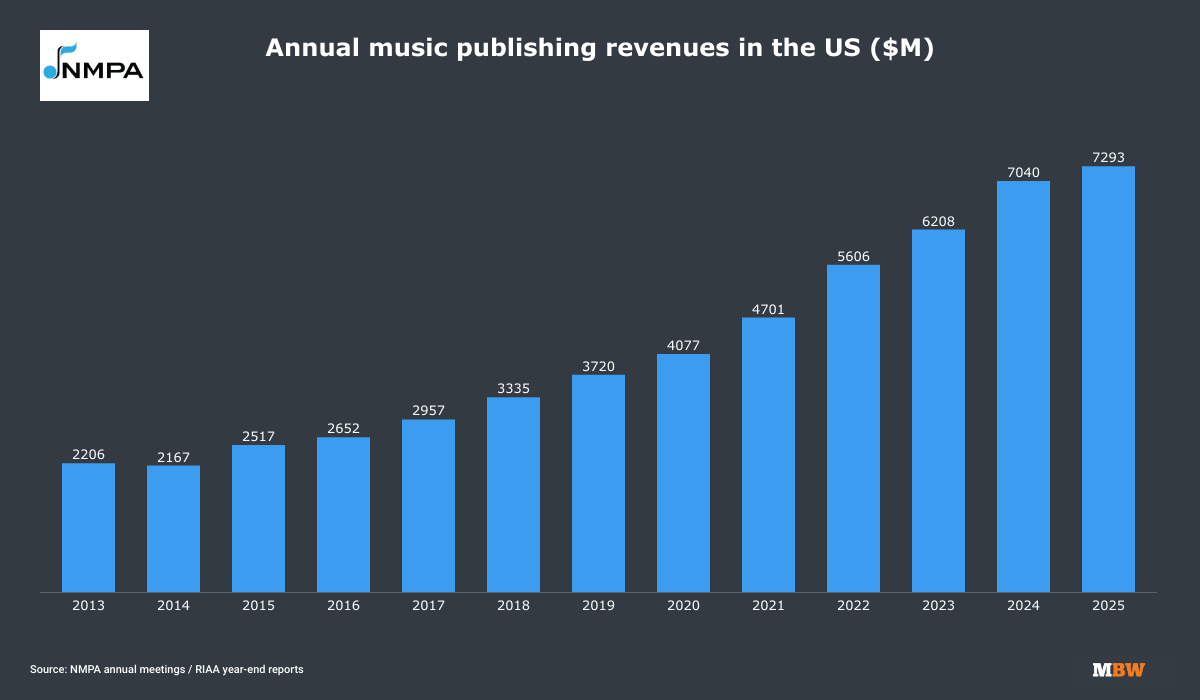
US music publishing revenues rose to USD $7.3 billion in 2025.
That’s according to the National Music Publishers’ Association (NMPA), which unveiled the figure at its Annual Meeting at Lincoln Center’s Alice Tully Hall in New York on Wednesday (June 10).
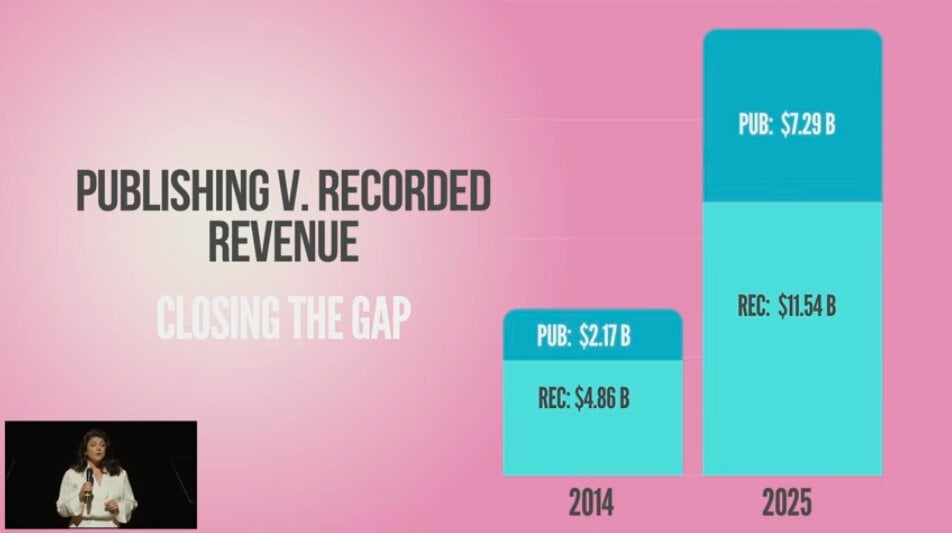
The total is up around 3.7% YoY on 2024’s $7.04 billion, which had climbed from $6.2 billion in 2023, and means US publishing has grown every year since 2014 (see below).
The NMPA said publishing outpaced the growth of recorded music for the fourth year in a row.
As the chart below shows, recorded music remains the bigger business. Its US wholesale revenues hit $11.5 billion in 2025, up 3.1% YoY, according to the RIAA.
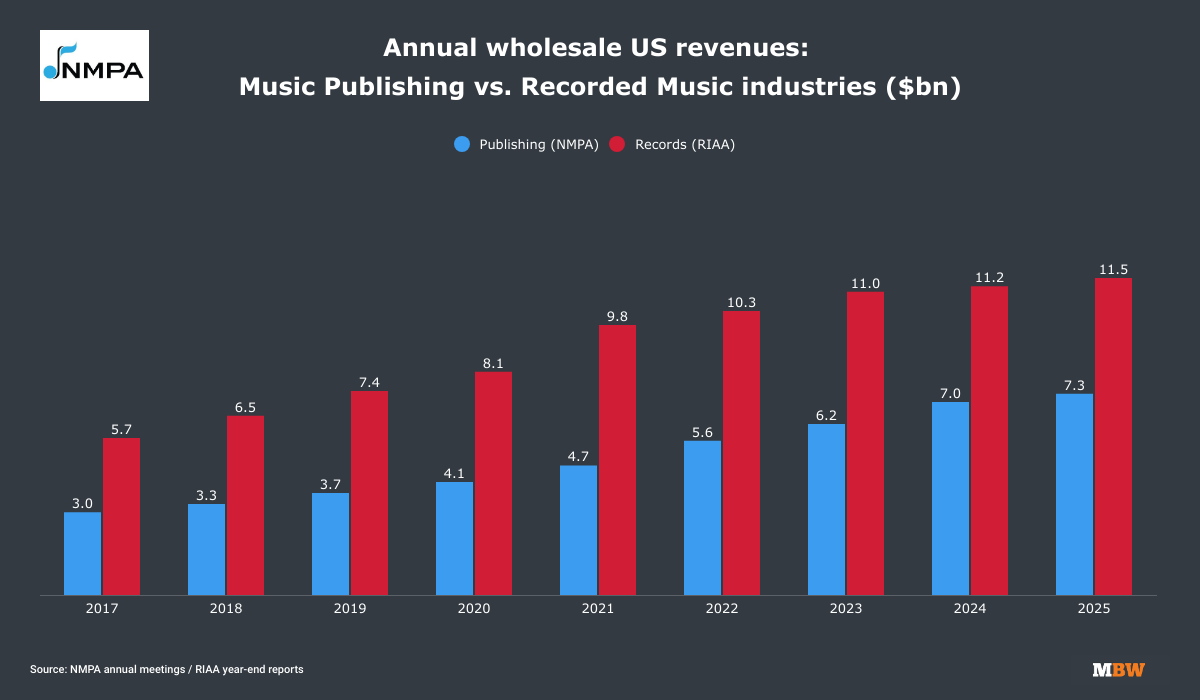
But publishing has steadily closed the gap: recorded music’s wholesale revenues were more than double publishing’s in 2014, at $4.86 billion against $2.17 billion, a margin that had narrowed to roughly 58% by 2025.
That growth has come despite what the NMPA describes as a sustained hit from streaming “bundles.”
Chief Legal Officer and Chief Operating Officer Danielle Aguirre told the meeting that, by Spotify‘s own estimates, its move to reclassify Premium subscription tiers as a bundle has cost songwriters and publishers almost $480 million since the practice began in 2024.
Aguirre said Spotify’s bundling, followed by Amazon‘s, had cut the royalties the two companies pay by approximately 30%.
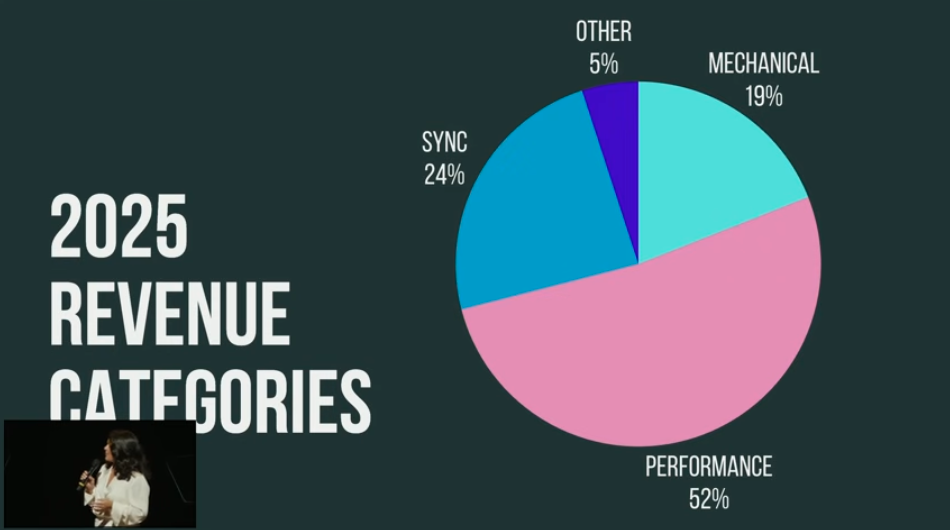
US publishing revenues in 2025 broke down to performance royalties at 52%, synchronization at 24%, mechanical at 19%, and other sources at 5%, according to the NMPA.
Aguirre said the split between the two royalty types that digital services pay, performance and mechanical, has now reversed.
“What was in 2024, a DSP-wide royalty distribution of 55% mechanical to 45% performance has flipped to now 53% performance and 47% mechanical due solely to the bundling implemented by Spotify and Amazon,” said Aguirre.
“WHAT WAS IN 2024, A DSP-WIDE ROYALTY DISTRIBUTION OF 55% MECHANICAL TO 45% PERFORMANCE HAS FLIPPED TO NOW 53% PERFORMANCE AND 47% MECHANICAL DUE SOLELY TO THE BUNDLING IMPLEMENTED BY SPOTIFY AND AMAZON.”
DANIELLE AGUIRRE, NMPA
“This is concerning because mechanical royalties… are paid through the MLC, and the MLC does not take out a commission or any fee from you for administration of mechanical rights… you are receiving 100% of them.”
Spotify’s most recent quarterly filing shows what is at stake in the underlying legal fight.
In a Form 6-K covering the three months to March 31, filed with the SEC in April, Spotify disclosed that if the Mechanical Licensing Collective (MLC) “were to ultimately be entirely successful” in arguing that its Premium service is not a bundle, its liability for the period March 1, 2024 to March 31, 2026 would be approximately €410 million (USD $473 million).
The sum is broadly in line with the almost $480 million Aguirre cited, which the NMPA said also came from Spotify’s own estimates.
“THIS IS CONCERNING BECAUSE MECHANICAL ROYALTIES… ARE PAID THROUGH THE MLC, AND THE MLC DOES NOT TAKE OUT A COMMISSION OR ANY FEE FROM YOU FOR ADMINISTRATION OF MECHANICAL RIGHTS… YOU ARE RECEIVING 100% OF THEM.”
DANIELLE AGUIRRE, NMPA
That figure would come “plus potential penalties and interest,” which Spotify said it “cannot reasonably estimate,” though the company added that any liability “would be partially offset by direct deals with publishers.”
The estimate has roughly doubled in a year as the exposure period lengthened: Spotify’s April 2025 filing put the equivalent figure at €205 million for the period to March 31, 2025.
The MLC sued Spotify in May 2024, alleging the streaming service was underpaying mechanical royalties after reclassifying Premium as a bundle that includes audiobook access.
Judge Analisa Torres dismissed the case with prejudice in January 2025, holding that Premium qualifies as a bundle. The MLC won reconsideration in September, reinstating the case, and filed an amended complaint in October before seeking an immediate appeal that Spotify is opposing.
Aguirre framed the dispute against the backdrop of the Copyright Royalty Board’s Phonorecords V proceeding, which got under way at the turn of the year and will set interactive streaming and physical mechanical rates for 2028 through 2032.
“All parties have expressed an interest to come to the table and discuss how to fix bundling issues and to move forward as partners,” said Aguirre.
“That is a welcome first step. But what really counts are actions.”
Aguirre said deals negotiated and settled by the NMPA in the past fiscal year have returned about $110 million to its membership, taking the organization’s total legal recovery under what it calls the “modern NMPA” to nearly $1.5 billion.
Elsewhere at the meeting, NMPA President and CEO David Israelite announced a licensing deal with AI music company Udio, which he called the first industry-wide licensing agreement between music publishers and a major AI music company. He also revealed an agreement in principle with AI platform KLAY.
The NMPA’s deal with Udio follows the settlements the AI company reached with Universal Music Group and Warner Music Group in late 2025 over copyright infringement litigation.
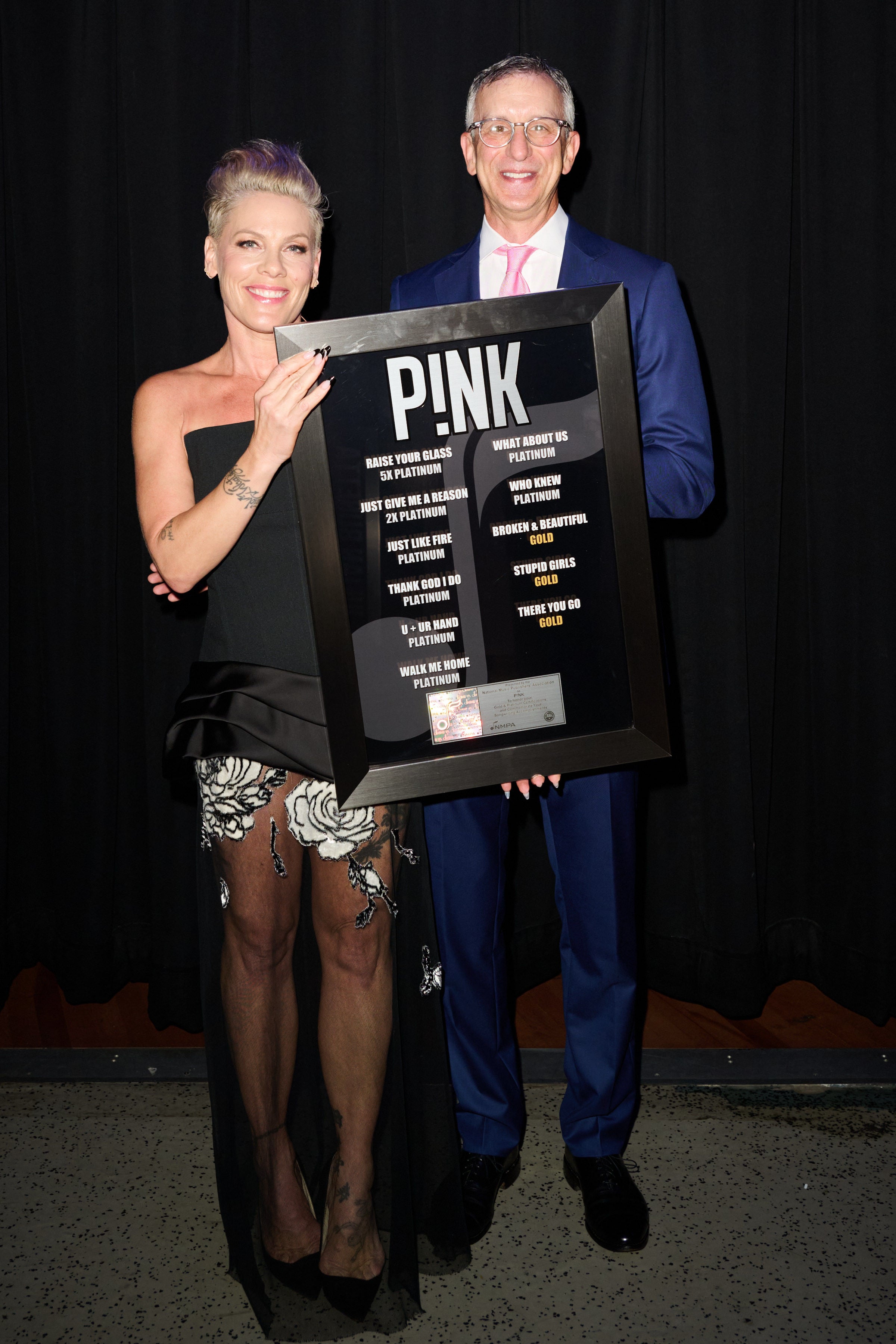
The meeting also doubled as the NMPA’s annual celebration of songwriters, headlined by P!nk, honored as the organization’s 2026 Songwriter Icon. The three-time Grammy winner, who hosted the Tony Awards three days earlier, marked the award with a rare acoustic performance. “I want to thank NMPA for this honor and for advocating for songwriters, because we are, frankly, a chaotic group of people who need someone in our corner,” she said.
Julian Bunetta, the writer-producer behind hits for Sabrina Carpenter, Teddy Swims, and One Direction, was named Non-Performing Songwriter Icon.
Singer-songwriter Amber Mark and frequent Bunetta co-writer John Ryan performed a rendition of Lose Control in tribute. Bunetta credited his publishing partners, lawyers, mentors, collaborators, and family, joking that with all of them “you would wake up and say songwriting is easy.”
Recording Academy CEO Harvey Mason jr. received the NMPA’s Industry Legacy Award, presented in a fireside chat with Israelite.
“My hope is that the recognition, the visibility around songwriting can build or continue to add momentum to the work that we’re all collectively doing to try and make things more equitable for songwriters,” Mason said. Jordin Sparks paid tribute with a performance of No Air, the 2008 hit she recorded with Chris Brown and one of Mason’s best-known songwriting credits.
The event also featured a keynote conversation between Israelite and Meta President and Vice Chair Dina Powell McCormick on the role of technology in music.
Asked how songwriters should approach AI, she urged the room to “become AI literate” but said “the most important asset will actually be creativity,” because amid “a lot of machines doing a lot of things,” it is human talent that “will ultimately make you stand out.”
The meeting had opened with a performance from Nashville singer-songwriter Carter Faith, who played Six String from her debut album Cherry Valley, nominated for Album of the Year at this year’s ACM Awards.
Music Business Worldwide