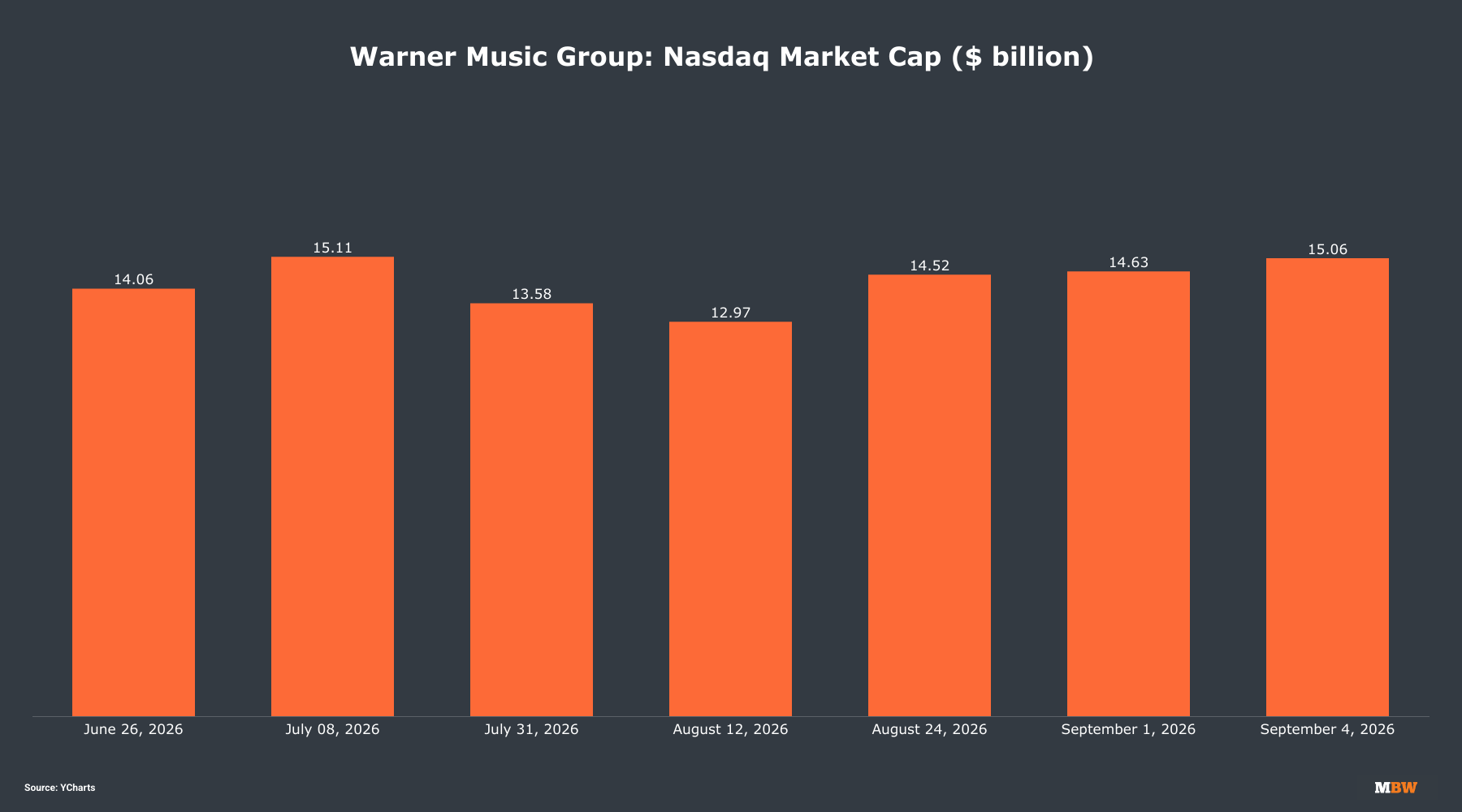
At the close of trading on the Nasdaq last Tuesday (September 1), Warner Music Group‘s public market cap stood at USD $14.6 billion.
This wasn’t, in itself, remarkable. WMG’s market cap sank to $13.0 billion in August, and has since settled into a $14 billion-plus rhythm.
What was remarkable was how Warner’s public valuation looked in light of the biggest headline running on MBW that same day.
Last Tuesday marked the official completion of the BMG/Concord merger – creating a new company operating under the BMG name.
As I told you in April, the private financial mechanics of that merger valued BMG and Concord at roughly $7.5 billion each – an approximate 20X blended multiple.
Combined, then, the enterprise value of ‘new BMG’ is somewhere around $15 billion.
(The math here is reasonably straightforward: ‘new BMG’ has publicly projected $730 million in EBITDA this year. A 20X multiple of that gets you to $14.6 billion; a 21X multiple gets you to $15.3 billion.)
To run it by you again:
- Warner Music Group’s public market cap valuation last Tuesday: $14.6 billion.
- ‘New’ BMG’s private market valuation on the same day: ~$15 billion.
I mean. That’s something, right?
Canny readers will have spotted this isn’t an apples-to-apples comparison: WMG carries debt, which pushes its actual enterprise valuation (vs. market cap) up to around $19 billion.
Even so, this BMG vs. Warner juxtaposition is a stark reminder of a defining theme of the 2026 music business: the gap between public- and private-market valuations is moving beyond oddity and into the realm of the ridiculous.
Put simply: right now, the public enterprise value of both Warner Music Group and Universal Music Group is roughly 11X their respective annual adjusted EBITDA/OIBDA.
Yet on the private market, a comparable large-scale competitor is being valued at a multiple nearly twice as high.
With Concord folded into its structure, ‘new BMG’ becomes a substantial player at the top of the global music rights market. But it’s worth putting its size vs. WMG into context.
- ‘New’ BMG is projecting $2.2 billion in revenue this year, alongside that $730 million EBITDA.
- Warner Music Group, in the first half of calendar 2026 alone, exceeded both these figures – $3.6 billion in revenue and $830 million in adjusted OIBDA.
In other words, WMG should end 2026 roughly three times the size of ‘new BMG’ in revenue terms, and around double its size in profit.
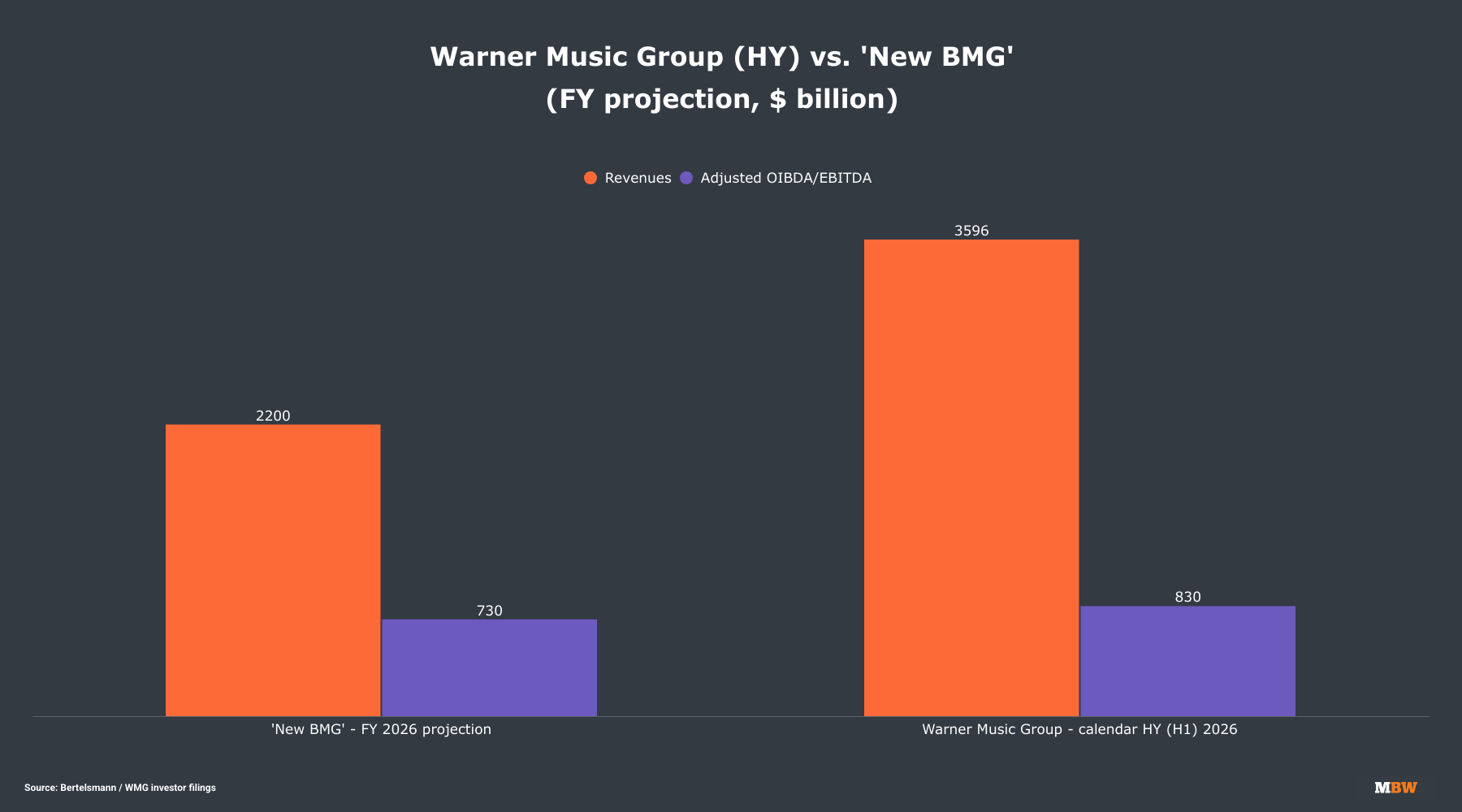
There is a margin differential to consider: ‘new’ BMG’s 2026 projections imply a 33% EBITDA margin, while Warner’s calendar H1 figures indicate a 23% margin. (BMG is targeting a 40–50% margin over the mid-term, with an annual EBITDA of $1.2 billion.)
Yet WMG’s financial performance remains robust.
Its subscription streaming revenues surged by double digits YoY in the first six months of 2026, while the company has stated its intention to expand that 23% margin to a “high-20s target in the medium to long term”.
These are confident figures you might expect to bring a warm glow to the investment community.
But with Warner’s share price currently sitting at $28 – close to half its $50 peak in 2021 – the Nasdaq’s arms remain folded.
Over on the Euronext, Universal Music Group investors are enduring a similarly bumpy ride.
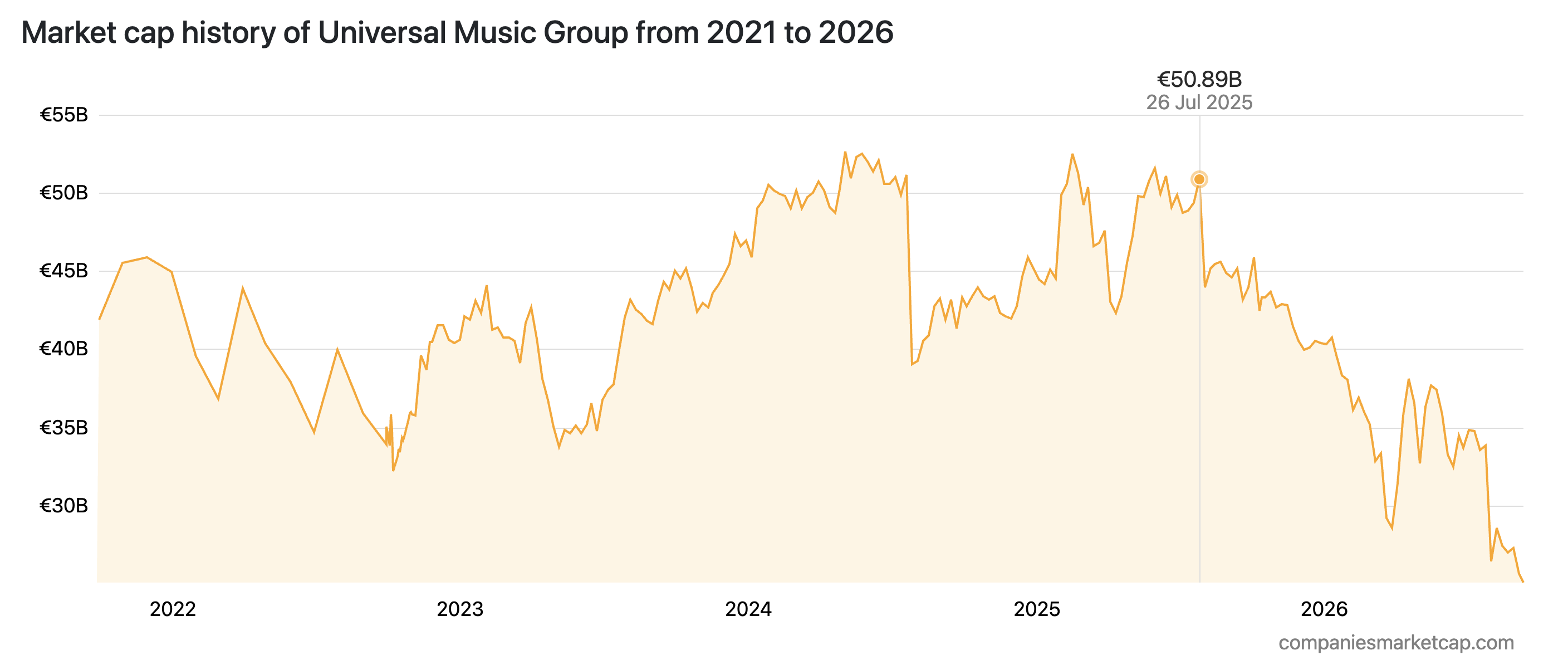
Following a one-day 25% drop in equity value in late July, UMG’s market cap has fallen from above EUR €50 billion as recently as July 2025, to around €26 billion today.
Time to go private?
Which brings us to the question on the lips of many in this business right now: if the public market is going to keep eroding the value of Universal Music Group and Warner Music Group, is it still the right home for either of them?
Could we soon see one or both going private?
In Warner’s case, that scenario is simple enough to imagine – because WMG is only partially a ‘public’ company in the first place.
Per Warner’s latest annual report: Len Blavatnik‘s Access Industries owns approximately 72% of WMG’s economic interest and approximately 98% of its total combined voting power. Warner is formally classified as a “controlled company” on the Nasdaq.
“All public minority shareholders in WMG hold around 28% of the company’s economics, and just 2% of the votes.”
That is to say: all public minority shareholders in WMG collectively hold around 28% of the company’s economics, but just 2% of the votes.
At today’s price (without applying a premium), buying these minority shareholders out would cost Access somewhere in the region of $4 billion.
Blavatnik – whose personal net worth is pegged at around $35 billion, per Forbes – has form here. Warner was listed on the NYSE in 2005, taken private by Access in a $3.3 billion deal in 2011, then returned to the market, this time on the Nasdaq, in 2020.
Universal’s situation is different in structure, but not so different in practice.
UMG has no controlling shareholder and a genuine ‘one share, one vote’ setup.
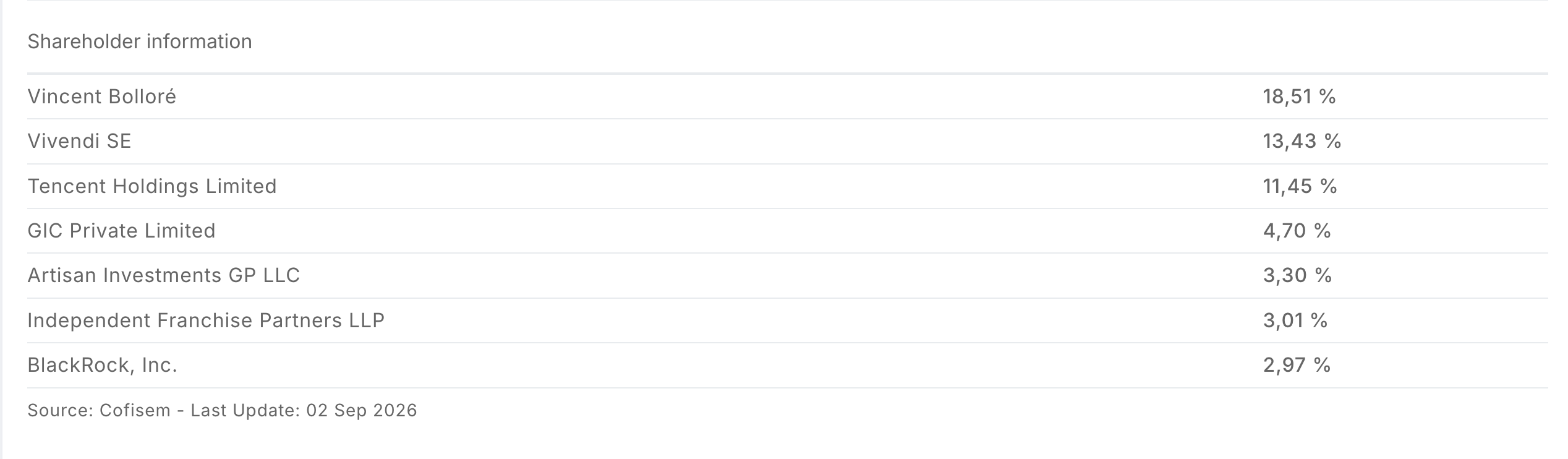
However, its register today is dominated by a trio of aligned long-term holders: Vincent Bolloré (~18.5%), Bolloré-controlled Vivendi (~9.9%), and Tencent (~11.5%).
“Vincent Bolloré, Tencent, and Vivendi jointly account for roughly 40% of UMG’s equity. The power of their bloc isn’t theoretical.”
Between them, these three account for roughly 40% of UMG’s equity.
The power of this bloc isn’t theoretical: all three have told the Dutch regulator they vote together as UMG shareholders, effectively as a single entity.
Cut to May this year, when Universal saw off a USD $64 billion proposal to reshape UMG from Bill Ackman’s Pershing Square on the grounds that it “fundamentally and materially undervalues UMG.”
Could one of UMG’s key stakeholders – watching the company carry a market cap today that’s less than half the size of Ackman’s rejected bid – now be tempted to pursue a privatization of their own?
Vincent Bolloré is the obvious name to watch.
According to Cofisem/Euronext data, the French mogul controlled roughly 28.5% of UMG as of September 2, via his own holding plus Vivendi’s. (Vivendi owns around 9.9% of UMG stock, but has increased its capital interest to 13.4% via an equity swap.)
Speaking of Vivendi, its faith in Universal remains unshakable.
This year alone, the French firm has seen its stake in UMG lose around €1.5 billion in value – from €4.04 billion at the end of 2025, to around €2.57 billion today.
Yet in an investor update last week, the company was sanguine about this value erosion, stating: “Vivendi considers that this decline, which intensified since the publication of UMG’s half-year results at the end of July 2026, should not be regarded as permanent given UMG’s long-term valuation prospects.”
“Vivendi considers that [the decline in UMG’s share price], which intensified since the publication of UMG’s half-year results at the end of July 2026, should not be regarded as permanent given UMG’s long-term valuation prospects.”
Vivendi, September 2026
Through this lens, could the public market’s pricing of Universal end up serving the company on a platter to its most believing, long-termist shareholder?
Might others plausibly be tempted to join Bolloré in a privatization bid?
Names familiar to the music business who might be in that conversation include Tencent Holdings, with that 11.45% UMG stakeholding.
Elsewhere, there’s GIC – the Singaporean sovereign wealth fund, best known in music as a funder of Sony‘s catalog acquisitions, but less well known as the owner of 4.7% of Universal Music Group (via GIC Private Ltd).
Universal has other options to consider away from privatization.
For example, Bill Ackman believed that UMG could realize significantly greater market value via a US listing; the company explored the idea but has since shelved it.
Universal’s own behavior this year certainly reflects dissatisfaction with its public price.
So far in 2026, UMG has spent around €1 billion buying back its own shares – with CFO Matt Ellis calling out “a meaningful dislocation in UMG’s market valuation.”
This shouldn’t, in itself, be read as a harbinger of privatization.
The roughly 57 million shares UMG has repurchased this year equate to just over 3% of the company.
It does suggest, however, that Universal’s board rates the asset much higher than the public markets do.
A personal story
Earlier this summer, I put a hypothetical to two veteran public stock analysts, separately: what if UMG bought into – or merged with – a leading live concert promoter? Say, AEG Presents?
The logic of this thought experiment: Universal works closely with the artist and management communities; streaming subscriber growth is plateauing in the biggest markets; better monetizing “superfans” is a core stated growth thesis of UMG; and the majors are already seeing promising returns from investments in ‘expanded rights’, including concert promotion.
Live music, of course, is one corner of this business that generative AI – the No.1 boogeyman for many of UMG’s Wall Street analysts – can barely touch.
As Live Nation CEO Michael Rapino smartly phrased it: “In a world of endless screens and AI-generated everything, the one thing that can’t be copied is being there.”
“In a world of endless screens and AI-generated everything, the one thing that can’t be copied is being there.”
Michael Rapino, Live Nation, speaking in July
There are, naturally, strong counterarguments to be made against my hypothesis – not least that live and music rights management are distinct disciplines, often with contrasting incentives.
But whatever you make of the thesis, surely, if UMG made such a move, its stock would pop?
Both analysts disagreed with that presumption. They suggested, if anything, the opposite would be likely – UMG’s share price would sink further, they said, as the market read an overt expansion into live as proof that the company’s existing strategy required a pivot.
Reader, the logic of this twisted my brain. If a public music company makes a transformative expansion into an adjacent vertical, it gets punished by the markets?
UMG has arguably been facing a similar economic pathology back in the real world.
A key pillar of UMG’s modern growth strategy is to invest heavily in tier-one artist relationships via Virgin Music Group and Downtown, whose services agreements with talent naturally carry lower margins than typical frontline label agreements.
At the same time, UMG has been badgered by analysts who appear keen for it to pull back from lower-margin activity and focus more on the higher-margin guarantees of catalog rights.
Again: a strategy to build long-term value at a music company – embracing the fast-rising independent music sector, while taking the fight to Sony’s The Orchard – appears penalized by short-term investor impatience.
Music has one recent, instructive story of a public company reprivatizing.
Believe floated on Euronext Paris in June 2021 at €19.50 per share. Four years later, founder/CEO Denis Ladegaillerie led a consortium that took it back off the market, squeezing out the last minority holders at €17.20 – below the IPO price.
That consortium was a bloc of three long-term believers in the company’s worth – Ladegaillerie, TCV, and EQT – who had evidently concluded that the stock market didn’t appreciate what it had.
Believe is not Universal, obviously. A company valued in the low billions has options that a €26 billion business with Tencent and Vincent Bolloré on its register may not.
Yet Universal is in a similar boat on the one metric that matters.
When UMG was admitted to Euronext Amsterdam in September 2021, its reference price was €18.50 per share. Today it trades at €13.99. Five years on from its own listing, it’s worth less than it was on day one.
Denis Ladegaillerie is no pessimist on the value of the likes of UMG and WMG – he told me in April that he rates the chances of prominent public music company valuations re-rating upwards within two or three years as “super high”.
Yet in that same conversation, Ladegaillerie – in charge of a firm with no remaining tether to the stock market, and from a CEO’s perspective – made a telling statement.
“It’s always better to be a private company than a public one.”Music Business Worldwide