A new study commissioned by TikTok concludes that the app “remains a meaningful driver of music discovery, monetization, chart success, music fandom and culture.”
Its headline finding: TikTok says that 94% of songs that entered the Billboard Global 200 in 2025 went viral on its platform before they charted.
Another 5% of songs went viral on TikTok at the same time as, or after, entering the chart. Just 1% had no TikTok viral moment tied to their charting, down from 4% in 2024.
Songs that went viral on TikTok spent an average of eight weeks on the Billboard Global 200 in 2025, compared with two weeks for songs without a viral moment, according to the report.
Viral tracks also reached a median peak of No. 79 on the chart, versus No. 120 for non-viral tracks.
The chart analysis covered the period from March 11 to December 4, 2025, and excluded Christmas and holiday songs, for a total of 484 songs.
The weeks-on-chart comparison was based on a narrower sample of 454 songs, which also excluded any song that charted in the second half of 2024, to account for recurrence.
Last year’s edition analyzed the period from December 29, 2023, to September 26, 2024.
The TikTok virality and engagement data used in the study was provided by TikTok, according to the report.
“Every year, more of the world’s biggest songs start life on TikTok, and this latest report shows just how central our platform has become to global music success.”
Tracy Gardner, TikTok
“Every year, more of the world’s biggest songs start life on TikTok, and this latest report shows just how central our platform has become to global music success,” said Tracy Gardner, Global Head of Music Business Development at TikTok. “When 94% of songs entering the Billboard Global 200 have gone viral on TikTok first, it’s clear that TikTok’s influence extends far beyond a single viral moment.
“Our community doesn’t just discover music. It helps turn songs into hits and connects fans with the music they go on to stream and buy. From emerging talent breaking through to established artists reaching new generations of fans, TikTok is creating real opportunities across the music industry.
“We’re proud to work alongside our partners to turn discovery into lasting fandom, streaming success and commercial value for artists and the wider industry.”
Asked by MBW what was driving the jump from 84%, Gardner said: “A few things are happening at once. The first is that the industry has caught up with how fans actually discover music. Today, artists and their teams build TikTok into a launch from day one, and often before the song is even out.”
She also credited TikTok’s Add to Music App feature. “The gap between a music discovery moment on TikTok and a stream that counts towards the chart is incredibly small, and getting smaller,” she said.
“The figure I keep coming back to is the other end of the scale,” Gardner added, referring to the 1% of new entries with no viral moment tied to their charting.
“It’s become genuinely rare for a song to be a global hit without TikTok being part of its story. TikTok isn’t just reflecting what’s popular anymore. More and more, it’s where popularity starts.”
On chart longevity, she said: “A viral moment gets a song noticed. What makes it last is participation. Songs with real staying power never ride on one video or one trend.”
She cited sombr‘s Back to Friends, which the report says was the most-saved track of 2025 globally via Add to Music App. “Those saves become repeat listening, which is exactly what keeps a song on the chart, and it ended up spending over 80 weeks on the Billboard Global 200,” Gardner said.
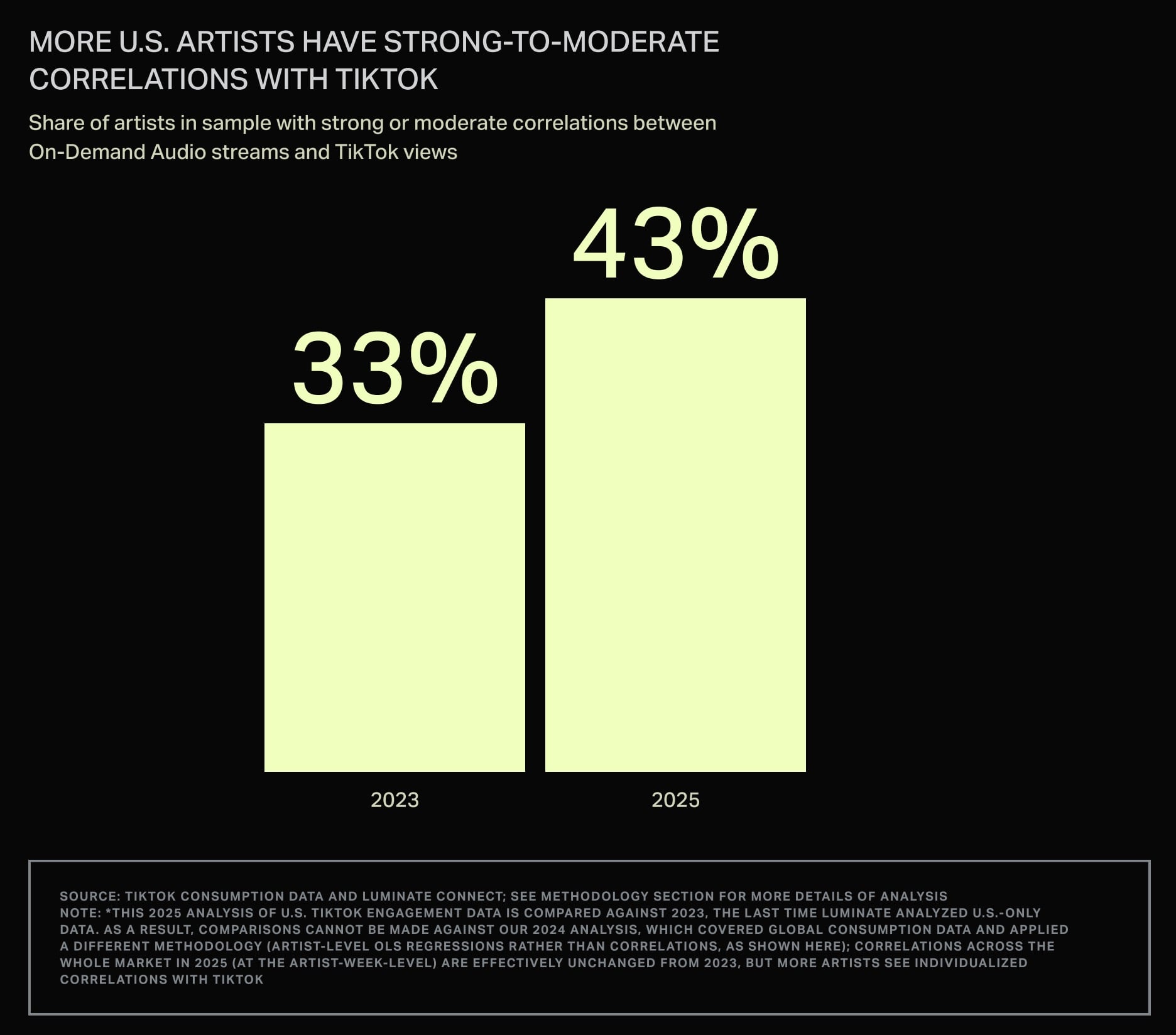
Luminate also compared TikTok views with US on-demand audio streams across 2025 for a sample of 516 artists, which it says represent around two-thirds of US streaming volume.
43% of those artists showed strong or moderate positive correlations between TikTok views and on-demand audio streams, up from 33% in 2023.
Among the fastest-growing artists, defined as those whose streams rose by 20% or more in Q4 2025 versus Q4 2024, that figure was 74%.
The report adds that correlations across the whole market in 2025 were “effectively unchanged” from 2023, while more individual artists saw correlations with TikTok.
Luminate says its 2025 figures can’t be compared with last year’s analysis, which used global consumption data and a different methodology.
“Correlation on its own doesn’t prove cause and effect, and Luminate is careful about that,” Gardner told MBW. “But when the same pattern shows up that consistently among the fastest-growing artists, it’s not something the industry can ignore.”
“It’s true at every stage of a career, from breakout artists like Olivia Dean, EsDeeKid and Disco Lines to established acts like Justin Bieber,” she added.
“Today, breaking an artist doesn’t happen around a single release date. It’s an ongoing process. And it isn’t just about getting people to hear a song. It’s about giving them a reason to care about the artist behind it.”
The report’s consumer findings come from two Luminate surveys, each of more than 4,000 US respondents aged 13 and over, conducted in May and June 2026.
According to the surveys, 45% of US TikTok users said they use the platform to discover new music and artists, compared with 39% of YouTube users, 36% of Instagram users, and 28% of Facebook users.
US music listeners on TikTok are 78% more likely than the US general population to use a paid music streaming subscription, according to the report, ahead of music listeners on Instagram (+72%), YouTube (+48%), and Facebook (+48%).
Last year’s report said US music listeners who use TikTok were 68% more likely than the US general population to use a paid music streaming subscription.
The report also found that 61% of US TikTok users who listen to music bought physical or digital music in the past year, and that US TikTok users spend 22% more on physical music than the average music listener.
US TikTok users who buy music are also 23% more likely than the average music listener to say supporting artists is important when deciding what form of music to purchase, while those who listen to music are 28% more likely to say they buy merchandise to financially support artists.
The report says US TikTok users are 61% more likely than the average music listener to identify as members of a dedicated artist fan base, such as Swifties, BTS’ ARMY, or the BeyHive, more than users of any other major social platform.
Among US TikTok users who engage with music on social media, 52% watch videos about artists, 47% follow artist accounts or fan pages, and 39% listen to artists perform live, for example via social livestreams.
“That’s a fan who wants to invest in an artist, not just play a track,” Gardner said.
On how the industry should measure TikTok’s value off-platform, she said: “A lot of measurement still treats platforms separately: views here, streams there, sales somewhere else. But fans move across all of them.”
“There’s an outdated idea that TikTok users are passive scrollers who don’t pay for music,” she said. “But the data says the opposite.
“Music listeners on TikTok are far more likely than the general population to pay for a streaming subscription, more than on any other major social platform. And those who don’t subscribe yet are more likely to say they’ll sign up in the next six months than the average listener. That’s a ready-made pipeline for streaming services.”
“So discovery on TikTok isn’t separate from making money. It’s where a lot of that money starts. The fan who finds a song in a video on a Tuesday is the same fan paying for the subscription, streaming the album and buying the vinyl.”
“TikTok’s role as a music discovery engine is statistically undeniable, driving both global music consumption and chart success.”
Jaime Marconette, Luminate
“TikTok’s role as a music discovery engine is statistically undeniable, driving both global music consumption and chart success,” said Jaime Marconette, VP of Music Insights and Industry Relations at Luminate.
“It’s increasingly difficult to find high-growth artists whose success isn’t highly correlated with TikTok,” Marconette added.
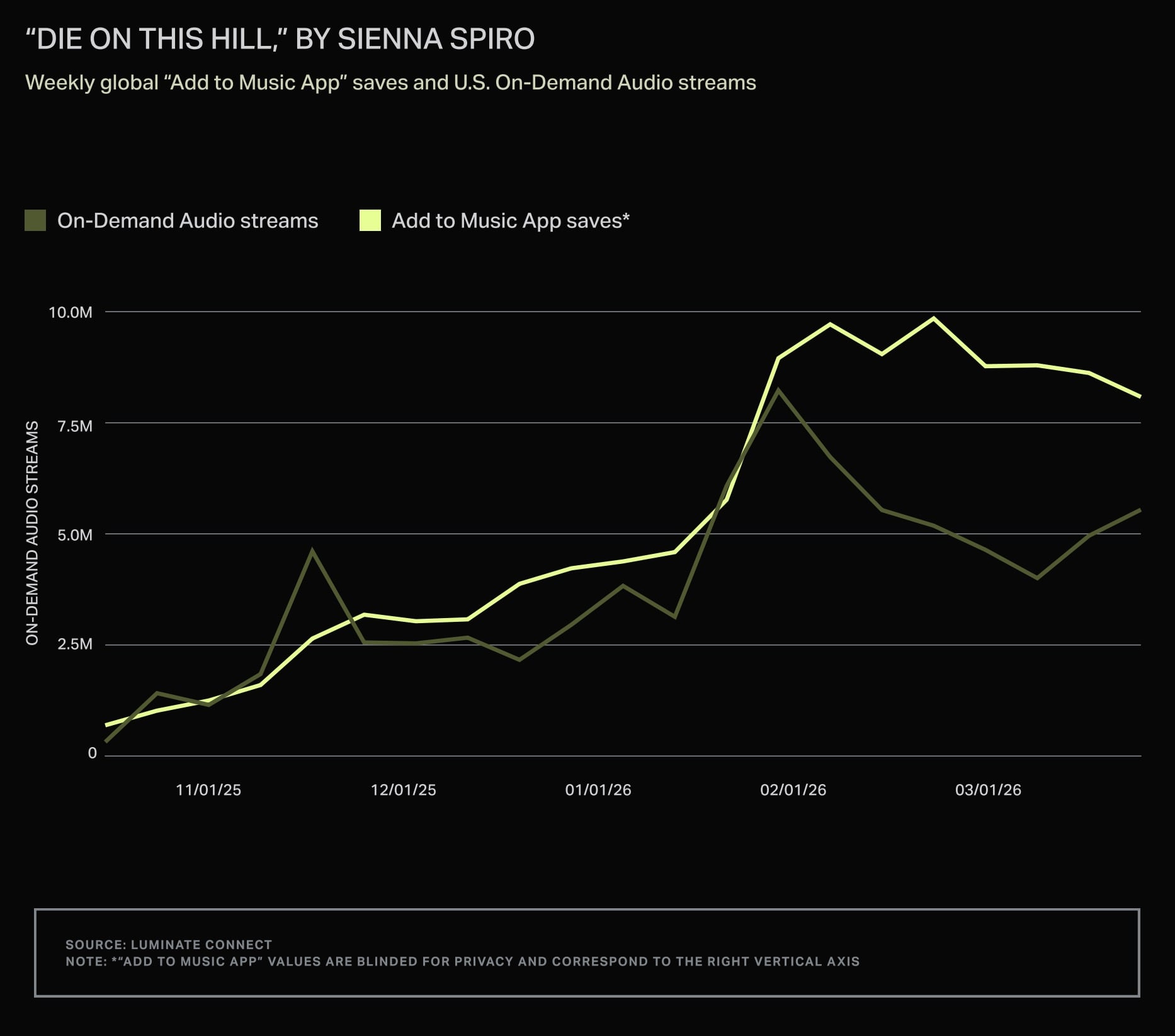
The report includes case studies on sombr, Sienna Spiro, Pierce The Veil, and Zara Larsson.
According to the report, Pierce The Veil‘s 2023 track So Far So Fake went viral on TikTok in July 2025.
In the 12 weeks that followed, the band’s average weekly US on-demand audio streams across its catalog rose 75% year-over-year, for a cumulative 113 million additional streams.
In Larsson‘s case, a video of a fan dancing onstage with her to her 2015 hit Lush Life went viral in November 2025, sparking a TikTok trend that sent the track back onto multiple charts, according to the report.
“Zara embraced all of it – on TikTok, in her live shows and in her whole aesthetic,” Gardner said.
Asked about the catalog opportunity on TikTok, she said: “It’s huge, and I think it’s still underestimated.
“For rights holders, the point is that when one song catches fire, the lift spreads across everything else an artist has made. Every catalog has songs waiting for their moment to connect with an audience again, and our community is very good at finding them.”
Spiro‘s Die on This Hill was the most-saved track globally via TikTok’s Add to Music App feature in the year to April 2026, the report says.