
Tidal is banning wholly AI-generated music from its platform.
The Block-owned streaming service says it will reject and remove “any wholly AI-generated track that’s submitted to Tidal,” starting on December 9.
Tracks that were “assisted by AI tools, but not the sole outputs, will be allowed on the platform,” according to the company.
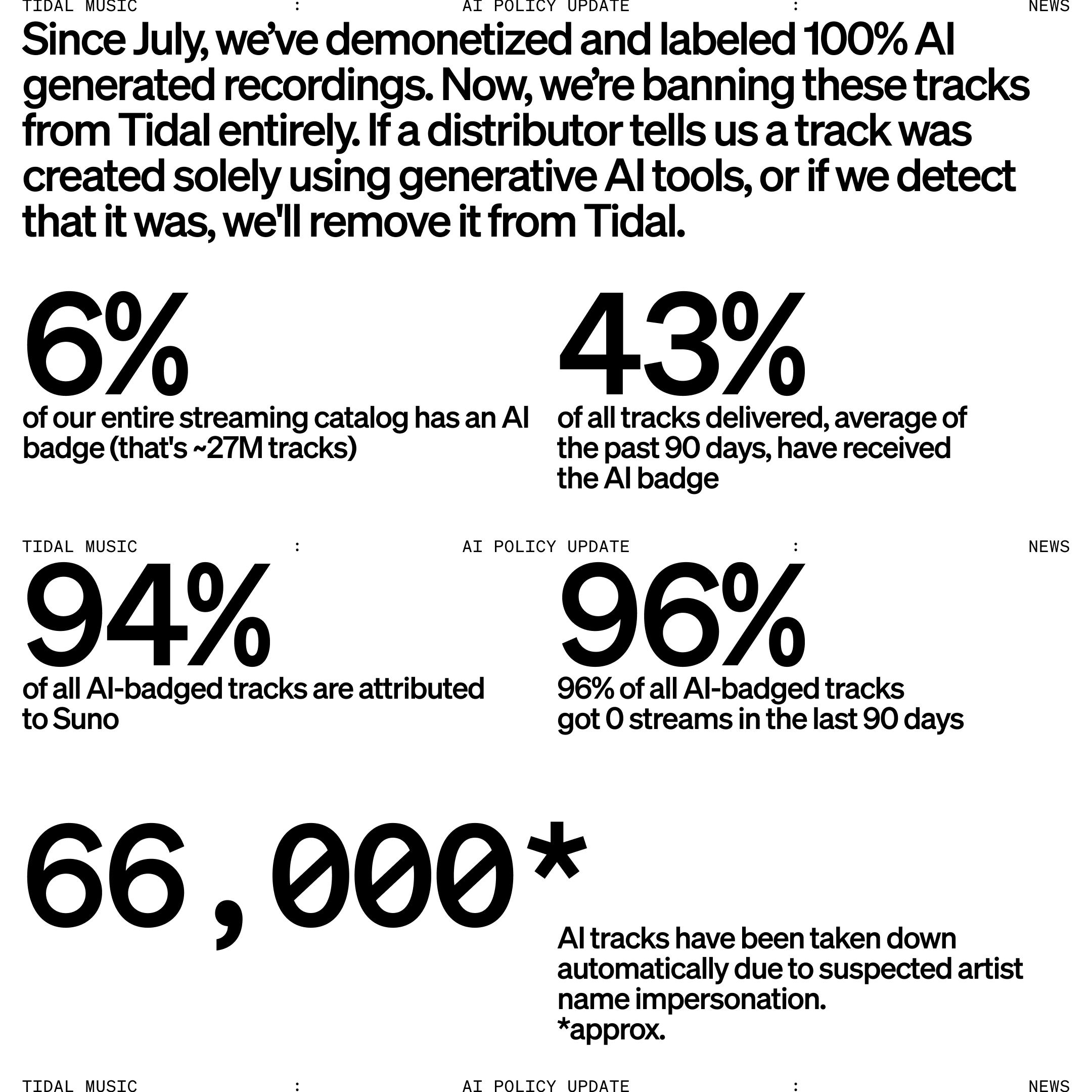
Tidal says that 43% of all tracks distributed to it over the past 90 days were detected as wholly AI-generated.
The company has also named Ircam Amplify, the commercial subsidiary of French audio and music research institute IRCAM, as the technology partner behind its AI detection.
The policy update was announced on X on Tuesday (November 24) by Tidal and by Robert Andersen, Tidal Lead at Block.
“This year we introduced Tidal’s AI Policy to protect artists and keep listeners informed,” Tidal said in its post. “Since then, we’ve been identifying, labeling, and demonetizing tracks we determined are 100% AI generated outputs of tools like Suno, Lyria, and more.
“But that’s not enough. We think a more drastic change is in order.”
“Tidal will always fight for artists to get paid more.”
Tidal
Under the update, Tidal is also banning distributors from delivering wholly AI-generated tracks, and says it “will reject deliveries if their metadata says they were generated solely using AI tools.”
On November 6, Tidal says it saw “the greatest influx of AI music yet,” with over 60% of the deliveries it received that day being wholly AI-generated.
“Today, approximately 27 million tracks in our catalog are tagged as such, representing 6.3% of all available music on Tidal,” Tidal said. “Yet Tidal subscribers are not listening to these tracks: 96% of them have received zero streams in the last three months.”
Tidal says 94% of the tracks carrying its AI badge are attributed to Suno.
The company added that, to date, it has automatically taken down more than 65,000 AI tracks over suspected impersonation of artist names.
Tidal said: “Wholly AI-generated music intended to mislead listeners and impersonate artists is another serious problem that has only increased in scale: It diverts streams and royalties away from the artists, and confuses fans.”
Tidal added: “It’s true that not all songs catch on immediately, and artists should have time to build their fanbases. But this situation is different – at this scale, the authentic music and artists that Tidal subscribers are looking to listen to and discover get buried.”
“Tidal will always fight for artists to get paid more. Everything in this update comes back to that. If you make music, you should be able to put it on Tidal knowing it won’t be buried under tracks no one asked for, or copied by someone pretending to be you,” the company said.
Tidal‘s ban goes further than the AI policy it introduced in June, which tagged wholly AI-generated music in its app and blocked it from earning royalties.
At the time, Tidal said it “will accept AI-generated music,” provided it met the standards in the policy and in its agreements with rightsholders and distributors.
According to Tidal, enforcement of the updated policy is “made possible with technology provided by Ircam Amplify, our AI detection partner.”
Ircam Amplify describes itself as “the independent trust infrastructure for music in the age of AI,” and says it analyzes audio to assess the use of AI in tracks for streaming platforms, distributors, and collective management organizations.
Its AI Music Detector can analyze more than 250,000 tracks per hour, according to the product’s listing on IRCAM’s website.
Ircam Amplify launched its AI-Generated Detector in May 2024, when it said the tool could scan up to 5,000 tracks in under a minute with an accuracy rate of 98.5%.
“When a streaming service tells listeners that a track is AI-generated, it puts its reputation behind that decision.”
Nathalie Birocheau, Ircam Amplify
“When a streaming service tells listeners that a track is AI-generated, it puts its reputation behind that decision,” said Nathalie Birocheau, CEO of Ircam Amplify. “A false positive can cast doubt on the authenticity of an artist’s work, with consequences for both the artist and their rightsholders. This can also affect the trust a listener places in their streaming service.
“That is why AI detection at scale demands the highest standards of accuracy and transparency. The industry needs a neutral, independent partner it can trust to assess the audio, deliver consistent results across a catalog and be clear about where the evidence is inconclusive. The same rigor matters upstream: distributors and labels can use this same detection system to evaluate content before it reaches the platforms, thereby ensuring that their deliveries meet the new standards and prerequisites in the age of AI.
“Our detection technology is built on nearly 50 years of audio and music research at IRCAM: half a century of studying how sound is made and perceived, working alongside artists to understand the language of music, and developing tools to analyze audio with the highest precision. That depth of expertise is what Ircam Amplify brings to AI detection, helping us achieve a market-leading false positive rate below 0.02%.
“We are proud that TIDAL has chosen us to help put its artist-centric AI policy into practice.”
Tidal‘s 43% figure is close to what Deezer has reported. The French streaming service said in April that fully AI-generated tracks accounted for more than 44% of its daily deliveries.
In July, Deezer said it was receiving nearly 90,000 fully AI-generated tracks every day in June, accounting for more than 50% of new music delivered to the service on peak days. Tidal‘s own peak was higher, with over 60% of deliveries on November 6 being wholly AI-generated.
Tidal‘s roughly 27 million AI-tagged tracks compare with the more than 42 million AI-generated tracks that Deezer says it detected between January 2025 and August 2026.
Listening data from both services points the same way. Tidal says 96% of its AI-tagged tracks have received zero streams in the last three months, while Deezer says fully AI-generated music accounts for just 1% to 3% of all streams on its platform, and that up to 85% of the streams on those tracks were fraudulent in 2025.
Deezer keeps fully AI-generated tracks out of algorithmic recommendations and editorial playlists, and said in July that it would take down AI-generated tracks used to inflate streams fraudulently, as well as those that had not been streamed for six months or more.
In October, it said it would let users block fully AI-generated music from its search results by the end of 2026, but it has so far stopped short of the outright ban that Tidal is introducing.
In January, direct-to-fan platform Bandcamp banned music and audio created “wholly or in substantial part by AI” from its platform.
Tidal also said in its post: “We’ll keep sharing what we find and we’ll keep acting on it.”Music Business Worldwide