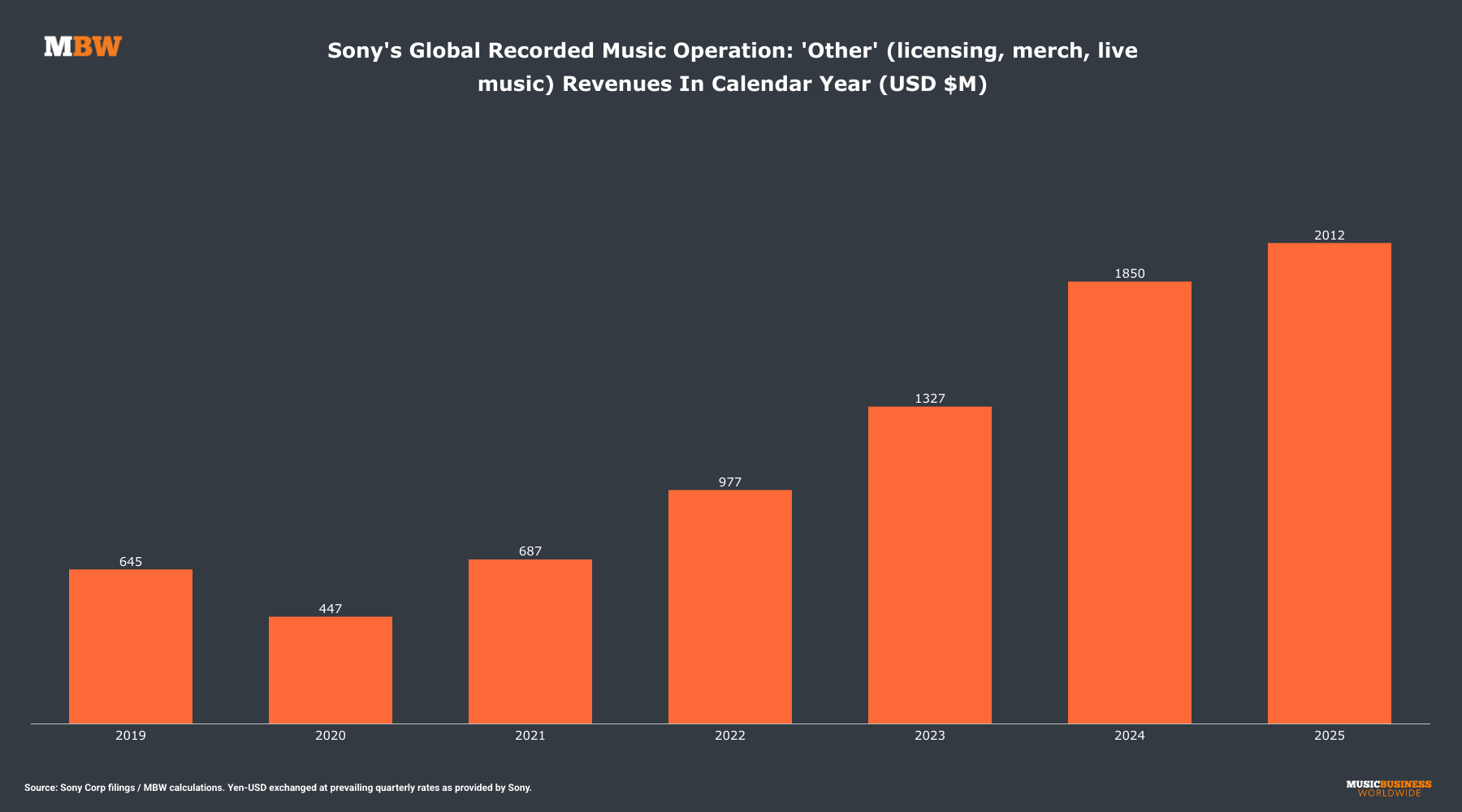
Which income stream has grown more than 4X at Sony’s music companies over the past five years, adding a whopping USD $1.6 billion to the company’s annual topline?
Streaming? Guess again.
In the anonymizing language of Sony Corp‘s financial reports, I’m actually talking about ‘Recorded Music: Other’.
Don’t be fooled by the vague descriptor. This category covers sync and public performance licensing royalties – but also, more interestingly, artist ticketing and merchandise sales.
Whenever Sony participates in an artist’s live event or merch sales, it shows up here.
This is becoming a highly significant source of revenues.
As recently as 2020, ‘Recorded Music: Other’ was generating just USD $447 million a year at Sony Music, according to fiscal figures analyzed by MBW.
Last year, this global figure ballooned beyond $2 billion.
There are some obvious drivers of this growth.
In 2022, Sony acquired Ceremony of Roses, significantly expanding its footprint in artist merch.
Indeed, in its most recent corporate report, published in September, Sony noted: “[Since] Sony Music Group‘s acquisition in 2022 of Ceremony of Roses, revenue from the merchandising domain has increased approximately seven-fold.”
Meanwhile, Sony’s participation in Bad Bunny’s record-breaking 2025 tour would have also had a meaningful impact. (Sony is believed to own ~30% of Rimas Entertainment, Bunny’s home for recorded music, management, and other activities.)
Yet this is a story that goes far beyond these individual events: live/merch income has quietly been growing at Sony for years.
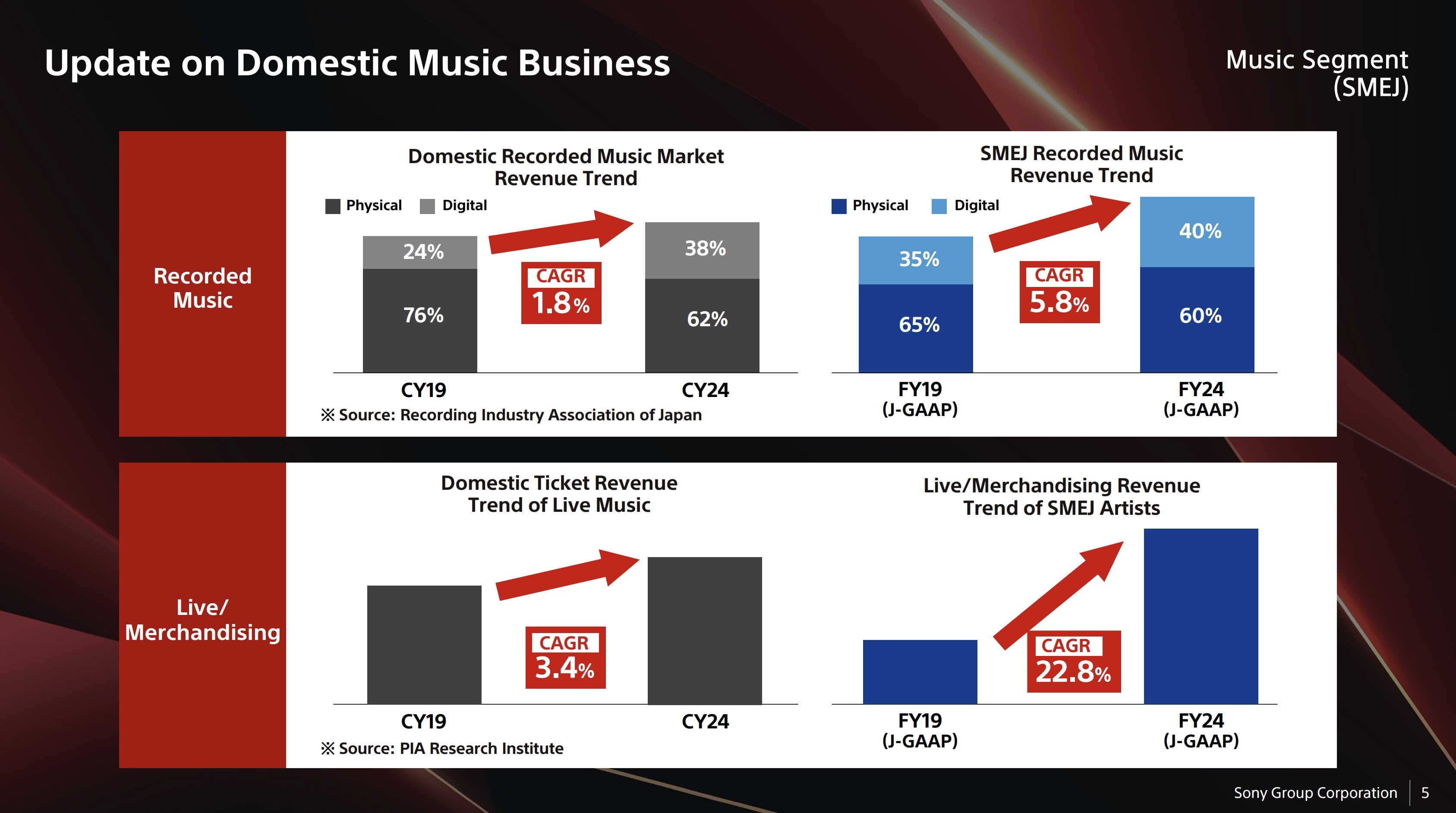
Just look at Japan – where Sony Music’s local company saw an average +41.1% annual uplift in the number of events it produced in FY 2024 vs. FY 2022, according to a company presentation.
Indeed, the CAGR of Live/Merch revenues grew significantly faster, percentage-wise, at Sony Music Entertainment Japan between FY2019 and FY2024 (+22.8%) than any other income stream.
(For example: Sony Japan’s recorded music revenues were up by a +5.8% CAGR in the same period – see below.)
The pattern continues: Universal Music Group
UMG reports its merch sales as a standalone unit (‘Merchandising & Other’), while also separately reporting its live concert revenues within a ‘License & Other’ category.
Universal’s ‘License & Other’ category houses both sync and public performance licensing… but also reflects UMG’s revenues from ticketing, artist management, and live concerts.
“In 2025, merch plus ‘License & Other’ at UMG generated over USD $2.5 billion… That $2.5 billion was more than 50% higher than UMG’s turnover from either physical music sales or ad-funded streaming in the same year.”
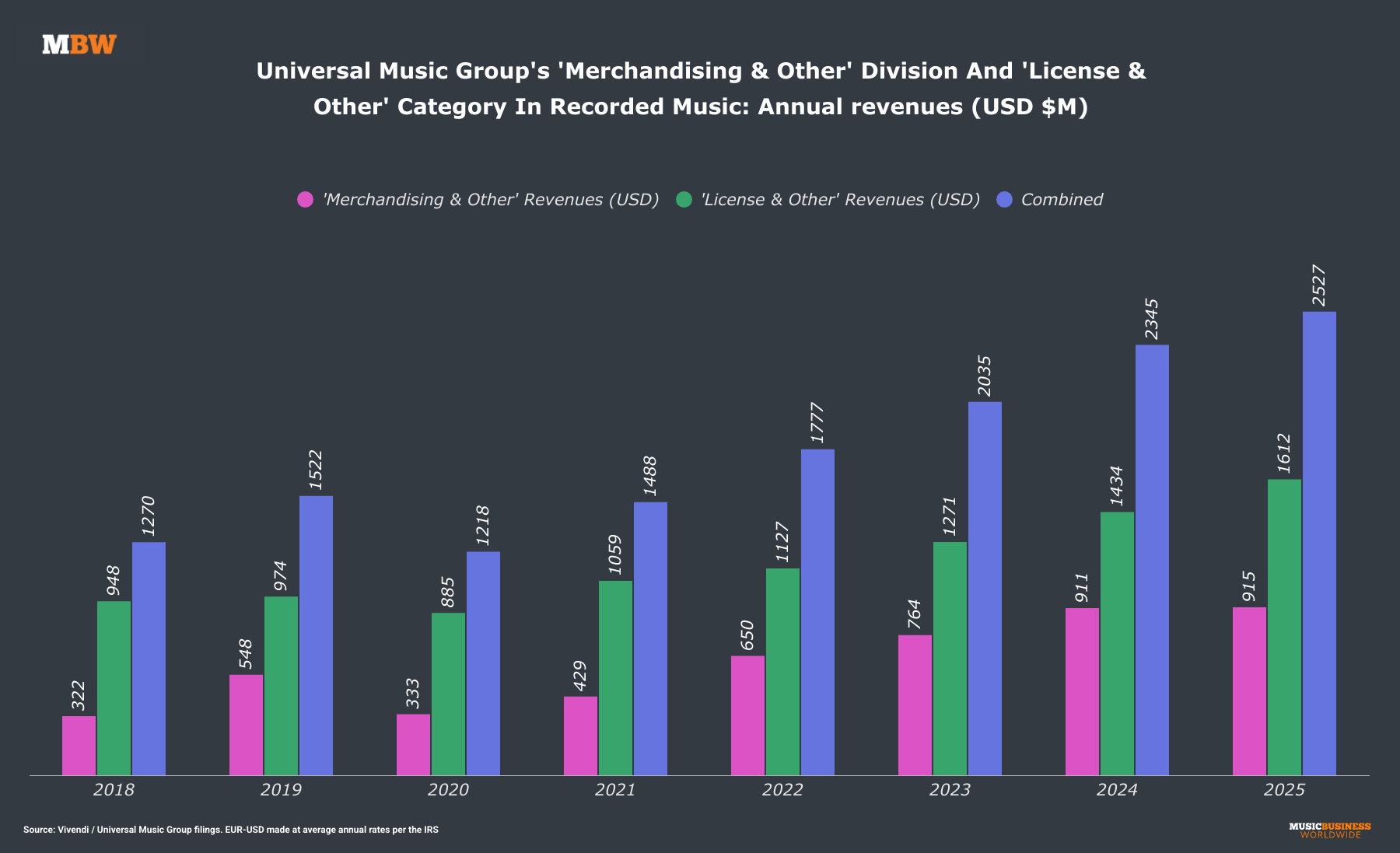
As you can see below, UMG’s ‘License & Other’ annual revenues have roughly doubled since 2020, while its merch revenues have roughly tripled in the same time frame.
In 2025, merch plus ‘License & Other’ at UMG generated over USD $2.5 billion, according to UMG’s reported results analyzed by MBW.
That $2.5 billion was more than 50% higher than UMG’s turnover from either physical music sales or ad-funded streaming in the same year.
Like Sony, UMG muddies our ability to see its standalone live music takings by reporting them (within ‘License & Other’) alongside sync and public performance income in its fiscal reports.
Yet here’s something we know for sure: according to IFPI data, recorded music sync income across the global business has pretty much flatlined in the past few years.
Industry-wide, global recorded music sync revenues remain firmly sub-$1 billion. In 2025, they stood at $641 million – up 4% on 2023, but down 2% on 2024.
It’s a similar story for public performance income: IFPI notes that ‘Performance Rights’ generated $2.9 billion for the entire recorded music industry last year – flat vs. 2024, and only slightly up on the $2.8 billion generated in 2023.
This implies something else must be driving the rapid growth of both Sony’s ‘Other’ category and UMG’s ‘License & Other’ category in the same period.
Namely: ‘Expanded rights’ deals with artists… including live.
The pattern continues: Warner Music Group
Unlike Sony and UMG, Warner Music Group does not include sync/public performance licensing revenues in its reported numbers for ‘Artist Services and Expanded Rights’ (aka: ASER).
According to WMG’s filings, this category includes revenue from its “artist services business” plus its “expanded rights” income from merchandise, artist sponsorships, touring/concert promotion, ticketing, fan clubs, and artist/brand management.
In calendar 2025, WMG’s ‘Artist Services & Expanded Rights’ business generated USD $870 million.
Five years prior, that figure was far smaller, at $517 million.
Warner has publicly acknowledged that its role as merch provider for tours from Oasis and My Chemical Romance helped drive this growth in 2025.
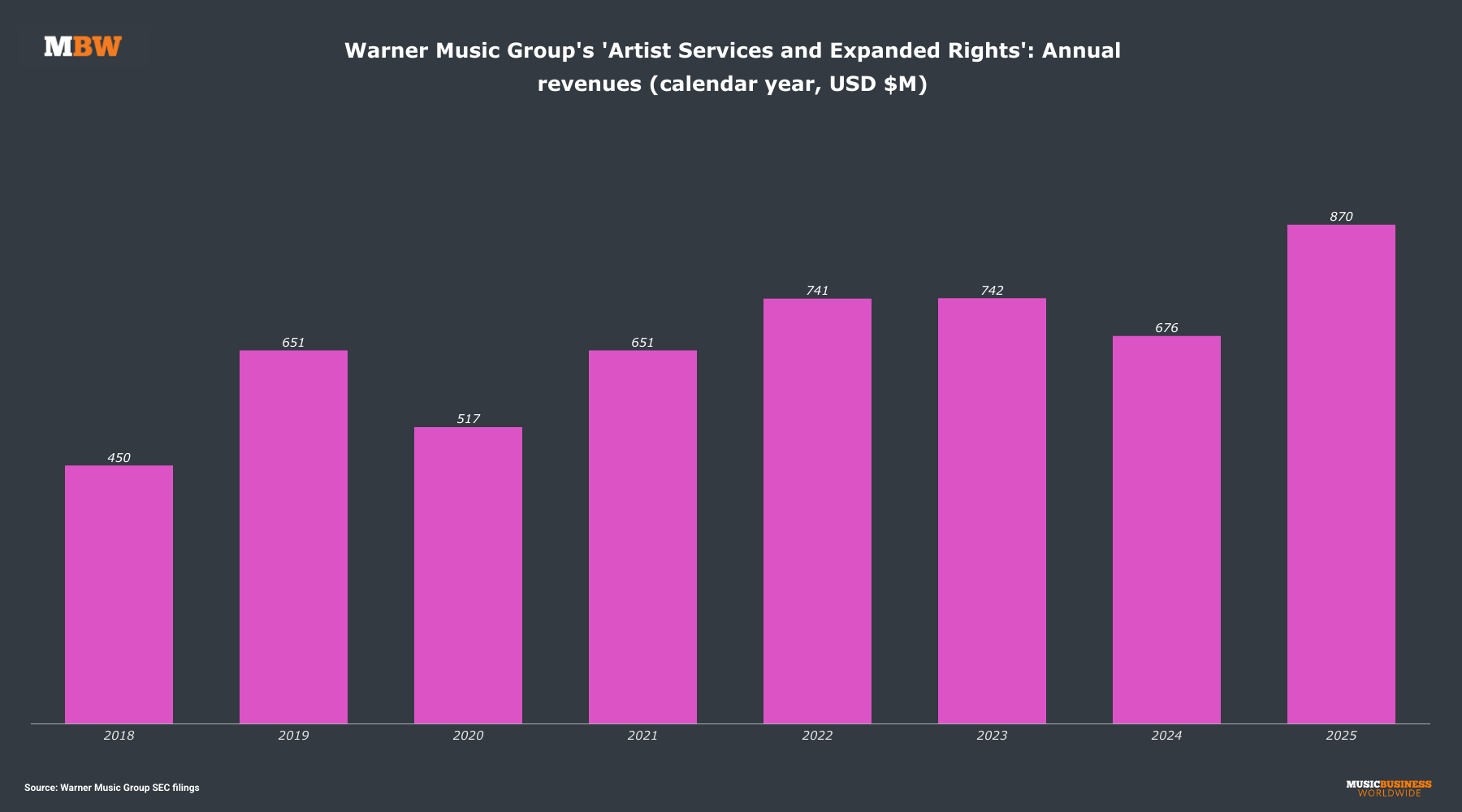
Just in case you’re not keeping score: in calendar 2025, the three major music companies – Universal, Sony, and Warner – jointly generated comfortably north of USD $5 billion in ‘expanded rights’ categories.
Again, that was substantially more than these companies generated from either ad-supported streaming or physical music sales.
This flies in the face of the oft-spoken misnomer that Universal, Sony, and Warner are mere “major labels.”
They are also music publishers, obviously.
But they’re increasingly merchandising and live concert companies too – with growing income from, and seemingly a growing interest in, sectors outside of rights management.
Kyncl’s live promotion plan
If you want evidence of the majors’ desire to further increase their revenues from the live music space, listen to Robert Kyncl.
As I’ve mentioned before, the Warner Music Group CEO told Bloomberg in a filmed interview last year: “I think [major music companies] will be full-service companies in [5 years].
“Today [in the US], we don’t offer management; we don’t offer live promotion. There are a lot of services like that we’re not in the business of here in the United States… I think that is going to change.”
“Today [in the US], we don’t offer management; we don’t offer live promotion… I think that is going to change.”
Robert Kyncl, October 2025
As noted above, all three major music companies already offer both live concert and management services to artists – and increasingly so. They just don’t (as Kyncl was alluding to) do it very much in the United States.
The latest example comes from Warner Music India, which last week announced a renewed focus on income from live concerts, management etc. via its own ‘Artist Services and Expanded Rights’ operation.
The M&A story
The major music companies have each made a string of investments in the management/merch/live space in recent times. To Kyncl’s point, these have largely come outside the United States.
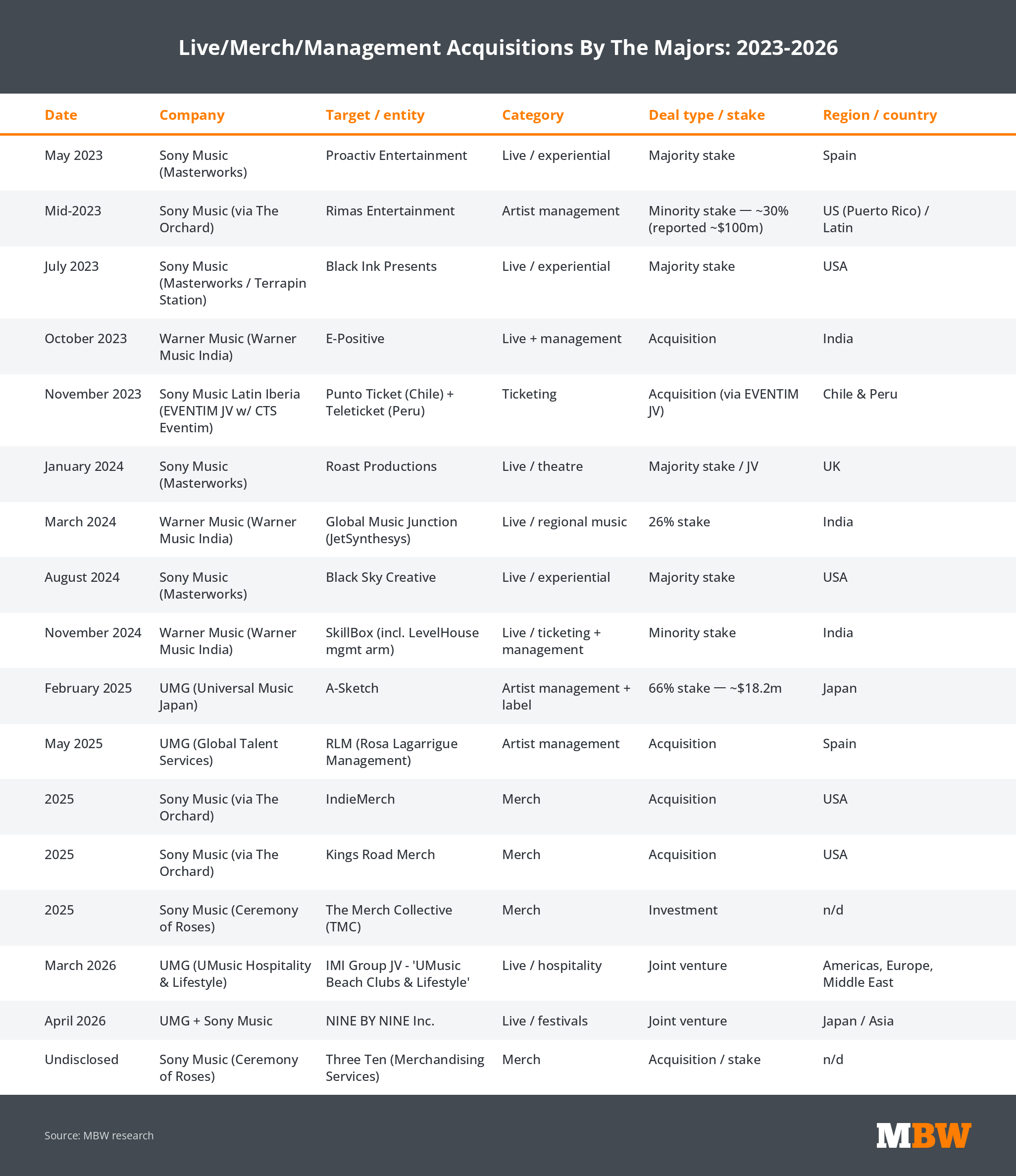
The table below collates a multitude of deals MBW has been made aware of over the past three years (from the start of 2023 to mid-2026).
Most were announced publicly, but at Sony Music, a few more were revealed during the company’s annual business presentations to investors in Tokyo.
The table shows a clear trend: Each of the majors – especially Sony – has been quietly building merch, artist management, and live event capabilities through acquisition in the post-COVID era.
In addition to the array of “experiential” production experts acquired below (see: “immersive experiences”), I’m especially intrigued by Sony Music and Universal Music joining forces in Japan to create NINE BY NINE – a JV with the intention of launching music festivals across Asia.
(Interestingly, not all M&A activity among the majors in this sector has gone in the same direction: Warner Music Group sold an Italian live music promoter back to its Managing Director in 2018, a year after making a similar divestment in Germany. WMG is also currently in the process of offloading German merch e-tailer EMP.)
What’s driving this investment?
Here are three good reasons the majors have made all the moves above:
(i) As streaming revenue growth slows in mature markets – and the majors receive disappointing subscription receipts from key ’emerging’ territories like India – so ‘expanded revenues’ offer an alternative income stream. After streaming’s ‘boom years’, are we now seeing a gradual return to ‘360’ deals at major record companies – but with deeper, and more global, in-house expertise on offer?
(ii) Consumer willingness to spend money on live experiences is expanding, despite ticket prices hitting all-time highs. According to a recent Luminate survey of over 4,000 US consumers, 57% of Gen Z participants said “cost of tickets” was a primary barrier to them attending music events in Q1 2026 – down significantly from the 75% who said the same in Q1 2024.
(iii) By their nature, live events are more insulated from AI’s potential impacts than online businesses. As Live Nation CEO, Michael Rapino, put it in May: “In an increasingly digital and AI-driven world, the global desire for authentic human connection has never been stronger. We are seeing a fundamental shift as fans prioritize the ‘live’ experience – the chance to be physically present with their favorite artists and share that energy with friends and fellow fans in a way a screen simply cannot replicate.”
Speaking of Michael Rapino…
The race is on?
Live Nation, and to a smaller extent AEG Presents, are all-powerful in North America’s live music business.
But that’s less true around the globe.
In 2019, Michael Rapino estimated that Live Nation held a 30% worldwide market share of the live concert industry.
He told CNBC that the live music business was “still fragmented on a global basis” and that LN planned to unleash an international drive via “bolt-on acquisitions around the world.”
He’s come good on that promise.
Key stat: In 2025, for the first time ever, more music fans attended Live Nation concerts outside of the United States than inside it.
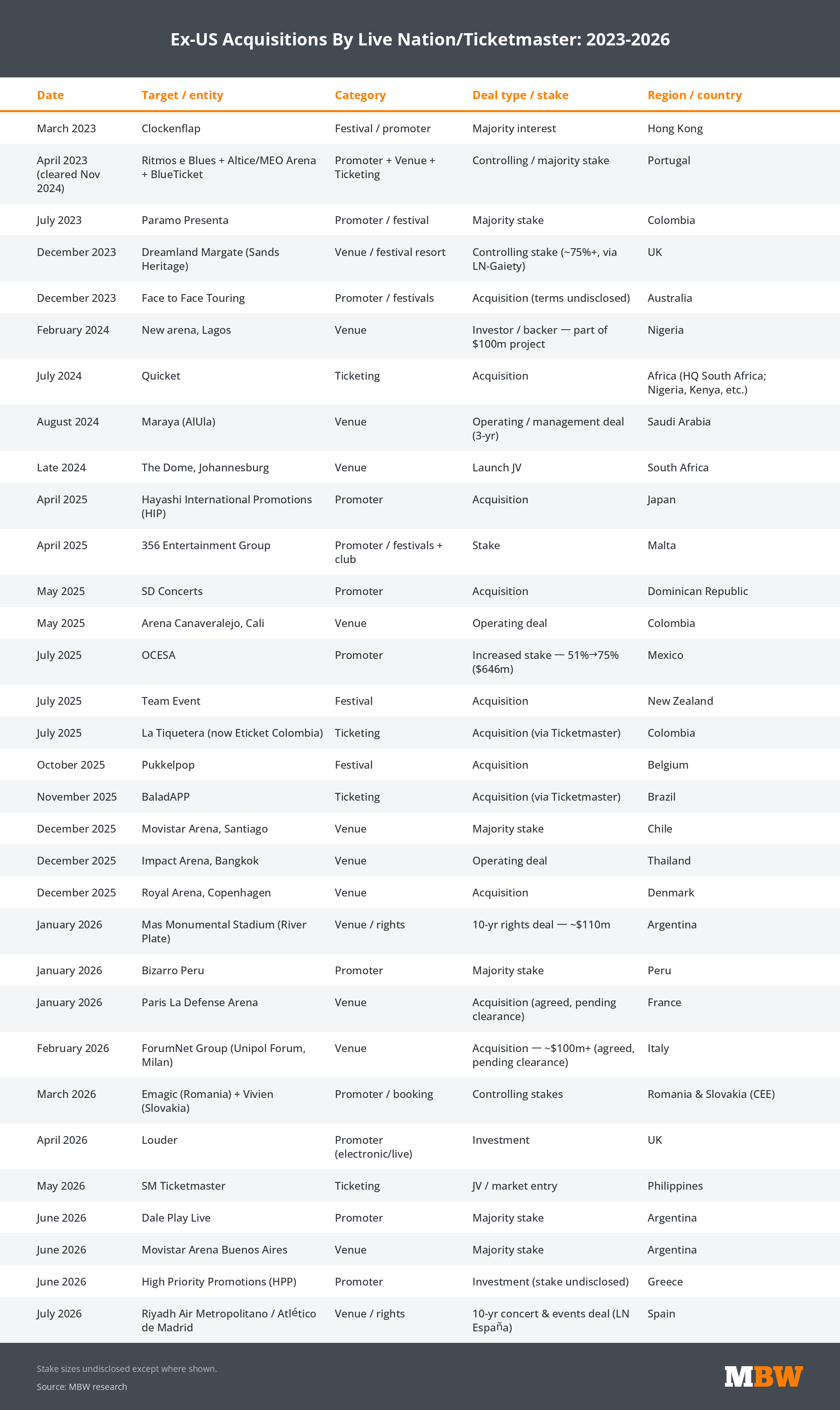
Unlike the majors’ M&A list above, many of LN’s company buyouts over the past three years have centered on venues.
However, there has been a run of significant promoter acquisitions too – especially in Latin America.
That includes Mexico, where LN’s majority acquisition of OCESA has cost Rapino and co. over $1 billion in total, via two deals in 2021 and 2025.
LN has also recently invested in promoters in Argentina (a majority stake in Dale Play Live) and in Peru (a majority stake in Bizarro Peru).
The question now for watchers of the three major music rights companies – Universal, Sony, and Warner – is whether they will now ramp up their international acquisition drive across live events, merch, and artist management.
All three remain understandably focused on purchasing premium copyright catalogs, via their respective JVs with Chord Music/Dundee Partners (UMG), Singapore’s GIC (Sony Music), and Bain Capital (Warner).
The buyout of such catalogs typically offer substantially higher margins than investments in merch or live, especially in emerging markets.
Return-hunting investors will inevitably be attracted to margin-boosting acquisitions vs. lower-margin, ‘non-core’ activities.
Yet, with each of the majors seeing impressive revenue results from their limited involvement in live and merch to date, it’s a fair question: should they start deploying more resources in these traditionally “ancillary” areas? Especially outside of the US?
One thing’s for sure: If they don’t, Live Nation will.Music Business Worldwide