
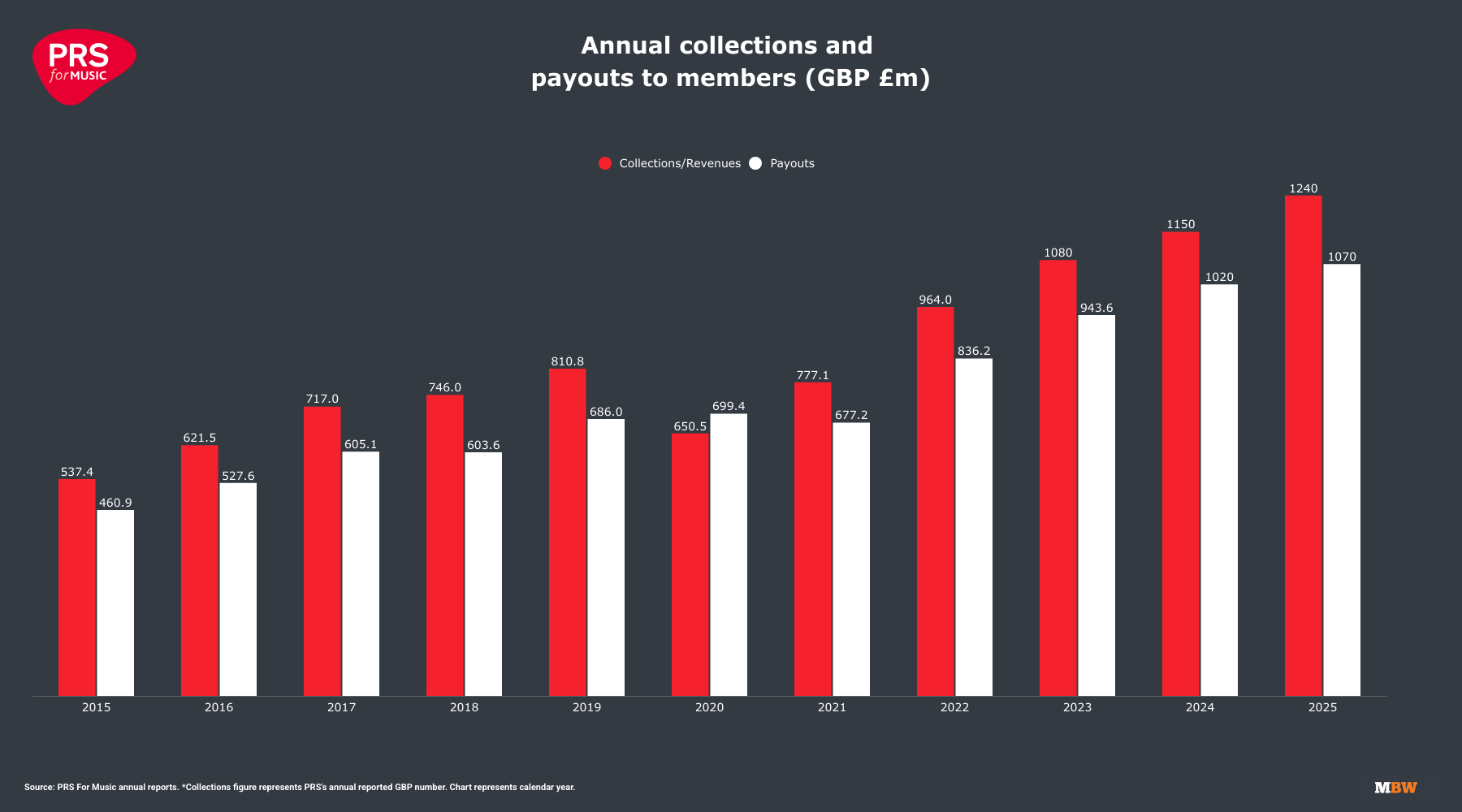
The UK’s PRS for Music paid out GBP £1.07 billion (USD $1.41 billion) to songwriters, composers, and publishers in 2025, up 4.9% year-on-year, while royalty collections reached £1.24 billion ($1.63 billion), an increase of 7.7% YoY.
The annual figures, announced on Thursday (April 30), mark the second consecutive year in which the UK collection society has distributed more than £1 billion to rightsholders.
PRS says it has doubled the value flowing back to members in a decade, from £621 million in 2016 to £1.24 billion in 2025.
For the first time in PRS for Music’s more than 110-year history, revenue collected from live music exceeded £100 million ($133.6 million), reaching £101.4 million, up 13.2% YoY on the prior year.
Overall public performance revenues, including live music and music played in public settings such as shops, restaurants, and bars, totaled £313.4 million ($413 million), up 9.1% YoY.
Streaming remained the largest source of royalty collections, contributing £351.4 million ($463 million), up 11.8% YoY on 2024. Video-on-demand revenue grew 20.1% to £77.2 million ($101.7 million). Collectively, online royalties reached £447.2 million ($589.2 million), an increase of 9.6% YoY.
International royalty income totaled £367.3 million ($484 million), up 4.2% YoY, with Europe remaining the largest overseas market at £200.6 million, up 7.9%. PRS says 28% of international revenue was collected for music used in North America. Revenue from linear TV and radio broadcast remained relatively stable, increasing 0.2% to £111.8 million.
Andrea Czapary Martin, CEO of PRS for Music, said: “We’ve delivered another year of strong growth, with revenues up 7% and for the second consecutive year paying over £1 billion to songwriters, composers and publishers. In just 10 years PRS has doubled the value flowing back to rightsholders, £621m in 2016 to £1.24bn in 2025, by accelerating licensing in new markets and securing new terms with major existing customers.”
Martin added: “I believe success for a society shouldn’t be measured by the money collected. It must be measured by how quickly, fairly and accurately the songwriters and composers receive the royalties they are due.”
The society says it paid out against 7.8 million unique works in 2025, an increase of 41% (2.3 million) since 2020. Of the members paid, 4,541 songwriters and composers received royalties for the first time, collecting £1.96 million between them. PRS now represents the rights of more than 190,000 songwriters, composers and music publishers.
More than 37,600 members received royalties from live performances in 2025, with a quarter of all first-time earners paid because their music was performed live. More than 231,000 setlists were submitted for live performances, which PRS says is helping ensure that more performances are recognized and paid.
Martin said: “In 2025, we saw particularly strong growth in live with more creators earning from performances than ever before, including many being paid for the first time. We moved to monthly payments for online streaming, giving creators faster access to the money they’ve earned and the insights they need to understand how their music is performing.”
The results represent an acceleration in revenue growth from the 6.1% increase PRS recorded in 2024, when it collected £1.15 billion and distributed £1.02 billion. In an interview with MBW in 2023, Martin outlined a five-year plan that included reaching £1 billion in annual payouts by 2026 — a target the society hit two years ahead of schedule.
PRS for Music confirmed in March that Martin, who joined as CEO in June 2019, will be stepping down at the end of 2026. The society said the decision was intended “to allow for the best possible leadership transition.”
Last year, PRS Foundation — the society’s charitable arm — celebrated 25 years since its launch. PRS for Music says it has provided funding in excess of £50 million to the Foundation during that period. PRS Foundation, as its CEO Joe Frankland wrote in MBW in December, has supported the early careers of artists including Sam Fender, Little Simz, Dave and Ezra Collective.
The society says it continues to advocate for creators’ rights in areas including AI and licensing, and has engaged with the UK government to help shape legislation. PRS has also recently launched legal proceedings against Valve Corporation, alleging that its Steam platform has used members’ music without a license since launching in 2003.
Dollar figures in this article are calculated using the 2025 yearly average GBP/USD exchange rate published by the IRS.Music Business Worldwide