
Licensed fan-made remixes just got their biggest stamp of approval yet.
In May, Spotify and Universal Music Group struck a landmark deal to let Premium subscribers create licensed AI covers and remixes on the platform.
The message to the wider industry is clear: fan creativity built on artist permission is a market the biggest players now want a piece of.
One company that has been building on that exact premise since 2022 is Hook, the New York-headquartered social music platform founded by Gaurav Sharma.
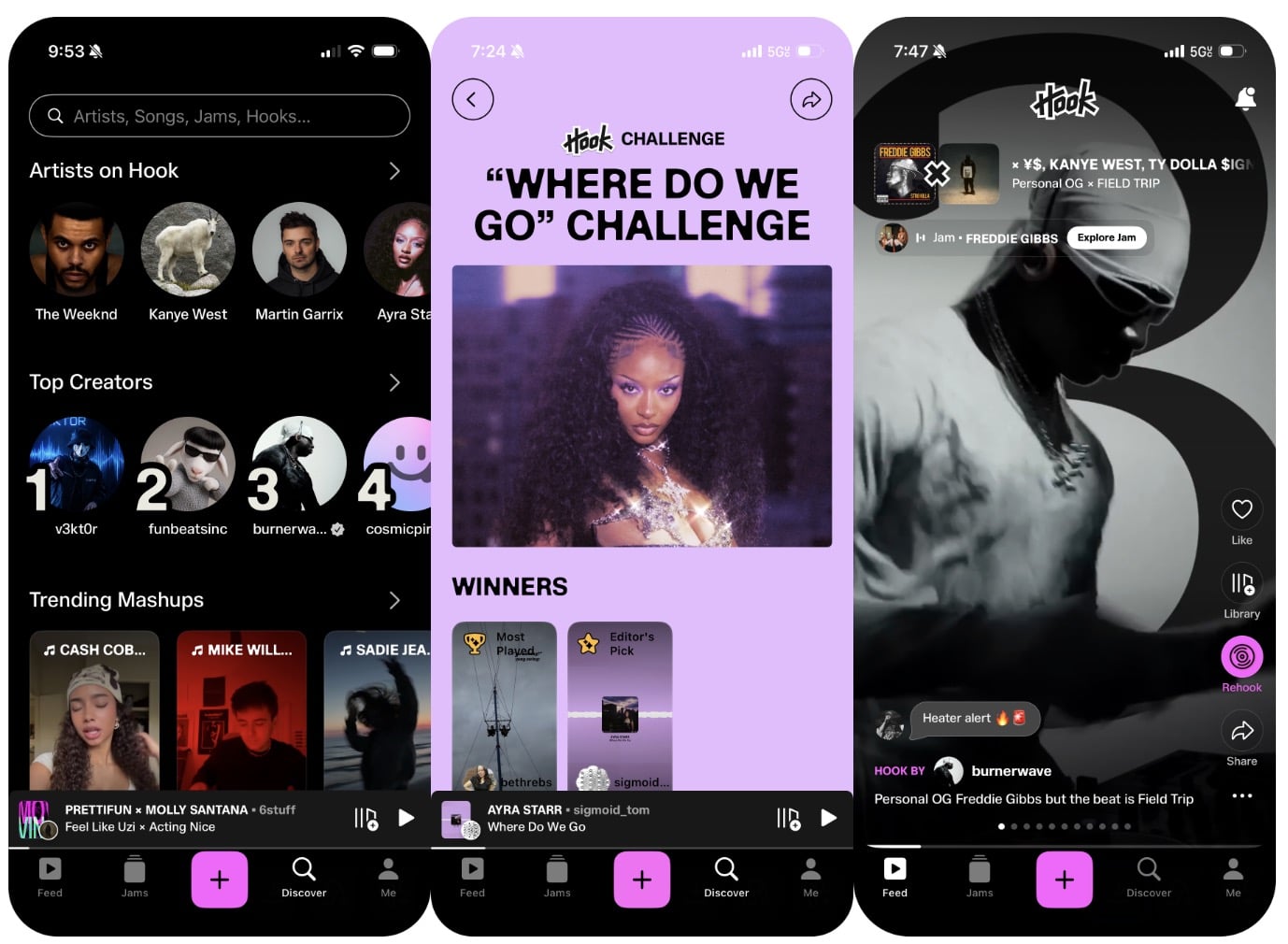
He tells us that the app allows fans to “express themselves with their favorite music, creating UGC that remixes music, syncs their creations to video”.
Those creations can then be shared across TikTok, Instagram, Snapchat, and SoundCloud. Sharma adds that the platform has licensed a catalog of over 20 million songs and “ensures that artists and rightsholders have full creation-control.” He says they are compensated every time their music is used on Hook, and are able to claim wherever their content is shared.
“We built streaming platforms to solve access, so people could hear almost any song ever made, instantly,” Sharma tells MBW. “But somewhere along the way, listening became passive, and discovery became impossible.”
He adds: “The platform that wins the future of music doesn’t just own creation. It owns creation, consumption, and community together, and pays artists for all of it.”
Hook says its active users grew 45X in the 12 months leading up to its USD $10 million Series A in February – a round led by Khosla Ventures, the firm that wrote one of OpenAI’s first venture capital checks.
Earlier backers include Waverley Capital, co-founded by Edgar Bronfman Jr., the former Chairman and CEO of Warner Music Group who previously led Seagram’s acquisition of PolyGram and its merger with Universal Music. Point72 Ventures and Imaginary Ventures are also investors, bringing Hook’s total funding to $16 million.
“The real debate isn’t AI versus artists,” says Sharma. “It’s whether innovation and rightsholder participation can coexist. We believe they can.”
Hook has run direct remix collaborations with The Weeknd, Lil Wayne, Metro Boomin, and Empire of the Sun, with licensing partnerships spanning Downtown Music, Primary Wave, Avex, Too Lost, and Glassnote Records.
Prior to founding Hook, Sharma studied Computer Music Composition at Johns Hopkins’ Peabody Institute, before joining India-focused streaming service Saavn in 2010.
As COO, he oversaw the platform’s growth to more than 100 million monthly active users through its 2018 merger with Reliance Jio to become JioSaavn. Today, JioSaavn claims to be the “second most downloaded entertainment app in India,” trailing only JioHotstar, which recorded 1 billion downloads. Both services operate under the Jio digital ecosystem, controlled by Reliance Industries.
Looking to the future, Sharma predicts that “over the next decade, we’ll see creation become as common as listening”. He adds: “Millions of people who don’t consider themselves musicians will participate creatively. We’ll also see entirely new categories emerge, between artist and fan, professional and amateur, creator and consumer.”
Here, Sharma discusses Hook’s positioning, what superstar artists want before they say yes to a remix platform, and why he believes fan creation is becoming a core pillar of music consumption…
What did your time at JioSaavn teach you about the industry?
Three things. First, the idea that innovation requires ignoring copyright or alienating the artists of today is not true. If you build with artists, not around them, then trust becomes your moat.
Second, scale comes from removing friction. Make the experience effortless, and the audience shows up.
“In five years, we see Hook as the default way the next generation engages with music.”
Third, the world is bigger than the markets people obsess over. At Saavn, we saw how differently India engaged with music, and how much value sits outside the usual Western lens.
Those three learnings are baked into Hook. Artists first, frictionless by design, and a global view from day one.
Hook has integrated with TikTok, Instagram, Snapchat, and SoundCloud. Could you explain your ‘open platform’ approach and how it works?
We don’t believe the future is one destination platform that captures all creative activity. The reality is that consumers express themselves across many platforms.
Our approach is to be an open creative layer that sits across the broader music ecosystem. Users make licensed creations within Hook and then distribute that content to the platforms where they already spend time. We’ve integrated directly with all of these platforms and have built the tech to support attribution.
For rightsholders, this means they can enable fan creativity while maintaining control, attribution, and monetization. For users, it means they don’t have to choose between creating and reaching their audience.
Hook has raised $16 million in total, with Khosla Ventures leading your Series A and Edgar Bronfman Jr.’s Waverley Capital backing you since the seed round. Khosla Ventures wrote one of OpenAI’s first venture checks; Bronfman ran Warner Music Group. What does it tell you that money from both sides of the AI debate is backing a consent-based platform?
I don’t actually think they’re on opposite sides of the debate. The real debate isn’t AI versus artists. It’s whether innovation and rightsholder participation can coexist. We believe they can, and our investors do too.
Khosla wrote one of the earliest checks into OpenAI, so they understand where AI is heading better than almost anyone. Edgar built and ran one of the largest music companies on earth, so he understands rights, artists, and how value moves through this business. One sees the technology, the other sees the catalog and the creators.
The fact that investors with deep expertise in both AI and music are backing Hook reinforces our belief that building an equitable framework for creation isn’t a constraint on innovation. It’s the foundation for long-term innovation.
How is Hook positioned in the market today, and how do you want to be positioned five years from now?
Today, Hook is the social, active layer for music on the internet. It’s the place you go to create and build community with music, not just to listen to it. Music consumers and fans today express themselves through creativity, and there’s currently no economics for that consumer behavior. Hook bridges that gap.
Five years from now, we see Hook as the default way the next generation engages with music. Where new artists break, where catalogs earn from active fans, and where putting your own stamp on a song is as normal as adding it to a playlist is today.
You’ve run direct remix collaborations with The Weeknd, Lil Wayne, Metro Boomin, and Empire of the Sun. What’s the pitch that gets a superstar to actively embrace a licensed, AI-powered remix platform?
The pitch is actually straightforward: your fans are already creative. The question isn’t whether your fans will engage with your music creatively. The question is what experiences we can create with your participation.
Hook allows artists to channel that creativity in a way that preserves artistic control and creates new opportunities for engagement. Artists can nudge their fans into the kinds of creations they’re interested in hearing. It’s true, collaborative co-creation with your fans, and you get to see where their creations travel throughout the internet.
Most artists understand that fan creativity is a sign of cultural relevance. What they want is a framework that respects their work. That’s exactly what we’ve built.
What are the opportunities for emerging to mid-tier artists in this space, and on Hook specifically?
The opportunity may actually be greater for emerging artists than established ones.
Historically, artists had limited ways to engage fans beyond listening, following, or attending shows. Fan-powered creation introduces a new layer of participation.
“Historically, artists had limited ways to engage fans beyond listening, following, or attending shows. Fan-powered creation introduces a new layer of participation.”
When fans remix, reinterpret, and share music, they become active participants in building an artist’s audience. When fans create with your music, every one of those creations is a doorway back to you and a new touchpoint with a potential fan. You do not need a major label budget to break through.
Hook has access to over 20 million licensed songs, and you say your active users grew by more than 4,400% in a single year. Is that growth telling you something about what fans actually want, to create using music by their favorite artists rather than replace them?
Absolutely. We reject the idea that the consumer use case for music is to create fake, synthetic versions of their favorite artists to replace them. UMG’s own consumer research backs this up, finding that 69% of music streamers express disinterest in AI artists and 67% want the ability to filter out AI-generated music entirely.
Fans are passionate because they admire artists. What we consistently see is that people want a deeper relationship with the music they love. They want to participate in the culture, not just consume it.
The growth we’re seeing reinforces our view that creative expression is becoming a core part of music consumption. Fans don’t want less connection to artists. They want more. You’re not going to win the artists of tomorrow by losing the artists of today.
Taylor Swift filed to trademark her voice and likeness in April, protecting her identity. You built Hook around artist consent and identity from day one. Did her move validate a bet you’d already made, or change how you think about it?
Validation. We built Hook around artist consent and identity from the first day, so an artist of Taylor’s stature moving to protect her voice and likeness is the world we designed for becoming mainstream. It does not change our thinking; it confirms it.
From the beginning, we’ve believed that voice, likeness, identity, and creative works are valuable assets that artists should control. As generative AI becomes more powerful, those assets become even more important.
I think we’re moving toward a world where identity rights become a central part of the creative economy.
You’ve argued that fan remixing isn’t just promotion, it’s “a new form of active music consumption” that rightsholders should be paid for. Why has the industry been so slow to treat UGC as consumption rather than free marketing?
Because the entire business has been driven on a single unit: the monetization of [a 30-second-plus] stream of a song, and everything else is filed under marketing. For decades, anything a fan did with a song was treated as free promotion for the thing that made the money: streams. That model has driven the predictability of copyright value for every major rights holder. Rethinking it means rewriting how the industry accounts for value.
But if millions of people are spending meaningful time actively creating with music, and they’re consuming their creations more than the music on streaming services, that’s not just marketing. That’s engagement. That’s consumption.
I think the industry is increasingly recognizing that distinction. The next phase is building systems that allow rightsholders to participate economically in social engagement while still preserving the standard streaming model.
In May, Spotify and Universal Music struck a landmark deal to let Premium subscribers create licensed AI covers and remixes. What are your thoughts on the development, and what does it mean for Hook’s position in the market?
It’s a major validation of everything we have been saying. The largest streaming platform in the world just told the industry that fan creation is a licensed, paid product built on consent, credit, and compensation, not free marketing.
The difference is structural. Hook’s business model and partnership with rightsholders is a new framework for music creation and consumption, built for how consumers engage with music today: socially. It’s free, it’s fun, it’s a community. Spotify [validates our view] but through a model different from ours.
What are your long-term predictions for the fan-made remixes and music creation space?
The platforms that succeed won’t be the ones that try to replace artists. They’ll be the ones who help artists scale creativity through their communities. Ultimately, I believe fan engagement becomes one of the largest engagement layers in music, sitting alongside streaming, live events, and merchandising.
If there was one thing you could change about the music business, what would it be and why?
I would change where the money flows. The business pays for passive plays and treats almost everything else a fan does with music as free marketing. That leaves an enormous amount of real value and real human passion, completely uncompensated.
I would make active consumption a first-class category, so that artists and rightholders earn when fans engage with their music, not only when someone presses play. Fans are already doing the work of keeping music alive. Let’s build economies with it.
All MBW+ subscribers get digital access to our Music Business Worldwide magazine, with six issues released each year. Music Business Worldwide