Higher-priced ‘super premium’ music streaming tiers remain one of the biggest revenue opportunities in the music industry.
UMG Chairman and CEO Sir Lucian Grainge said in his 2026 new year memo that UMG will work with DSP partners on “enhanced premium tiers for superfans,” and on UMG’s Q4 earnings call earlier this month referenced “premium tiers being developed by the traditional DSPs” as part of a broader superfan ecosystem.
Spotify experimented with Premium price segmentation last November when it launched a higher-priced ‘Premium Platinum’ tier in five emerging streaming economies – but the industry continues to watch for the arrival of a fully-fledged super premium offering in western markets.
Over in China, the concept has already proven successful, and is scaling fast
Tencent Music Entertainment‘s (TME) ‘Super VIP’ tier has just hit a major new milestone.
TME published its Q4 and full-year 2025 results today (March 17), revealing that its SVIP subscribers surpassed 20 million by year-end – up from the 15 million the company reported at the end of Q2, and just 10 million in Q3 2024.
That growth trajectory – doubling in barely over a year – tells us something important about the appetite for higher-priced music streaming, and offers a real-world blueprint for what higher-priced streaming tiers could deliver.
Here’s what the numbers show…
1. SVIP penetration is accelerating – even as the wider user base shrinks
TME’s SVIP tier now represents approximately 15.7% of the company’s 127.4 million total paying music subscribers.
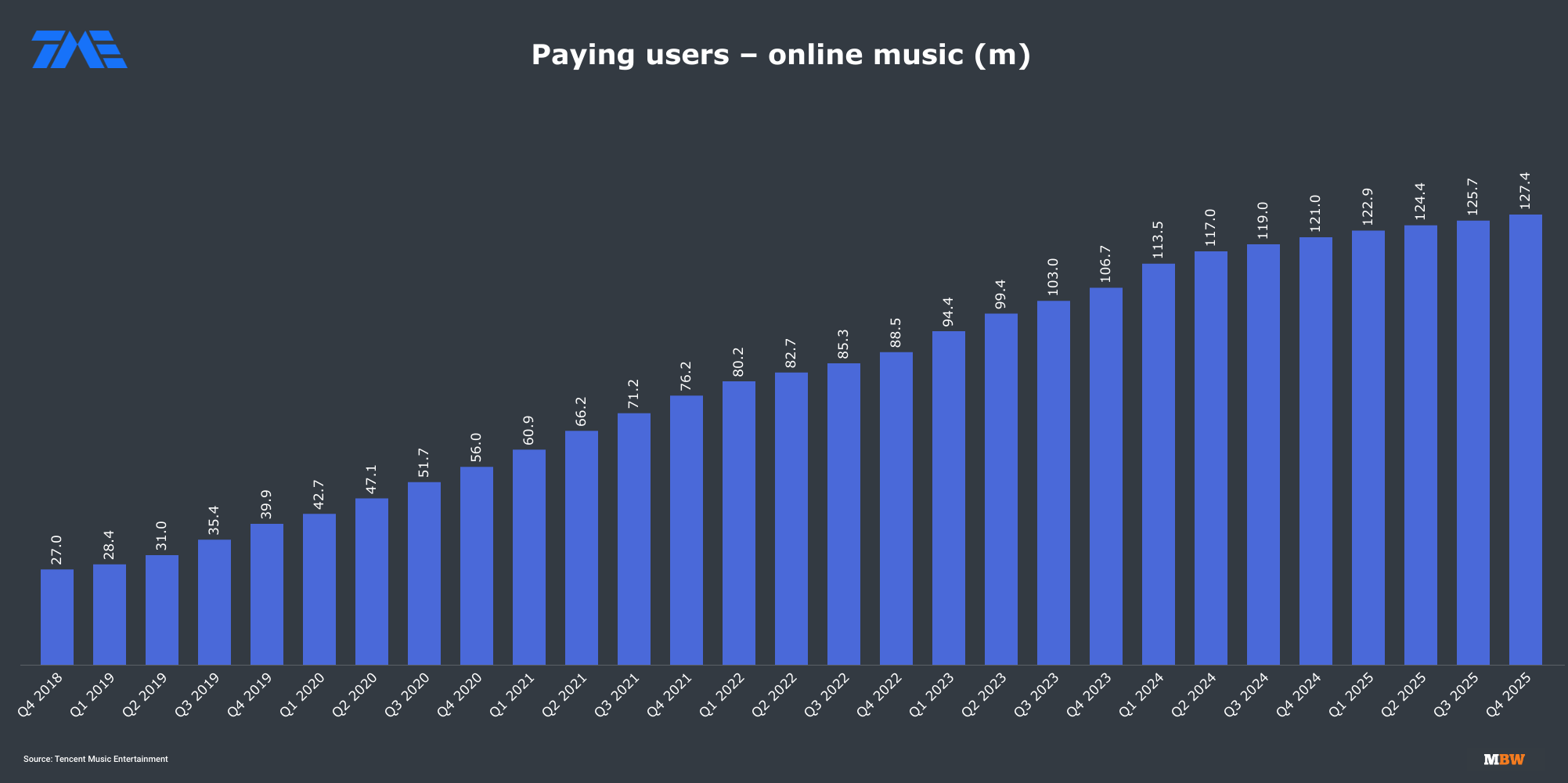
That’s up from around 12% at the end of Q2 2025, and just 8% as recently as September 2024.
What makes this particularly striking is the context in which it’s happening.
TME’s total music monthly active users (MAUs) actually fell 5.0% YoY to 528 million in Q4 – a continuation of a long-running decline from a peak of over 650 million.
The broader user base is contracting. But the paying user base isn’t.
TME’s total number of paying music users grew 5.3% YoY to 127.4 million in Q4, while monthly ARPPU (average revenue from each paying user) climbed 7.2% YoY to RMB 11.9 (around USD $1.70).
In other words: TME is losing casual listeners but converting and monetising the ones who stay at an ever-higher rate.
SVIP is a key engine behind that monetization story.
TME’s SVIP subscribers pay approximately RMB 40 (USD $5.72) per month, compared to the standard RMB 8 (USD $1.14) subscription – roughly five times the revenue per user.
When you consider that these 20 million subscribers represent less than 16% of TME’s paying base but are generating five times the ARPU, the economic weight of the tier becomes clear.
2. What’s driving SVIP adoption?
TME attributed the SVIP milestone to “deepened collaborations with music labels, artists and the rollout of new, high-valued benefits.”
According to TME, premium sound quality – including Dolby Atmos support and advanced audio technologies – remains a key SVIP draw. That should be noted by anyone tracking the Spotify lossless/super-premium debate: in the one major market where HD audio is gated behind a higher-priced tier, it’s working.
But audio quality is only part of the picture. In Q4, TME appointed brand ambassadors for its SVIP program – including Ryan Ding, Ju Jingyi, and Karry Wang for QQ Music, and Liu Yuning for Kugou Music (pictured below) – and launched prioritized ticketing packages for flagship events including QQ Music’s Top Music Night 2026 and the annual gala of Melody Journey 2. Both, the company said, resulted in “effective SVIP adoption.”

Other SVIP benefits such as premium audio effects, personalized avatar outfits and feature-related perks also contributed to acquisition and retention, TME said.
The company has also leaned heavily into what it calls “artist-centric privileges” more broadly: exclusive and timed-exclusive digital album releases, priority access to concert tickets for in-demand shows, and collectible ‘star card’ series tied to popular artists.
TME CEO Ross Liang framed the milestone in the context of a broader strategic shift: “Driven by differentiated, expansive content privileges and immersive experiences, our SVIP user base surpassed 20 million, with ARPPU continuing to trend upward. Our newly launched ad-supported subscription plan is gaining initial progress and will, over time, allow us to broaden user access and attract new audiences.”
That last point is notable: TME is now operating a three-tier model – ad-supported, standard, and SVIP – similar to what Spotify is piloting with its Lite/Standard/Platinum structure in India and elsewhere.
3. The subscription revenue picture
TME’s music subscription revenues reached RMB 4.56 billion (USD $653 million) in Q4, representing 13.2% YoY growth. That was a deceleration from the 17.2% posted in Q3 and 17.1% in Q2 – though still robust.
For the full year, music subscription revenue hit RMB 17.66 billion (USD $2.53 billion), up 16.0% YoY from RMB 15.23 billion in 2024.
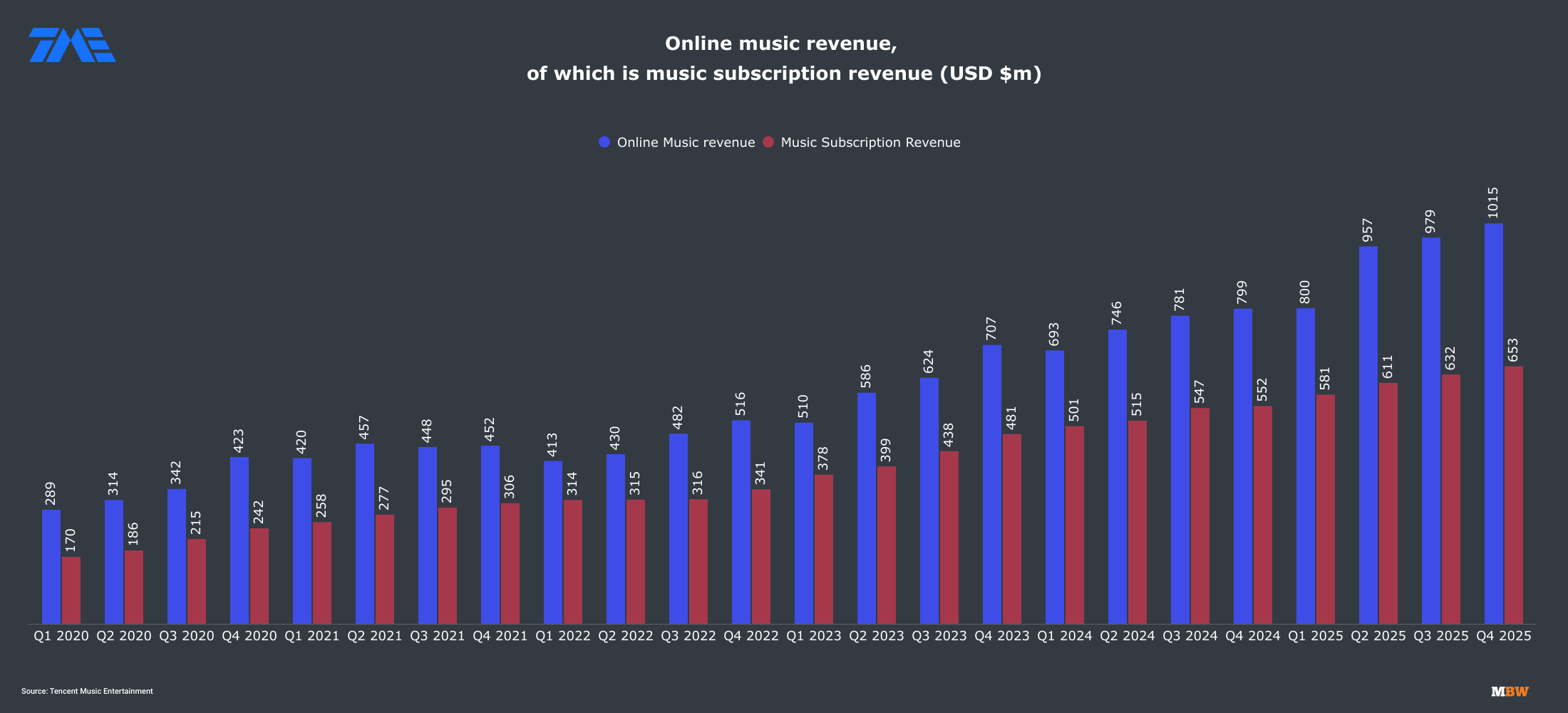
Total online music services revenue (which includes advertising, artist-related merchandise, and offline performances alongside subscriptions) grew 21.7% YoY to RMB 7.10 billion (USD $1.02 billion) in Q4. Music subscriptions accounted for around 64% of that total; the remainder was driven by what the company described as “robust” growth in offline performances and concert-related revenue.
For the full year, online music services revenue reached RMB 26.73 billion (USD $3.82 billion), up 22.9% YoY – making it the dominant driver of TME’s overall business. Music operations now account for 82% of total company revenues, up from around 77% a year ago, as the firm’s legacy ‘social entertainment’ division (karaoke and live-streaming tipping) continues to decline.
Note: RMB to USD conversion for Q4/FY 2025 carried out at the exchange rate as of December 31, 2025, as provided by TME.