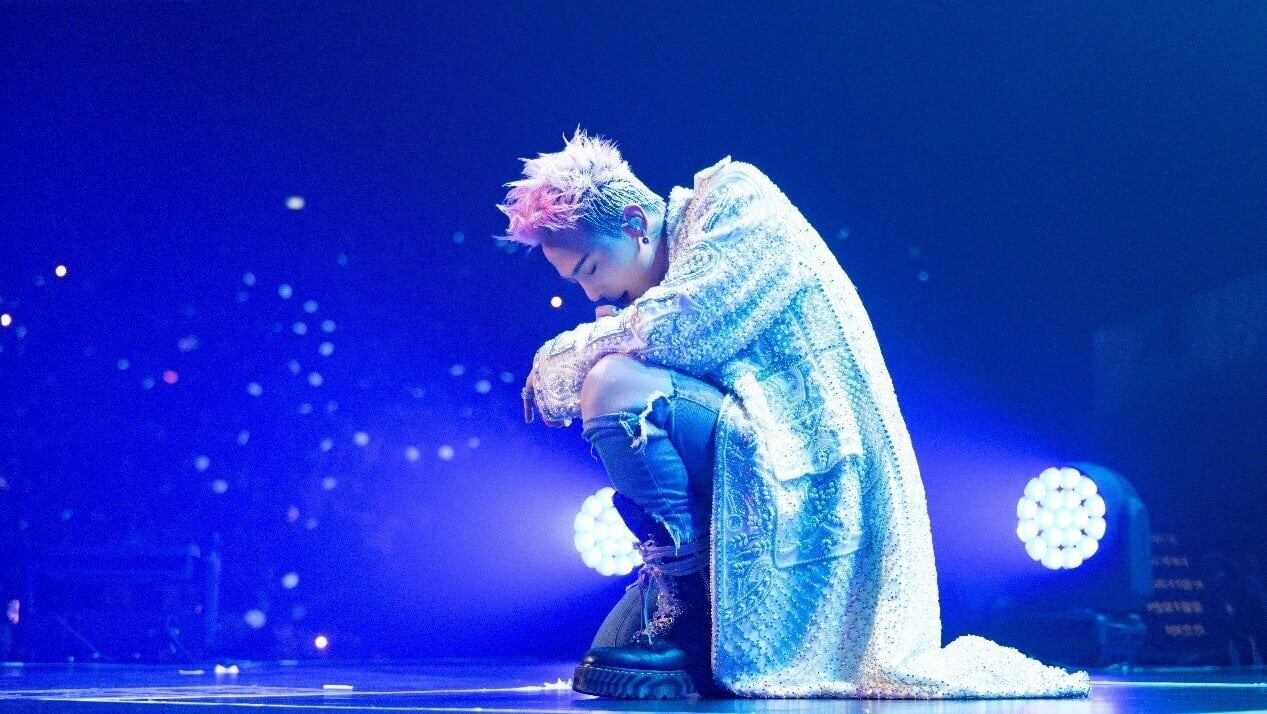
Credit: GALAXY CORPORATIONTME partnered with Galaxy Corporation, the agency representing G-Dragon, to co-promote the South Korean rapper's regional tour across Southeast Asia, the Middle East, Australia, and New Zealand.
MBW Explains is a series in which we dig behind the headlines, via data and context, to improve your understanding of key stories. Only MBW+ subscribers have unlimited access to these articles. MBW Explains is supported by Reservoir.
Can a music streaming giant also be a major concert promoter, ticketing platform, and merch seller?
Tencent Music seems to be pulling it off in China, and global DSPs will be watching closely.
On its Q1 2026 earnings call on Tuesday (May 12), China’s largest music streaming provider reported that its offline concert business achieved “another quarter of triple-digit year-over-year growth.”
Non-subscription music services revenue, encompassing live concerts, advertising, and merchandise, jumped 28.0% YoYto RMB 1.94 billion (USD $282 million) in the quarter.
CFO Shirley Hu described the company’s offline performance services as “our emerging growth engine” on the call, noting that TME had “positioned our strategic artists, such as Will Pan, Silence Wang, and GAI, on high-profile stages across domestic and overseas markets.”
TME’s total revenue in Q1 was RMB 7.90 billion (USD $1.15 billion), up 7.3% YoY.The company also renamed its core division from “online music services” to “music-related services” starting this quarter, a signal of how far it has moved beyond streaming.
Here’s how TME became a serious player in the live music market in China, and why, as AI reshapes the economics of recorded music and superfans become more crucial, concerts might be the one product a streaming platform can sell that no algorithm can replicate.
From streaming platform to concert promoter and ticket seller
TMEestablished its in-house live music arm, TME Live, in 2020.
The pivot toward physical concerts began in 2023, when TME Live entered a strategic partnership with Galaxy Arena, the 16,000-seat venue in Macau. That partnership was renewed for a further three years in August 2025.
Separately, in October 2024, TMEpartnered with Galaxy Corporation, the agency representing G-Dragon, to co-promote the South Korean rapper’s regional tour across Asia, the Middle East, Australia, and New Zealand. The tour was promoted byAEG Presents, TME Live, and Chessman.
By Q2 2025, TME had staged three sold-out G-Dragon shows at Galaxy Arena, drawing over 36,000 attendees. Executive Chairman Cussion Pangcalled them the company’s “first large-scale international concert production”.
G-Dragon on tour in 2025
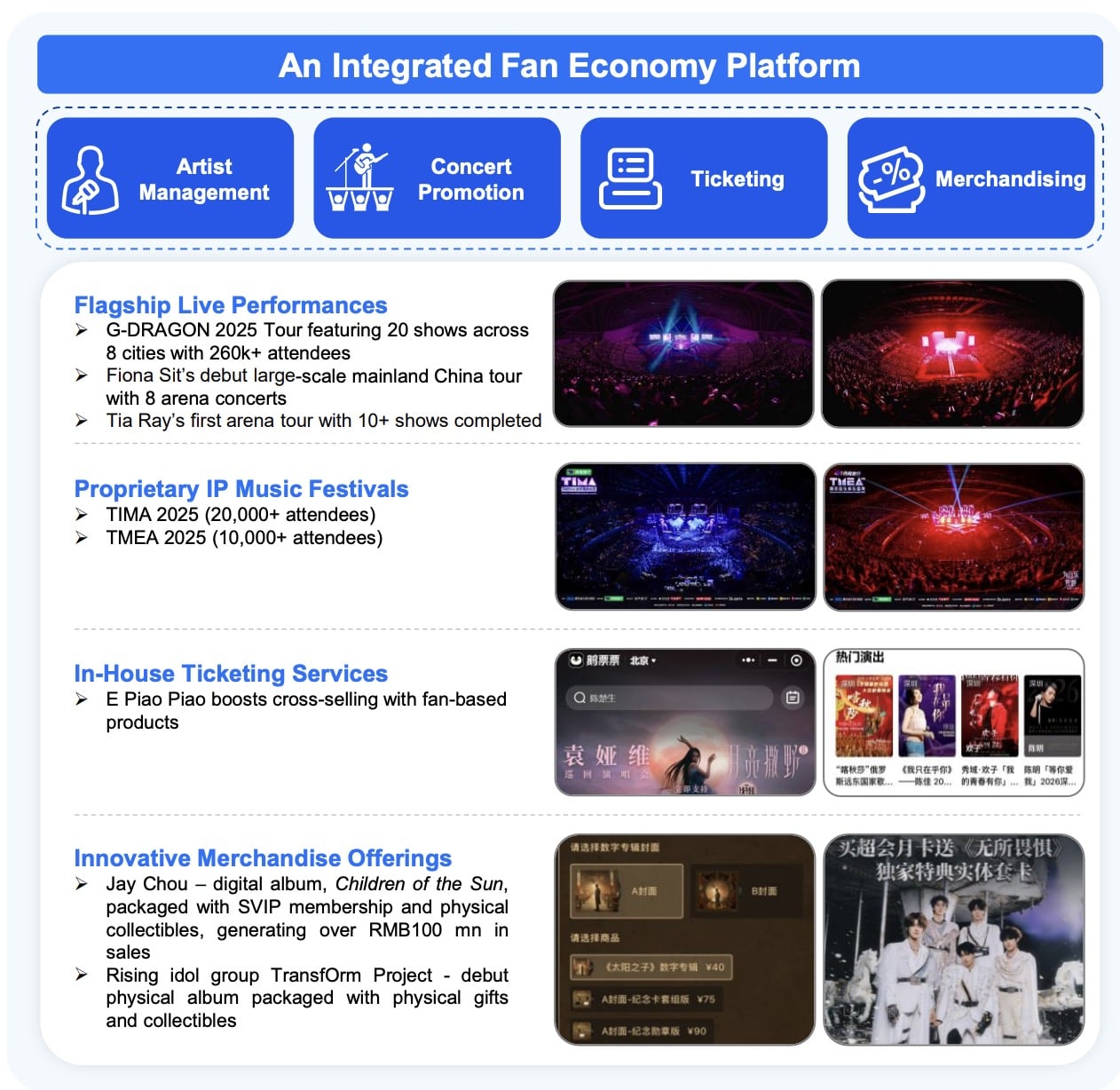
The G-Dragon 2025 tour ultimately comprised 20 shows across eight cities, drawing over 260,000 attendees, according to TME‘s Q1 2026 investor presentation.
In Q1 2026, Pang said TME “delivered multiple flagship concerts, each drawing over 10,000 attendees,” including BABYMONSTER‘s concerts in Taiwan, China, and NCT WISH‘s concerts in Hong Kong, China.
The company is also taking Chinese artists international: Silence Wang embarked on his debut world tour across Asia and North America in the quarter, while rapper GAI staged his first large-scale show in Singapore.
As of Q4 2025, TME‘s online music services had 528 million monthly active users. When a user repeatedly plays a particular artist’s tracks, the platform can push that artist’s tour information and guide the user to purchase tickets. That conversion path from streaming to ticketing is something standalone ticketing platforms cannot replicate.
TME runs two proprietary live event brands: the TME Live International Music Awards (TIMA), which drew over 20,000 attendees in 2025, and the TMEA concert, which attracted over 10,000 (see below).
Source: TME Q1 Investor Presentation
concerts, Super VIPs, and the fan economy
What makes TME’s live music push distinct from other streaming companies’ experiments in live events is how tightly it is integrated with subscription monetization.
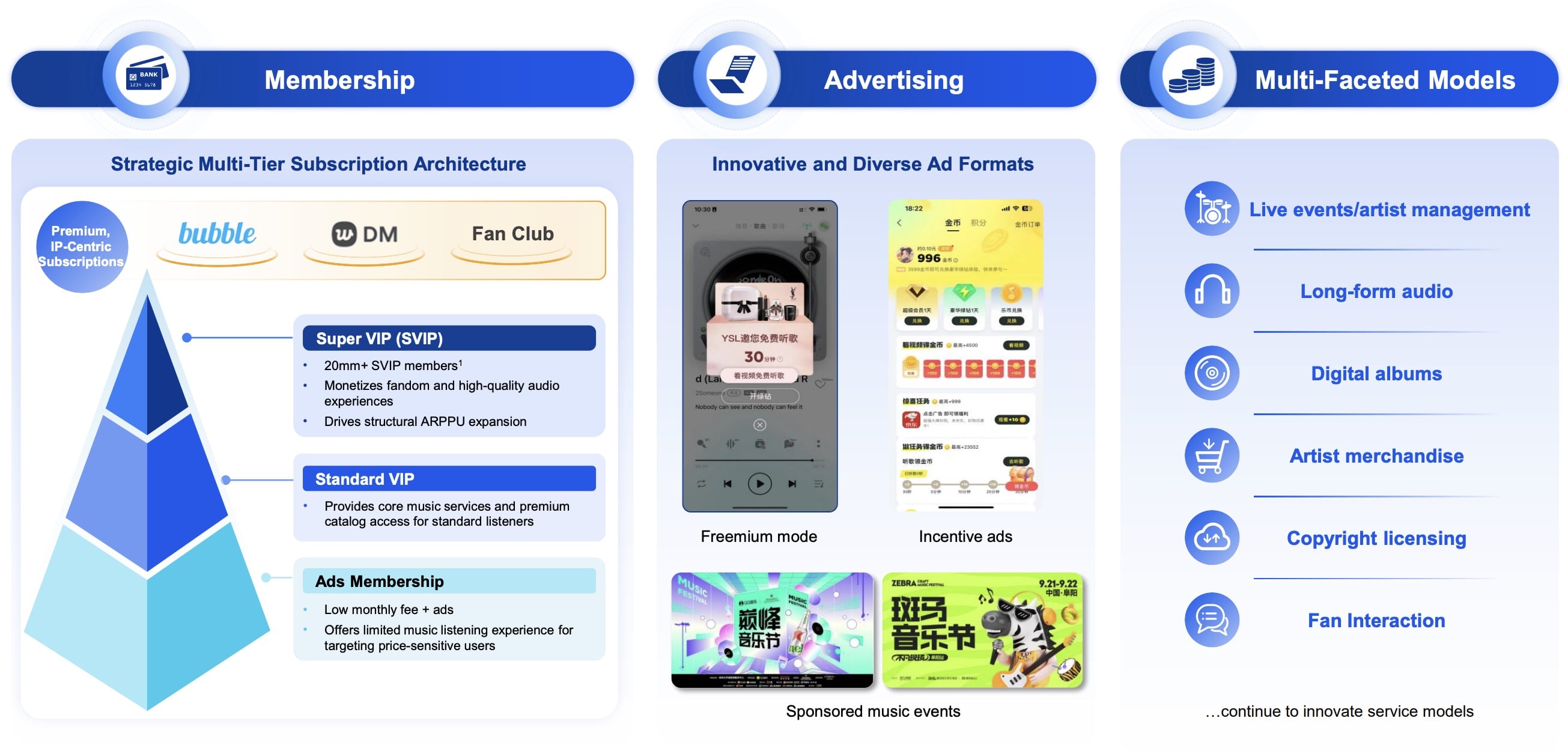
TME’s higher-priced Super VIP (SVIP) streaming tier costs approximately RMB 40 (USD $5.72) per month, roughly five times the standard subscription price of RMB 8 (USD $1.14), and grants members priority access to concert tickets and artist merchandise.
The SVIP tier surpassed 20 million subscribers at the end of 2025 (see below), up from 15 million at the end of Q2 2025 and 10 million in Q3 2024.
Membership services revenue grew 6.6% YoY to RMB 4.57 billion (USD $662 million) in Q1 2026. TME attributed the growth to “continuous expansion of SVIP membership privileges,” including early access to concerts and artist-related merchandise.
Source: TME Q1 Investor Presentation
As an example of this strategy in action, TME cites its collaboration with Jay Chou on his digital album Children of the Sun, which was packaged with SVIP membership and physical collectibles, which, according to TME, “drove strong engagement and generated over RMB100 million in sales”.
TME’s strategy is clear: Concerts drive SVIP adoption; SVIP privileges make concerts more attractive.
Speaking on the company’s Q1 earnings, CFO Shirley Hu said: “IP-related benefits, such as artist merchandise and offline performances, have emerged as key drivers of SVIP adoption.”
Ross Liang added: “We are transitioning to a membership-based model that goes beyond content subscriptions to deliver more immersive music experiences.”
Credit: miss.cabul / Shutterstock.comA DIFFERENT MODEL TO SPOTIFY
Spotify, the world’s largest audio streaming platform by subscribers, has taken a different approach to live music.
After experimenting with direct ticket sales in 2022, Spotify scaled back its own ticketing initiatives in 2024, pivoting to integrations with third-party ticketing platforms including Ticketmaster, Bandsintown, SeatGeek, and others.
Spotifysaid in February that it had helped artists generate over $1 billion in ticket sales to date. But the company acts as a discovery and referral layer, not a promoter.
Concert ticket access has also been widely reported as a planned feature of Spotify‘s long-awaited ‘Music Pro’ super-premium tier – first reported by Bloomberg in February 2025 at a potential price of up to $5.99 more per month on top of a Premium subscription.
When Spotify finally launched lossless audio in September 2025, however, it made the feature available to standard Premium subscribers for no additional charge, rather than gating it behind a higher-priced tier.
Spotify did launch a Premium Platinum tier in November 2025, in five emerging markets including India, Indonesia, and Saudi Arabia.
But as of May 2026, a super-premium tier with concert ticket access has yet to launch in any mature streaming market.
One obstacle: Spotify doesn’t control the concert ticket inventory it would need to offer presale access as a subscription perk.
Live Nation has previously confirmed that it held ticketing talks with Spotify, Apple, and Amazon around presale access for super-premium tier subscribers.
Discussing those talks with investors on a Live Nation earnings call last February, President and CEO Michael Rapino said: “We’ve talked to them all about ideas on if they wanted inventory.
“There’s a cost to that, and we would entertain and look at that option if it made sense for us in comparison to other options we have for that presale, which is a very valuable asset.”
TME, by contrast, is the promoter, the ticketing platform, and the streaming service, all in one.
The concert business is booming in China
Tencent’s concert push arrives amid a buoyant time for live music in its home market, China.
China Global Television Network, or CGTN, reports that there were 3,000 large-scale concerts in China last year and that concert box office revenues in the market reached $8.7 billion in 2025.
TME‘s concert push also arrives against a backdrop of a broader live music investment cycle across Asia.
Why the rise of AI factors into TME’s Live Music push
TME‘s live music expansion is also shaped by the company’s growing concern about the impact of AI on music streaming.
Cussion Pang was blunt on the earnings call about the challenges AI poses to TME‘s core subscription business.
“The proliferation of unauthorized AI-generated content not only creates headwinds for our music subscription growth, but also undermines creators’ rights and dilutes the long-term value of the music ecosystem as a whole,” he said.
But Pang framed live music, and human creativity more broadly, as a counterweight to that threat.
“Today, we are more convinced than ever that original human creativity and premium music IPs are the ultimate differentiators,” he said.
“That’s why we are evolving beyond traditional streaming services into an integrated music ecosystem that further unlocks the value of every piece of IP.”
He added: “As more premium IPs thrive on our platform, they serve as a powerful engine for our broader commercialization efforts. By building holistic, pan-IP-related music experiences, we continue to lead industry consumption and grow at scale. Whether through immersive live performances or innovative fan-based economy, we are elevating music’s influence while deepening wallet share.”
“Today, we are more convinced than ever that original human creativity and premium music IPs are the ultimate differentiators.”
cussion Pang
It is not just streaming platforms and promoters that see value in live music infrastructure.
Even Suno, the controversial AI music generator, has muscled into the live music space.
In late April 2026, Suno formally assumed control of Songkick‘s user data, including artist preferences and location information built up through years of Spotify integration.
The company has since posted a job listing for a General Manager of Songkick, describing the platform as having “a massive untapped opportunity to reimagine what live music discovery experiences look like when powered by AI.” The role calls for the new hire to “connect Songkick‘s live music graph with Suno‘s artist and creation ecosystem.”
In a market where AI is making recorded music increasingly abundant, concert experiences may prove to be the one product a streaming platform can sell that AI cannot replicate.
TME appears to be betting accordingly.
Reservoir (Nasdaq: RSVR) is a publicly traded, global independent music company with operations across music publishing, recorded music, and artist management.