
Taylor Swift will release the music video for Opalite exclusively on Spotify Premium and Apple Music on Friday (February 6) at 8am ET.
The video will not be available on YouTube until Super Bowl Sunday (February 8), meaning the pop superstar is windowing a major music video premiere on paid streaming platforms before its YouTube release.
Opalite is the second single from Swift’s album The Life of a Showgirl, which debuted at No. 1 on the Billboard 200 in October 2025 with 4.002 million equivalent album units — the largest single-week consumption figure in the chart’s history, surpassing Adele‘s 25.
Alongside the music video announcement, Swift’s online store launched a limited 48-hour pre-order window for a blue pearlescent Opalite 7-inch vinyl, priced at $10.99.
Swift’s decision to premiere the video first on subscription platforms follows YouTube’s withdrawal from Billboard’s US charts, which took effect on January 16.
YouTube’s Global Head of Music Lyor Cohen announced the move in December, one day after Billboard revealed changes to its chart methodology that narrowed the weighting gap between paid and ad-supported streams.
Under Billboard’s previous formula, one album unit equalled 1,250 paid streams or 3,750 ad-supported streams — a 1:3 ratio.
The new methodology tightens that to 1:2.5, with one unit now equalling 1,000 paid streams or 2,500 ad-supported streams.
Cohen argued the changes did not go far enough, insisting that all streams should be counted equally regardless of whether they come from paid subscriptions or ad-supported services.
“Billboard uses an outdated formula that weights subscription-supported streams higher than ad-supported,” Cohen said in December.
“This doesn’t reflect how fans engage with music today and ignores the massive engagement from fans who don’t have a subscription.”
With YouTube no longer contributing data to Billboard, views on the platform have no impact on chart positions.
Swift’s two-day windowing strategy ensures the “Opalite” video will accumulate streams exclusively on platforms where every play counts toward the Hot 100.
2018: BILLBOARD TIPS THE SCALES TOWARD PAID
The question of how to weight different types of streams has been contested since Billboard first introduced tiered streaming values in 2018.
Prior to that change, all streams — whether from paid services like Apple Music or ad-supported platforms like YouTube — were counted equally.
In a 2017 interview with MBW, Apple‘s Jimmy Iovine argued that having YouTube streams count equally alongside paid-for music on Billboard’s Hot 100 disadvantaged artists.
Iovine was unequivocal about his view that paid streams should carry more weight on industry charts. “I’ll put it this way: people who pay for subscriptions should be advantaged,” he said. “The labels owe it to their customers.”
He added: “The most important thing for labels is to make the paid services compelling and entertaining. And don’t make free services as good as the paid services. Is that not obvious?!”
When the 2018 changes were implemented, paid subscription streams were weighted more heavily than ad-supported streams on both charts.
On the Hot 100, paid streams were given full point value, ad-supported streams two-thirds, and programmed streams half. On the Billboard 200, it took three times as many ad-supported streams (3,750) as paid streams (1,250) to equal one album unit.
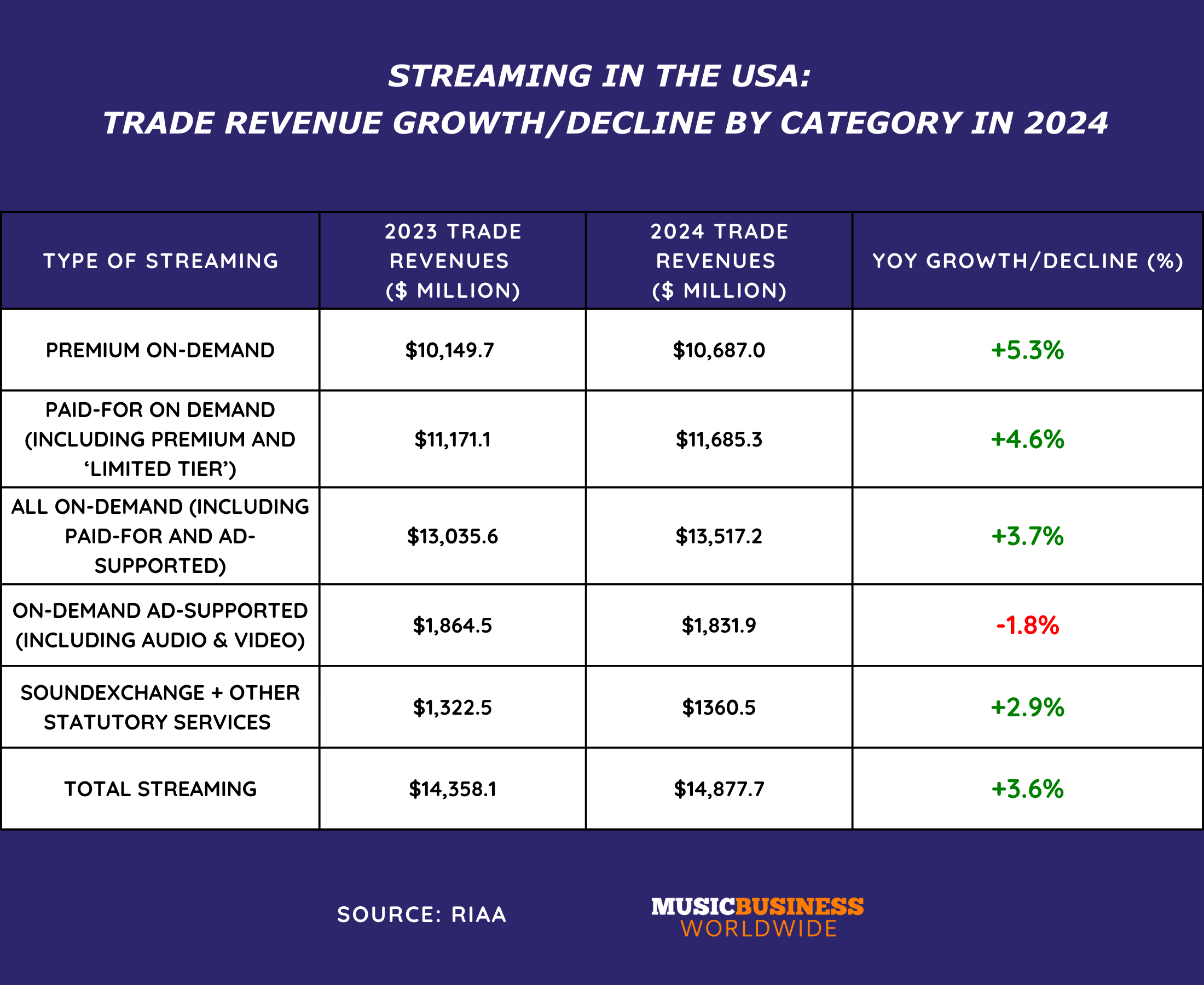
Recent data shows that the US recorded music industry’s overall streaming revenue performance in 2024 was dragged down by payouts from on-demand, ad-supported music services, including YouTube and Spotify’s free tier.
Combined, these platforms saw their revenue contribution to the recorded music industry decline in the US last year, down 1.8% YoY to $1.83 billion.
However, Spotify’s overall US payouts — across both its free and Premium tiers — grew by double-digits in 2024, outpacing the wider market.
Meanwhile, on-demand paid subscription platforms contributed $11.685 billion to recorded music rightsholders, up 4.6% YoY.
The disparity in revenue per stream between paid and free tiers is at the heart of the debate.
As Iovine put it in 2017: “The fact is that ‘free’ in music streaming is so technically good and ubiquitous that it’s stunting the growth of paid streaming. Two things have to happen: free has to become more difficult or restricted, and the paid services have to get better.”
Cohen’s decision to withdraw from Billboard represents a reversal from 2019, when he welcomed YouTube’s inclusion in the Billboard 200, calling it a “very important moment in making the chart a more accurate representation of what people are listening to.”
At that time, Cohen said: “Genres like Latin, hip-hop and electronic, which consistently dominate the YouTube charts, will now be properly recognized for their popularity. This is another great step in bringing YouTube and the industry together.”
YouTube reported in October that it paid more than $8 billion to the music industry during the 12 months from July 2024 to June 2025, covering revenue from both advertising and subscriptions on the Google-owned platform.
In his December statement, Cohen directed fans to YouTube’s own charts as an alternative to Billboard’s lists.
“If you’re curious about what music is making waves on YouTube, you can visit our charts,” he said.Music Business Worldwide