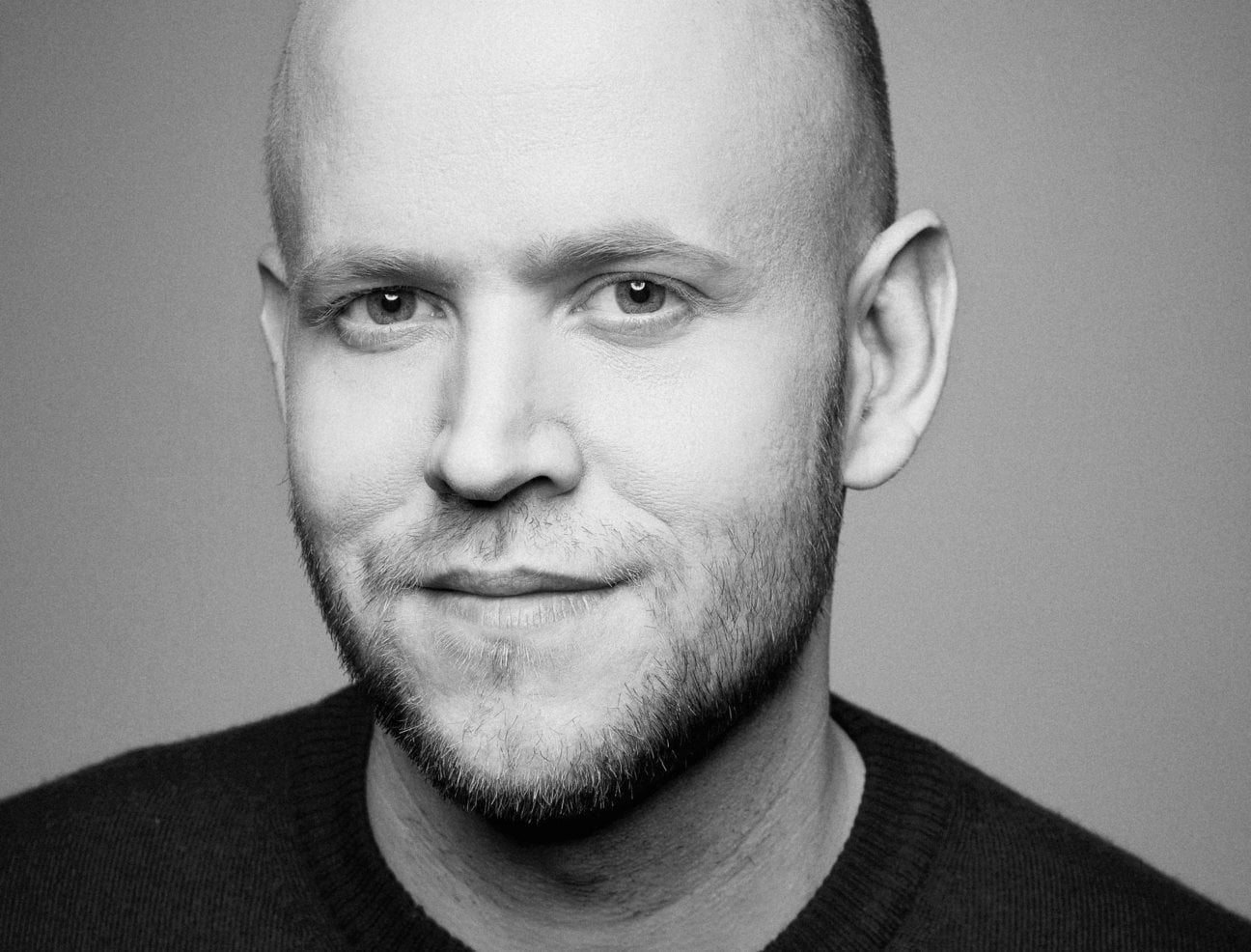
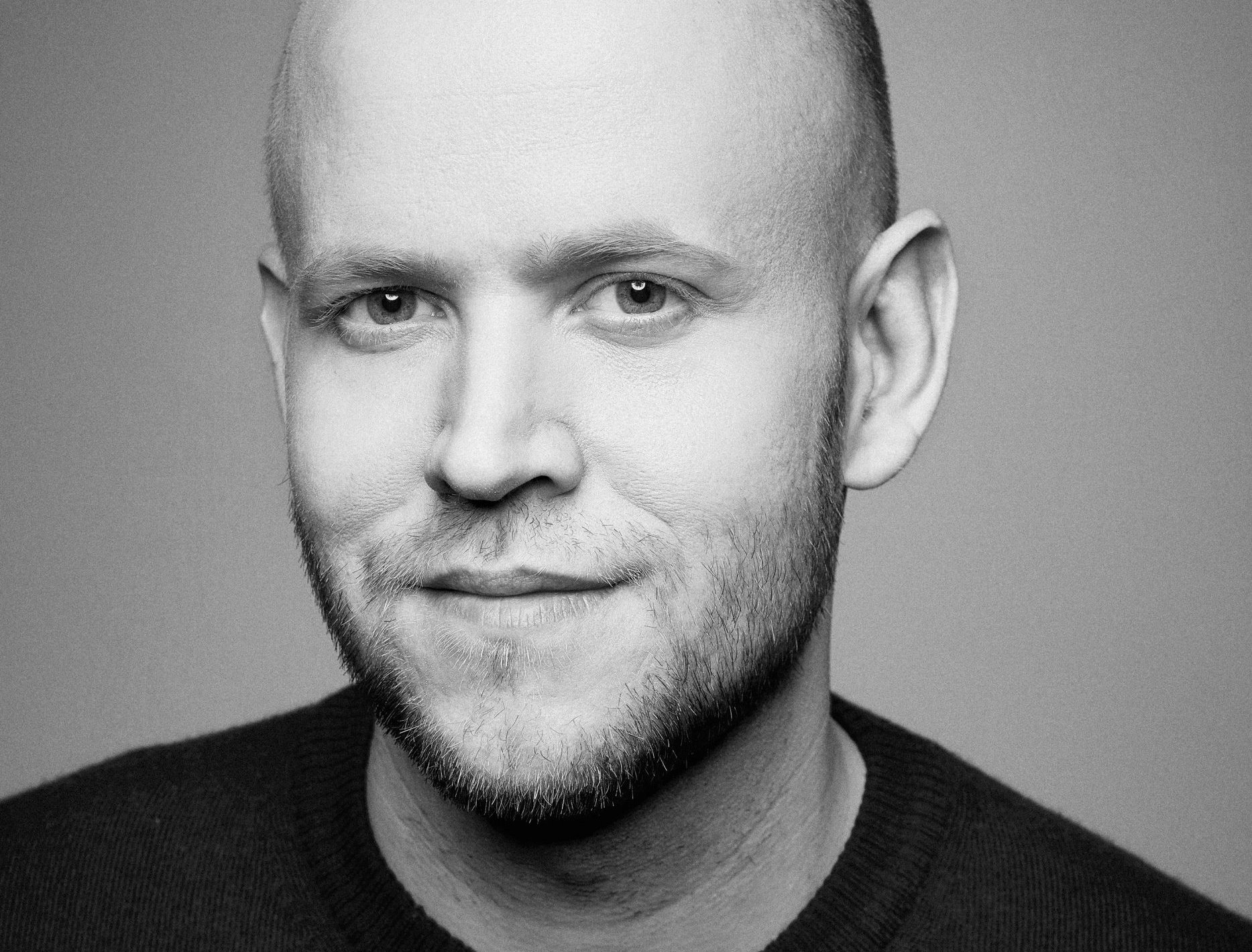
Swedish billionaire Daniel Ek co-founded Spotify alongside Martin Lorentzon in 2006, launching the streaming platform as a fully-licensed service in October 2008 in Europe.
On September 30, 2025, Spotify announced that its Chief Executive Officer, Ek, would step back from the CEO role and transition to Executive Chairman, effective January 1, 2026.
The company named Gustav Söderström (former co-President and Chief Product and Technology Officer) and Alex Norström (former co-President and Chief Business Officer) as its new co-Chief Executive Officers.
Spotify’s new Co-CEOs report to Daniel Ek and also serve on the company’s Board of Directors.
In a memo sent to employees on September 30, Ek confirmed that “with full confidence in Gustav and Alex, on January 1, 2026, I will move to Executive Chairman”.
Said Ek: “I always believed that Spotify could play an important role in revolutionizing listening around the world, and with more than 700 million users, we’ve truly charted a new course bringing creativity to every corner of the globe.
“In my role as Executive Chairman, I will focus on the long arc of the company and keep the Board and our co-CEOs deeply connected through my engagement.”
Spotify
“I always believed that Spotify could play an important role in revolutionizing listening around the world, and with more than 700 million users, we’ve truly charted a new course bringing creativity to every corner of the globe.”
Daniel Ek
Added Daniel Ek: “Over the last few years, I’ve turned over a large part of the day-to-day management and strategic direction of Spotify to Alex and Gustav – who have shaped the company from our earliest days and are now more than ready to guide our next phase.
“This change simply matches titles to how we already operate. In my role as Executive Chairman, I will focus on the long arc of the company and keep the Board and our co-CEOs deeply connected through my engagement.”
Daniel Ek: Pre-Spotify career
Daniel Ek was born in February 1983 in Stockholm, Sweden, growing up in the Rågsved district of the city. Ek went on to study engineering at the KTH Royal Institute of Technology, but dropped out of his studies to focus on his career in tech.
After running a home business building websites in his teens, Ek worked at Swedish online auction business Tradera, which was founded in 1999 and sold to eBay in April 2006.
“Daniel Ek’s most controversial pre-Spotify job was at notorious piracy-enabling platform uTorrent, which he joined after selling Advertigo in 2006.”
Prior to Spotify, Ek also worked as the Chief Technology Officer (CTO) of online fashion game, Stardoll, as well as launching his own digital advertising company, Advertigo, which he sold to TradeDoubler in March 2006 for SEK 10 million (around $1 million).
Ek’s most controversial pre-Spotify job was at notorious piracy-enabling platform uTorrent, which he joined after selling Advertigo.
Ek was briefly CEO of uTorrent, a role which came to an end when uTorrent was sold to BitTorrent in December 2006 – in the same year Ek and Lorentzon launched Spotify.
“I’ve always done sort of impossible things” Ek said of his career path at a Pando event in New York in 2012, adding: “I’m naive enough to think things will always work out and I don’t fully understand how hard things are.”
Daniel Ek: Spotify launch and move to cEO
Daniel Ek and Martin Lorentzon established Spotify AB in Sweden in April 2006, with Ek as CEO and Lorentzon as Chairman.
Prior to Spotify, Lorentzon was the co-founder of TradeDoubler, which acquired Ek’s Advertigo company the month before Spotify was founded – March 2006 – for SEK 10 million.
In October 2008, Spotify launched in a number of European territories, including the UK, Germany, France, Italy, Spain, Finland, Norway, and Sweden.
In October 2016, nearly ten years after Spotify was first established, Martin Lorentzon announced he was stepping down from his role as Chairman of the company.
Ek subsequently took on Lorentzon’s former duties as Chairman of Spotify. Lorentzon remained on the board of Spotify as Vice-Chairman following the announcement.
“We will end up with a company worth tens of billions.”
Daniel Ek (correctly) predicting Spotify’s future in 2010
In an interview with the Daily Telegraph in 2010, Daniel Ek said he was “never going to be interested in selling” his stake in Spotify, adding: “I’m just interested in building a company that doesn’t necessarily change lives but adapts people’s behaviour.”
He also commented: “The music industry is currently worth $17 billion; it’s going to be $40 billion or $50 billion soon. There will only be four or five players left in a few years. If that’s the case, we will end up with a company worth tens of billions.”
He was right: At the close of 2020, Spotify’s market cap on the New York Stock Exchange was worth $59.66 billion, according to YCharts.
Daniel Ek: Net worth of Spotify shareholding as of December 31, 2024
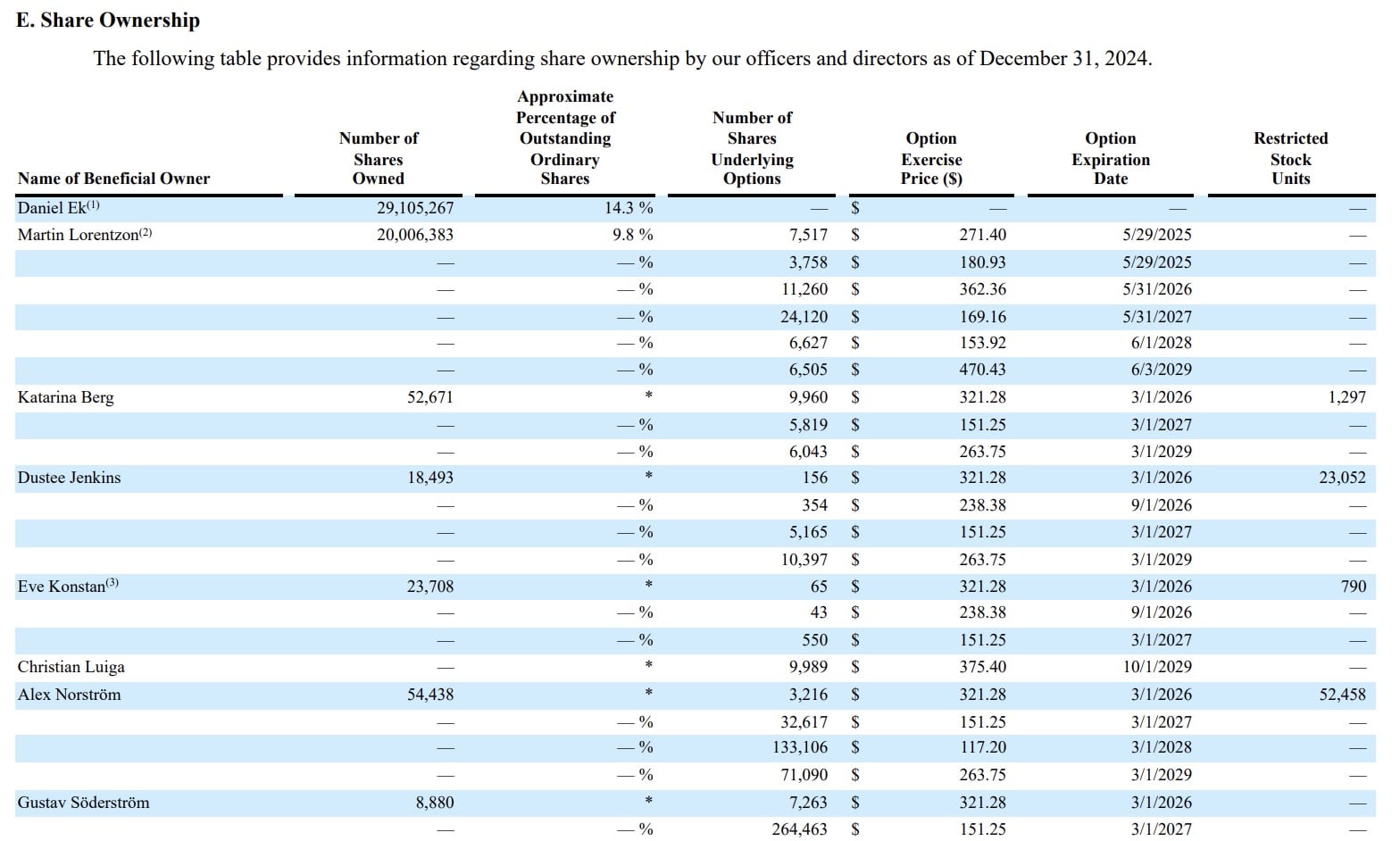
According to Spotify’s annual investor report, Daniel Ek owned 14.3% of Spotify’s ordinary shares on December 31, 2024 (see below).
Martin Lorentzon owned a further 9.8% of these ordinary shares at the time.
A 14.3% share of Spotify’s market cap at close of trading on December 31, 2024 ($90.41bn) would have meant Ek’s shares were worth $12.93 billion.
Ek and Lorentzon’s voting power was bigger than the percentage ownership of their ordinary shares suggests, however.
According to Spotify’s annual 20F report, filed with the SEC: “As of December 31, 2024, our founders, Daniel Ek and Martin Lorentzon, beneficially owned or controlled, directly or indirectly, ordinary shares and beneficiary certificates representing 29.1% and 41.6% of the combined voting power of all of our outstanding voting securities, respectively (or 70.7% in the aggregate)..”
Daniel Ek: Spotify’s public listing and growth of “top tier” earners
In April 2018, Spotify floated on the New York Stock Exchange via the unusual route of a DPO (Direct Public Offering) as opposed to an IPO (Initial Public Offering).
In an Investor Day presentation in March 2018, Ek told analysts that, as of the end of 2017, Spotify counted 22,000 artists/creators within what Ek called the “top tier” of earners on the service.
“My goal over the next few years is to increase that number of [‘top tier’] creators to hundreds of thousands that have material success on our platform.”
Daniel Ek, Spotify (speaking in March 2018)
This, said Ek, represented a 28% increase on the 16,000 artists who were in Spotify’s “top tier” at the end of 2015.
“My goal over the next few years is to increase that number of [‘top tier’] creators to hundreds of thousands that have material success on our platform,” said Ek at the Investor Day.
Ek has been getting gradually closer to that goal: In July 2020, Spotify announced that, at the end of Q2 that year, it had 43,000 artists within its “top tier” of earners, up from 30,000 one year prior.
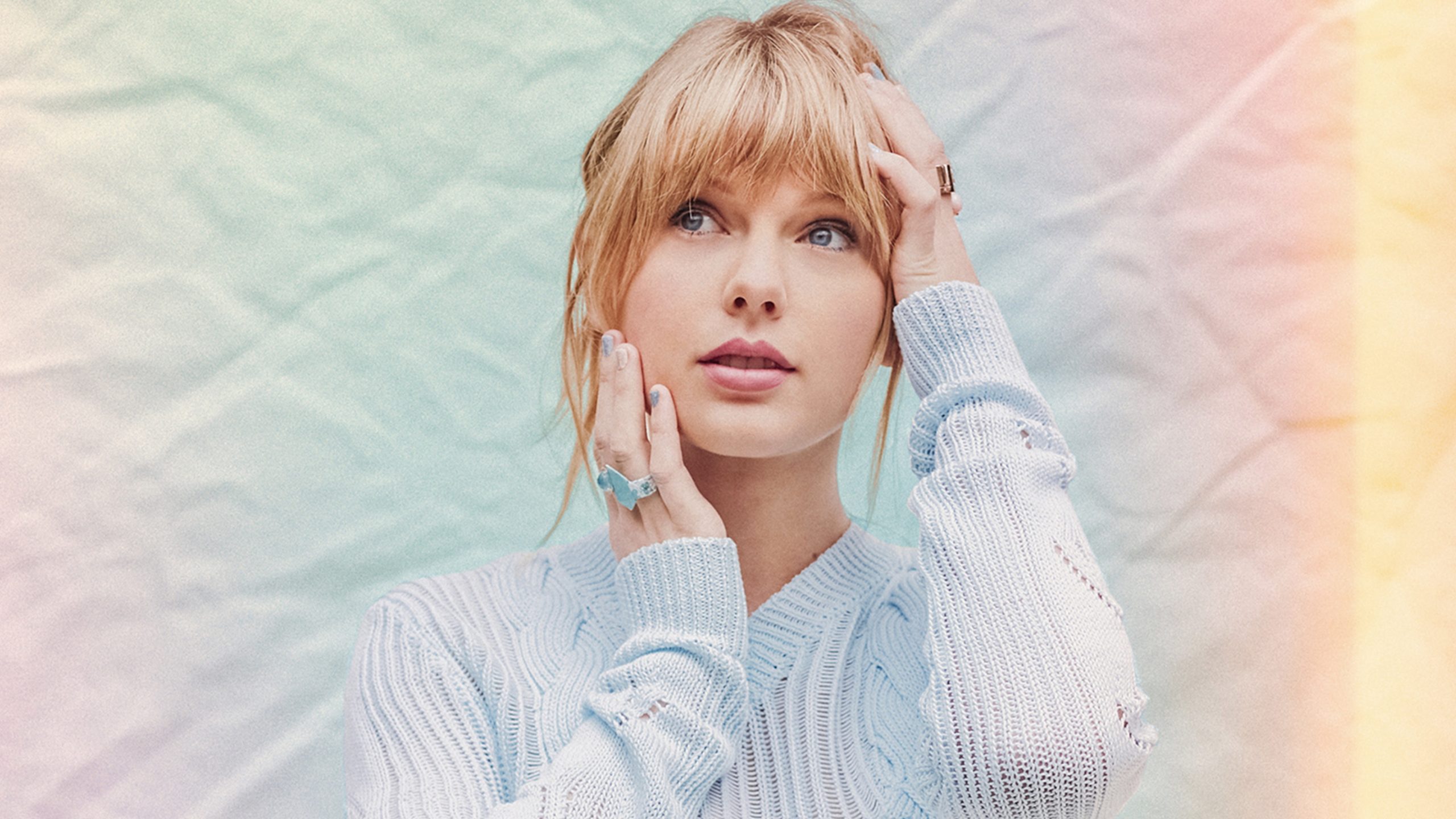
Daniel Ek: Public spat with Taylor Swift
In October 2014, Taylor Swift released her most successful album to date, 1989. Yet it did not appear on Spotify.
Explaining her decision to keep the record off Daniel Ek’s service, Swift said at the time: “[The] landscape of the music industry itself is changing so quickly that everything new, like Spotify, all feels to me a bit like a grand experiment. And I’m not willing to contribute my life’s work to an experiment that I don’t feel fairly compensates the writers, producers, artists, and creators of this music. [I] just don’t agree with perpetuating the perception that music has no value and should be free.”
A month later, in November 2014, Swift pulled her entire catalog from Spotify as an act of protest against the service’s ad-funded ‘free’ tier – specifically, the fact that artists (at this time) couldn’t chose to only release their music on Spotify’s paid for Premium offering.
“You can’t look at Spotify in isolation – even though Taylor can pull her music off Spotify (where we license and pay for every song we’ve ever played), her songs are all over services and sites like YouTube and SoundCloud, where people can listen all they want for free.”
Daniel Ek in 2014, responding to Taylor Swift’s decision to pull her music from Spotify
Spotify said in a surprisingly upbeat statement at the time, borrowing from Swift’s own lyrics: “We were both young when we first saw you, but now there’s more than 40 million of us who want you to stay, stay, stay. It’s a love story, baby. Just say yes.”
The fallout between Swift and Spotify was whipped up by Wall Street Journal op/ed from Swift published in July 2014, which read: “It’s my opinion that music should not be free, and my prediction is that individual artists and their labels will someday decide what an album’s price point is. I hope they don’t underestimate themselves or undervalue their art.”
In November 2020, Spotify CEO Daniel Ek wrote a public blog responding to Swift’s criticism in which the Swedish exec said: “You can’t look at Spotify in isolation – even though Taylor can pull her music off Spotify (where we license and pay for every song we’ve ever played), her songs are all over services and sites like YouTube and SoundCloud, where people can listen all they want for free.
“[That’s to] say nothing of the fans who will just turn back to pirate services like Grooveshark. And sure enough, if you looked at the top spot on The Pirate Bay last week, there was 1989…”
Referencing the marked difference she’d witnessed between Apple and Spotify in reaction to her public critique of their services, Swift told Vanity Fair in August 2015: “I found it really ironic that the multi-billion-dollar company reacted to criticism with humility, and the start-up with no cash flow reacted to criticism like a corporate machine.”
(That ‘startup with no cash flow’ was Spotify.)
By the release of Swift’s Lover in August 2019, all had been forgiven. Swift’s Lover landed on Spotify on day one of its release – with Daniel Ek’s service even paying for promotional billboards for the album in Times Square.Music Business Worldwide
JPMorgan analysts estimated that a $1 monthly increase in the US would add about $500 million to Spotify's annual revenue, the Financial Times reported.
The Mechanical Licensing Collective's legal battle with Spotify over audiobook bundling and royalty payments has entered a new phase following a series of October court filings.
The 8.3% increase to Premium Individual in the UK marks the second time in 18 months that the Swedish streaming giant has raised prices by £1 in the market.