Q3 2026: Glub.
UMG’s results for the three months to the end of September, published last Thursday (October 29), showed revenues up 11.7% YoY at constant currency to €3.394 billion ($3.90B). Adjusted EBITDA climbed 9.0% YoY to €729 million ($838.7m).
The number investors cared about most? Subscription revenue.
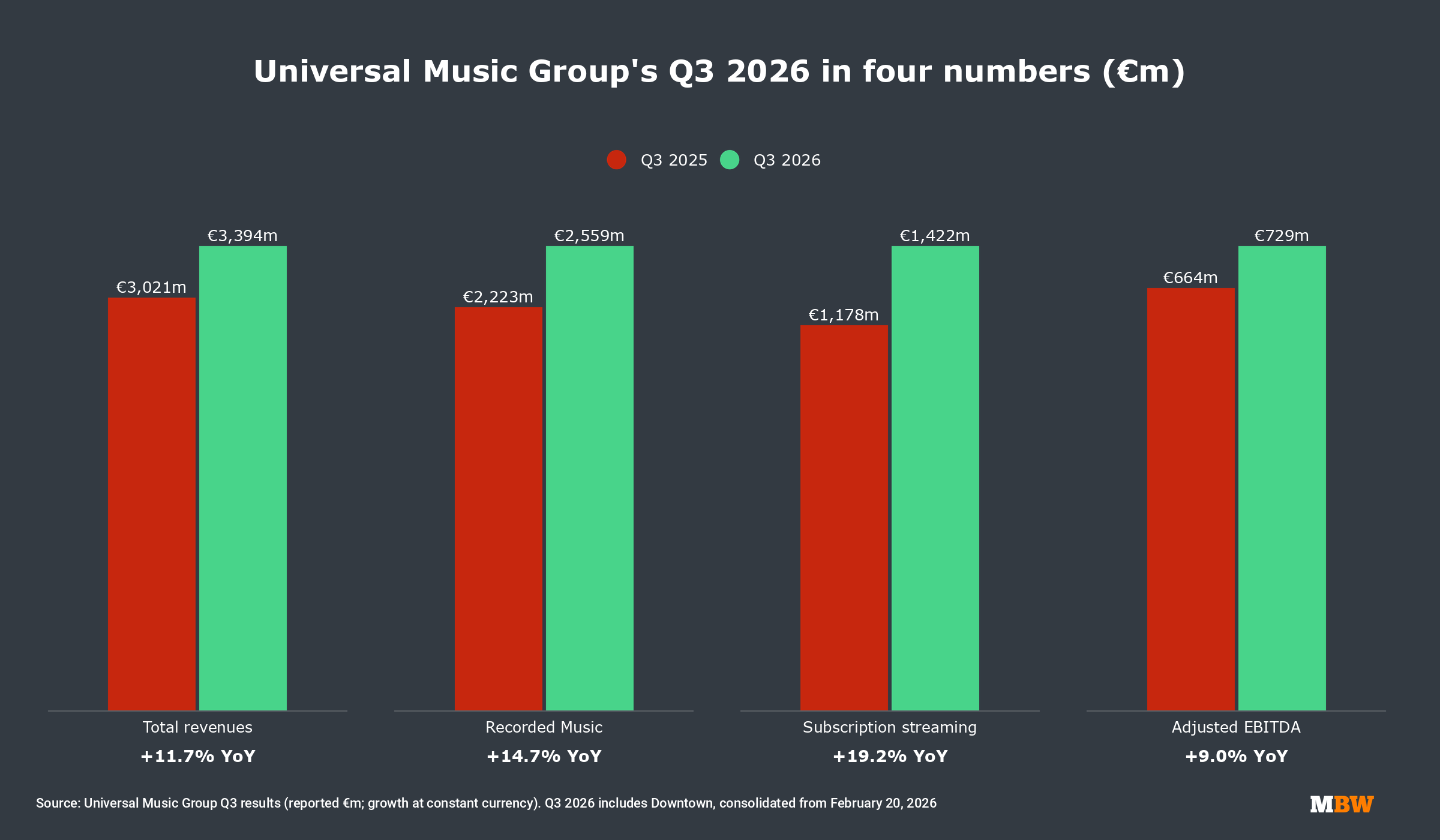
Excluding the contribution of Downtown, UMG’s subscription income grew 9.5% YoY in the quarter – comfortably ahead of the 8.2% analysts had expected, according to a pre-results note from ING cited by Reuters.
The market liked it. UMG’s shares bounced up as much as 15% at one point last Friday (October 30), before closing the day up 7.9% at €17.09 on Euronext Amsterdam.
(That’s still a long way short, mind you, of the €30.40-per-share proposal from Bill Ackman’s Pershing Square that UMG’s board rejected in May.)
“UMG may need to deliver another couple of quarters to convince investors, but Q3 was much improved,” said analysts at JPMorgan in a note.
Grainge, for his part, told analysts: “We are building from a position of strength. The industry is healthy and growing… That makes us more ambitious, not more comfortable.”
Here are five things that particularly caught my attention from UMG’s Q3 earnings call…
1) UMG wants ‘supercharged’ artist-centric royalties
The word ‘supercharged’ in this context didn’t come from UMG.
It came from BNP Paribas analyst Will Packer, who asked whether we could see “a supercharged version of the artist-centric model” in the future, whereby the likes of Spotify pay “elevated royalties” for music made by human superstars – and, by implication, lesser royalties for 100% AI ‘slop’.
“I liked your characterization of supercharged artist-centric, because our entire focus is on ensuring that our artists are properly compensated for the value that they bring to the platforms,” said Michael Nash, UMG’s Chief Digital Officer.
He added: “We have got to evolve our partnerships so the models more fairly reflect that value.”
Grainge was succinct in response: “The answer is obviously yes. Real artists drive the value of the platforms… they deserve to be more highly compensated for how critical they are.”
“By treating AI slop as the same as the greatest songs in the world by some of the greatest artists, [pro-rata] incentivizes industrial-scale content production and dilutes the compensation earned by real talent… The structure of our DSP agreements has to change, so the compensation better reflects the value different content creates.”
Sir Lucian Grainge
In his prepared remarks, the UMG leader said: “The uniform application of pro-rata payments [at DSPs] makes the problem worse. By treating AI slop as the same as the greatest songs in the world by some of the greatest artists, it incentivizes industrial-scale content production and dilutes the compensation earned by real talent.”
Added Grainge: “[The] structure of our DSP agreements has to change, so the compensation better reflects the value different content creates.”
Nash mentioned what UMG calls its ’80/80′ rule: “80% of the subscriber acquisition and 80% of the subscriber retention [on music DSPs] is based on fans’ engagement on the platforms with real artists, career artists, classic catalog, emerging new talent.”
Translation: If real artists bring in the subscribers – and keep them – why should they lose a share of their rightful revenues to the robots?
2) Downtown’s margins aren’t fat – but they’re heading the right way
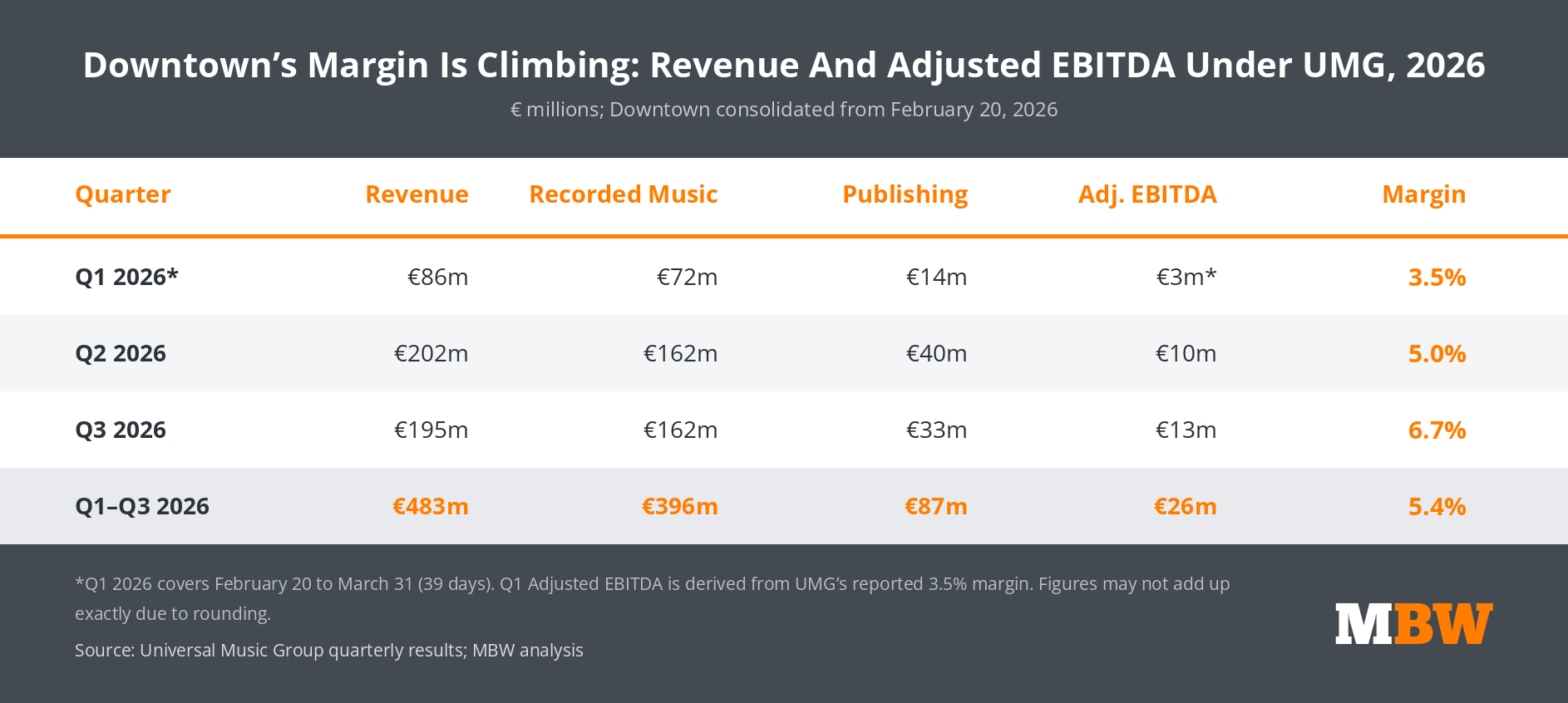
Downtown contributed some €195 million ($224.3m) of UMG’s €3.394 billion total revenue in the period.
Grainge didn’t mince his words: “Downtown is the most important acquisition UMG has made since EMI. This was a timely, strategic move, and we are only just beginning to realize the full benefits.”
He added: “The numbers are already proving why we made this deal, and we continue to capture upside in terms of additional capabilities, revenues, and synergies.”
The numbers in question? Downtown delivered €13 million of Adjusted EBITDA in Q3 – at a 6.7% margin.
Not a figure to make UMG shareholders weep with joy, perhaps. (UMG’s Recorded Music division, excluding Downtown, ran at a 26.2% margin in the quarter.)
But look at the direction of travel in the right-hand column below.
UMG CFO Matt Ellis said the integration of Downtown “is well underway, and it is contributing to our business as we expected it would when we agreed the deal.”
“We have already delivered the initial synergies target on a run-rate basis, and the team sees additional opportunities.”
The trade-off, of course, is that fast-growing, lower-margin indie services naturally drag on Universal’s profitability metrics.
Case in point: Universal’s headline Adjusted EBITDA margin was 21.5% in Q3, down from 22.0% a year earlier. Yet excluding Downtown, it was 22.4% – up 40 basis points YoY.
Which brings us to costs.
3) UMG’s €250m cost-cutting program is officially complete. Is another one on the way?
In mid-October, UMG pushed through a fresh round of changes across its labels – with a string of senior executives heading for the exit, including Def Jam Chairman and CEO Tunji Balogun and Polydor Label Group President Ben Mortimer.
Two weeks later, on the Q3 call, Grainge declared the €250 million cost-cutting program behind those moves – first announced in February 2024 – officially over.
“That program is now complete,” said Grainge. “You can see the results in our cost structure.”
Could another cost-cutting program soon be on the horizon? It seems likely.
“Looking ahead, our continued transformation will allow us to expand our margins by leveraging technology to redesign processes and bring together non-creative functions currently spread across labels and regions,” commented Grainge.
“We will continue to reduce costs, operate more efficiently, and improve margins. That is a clear financial objective.”
Ellis said: “We know there are additional opportunities to improve efficiency and strengthen our financial performance, and the next phase of this work to build the UMG of the future will focus on both further improving our cost structure and accelerating growth across the business.”
This “next phase” – which encompasses cost cutting as well as new DSP deals – is already underway, said Grainge, and will ‘run through to the end of 2028.
More details, he said, will be shared on UMG’s Q4 earnings call next year.
“You should expect to see changes to the cost structure across almost every facet of the company.”
Matt Ellis, UMG
Asked by Wolfe Research’s Peter Supino where UMG sees further efficiency opportunities, Ellis replied: “I would say you should expect to see changes to the cost structure across almost every facet of the company.”
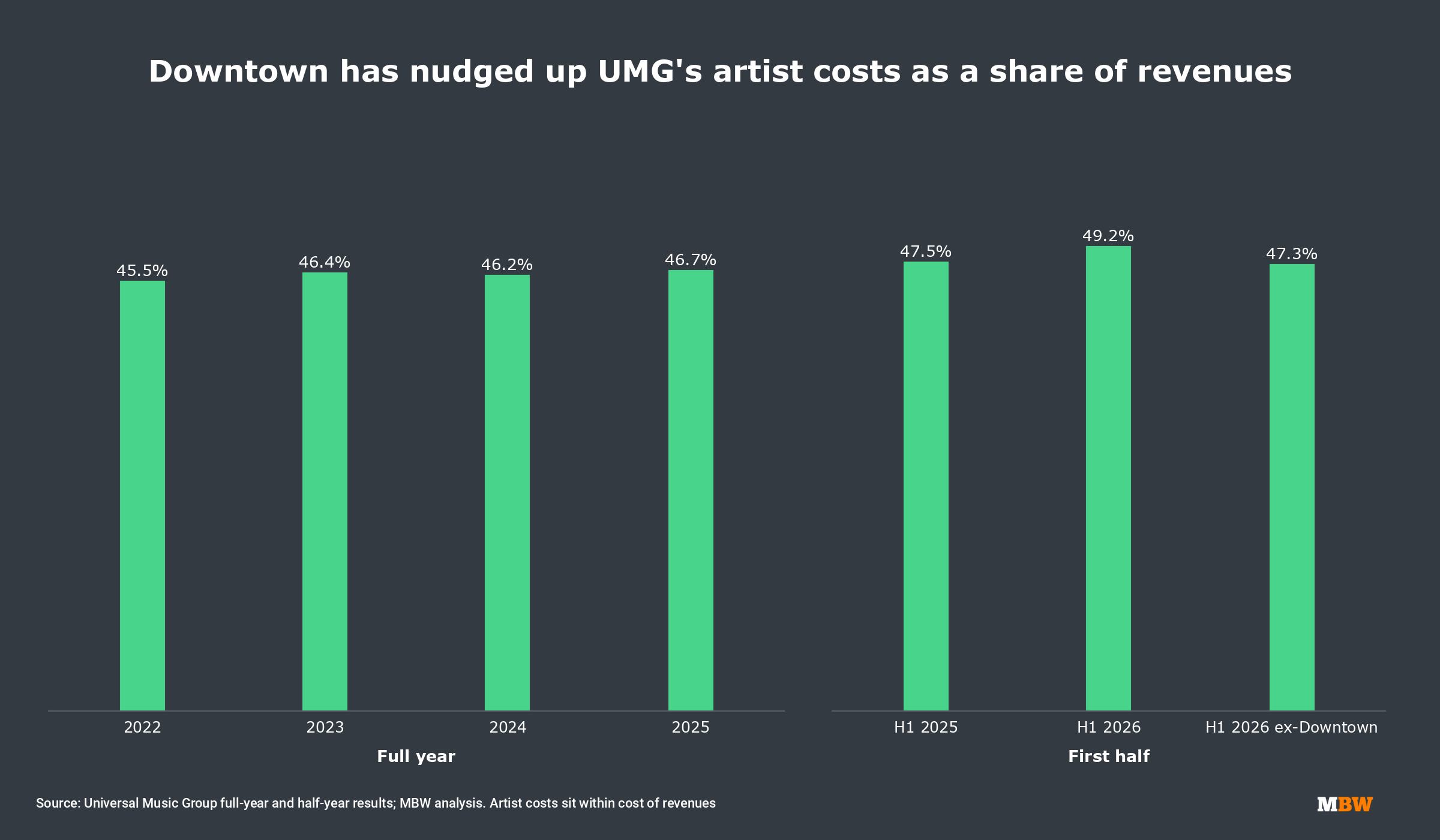
Pushing all of those savings through to the bottom line will prove a challenge for UMG, though – partly due to the growing success of Virgin Music Group and Downtown, whose typical deals rely on thinner margins than ‘frontline’ labels.
Grainge acknowledged this tricky balance: “Excluding share-based compensation, SG&A [costs] as a share of revenue has declined by more than two percentage points since we began the realignment, even after reinvesting some of those savings in the business… Over the same period, we paid a growing share of revenue to artists, songwriters, and label partners.”
Put another way: The more successful UMG’s indie services strategy becomes, the harder its cost-cutters have to work to move the company’s margin.
Virgin’s share of UMG’s recorded music revenues rose from 7.5% in 2024 to 8.4% in 2025.
4) UMG doesn’t have a Streaming 2.0 deal with Apple… yet
On July 17, Apple Music raised its prices for the first time since October 2022.
Apple’s explanation, in a statement to MBW: “As a result of rising licensing costs, Apple Music is increasing its subscription price beginning today.”
UMG felt a revenue bump from that rise in Q3.
Of the 9.5% YoY growth in UMG’s subscription revenues (excluding Downtown), Ellis said a little over 3.5 percentage points came from what he called “Streaming 2.0 pricing initiatives” – slightly more than in Q2, thanks to “a partial benefit from Apple’s recent retail price increase.”
In other words: More than a third of UMG’s organic subscription growth in Q3 came from pricing.
“We’ll start to see more of a benefit of the Apple retail price increase [though there’s] not a 2.0 agreement there yet.”
Matt Ellis, UMG
And there’s more to come. Over the coming year, said Ellis, UMG will “start to see more of a benefit of the Apple retail price increase” – though he noted that UMG does not have “a 2.0 agreement there yet” with Cupertino’s finest.
UMG has announced what it calls ‘Streaming 2.0’ agreements with Amazon Music (December 2024), Spotify (January 2025), and YouTube (October 2025).
Apple evidently still isn’t on that list.
When UMG and Apple do sit down to talk 2.0, one suspects ‘supercharged’ artist-centric will be somewhere near the top of the agenda.
5) Physical out-earned ad-supported streaming. Again.
UMG’s physical revenues grew 17.4% YoY in Q3 to €392 million ($451m).
Its ad-supported streaming revenues grew 13.5% YoY to €387 million ($445m).
That’s right: In Q3, UMG generated more wholesale revenues from CDs, vinyl, and other physical products than it did from ad-supported streaming – even with Downtown’s ad-supported revenues included in the latter. (Downtown contributed nothing to physical.)
Strip Downtown out, and ad-supported grew just 4.7% YoY. My rough calculation therefore puts UMG’s non-Downtown ad-supported revenues at around €350m in Q3 – roughly €40m behind physical.
This isn’t a brand-new trend: In Q3 2025, UMG’s physical revenues (€341m) also edged past ad-supported (€337m), though that was a quarter boosted by pre-release shipments of Taylor Swift’s The Life of a Showgirl.
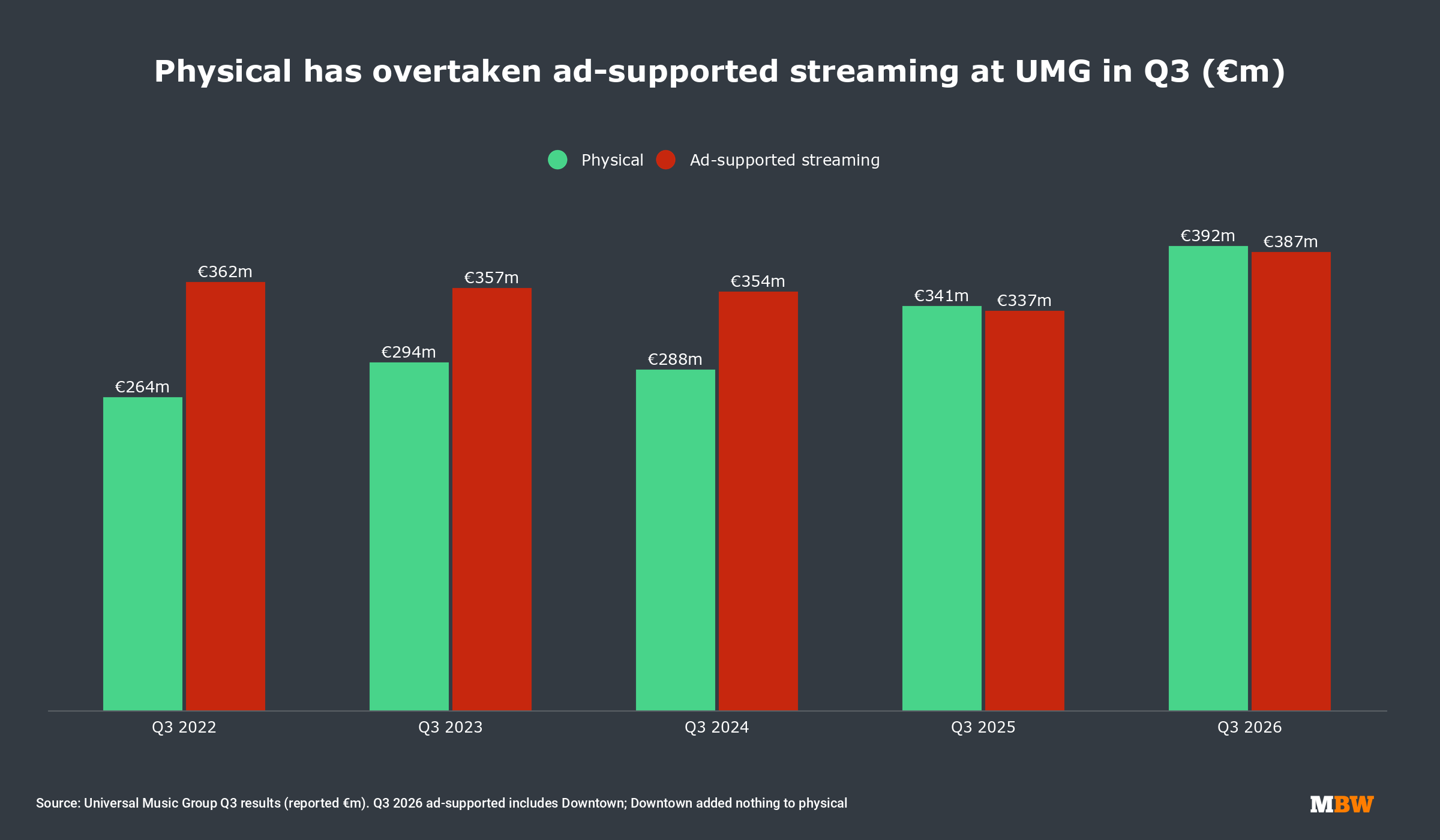
This year’s Q3 YoY physical growth actually came on top of that Swift comp.
“Physical revenue, which had no contribution from Downtown, continued to be strong, growing 17.4%,” said Ellis. “Performance was broad-based across North America, Japan, and Europe, and across frontline and catalog.”
He added: “Releases from Mrs. GREEN APPLE, Stray Kids, Olivia Rodrigo, The Beatles, Rolling Stones, and Ariana Grande all performed strongly and more than offset the pre-release sales of Taylor Swift’s album last year.”
Interestingly, you can make the argument that physical is the purest expression of the ‘real music vs. fake music’ value that UMG spent much of its earnings call discussing: a fan of a human being, handing over cash for a material object… with a human artist’s name on it.Music Business Worldwide