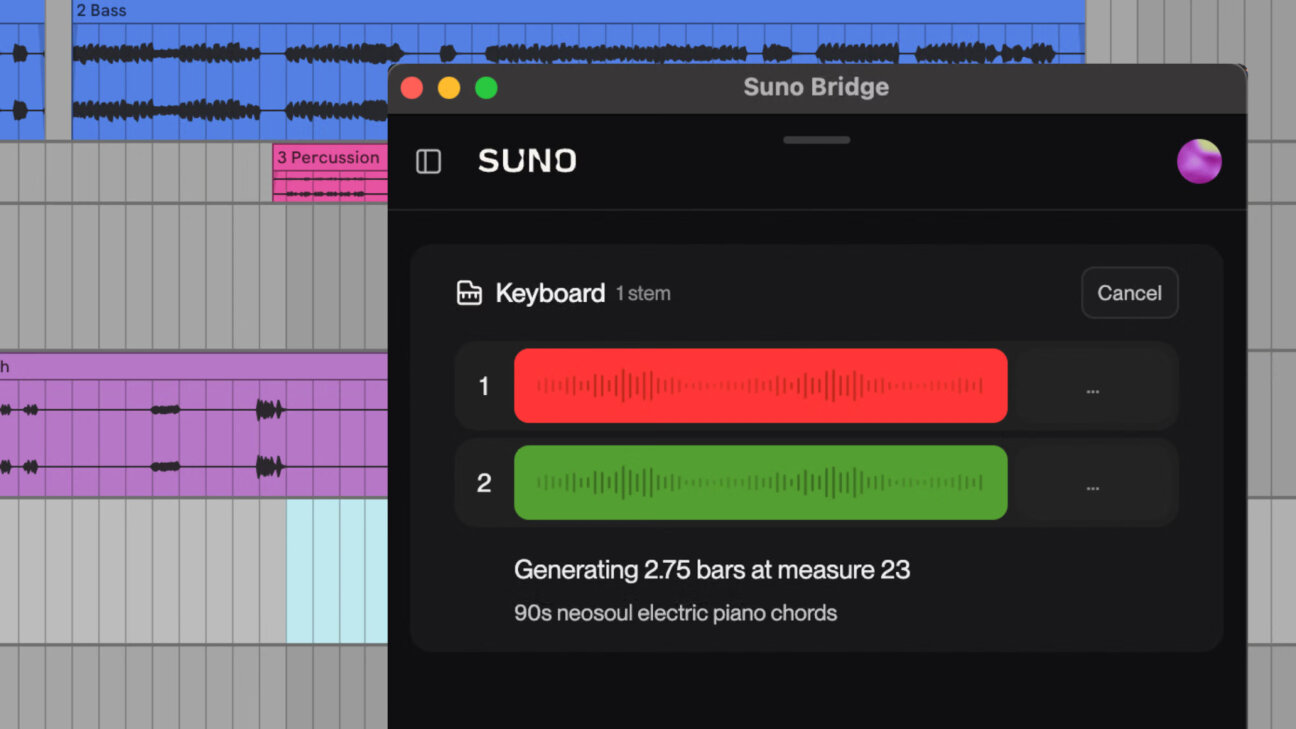
Suno has launched an app that drops AI-generated instrument and vocal parts straight onto the timeline of a producer’s own digital audio workstation (DAW).
The app, Suno Bridge, went live in beta on November 13.
At launch, it works only with Ableton Live 12 on a Mac and requires a Suno Premier subscription.
“Today, we are introducing Suno Bridge, a new standalone app that brings the power and inspiration of Suno into your music production software,” Suno said in a blog post announcing the launch. “For the first time you can combine your Suno workflow with the VSTs, plugins and DAW you already know.
“At Suno, we’re always talking with artists, producers and songwriters, and their ideas shape what we build. Bridge came straight from those conversations, and we can’t wait to see what people make with it.”
Bridge operates as a separate application from Ableton Live, and both must be open at the same time for it to function.
Prompts typed into Bridge generate instrumentation and vocals that Suno says will “fit the tempo, key, style, harmonic content and groove” of the user’s Ableton session.
“Bridge brings Suno’s music models straight into your favorite DAW. This means you can create new instrument and vocal parts and drop them straight onto your timeline. No leaving your session, no dragging and dropping, no manual alignment.”
Suno
“Bridge brings Suno’s music models straight into your favorite DAW,” said Suno. “This means you can create new instrument and vocal parts and drop them straight onto your timeline. No leaving your session, no dragging and dropping, no manual alignment.
“And unlike stock samples, new sounds from Suno follow your chord progressions, musical groove and key perfectly.”
Users choose the section of a track they want Bridge to write for by setting loop start and end markers in Ableton’s Arrangement View.
In Suno’s example, a loop running from bar 9 to bar 16 yields an eight-bar section beginning on the first beat of bar 9.
The clips Bridge generates are then placed directly onto the Ableton timeline, in sync with the track, according to the company.
Suno‘s blog post pitches Bridge as “an endless library of unique sounds designed to fit your music,” suggesting producers use it to complete unfinished projects and overcome writer’s block.
Each generation in Bridge uses 10 Suno credits, according to the company’s help center.
Suno’s pricing page lists Premier at USD $30 per month, or USD $288 billed annually, with 10,000 credits included each month.
The Bridge app itself is a free download, and the audio it generates is stored separately from users’ main Suno libraries.
Suno states on its website that Bridge “has been developed independently of Ableton.”
The company says it plans to bring Bridge to more operating systems and DAW platforms in the future, without specifying which.
When a user opens a session in Bridge, the app uploads their Ableton Live project, along with its audio files, to their Suno account, according to an FAQ on Suno’s website.
“Bridge synchronizes with your Ableton session, and this process involves uploading your session files to Suno so that Bridge understands the musical context of your track,” Suno said in its blog post.
The FAQ adds that Bridge uploads only the project the user selects and asks for permission before including any audio files it cannot access. It also addresses what happens if that project contains music the user does not own.
“Audio files uploaded to Suno via Bridge go through our filters to detect copyrighted materials,” it states. “Files flagged by the system will not be ingested into Suno.
“If your project contains original material and rightsholder material, only the rightsholder material will be blocked.”
The FAQ directs users to Suno’s Terms of Service and Privacy Notice for information on how their data is stored and processed.
Suno’s current terms of service, in effect since September 3, define user “Submissions” as including “music, sound and other audio.”
Under those terms, users retain ownership of their Submissions but grant Suno a non-exclusive, “perpetual, irrevocable” license to “any and all Content” – the terms’ collective label for user submissions and the output generated from them.
That license covers uses connected to the provision, monetization, marketing, and “improvement” of Suno‘s products and services, “including the Service and the artificial intelligence and machine learning models related to the Service,” according to the terms.
By uploading Submissions, users also warrant that Suno will not need licenses from, or have to pay, anyone else to use them, including “to train, develop, fine-tune or otherwise improve the Service” and any related AI models.
Bridge follows Suno’s launch of its own DAW, Suno Studio, in September 2025.
Suno Studio, which also debuted in beta for Premier subscribers, built on Suno’s acquisition of browser-based DAW WavTool in June 2025.
On September 9 this year, Suno launched its v6 suite of AI music models, which it says were developed with Warner Music Group, BMG, and Believe.
Universal Music Group and Sony Music Entertainment, neither of which has licensed Suno, sued the company for a second time on September 18.
The labels’ complaint accuses Suno of copying 60,202 of their sound recordings without a license, and describes v6 as “the fruit of the same poisoned tree.”
Suno co-founder and CEO Mikey Shulman said on October 1 that the company is “far beyond” the 2 million paid subscribers and USD $300 million in annual recurring revenue it disclosed in February.
In June, Suno raised over USD $400 million in a Series D round at a USD $5.4 billion post-money valuation.Music Business Worldwide