
Suno has launched an incubator program for independent artists, offering grants, mentorship, and marketing support to a selected group of unsigned musicians.
The program, called Spark, was unveiled on Thursday (June 25) in a blog post co-authored by Suno Chief Music Officer Paul Sinclair and the company’s Head of Creative Economy and Monetization, Rosie Nguyen.
“Making it as an independent artist isn’t easy,” Sinclair and Nguyen wrote, noting that indie artists often lack “the resources or connections to take the next step.”
Spark, they said, is designed to help these artists “bring their music projects to life through grants, mentorship, and dedicated marketing support.”
It’s understood these grants will range from the thousands to tens of thousands of dollars for each act.
According to the blog post, each selected Spark artist will receive a grant toward their creative work, additional marketing funding, an invitation to collaborate with established artists at Suno‘s writing camps, and the opportunity to give feedback on features the company is building.
“Making it as an independent artist isn’t easy. Every day, we meet talented artists with great ideas, unique perspectives, and a clear vision for their music, but who may not have the resources or connections to take the next step.”
Paul Sinclair and Rosie Nguyen, Suno
The Spark landing page adds further detail: selected artists will also receive a dedicated Suno partner manager, free Suno Premier access and song credits, early access to upcoming tools, editorial placements on the platform, and opportunities to work with established music video directors.
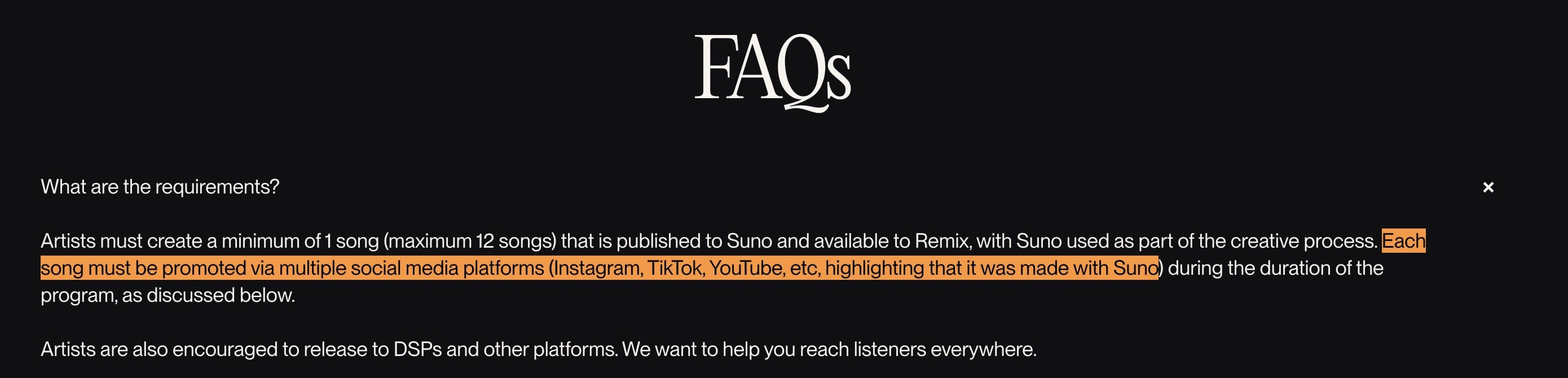
In return, participating artists must promote their songs “via multiple social media platforms (Instagram, TikTok, YouTube, etc, highlighting that it was made with Suno),” according to the program’s FAQ.
Selected artists are also “encouraged to release to DSPs and other platforms”.
To be eligible for Spark, applicants must be at least 18, releasing music under their own name, and operating as independent, unsigned acts.
Suno says participating artists will retain creative control and the commercial rights to their work, and it won’t tell artists how to distribute their music.
Meanwhile, Suno’s separate “fine print” terms for Spark carry an array of conditions for participating artists that the main Spark blog post does not mention.
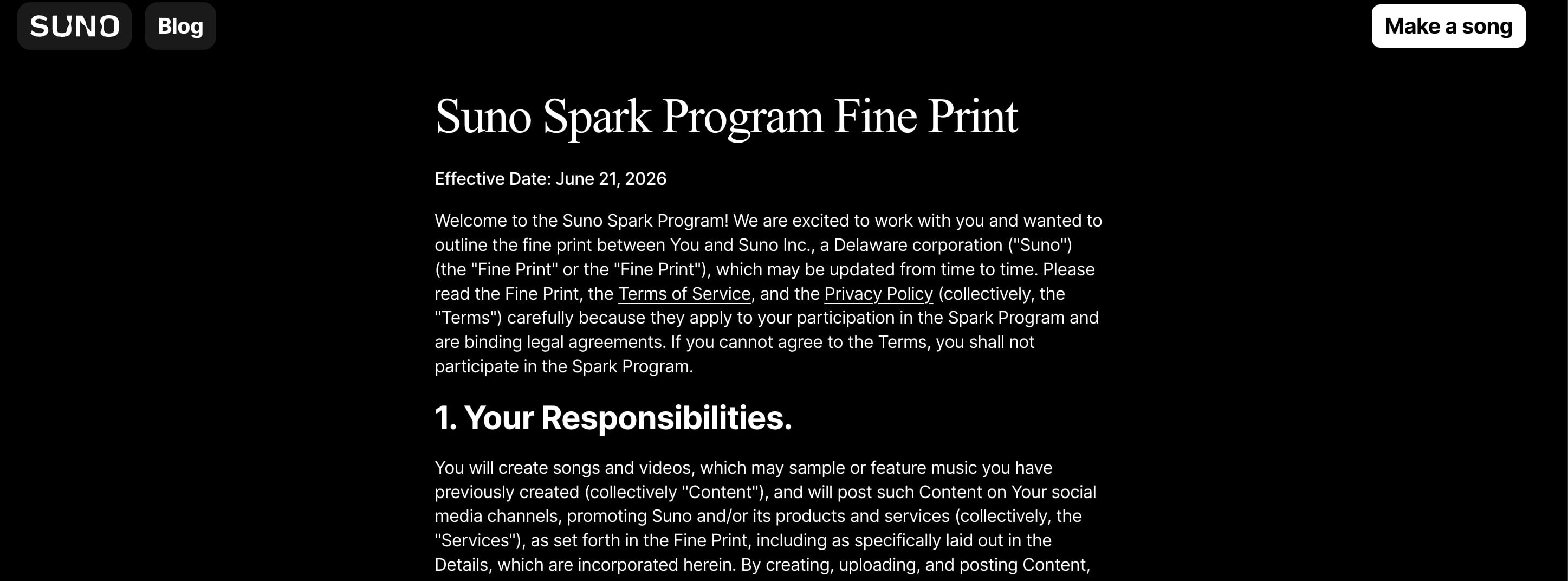
One of these is an ant-disparagement clause.
Under a clause headed “Good Vibes Only,” participants agree that “during the Term and thereafter,” they “will not at any time make any statements or representations, either directly or indirectly, whether orally or in writing, that portrays Suno, Suno personnel, and/or any Suno products or services in a negative light.”
A violation of that clause “will be considered a material breach and grounds for termination,” the Spark terms state.

A separate section covering name, image and likeness grants Suno permission to use a participating artist’s content “and your name and likeness for marketing and promotional purposes during the Term and thereafter.”
That license extends, according to the terms, to “Suno owned or operated channels, press and other digital media, including in derivative works.”

The Spark fine print also notes that participants must accept Suno’s standard terms of service.
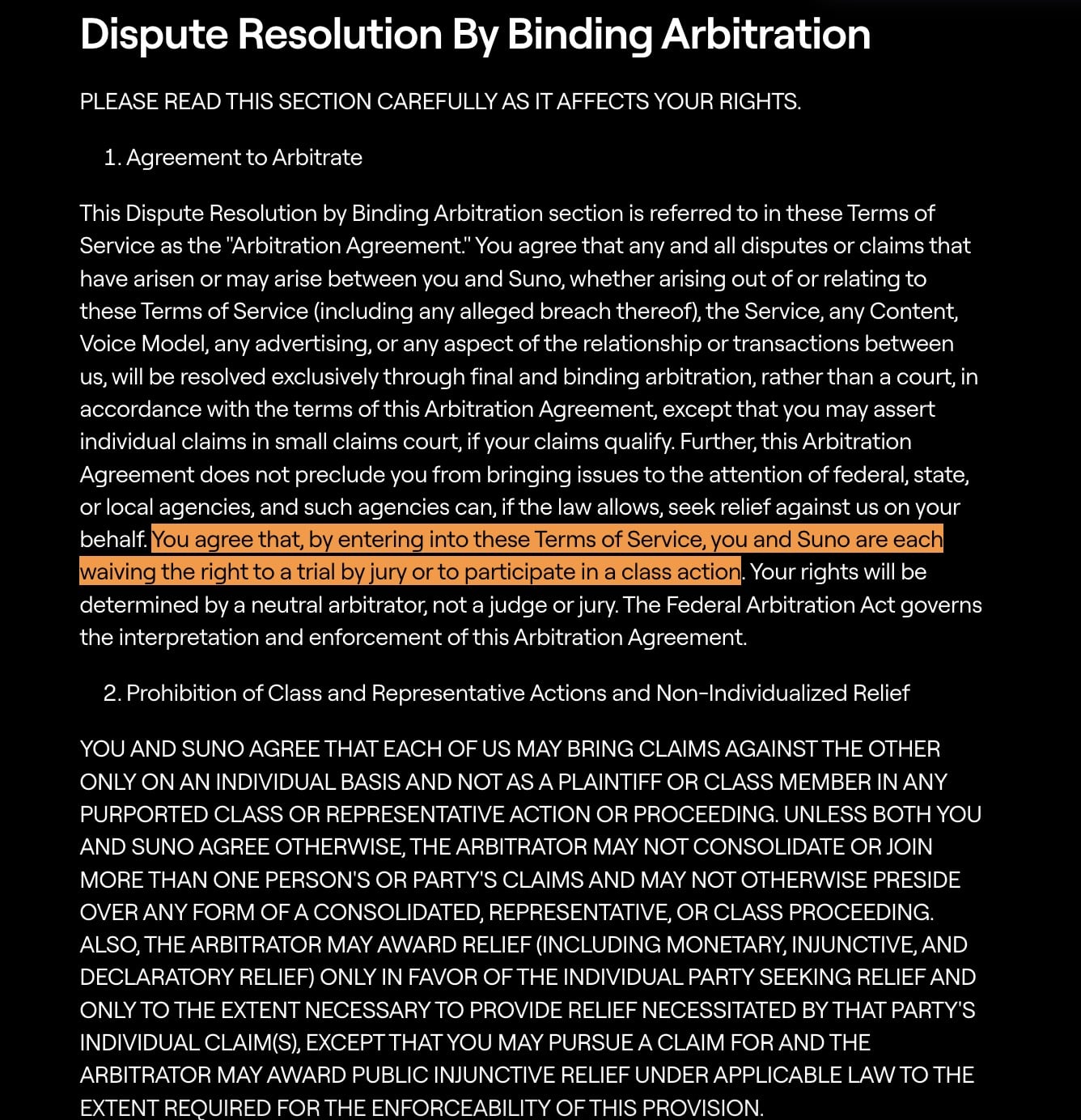
Within those terms is a reference to class action claims.
According to the ToS, by agreeing to them, “you and Suno are each waiving the right to a trial by jury or to participate in a class action,” with disputes instead decided by “a neutral arbitrator, not a judge or jury.”
Suno is currently facing a proposed class action brought by independent artists, as MBW reported when the case was filed in June 2025.
Earlier this week, plaintiffs’ class-action firm Hagens Berman joined that lawsuit, which alleges that artists’ copyrighted recordings were used, without authorization, to train Suno‘s AI models; the same models that underpin the platform Spark is built around.
Whether that arbitration agreement would affect an artist’s ability to take part in the case against Suno is a separate legal question.
Elsewhere, Suno is also still being sued by two of the three major music companies.
While Warner Music Group settled its claims and struck a partnership with Suno in November, Universal Music Group and Sony Music Entertainment remain in active litigation with the company.
The majors first sued Suno, alongside rival Udio, via the RIAA in June 2024, alleging the mass copying of copyrighted sound recordings to train AI music-generation models.
Meanwhile, the Spark launch has landed during a fresh wave of public criticism from high-profile artists.
Over the past week, SZA condemned the use of her music to train AI models in a series of social media posts, while Doja Cat publicly disavowed AI music after she said fans had mistaken AI-generated tracks for her own.
The incubator also follows a period of rapid fundraising for Suno.
Earlier this month, the company closed a $400 million Series D round at a $5.4 billion valuation, more than double the $2.45 billion valuation attached to its $250 million Series C in November.
“One of the best parts of working in music is discovering artists at the beginning of their journey,” Sinclair and Nguyen wrote.
“We can’t wait to meet the talented creatives who join Spark, hear what they’re working on, share their stories, and learn from them along the way.”Music Business Worldwide