Suno has formally assumed control of Songkick user data — presumably including artist preferences and location information built up through years of Spotify integration. The news comes five months after Suno acquired the concert discovery platform from Warner Music Group.

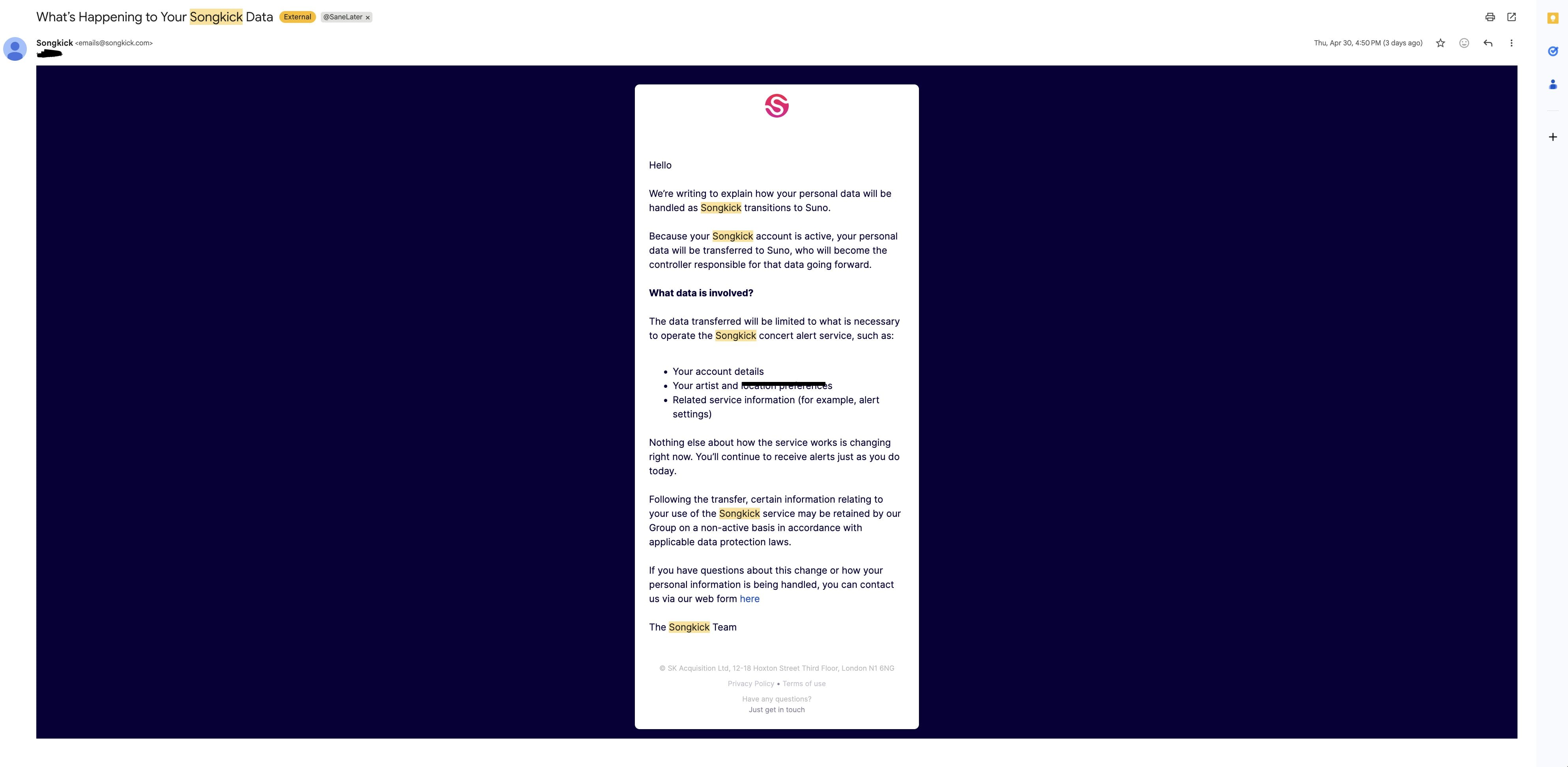
Emails sent to Songkick users on Thursday (April 30) confirmed that personal data held by the platform “will be transferred to Suno, who will become the controller responsible for that data going forward.”
The data being transferred includes users’ account details, artist and location preferences, and related service information such as alert settings, according to the email, which was sent by SK Acquisition Ltd — the UK entity through which Songkick operates.
Separately, Suno has posted a job listing for a General Manager of Songkick, describing the platform as having “a well-established artist and venue data layer” and “a massive untapped opportunity to reimagine what live music discovery experiences look like when powered by AI.”
The listing, posted last week, calls for the new hire to “develop and execute an integration roadmap that connects Songkick’s live music graph with Suno’s artist and creation ecosystem.”
It also calls on the GM to “champion a vision for what it means to move a fan from creating music on Suno to driving live experiences on Songkick.”
The role reports to Suno Chief Music Officer Paul Sinclair, the former General Manager and EVP of Atlantic Records, who joined the AI company in July 2025.
Suno acquired Songkick from WMG in November as part of the settlement and licensing deal that ended the major music company’s copyright lawsuit against the AI music generator.
At the time, Suno said it would continue to run Songkick as “a successful fan destination” and that “the combination of Suno and Songkick will create new potential to deepen the artist-fan connection.”
The question of what Suno actually wanted with a concert discovery app prompted scrutiny at the time.
Songkick‘s most recent UK filings showed GBP £4.5 million (approx. USD $6 million) in turnover for the year ending September 2024, with a pre-tax profit of zero. The platform owed £13.5 million to fellow WMG companies.
What Songkick does possess, however, is years of behavioral data tied to users’ Spotify listening habits — information on which artists fans follow, which concerts they track, and where they are located.
As MBW noted at the time of the acquisition, the deal gave Suno “behavioral data for millions of users spanning the entire fan journey: what music people want to create, which artists inspire their ideas, and crucially; which live shows they’re tracking and planning to attend.”
The data transfer email and the GM job listing suggest Suno is now moving to operationalize that data asset.
The developments come as Suno‘s licensing negotiations with the remaining major music companies have stalled.
The Financial Times reported in April that talks between Suno and both Universal Music Group and Sony Music Entertainment had made little progress, with a person involved in the negotiations telling the newspaper: “We have ongoing engagement, but there is no path forward with the current proposal.” The FT also reported that Suno‘s partnership with WMG itself had seen “minimal progress.”
On the same day as the Songkick data transfer emails went out, Believe CEO Denis Ladegaillerie told MBW that Believe and TuneCore are now blocking distribution of tracks made on unlicensed AI platforms — labeling Suno a “pirate studio.”
Ladegaillerie said: “The reality now is it’s unlikely [Suno gets licensed], at least for the models they’ve already trained on. Which means the Gen-AI content made on those models is illegal, and is going to stay illegal, for the foreseeable future.”
Suno reported in February that it had reached 2 million paid subscribers and $300 million in annual recurring revenue. The company, which says over 100 million people have used its platform, closed a $250 million Series C round in November at a $2.45 billion post-money valuation.Music Business Worldwide