That’s according to CEO and co-founder Mikey Shulman, who shared the figures in a LinkedIn post on Wednesday (February 25), two years after the platform’s launch.
He also noted that over 100 million people have now used Suno.
“We launched Suno 2 years ago to let the world feel the joy of making music,” Shulman wrote. “Since then, over 100M people all over the world have used Suno, from music lovers to Grammy winners.”
The $300 million ARR figure represents a significant jump from the $200 million in annual revenue previously reported by The Wall Street Journal in November, when Suno closed a $250 million Series C funding round at a $2.45 billion post-money valuation.
Suno offers a free tier alongside two paid subscription plans: a Pro plan at $10 per month ($8 if billed annually) and a Premier plan at $30 per month ($24 if billed annually).
The new figures arrive at a turbulent moment for Suno’s relationship with the music industry.
Earlier this week, a coalition of artist representatives published an open letter titled ‘Say No to Suno’, describing the company as a “brazen smash and grab” platform and accusing it of using “unauthorized AI platform machinery trained on human artists’ work”.
The letter was signed by figures including Ron Gubitz, Executive Director of the Music Artist Coalition; Helienne Lindvall, President of the European Composer and Songwriter Alliance; and Chris Castle of the Artist Rights Institute.
Suno continues to face copyright infringement lawsuits from major music companies and key European music rights organizations.
The RIAAfiled suit against both Suno and rival Udio in mid-2024, acting on behalf of all three majors, alleging “mass infringement” of copyright. Udio has since reached settlements with both Universal Music Group and Warner Music Group, signing licensing agreements with each for a new AI music platform expected to launch this year.
The open letter published by the group of artist reps earlier this week also waded into the ongoing debate over so-called “walled gardens” in AI music, criticizing Suno’s Chief Music Officer Paul Sinclair for taking aim at the closed-platform model championed by UMG in its licensing deals.
As previously reported by MBW, when WMG settled with Suno in November, the terms allowed users to continue creating and downloading songs — a contrast to the restrictions imposed in both UMG and WMG’s deals with rival Udio.
Despite the legal and reputational headwinds, Suno has been investing heavily in building bridges with the music business.
On Monday (February 23), the company appointed former Merlin CEO Jeremy Sirota as Chief Commercial Officer, the latest in a series of high-profile music industry hires.
“Suno lets everyone actively participate in music culture creation, bringing to life the music that’s inside millions of people. The future is creative entertainment.”
Mikey Shulman
In his LinkedIn post, Shulman framed Suno as a creative platform rather than a passive consumption tool, positioning it against what he described as the cultural flattening of algorithmic content feeds.
“Endless scrolling and passive consumption have flattened culture and reduced people’s taste to a homogeneous, lowest common denominator,” he wrote.
“People yearn for more, and the future of consumer entertainment is creative.”
He added: “Suno lets everyone actively participate in music culture creation, bringing to life the music that’s inside millions of people. The future is creative entertainment.”
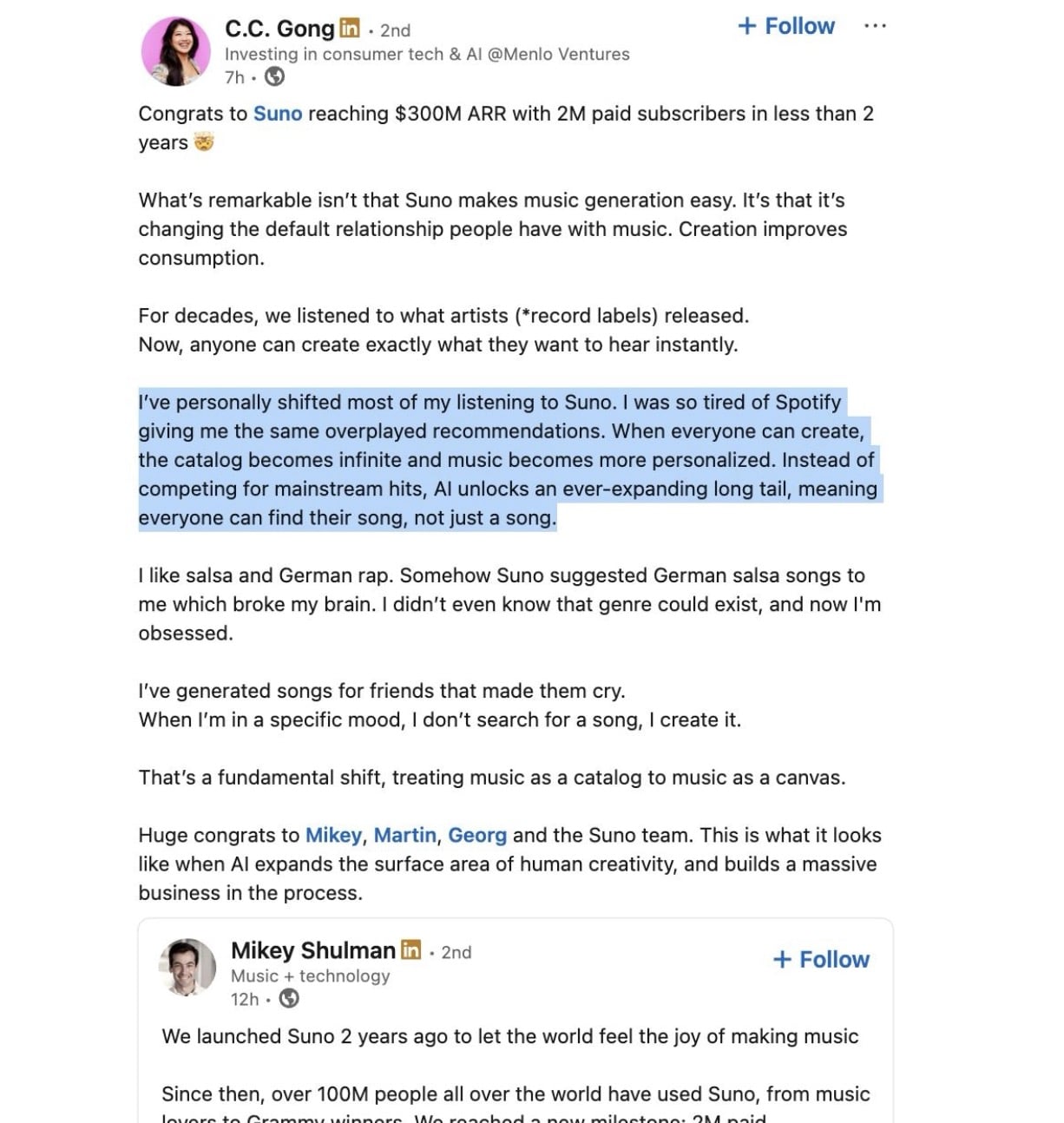
C.C. Gong, a Principal at Menlo Ventures — which led Suno’s $250 million Series C round — also commented on the milestones in a separate LinkedIn post, arguing that Suno is “changing the default relationship people have with music” and that “creation improves consumption.”
“For decades, we listened to what artists (*record labels) released,” Gong wrote. “Now, anyone can create exactly what they want to hear instantly.”
Gong added that she has “personally shifted most of my listening to Suno,” saying she was “so tired of Spotify giving me the same overplayed recommendations.”
She argued that AI-generated music “unlocks an ever-expanding long tail, meaning everyone can find their song, not just a song.”