MBW Reacts is a series of analytical commentaries from Music Business Worldwide written in response to major recent entertainment events or news stories.
These days, the company’s top executives arguably dedicate more time talking about video, podcasts and audiobooks than they do about the music that built the company into the global behemoth that it is.
It’s all part of what Spotify calls its “ubiquity strategy,” a long-term plan for Spotify to be everywhere: not just on phones or laptops, but in the car, on the TV… everywhere. It’s part of an ambitious goal to eventually build a paying user base of 1 billion people.
As part of its “ubiquity strategy,” Spotify is aiming to establish a greater presence on users’ TV screens. To that end, it has been pushing into video, particularly video streams of its growing library of podcasts.
On the earnings call, Alex Norström, Spotify’s Chief Business Officer (and soon to be co-CEO), revealed that more than 390 million users have streamed a video podcast, a 54% YoY increase.
“We now have almost 500,000 video podcast shows on our platform. Time spent with video content has more than doubled year-over-year, driven mostly by video podcast. And this consumption has increased by more than 80% since the launch of the Spotify Partner Program,” he said.
One notable new development on the video side is a partnership Spotify struck with Netflix that will bring podcasts from Spotify Studios and The Ringer to Netflix in early 2026.
Creators “want to syndicate everywhere,” Norström explained. “And we believe, of course, in helping them to reach audiences in as many places as possible, which is consistent with our core philosophy on being creator-first and also, of course, to help them monetize as much as possible.”
The Netflix partnership “is really a meaningful opportunity for both of these beliefs and just a natural extension of our ecosystem,” he added. “And what’s more is that we’re already seeing some strong interest from creators who want to use Spotify as sort of their distribution hub, if you will.” Spotify the video distributor? Yes, that apparently is part of the plan too.
The exec’s comments arrived after the Stockholm-headquartered streaming giant added 5 million net subscribers in Q3 to reach 281 million paid users, up 12% year-over-year, while MAUs grew by 17 million to 713 million.
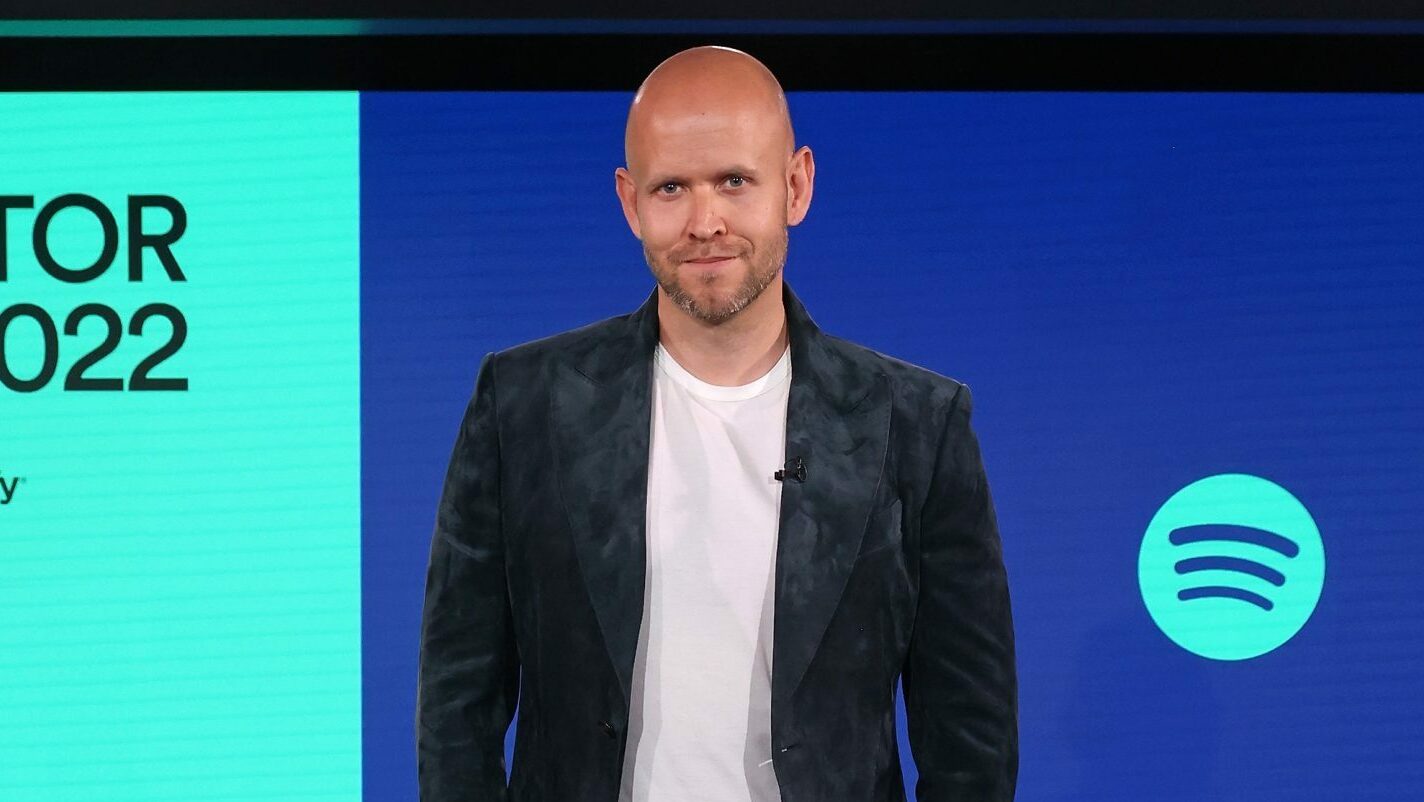
The results came as Spotify prepares for a leadership transition, with CEO Daniel Ek set to move to Executive Chairman on January 1, 2026, while Alex Norström and Gustav Söderström step into roles as co-CEOs.
Here are five other things we learned on Spotify’s latest earnings call:
SOPA/Alamy1. Price hikes aren’t increasing churn
Much to the frustration of music rightsholders, Spotify kept its subscription prices unchanged for years as it worked to build a subscriber base. But over the past few years, as it expanded its focus to margin growth, the platform has implemented a series of price hikes across numerous markets, and one key question was whether the higher monthly cost would slow down subscriber growth.
Now the results are in: Spotify hasn’t seen an increase in subscriber churn or slowdown in subscriber growth. The company reported281 million paying subscribers in Q3 2025, up 12% YoY.
“In many markets where we act now, Spotify is not just a music service anymore.”
Daniel Ek, Spotify
“We… saw steady retention rates following the rollout of our recent price increases across more than 150 markets. These results show the power of the product and the loyalty of our subscribers,” Norström said on the call.
He reiterated what Spotify execs have been saying in recent quarters – that price hikes are now an ongoing part of Spotify’s strategy.
Asked why Spotify is raising prices at different rates in different markets, Ek stressed that Spotify offers a different variety of products in different markets.
“In many markets where we act now, Spotify is not just a music service anymore,” he said. “It is a music, podcast and audiobooks service. In some markets, we haven’t yet gotten to with our audiobooks offering. So as you look at our pricing, we are factoring in the value, not just in music, but in all of the verticals that we act as well.”
2. Half of eligible Premium users have played an audiobook
Speaking of audiobooks, Spotify execs are stressing that the company’s expansion into this new vertical (as they call it) is proving to be a success. Norström revealed on the call that half of Premium users in markets where Spotify provides audiobooks have listened to one.
“Spotify has now introduced tens of millions of new younger listeners to audiobooks. We’ve brought audiobooks to 14 global markets and have more than tripled our catalog in English language markets to over 500,000 titles,” he said, adding that the number of users listening to audiobooks grew 36% YoY, with listening hours growing even more.
Spotify recently rolled out Audiobooks+, a subscription add-on that allows users to buy additional audiobook time beyond the 15 hours included in a Premium subscription. Uptake of the new add-on has been “really, really good.” Spotify says.
Credit: Primakov / Shutterstock.com3. ‘Enhanced free experience’ a key driver of user growth
Spotify raised some eyebrows in the music business recently when it rolled out the first enhancements to its free-to-use, ad-supported tier since 2018. While the free tier had allowed users only a shuffle option on playlists, it now allows users to pick any song they like from a playlist.
To some in the music business, that looked like Spotify was going in the wrong direction. After all, shouldn’t Spotify be incentivizing users to move to paid subscriptions?
Yet Spotify’s strategy continues to be to build its base of free users, as that’s the “funnel” that drives users to the paid tiers. The larger the funnel, the thinking goes, the more potential upgrades to paid subscriptions.
Credit: Spotify
“With the majority of users starting their Spotify journey on free and our bold ambitions to continue to attract new users of streaming, it was critically important to make [the free] experience even better,” Söderström said.
He suggested the strategy is paying off, with growth in monthly active users (MAUs) outpacing the company’s guidance. Total MAUs grew 11% YoY in Q3 to 713 million, beating guidance by 3 million.
“And we know over time that this simply leads to more conversion,” Söderström said.
Photo Credit: ElenaR/Shutterstock4. Ad revenue will bounce back from its slump
While overall user growth may be strong, revenue from the ad-supported tier appears to be one key weak spot in Spotify’s earnings.
Ad revenue came in at EUR €446 million (USD $521 million) in Q3, flat on a constant currency basis, or down 6% YoY when not adjusting for currency fluctuations.
But Spotify’s C-suite expects ad revenue to start bouncing back in the second half of 2026, as it signs partnerships with demand-side platforms like Amazon and Yahoo, thereby shifting more of its advertising onto its programmatic platform.
“We remain confident in our long-term strategy and the dynamics are improving. We’re really pushing hard to build for the long term. And while these changes will take some time, we believe that will yield significant results in the years ahead,” Norstrom said.
Chief Financial Officer Christian Luiga added: “It’s not if, it’s when… The question is when that programmatic side is then growing so much in amount that it compensates for the [slump in] direct sales… And that is progressing well, but the inflection point is a little bit further out than we expected before Q2.”
Credit: miss.cabul / Shutterstock.com5. Spotify is building AI tools for music creators – and wants to do it responsibly
Spotify’s leadership team was asked on the call if they see an opportunity for Spotify to help artists with AI tools for their music creation process.
Gustav Söderström confirmed that Spotify sees opportunities to help artists with AI tools for music creation, emphasizing the company’s commitment to doing so responsibly.
“What we think is important is that someone does this in a way where artists in the music industry can get to participate and to choose if they want to use these tools,” Söderström said.
“There’s obviously a lot of excitement, but also a lot of fear around these tools. So we are trying to be the ones who do this responsibly. And we’re very excited about that. I don’t want to talk more about the specific[s] at this time, but that’s what we’re trying to do.”
Söderström noted that AI tools aren’t limited to music creators. “It’s also important to remember that it’s not only for music. We think AI tools are also very helpful for podcasters and for authors. So we want to help all creators with these kinds of tools,” he said.
Spotify stated at the time that it is making investments in AI research and product development and has already begun building a generative AI research lab and product team.
The company said that all products developed through the collaboration will put artists and songwriters first through four principles: partnerships with record labels, distributors, and music publishers; choice in participation for artists and rightsholders; fair compensation and new revenue; and deepening artist-fan connections.