
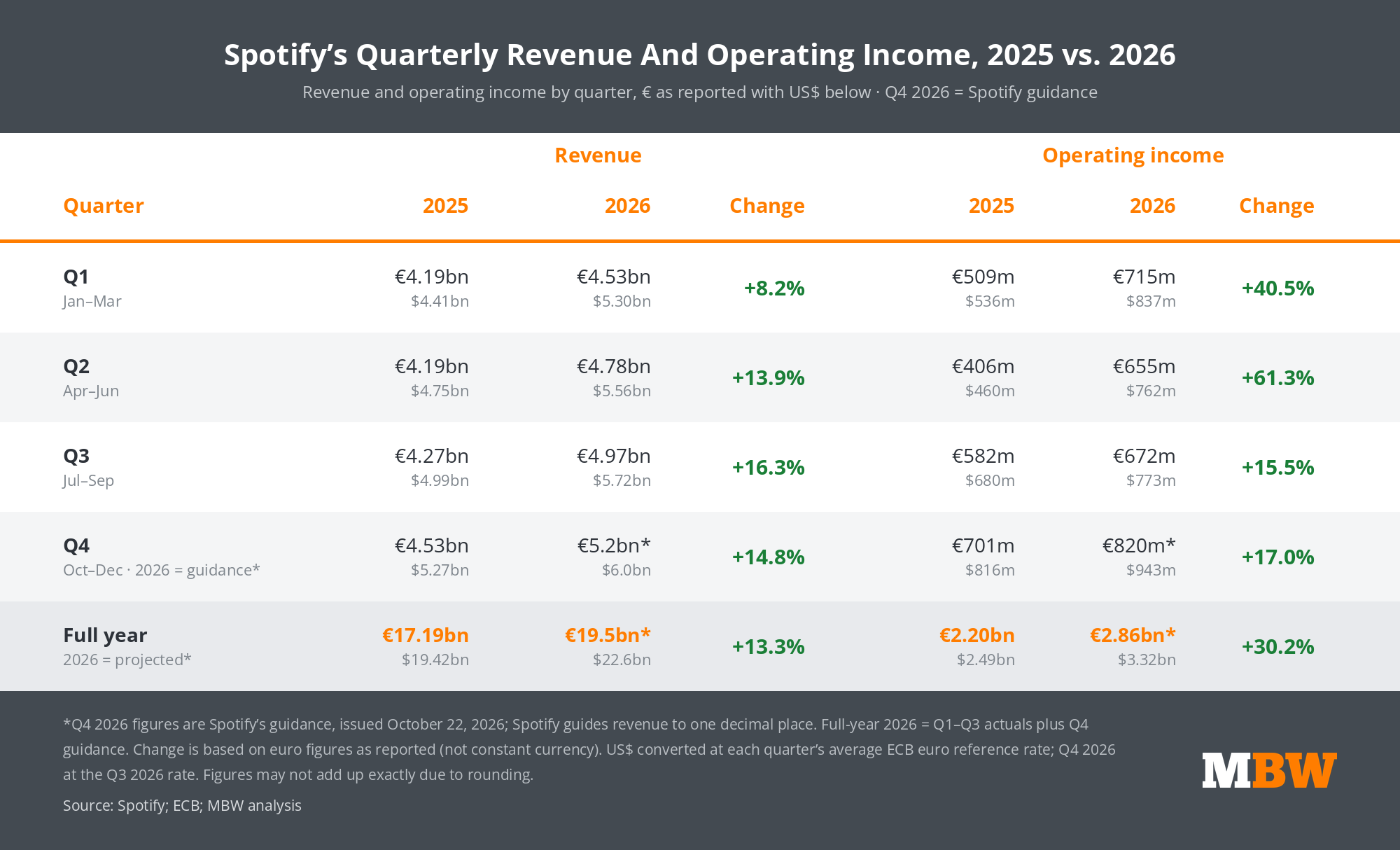
Spotify is on course to post an annual operating profit of EUR €2.862 billion (USD $3.32bn) in 2026.

That’s according to MBW‘s calculations, which combine Spotify’s actual operating income for the first three quarters of 2026 with the company’s own guidance for Q4.
Spotify published its financial results for Q3 2026 (the three months to the end of September) earlier today (October 22).
The firm’s Premium subscriber base reached 306 million in Q3, following +6 million net adds in the quarter. That was +1 million above its own guidance of 305 million.
Spotify said subscriber growth in Q3 “was driven by Q/Q gains in Latin America, Europe, North America and Rest of World”.
The company also cited “Global promotional campaign intake and partnership strength” as a driver of Premium subscriber growth.
“Our business performed well in Q3, with all of our KPIs meeting or exceeding guidance,” Spotify said in its Q3 2026 update to shareholders.
Spotify posted quarterly operating income of €672 million ($773m) in Q3, up 15% YoY. That followed operating income of €715 million in Q1 2026 and €655 million in Q2 2026.
Across the first nine months of the year, therefore, Spotify‘s operating income totaled €2.042 billion.
Spotify’s guidance for Q4 2026, issued today, forecasts operating income of €820 million. That would be up 17% on the €701 million Spotify posted in Q4 2025.
If Spotify hits that Q4 guidance, its operating income for full-year 2026 will total €2.862 billion.
That would be up 30% on the €2.198 billion in operating income Spotify posted for full-year 2025.
It would also be the highest annual operating income in Spotify‘s history, and its third consecutive full year of operating profit.
Monthly Active Users
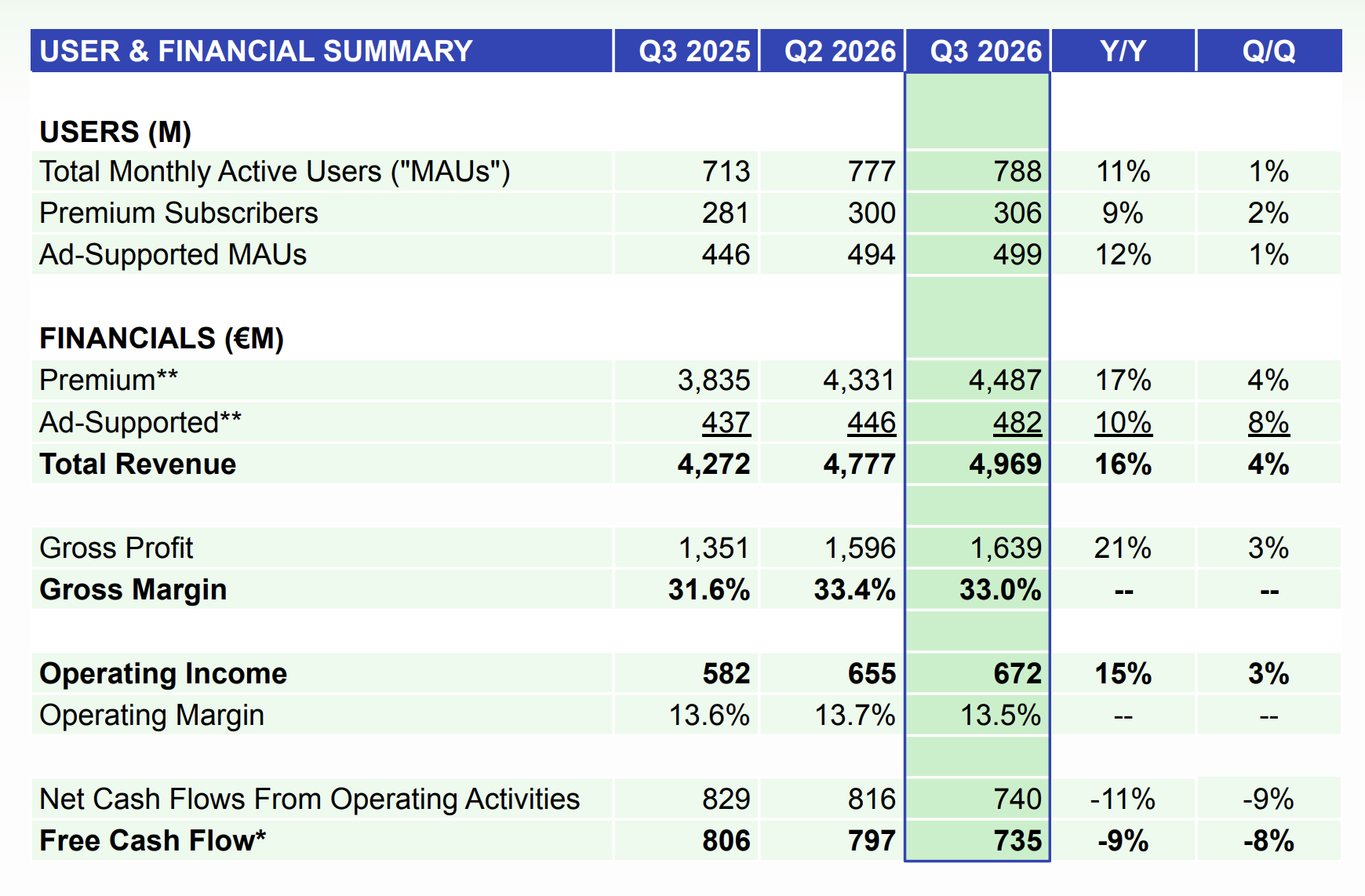
Spotify‘s Monthly Active Users (MAUs) – which include both Premium subscribers and ad-supported users – grew 11% YoY to 788 million in Q3.
That was up +11 million from 777 million at the end of Q2, and in line with Spotify’s guidance of 788 million.
Spotify said MAU growth “was driven by Q/Q gains in Rest of World, Latin America, Europe and North America”.
Ad-supported MAUs grew 12% YoY to 499 million.
Alex Norström, Co-CEO, said: “This was a quarter where we did what we said. We’ve built a strong business that keeps compounding, we invest when we see a path for growth, our costs are moderating, and there is more runway ahead…Spotify not only enjoys industry-leading engagement, but we also have the most passionate and engaged music, podcast and book fans in the world on our platform.
“That’s why we continue to grow and take share. Every time we expand what’s on Spotify, we bring in new listeners and give existing ones more reasons to come back, almost every day.”
“We’ve built a strong business that keeps compounding, we invest when we see a path for growth, our costs are moderating, and there is more runway ahead.”
Alex Norström, Spotify
Gustav Söderström, Co-CEO, added: “Spotify is in one of the few categories that actually stands to thrive in the agentic age. This is because agents excel at replacing and taking care of things people would rather not do.
“People love getting rid of chores. But entertainment is the opposite. Nobody asks an agent to ‘summarize a song’ for them.
“The whole point of getting rid of those chores is to free up even more time for the things that you actually enjoy.”
Revenue
Spotify‘s total revenue grew 16% YoY (or 14% YoY at constant currency) to €4.969 billion ($5.72bn) in Q3.
Premium revenue grew 17% YoY (or 15% YoY at constant currency) to €4.487 billion ($5.16bn).
Spotify said Premium revenue growth was “driven by subscriber and ARPU gains”.
Premium average revenue per user (ARPU) rose 9.3% YoY (or 7.5% YoY at constant currency) to €4.95 ($5.69).
“Excluding the impact of FX, ARPU growth was driven by price increase benefits, partially offset by product/market mix,” Spotify said.
Ad-supported revenue grew 10% YoY (or 9% YoY at constant currency) to €482 million ($555m).
“On a constant currency basis, music advertising performance was driven by growth in impressions sold, partially offset by softness in pricing,” Spotify said.
Spotify added that podcasting growth “was led by sponsorship gains within our Owned & Licensed portfolio”.
Profitability
Spotify‘s Q3 operating income of €672 million ($773m) was €2 million above its own guidance of €670 million.
Spotify said operating income “outperformed guidance due to lower than forecast marketing and personnel related costs and Gross Margin strength, partially offset by higher Social Charges”.
Spotify’s operating margin was 13.5% in Q3, compared to 13.6% in Q3 2025.
Gross margin finished at 33.0% in Q3, up 136 bps YoY and above Spotify’s guidance of 32.9%.
Spotify described the gross margin figure as “a Q3 record high”.
Operating expenses in Q3 included €22 million ($25m) in Social Charges on share-based compensation, which was €13 million above Spotify’s forecast.
“Social Charges are payroll taxes associated with employee salaries and benefits in select countries where we operate,” Spotify explained.
Spotify’s net income for Q3 was €518 million ($596m), compared to €899 million in Q3 2025 and €545 million in Q2 2026.
At the end of Q3, Spotify’s workforce consisted of 7,284 full-time employees.
Guidance for Q4
Spotify expects its MAUs to reach 818 million in Q4, representing approximately 30 million net new MAUs.
It expects its Premium subscriber base to reach 316 million, representing approximately 10 million net new subscribers.
Spotify is guiding for Q4 total revenue of €5.2 billion, gross margin of 33.8%, and operating income of €820 million.
The operating income guidance incorporates €6 million in Social Charges, based on Spotify’s Q3 closing share price of $487.38.
“Overall, we are very pleased with our performance heading into year-end and view the business as well positioned to deliver improved growth and margins in 2026,” Spotify said.
All Q3 2026 EUR-USD conversions made at the average Q3 2026 exchange rate published by the European Central Bank. The full-year 2026 projection converts each quarter at its own average ECB exchange rate, with Q4 guidance converted at the Q3 2026 rate.Music Business Worldwide