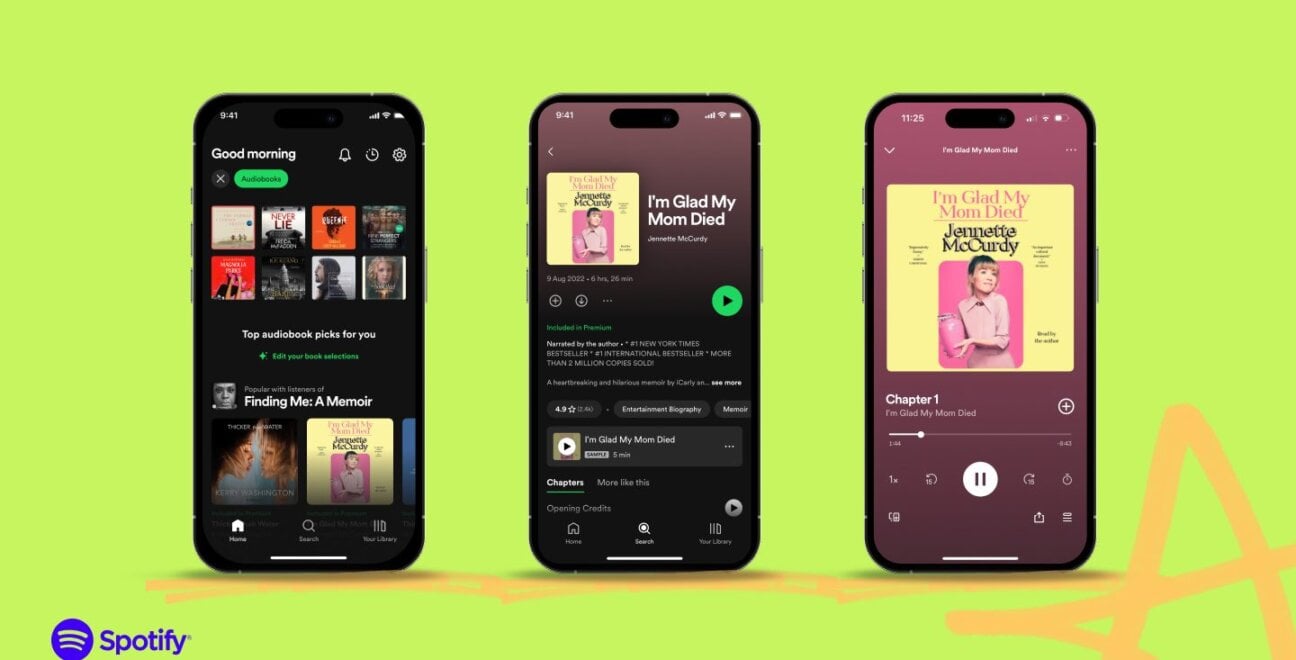
Spotify‘s audiobooks add-on, Audiobooks+, has passed USD $100 million in annual recurring revenue just over a year after its launch.
The company disclosed the milestone at the Frankfurt Book Fair on Wednesday (October 7), where it also announced plans to take audiobooks from 22 markets to more than 180 by the end of 2026.
The new markets include Japan, India, South Korea, Indonesia, and Brazil. Spotify said more than 750 million people will be able to stream or buy books on its platform once the rollout is complete.
Audiobooks+ lets users pay for extra hours of audiobook listening on top of their plan, and has more than 1 million subscribers, a milestone Spotify first reported in May.
Spotify has pointed to the add-on as the first payoff from a strategy it laid out at its Investor Day that month: getting its most engaged users to pay more through add-ons.
Co-CEO Alex Norström told investors that Spotify had expected music to be its first add-on, but that it was “our newest vertical, audiobooks, that got there first.” He added that Audiobooks+ subscribers have “lifetime values that are multiples of Premium-only users,” because they spend more and stay longer.
Norström also said Spotify had taken roughly 20% of the US audiobooks market within a couple of years.
Listening is growing too. Monthly audiobook listeners on Spotify grew by nearly 40% over the past year, while listening hours rose by more than 30%, the company said.
At Investor Day, Spotify said almost half of its audiobook listeners had started within the previous 12 months, many of them new to the format.
At an annualized run rate of more than USD $100 million, Audiobooks+ is still small next to Spotify’s EUR €17 billion in 2025 revenue.
In markets across Africa and Asia, as well as Argentina, Audiobooks+ will be the primary way to access audiobooks.
In other new markets, including Italy, Spain, Portugal, Brazil, Mexico, Colombia, Poland, Chile, Norway, and Peru, eligible Premium subscribers will get 12 hours of listening a month as part of their plan. That is the same allowance Premium subscribers get in Spotify’s existing continental European markets, such as Germany and France, but below the 15 hours included in the US and UK.
Listeners will also be able to buy individual titles outright. Availability and pricing vary by market, according to Spotify.
Listeners in the new markets will have access to more than 350,000 titles in more than 120 languages, including new Spanish, Portuguese, Italian, and Polish catalogs.
Spotify said all of its partnerships are non-exclusive “because we believe authors should find the largest possible audience.”
Alongside the expansion, Spotify announced two product updates.
Its Page Match feature, which lets readers switch between a print or e-book edition and its audiobook, now supports page numbers: readers can scan a book’s ISBN barcode and enter a page number to pick up the audiobook from that point.
More than 1 million readers have used Page Match since February, and the feature works in more than 30 languages, the company said.
From November, users on Student plans in Ireland, Belgium, Austria, and Finland will be able to buy extra listening hours through Audiobooks+.
The company plans to bring Audiobooks+ to Student plans in more markets over the coming year.
“Three years ago this fall, we brought audiobooks into Premium to build a better home for book lovers, authors, and publishers. Readers showed up,” Spotify said.
Spotify first included audiobooks in Premium in the UK and Australia in October 2023, with 15 hours of listening per month.
The offer later rolled out to Premium subscribers in the US.
Audiobooks+ launched in 11 markets in July 2025, after trials in Ireland and Canada.
The add-on arrived in the US on August 5, 2025.
In November 2025, Spotify brought audiobooks to Sweden, Denmark, Finland, Iceland, and Monaco, with Premium subscribers there receiving 12 hours of listening per month.
At the time, Spotify said audiobook listeners in its English-language markets had grown by 36% over the past year, with listening hours up 37%.
Spotify reported 777 million Monthly Active Users at the end of Q2 2026, including 300 million Premium subscribers.
In the US, Spotify’s audiobooks offering sits at the center of a dispute with songwriters and publishers.
In March 2024, Spotify reclassified its US Premium plans as music-and-audiobook bundles, based on the 15 hours of monthly audiobook listening they include.
Under the Phonorecords IV settlement, services can pay songwriters and publishers a lower mechanical royalty rate on bundles than on standalone music subscriptions.
At the National Music Publishers’ Association‘s Annual Meeting in June, Chief Legal Officer and Chief Operating Officer Danielle Aguirre said the move had cost songwriters and publishers almost USD $480 million since 2024, citing Spotify’s own estimates.
“All parties have expressed an interest to come to the table and discuss how to fix bundling issues and to move forward as partners,” Aguirre told the meeting.
“That is a welcome first step,” Aguirre added. “But what really counts are actions.”
The Mechanical Licensing Collective (MLC) sued Spotify over the reclassification in May 2024.
Judge Analisa Torres dismissed the case in January 2025, ruling that Premium qualifies as a bundle. In September 2025, she allowed the MLC to file an amended complaint, reviving the case.
The MLC‘s amended complaint argues that Spotify improperly used the price of its standalone Audiobooks Access plan to value Premium’s audiobook component, inflating that value and reducing the royalties paid on the music component. It also argues that Audiobooks Access, which comes with ad-supported music, is itself a bundle on which Spotify owes royalties.
On September 1, 2026, Torres denied the MLC’s request to immediately appeal her January 2025 bundle ruling.
Torres did, however, strike Spotify’s “unclean hands” defense, which accused the MLC of singling Spotify out while not pursuing other streaming services over similar practices.Music Business Worldwide