Rosalía was the most-streamed artist from Spain worldwide on Spotify in 2025, following the success of her 2025 album LUX
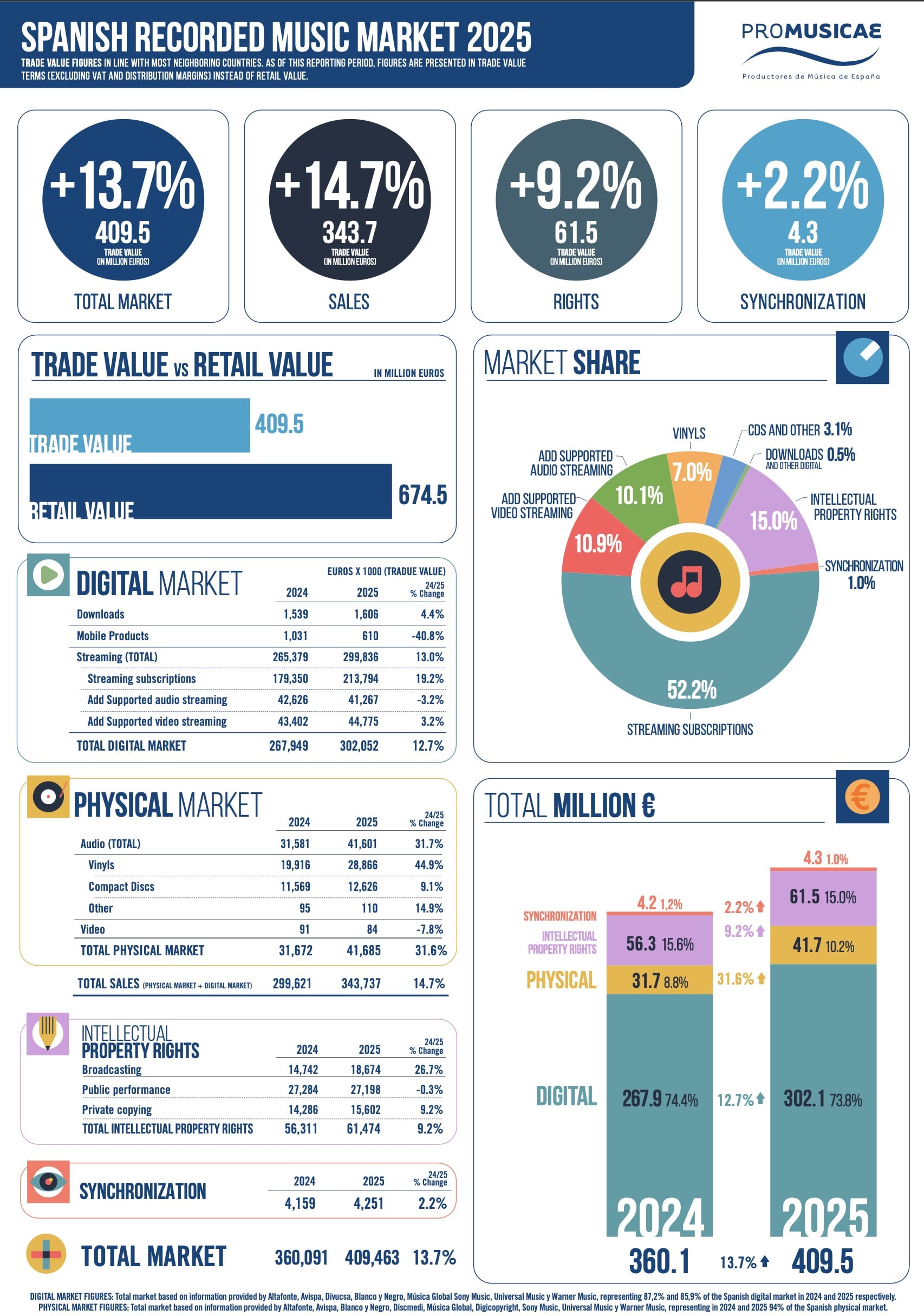
Spain’s recorded music industry posted wholesale revenues of EUR €409.5 million (USD $462.3m) in 2025, up 13.7% YoY.
That’s according to new data from Promusicae (Productores de Música de España), the trade body for the recorded music industry in Spain, on Thursday (March 5).
As with its H1 2025 report, Promusicae presents figures in wholesale “trade value” terms — representing actual revenue flowing to music companies rather than retail consumer spending — having previously published retail value figures.
At retail value, Promusicae reports that the 2025 figure represents a total market value of €674.5 million ($761.3m).
The new data published by Promusicae reveals that Spain’s overall wholesale music streaming revenues reached nearly EUR €300 million ($338.6m) in 2025, growing 13% YoY, and accounted for 99.2% of all digital music sales.
Paid subscription streaming, meanwhile, led the charge with EUR €214 million ($241.5m) in wholesale revenue, up 19.2% YoY, representing 71.3% of total streaming income.
Ad-supported audio and video streaming contributed a combined EUR €86 million ($97.1m) in wholesale revenue, or 28.7% of streaming revenue.
Promusicae’s report shows that while ad-supported consumption accounted for 60% of total listening time in Spain in 2025, it generated less than a third of streaming income.
More than 21 million people in Spain accessed music through audio streaming platforms in 2025. Over 8 million of those held premium subscriptions, up 18% from 2024.
Still, Promusicae noted that Spain’s paid subscriber base still lags behind “markets most focused on consumption of recorded music,” where consumption has shifted to paid services.
Promusicae President Antonio Guisasola said: “[W]e are still struggling in Spain due to the low penetration of music consumption through paid subscriptions.”
“[W]E ARE STILL STRUGGLING IN SPAIN DUE TO THE LOW PENETRATION OF MUSIC CONSUMPTION THROUGH PAID SUBSCRIPTIONS.”
Sales of physical formats, meanwhile, grew 31.6% YoY in 2025 to €41.7 million in wholesale revenue, driven by vinyl sales, which accounted for 69% of all physical sales.
Vinyl revenues jumped 44.9% YoY in 2025 to EUR €28.9 million ($32.6m).
Promusicae said: “Consumers’ interest for vinyl, as pieces that connect them with their most-loved artists, certifies the record companies’ efforts to offer fans unique and outstanding creativity works.”
CD revenues also grew, rising 9.1% YoY to EUR €12.6 million ($14.2m). Other physical formats added EUR €110,000, while video formats slid 7.8% YoY to EUR €84,000.
Beyond music sales, intellectual property rights managed through AGEDI, the Spanish collecting society, contributed EUR €61.5 million ($69.4m) to the sector, up 9.2% YoY.
Sync revenues from advertising and audiovisual productions came in at EUR €4.3 million ($4.9m), a 2.2% YoY increase.
Guisasola said: “The growth of the recording industry in 2025, not only is good news for the sector economically, but it also confirms that the efforts and investments made by recording companies in Spain to accompany Spanish artists’ talent and creativity, are generating returns that bring results back to 2003 levels, making the peaks of 2001 appear within reach.”
“CONSUMERS’ INTEREST ABOUT MUSIC IS CLEAR, AND IT IS NECESSARY TO KEEP REINFORCING THE STREAMING MODEL, WHICH IN EXCHANGE OF A MORE THAN REASONABLE PRICE GRANTS ACCESS TO A COMPLETE MUSIC LIBRARY THAT IS WITH US IN ALL OUR DAILY ACTIVITIES.”
ANTONIO GUISASOLA, PROMUSICAE
However Guisasola noted that despite the digital shift, 34% of consumers still engage in piracy, which the Coalition of Creators and Content Industries estimates costs the sector EUR €722 million ($815.1m) in lost profit.
He also called for public sector support “to ensure a safe framework where the Spanish recording industry can keep investing in the development of new talent,” and pushed for tax incentives, which are currently not available to the music sector.
Guisasola added: “Consumers’ interest about music is clear, and it is necessary to keep reinforcing the streaming model, which in exchange of a more than reasonable price grants access to a complete music library that is with us in all our daily activities. This reinforcement happens through expanding into other subscription formats, so that the sector benefits from its efforts and investments, as it does in neighbouring markets.”
According to the IFPIGlobal Music Report 2025, Spain ranked as the world’s 14th largest music market in 2024.