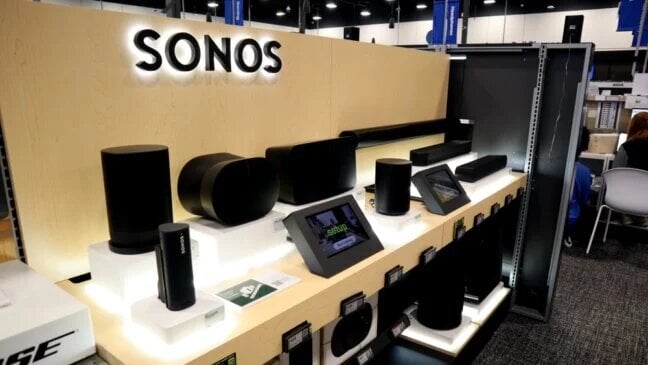
A federal judge has paused SoundExchange‘s lawsuit seeking more than USD $3.4 million in unpaid royalties and fees from Sonos.

Judge Hernán D. Vera of the US District Court for the Central District of California took the case off the court’s active list on October 16.
The order follows a December 2025 ruling that put the case on hold until a federal appeals court in New York rules in a separate dispute between SoundExchange and SiriusXM.
That appeal turns on whether SoundExchange has the legal right to sue services that fail to pay the royalties it collects.
The order, reviewed by MBW, can be read in full here.
It states that the Sonos case is “removed from this Court’s active caseload and administratively closed until further application by the parties or order of this Court.” All scheduled dates have been canceled, and the two sides must report back on its status “within 90 days and every quarter thereafter.”
SoundExchange sued Sonos and Napster, whose legal name is Rhapsody International, in June 2025.
The suit centers on Sonos Radio, a streaming service that launched in April 2020 and is available only on Sonos devices.
Like other radio-style streaming services, it relied on a statutory license in US copyright law that allows it to play commercially released recordings without negotiating individual deals with labels. In return, such services must pay royalties at rates set by the Copyright Royalty Board, which SoundExchange collects and passes on to artists and labels.
Napster powered the service and submitted the required royalty reports and made the payments on Sonos‘s behalf, according to the complaint.
SoundExchange says those reports and payments stopped in May 2022, the month Napster was acquired by Hivemind and Algorand, which the complaint describes as venture capital firms focused on crypto and blockchain.
The acquisition caused “a complete breakdown of reporting and payment for the Sonos Radio service,” the lawsuit alleges.
Sonos ended its partnership with Napster around April 2023 and moved the service’s back end to Deezer, according to the complaint.
SoundExchange claims the two companies owe at least USD $3,423,844.41, a figure that covers unpaid royalties for October 2022 to April 2023, late fees dating back to May 2022, interest, and audit costs, minus payments made so far.
It argues that Sonos, as owner of the service, is liable alongside Napster, because Sonos is “ultimately responsible for ensuring compliance with that statutory license, including the payment of royalties.”
Napster did not answer the complaint, and the court clerk formally recorded it as being in default in August 2025, according to the court docket.
The Sonos case is on hold because of what happened to SoundExchange‘s lawsuit against SiriusXM.
SoundExchange sued SiriusXM in August 2023 in Virginia federal court, alleging the satellite radio company had underpaid more than USD $150 million in royalties. It claimed SiriusXM did so by booking part of its satellite radio revenue as streaming income, which is excluded from the satellite royalty calculation.
The case was later moved to Manhattan, where Judge Naomi Reice Buchwald of the US District Court for the Southern District of New York threw it out in August 2025.
She found that the law designating SoundExchange to collect these royalties does not give it the right to sue over them. She pointed out that the separate provision governing The MLC, which collects royalties for songwriters and music publishers, expressly allows that organization to bring lawsuits.
SoundExchange called the ruling “entirely wrong on the law” and appealed to the US Court of Appeals for the Second Circuit in September 2025. It says SiriusXM‘s alleged underpayment now exceeds USD $400 million.
SiriusXM denies the allegations.
In September 2025, Sonos asked Judge Vera to dismiss the case against it or, alternatively, to pause it, arguing that SoundExchange could not relitigate in California a question it had already lost in New York.
In December 2025, Judge Vera agreed that SoundExchange was bound by the New York ruling, but paused the case rather than dismissing it, because that ruling could still be overturned on appeal.
The Second Circuit heard arguments in the SiriusXM appeal on September 25 and has not yet issued a ruling.
Judge Richard Sullivan, one of the three judges on the panel, raised the possibility of artists suing SiriusXM directly as a group, according to Courthouse News Service.
SoundExchange‘s lawyer, former US Solicitor General Paul Clement, called that “a pretty ridiculous scenario, with all due respect.”
Judge Alison Nathan, another member of the panel, said from the bench: “We don’t want courts to interfere with an enforcement scheme that Congress has set up.” She added that it was “hard to read [Section] 114 as something other than a structure by which SoundExchange is designed to collect these royalties pursuant to the statute.”
Arguing for SiriusXM, lawyer Andrew Tulumello described SoundExchange as “a runaway, a collective, not accountable to anyone,” the outlet reported.
The outcome reaches well beyond Sonos.
SoundExchange distributes around USD $1 billion in royalties each year, collected from approximately 3,600 licensees, according to its complaint against Sonos.
If the Second Circuit sides with SiriusXM, the claims against Sonos would likely be thrown out, and artists and labels could be left to pursue underpaying services themselves.
If SoundExchange wins, its USD $3.4 million claim against Sonos and Napster could move forward.
MBW has contacted SoundExchange and Sonos for comment.Music Business Worldwide