
Grammy-winning rap duo Salt-N-Pepa have filed a notice of appeal against the dismissal of their lawsuit against Universal Music Group over the copyrights to their master recordings.

The notice, filed on February 4 and docketed in the United States Court of Appeals for the Second Circuit on February 5, challenges the January 8 ruling by District Judge Denise Cote that dismissed both of the duo’s claims against Universal.
A judge ruled in January that the artists never owned the copyrights to their sound recordings and therefore cannot reclaim them.
The filing, obtained by MBW, also appears to reveal that Salt-N-Pepa (Cheryl James and Sandra Denton) have added prominent music industry lawyer Richard S. Busch of Nashville-based King & Ballow to their legal team.
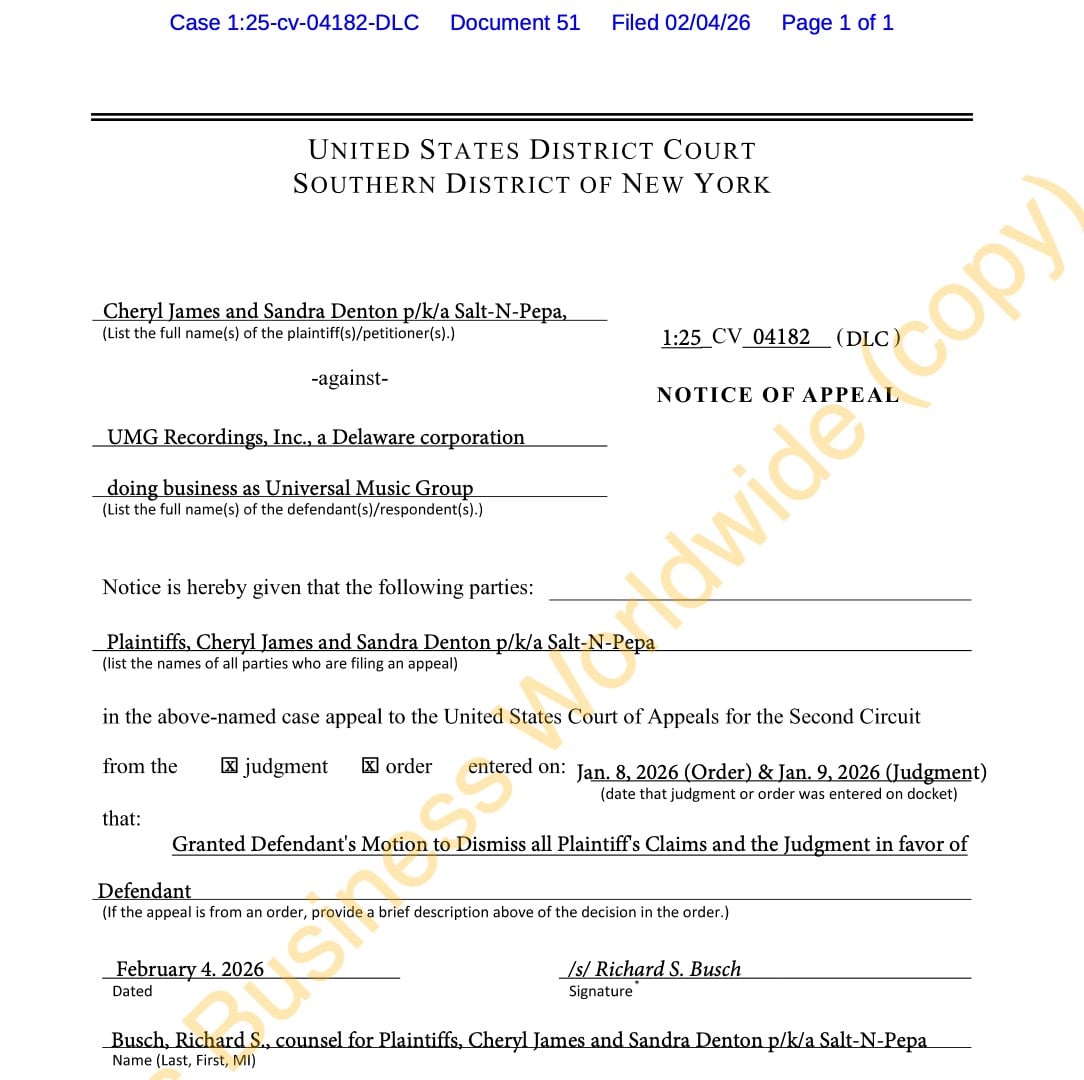
The Salt-N-Pepa case (now docketed as 26-253) centers on whether the Grammy-winning artists behind hits including Push It have the right to terminate UMG’s ownership of their sound recordings under Section 203 of the Copyright Act.
Section 203 allows artists to reclaim copyrights they transferred to labels 35 years after the original grant.
Salt-N-Pepa served their termination notices on UMG in March 2022, with the earliest effective termination dates falling on May 15, 2024.
Judge Cote’s ruling last month hinged on whether Salt-N-Pepa ever owned and transferred the copyrights to their recordings.
When James and Denton signed their first recording agreement in May 1986, it was with Noise In The Attic Productions, Inc. (NITA) – a company owned by their producer Hurby Azor.
That agreement stated that NITA “shall be the sole and exclusive owner of any and all rights, title and/or interest in and to master recordings recorded hereunder, including but not limited to the worldwide sound copyrights therein.”
On the same day, Azor entered into a separate distribution agreement with Next Plateau Records – to which UMG is a successor-in-interest – that transferred ownership from NITA to Next Plateau.
Salt-N-Pepa were not signatories to that distribution agreement, though they signed an “inducement letter” attached to it. The artists argued this letter – in which they agreed to “grant you all of the rights and remedies therein granted to you” – constituted their direct grant of rights to Next Plateau.
Judge Cote disagreed.
“Even viewed in the light most favorable to Plaintiffs, the 1986 agreements do not indicate that Plaintiffs ever owned the copyrights to the sound recordings or that they granted a transfer of those rights to anyone else,” the ruling stated.
“The only copyright transfer effectuated by these agreements was the one from NITA to Next Plateau Records. And the statutory text in § 203 is clear: Plaintiffs can only terminate copyright transfers that they executed. They cannot terminate a copyright grant executed by NITA.”
The court also dismissed Salt-N-Pepa’s conversion claim, in which the duo alleged that UMG “intentionally and substantially interfered with Plaintiffs’ possession of their Master Tapes.”
Judge Cote ruled: “None of the contracts identified by Plaintiffs indicate that they ever owned the Master Tapes.”
Following the dismissal, a Universal Music Group spokesperson said: “While we are gratified that the court dismissed this baseless lawsuit, it should never have been brought in the first place.
“Prior to this suit — and without any legal obligation to do so — we made multiple attempts to resolve the matter amicably, improve the artists’ compensation, and ensure that Salt-N-Pepa’s fans had access to their music.
“Even with the court’s complete rejection of their claims, we remain open and willing to find a resolution to the matter and turn the page so we can focus our efforts on working together to amplify Salt-N-Pepa’s legacy for generations to come.”
According to Salt-N-Pepa’s original complaint filed in May 2025, which you can read here, the duo’s recordings generate “approximately $1,000,000 in the past five months in synchronization licenses alone, and generating tens of millions of dollars annually through all forms of exploitation.”
UMG rejected Salt-N-Pepa’s termination notices in June 2022. Nearly two years later, in May 2024, the earliest termination date cited in the notices, UMG removed dozens of the duo’s sound recordings from US streaming platforms.
The parties entered a temporary exploitation agreement in July 2024, but Salt-N-Pepa terminated it in April 2025. UMG subsequently informed the duo it was “ceasing all U.S. exploitation of the Sound Recordings at this time.”
The duo’s early catalog – including the recordings at issue in the case – remains unavailable to stream in the United States.
Salt-N-Pepa were inducted into the Rock & Roll Hall of Fame in November 2025.
The attorney listed as counsel for Salt-N-Pepa on the appeal is Nashville-based Richard S. Busch, a partner at King & Ballow, who has worked on a number of high-profile copyright cases over the past several years.
In 2018, Busch represented the Marvin Gaye heirs when the Ninth Circuit Court of Appeals upheld its successful copyright infringement case against the co-creators of Blurred Lines, Pharrell Williams and Robin Thicke.
Also in 2018, Busch represented Irish band The Script as they sued British pop star James Arthur, again for alleged copyright infringement, this time for Arthur’s worldwide hit, Say You Won’t Let Go. That case was settled out of court.
In 2019, pop-punk band Yellowcard filed a lawsuit, via Busch, claiming that Juice Wrld’s smash Lucid Dreams had infringed on the copyright of the melody in their song, Holly Wood Died. The suit was dropped in 2020 following the rapper’s death.
In 2020, Busch filed a copyright infringement lawsuit on behalf of three songwriters against Travis Scott over his No.1 single Highest in the Room.
Music Business Worldwide