Cast your mind back to 2021.
Two of that year’s key stories in the music biz had similar punchy numbers in their headlines:
- Sony Music Group acquires AWAL and Kobalt Neighbouring Rights for $430 million and
- Warner Music Group acquires 300 Entertainment for $400 million.
The four years since leave little doubt where the smart money went.
As independent music has continued to gobble up market share, Warner has shut down 300 Elektra Entertainment as a frontline entity, folding the remnants of 300’s brand and team into the Elliot Grainge-led Atlantic Music Group.
Meanwhile, the performance of AWAL, alongside The Orchard, was proudly highlighted in Rob Stringer’s investor presentation to Sony Corp analysts in Japan earlier this year.
Stringer revealed that Sony’s ‘indie services’ divisions had doubled their combined gross revenues between the company’s FY2020 and FY2024.
The sky’s the limit. (Not least for The Orchard, which is understood to be a $1 billion-plus annual revenue business today. It became a fully-owned subsidiary of Sony via a $200 million deal in 2015 – an absolute bargain.)
I thought of those contrasting AWAL/300 headlines last week when I read in Hits Daily Double that James Steven, EVP & Chief Communications Officer at WMG, is jumping ship to join Universal Music Group.
Hits rightly suggests that James is “one of a small group of comms professionals able to discuss complex financial and tech developments with nuance and insight”.
His departure from WMG is an obvious blow to Robert Kyncl and Warner’s management team; he won’t be easy to replace.
Unfortunately, because ‘communications’ sits in my realm of Planet Music Biz, I’ve already caught the predictable scuttlebutt from negative gossips. Robert Kyncl’s not a music guy, the culture has shifted since Max and Julie left, more good people will leave next.
Blah blah blah. Tiresome.
Meanwhile, Warner continues to grow. And despite slashing headcount since taking over as CEO in 2023, Robert Kyncl continues to steer that growth.
I’m a believer in Occam’s Razor: that the simplest explanation is most likely correct.
And there’s one very simple explanation why a marquee executive at WMG, who commands a rare level of industry-wide respect, might be tempted to leap to one of the other ‘majors’ in 2025.
Influence.
Truth is, Warner’s historical underinvestment in independent distribution has widened the financial gulf between WMG and its strongest competitors. A gulf that is now reaching noteworthy proportions.
Case in point: In calendar Q2, Warner Music Group’s company-wide turnover (USD $1.69B) was almost exactly half the size of Universal Music Group’s turnover in the same period (USD $3.38B).
In fact, Warner’s revenues are now substantially closer, numerically, to those of Korea’s HYBE than they are to UMG’s.
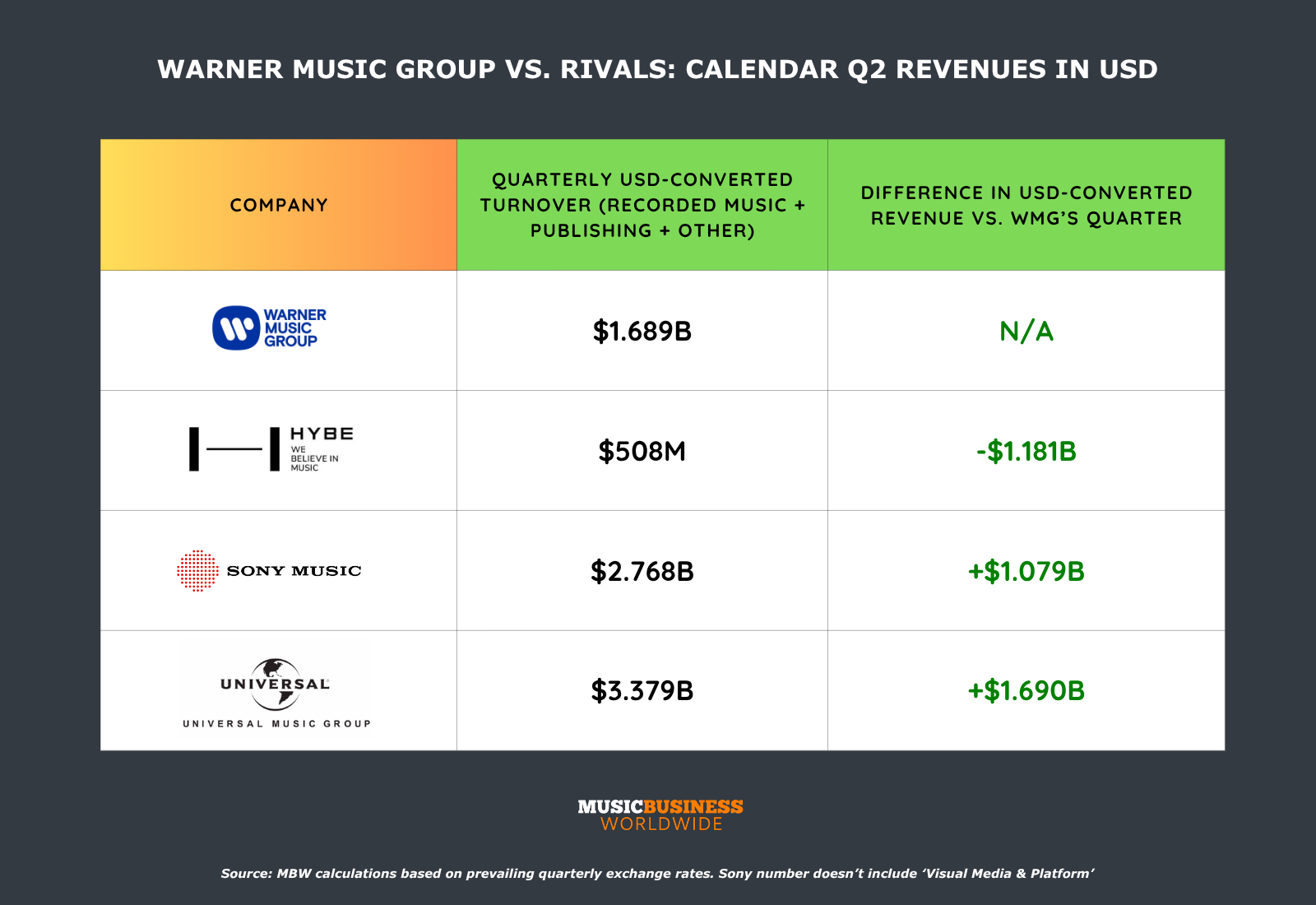
Due to scale begetting scale (and the catalyzing effect of Rob Stringer’s smart indie distribution investments), it seems inevitable that WMG’s revenues will also soon be closer to HYBE’s than to Sony’s global music operation.
(We’re waiting on Warner’s calendar Q3 results, which are out later this week. UMG’s hit USD $3.53B, up 10.2% YoY; Sony’s were at USD $2.89B, up 13.3% YoY.)
This isn’t about Robert Kyncl, ‘music guys’, or the corporate ‘culture’ of Warner Music Group.
The more meaningful question: If Warner still wants there to be a ‘Big Three’ – and to claim its seat at the table – where does it go from here?Music Business Worldwide