Credit: Joe Maher/GettyAvril Lavigne's 'Sk8er Boi' is cited in SOCAN's claim. Suno is accused of creating a near-identical copy of the song, but with some lyrics changed to Korean.
Canada’s SOCAN has sued Suno for copyright infringement.
GEMA and Koda both went after the copying (i.e. inputs) that trained Suno‘s model.
SOCAN is instead suing over the platform’s outputs, and over the act of streaming them to users in Canada.
“This case is about a simple principle: technological innovation does not displace copyright,” reads the opening of SOCAN‘s 42-page claim (which you can read in full here).
The lawsuit lists 150 tracks (outputs) on Suno‘s platform that SOCAN says are identical, or substantially similar, to songs in its repertoire. It calls these 150 tracks “just the tip of the iceberg.”
On its litigation webpage, SOCAN has posted five side-by-side comparisons, pairing the original recording with the Suno version.
They cover Tom Cochrane‘s Life is a Highway, Avril Lavigne‘s Sk8er Boi, K. Maro‘s Femme Like U, Alexisonfire‘s Passing Out in America, and Daniel Balavoine‘s S.O.S. d’un terrien en détresse.
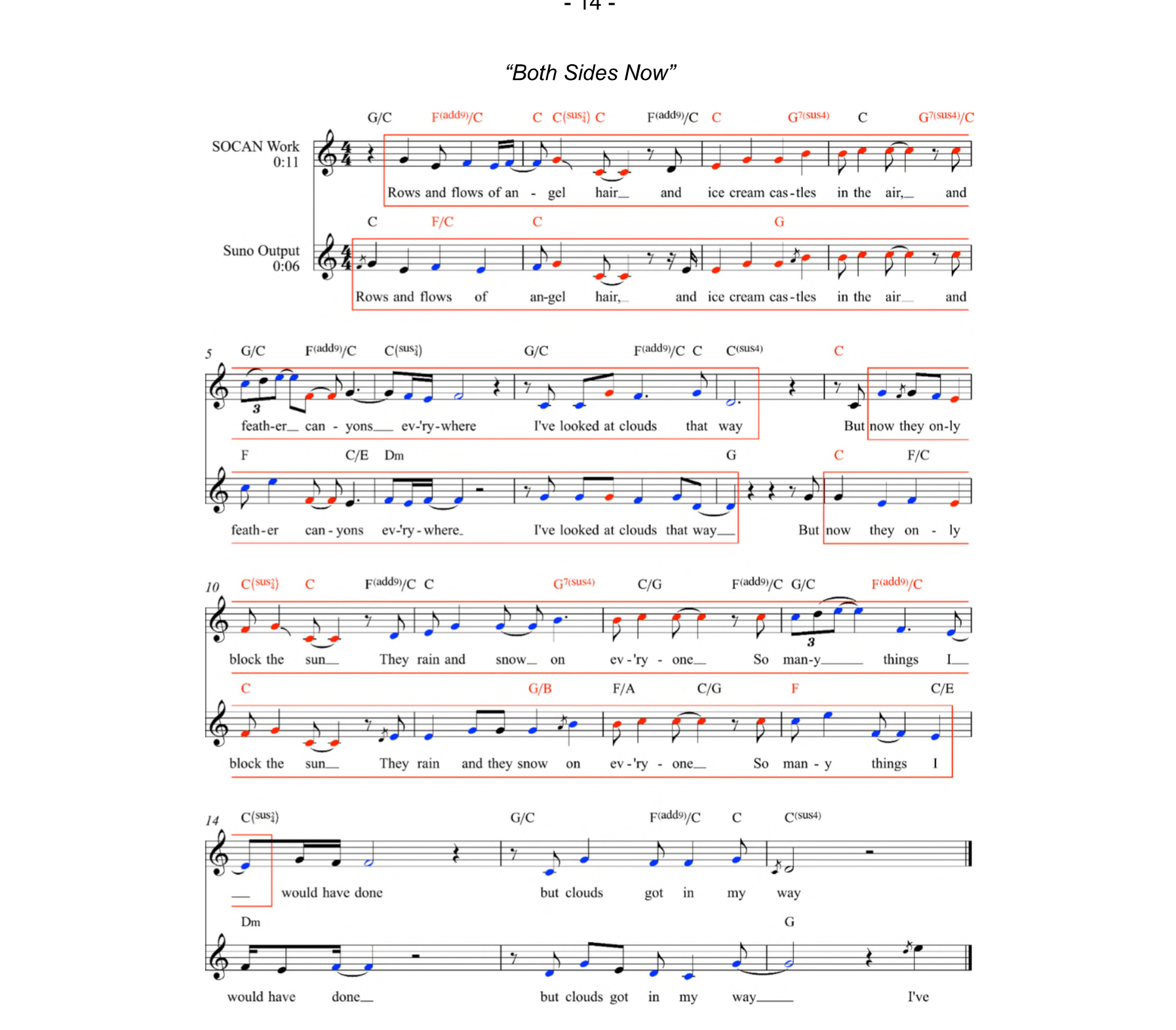
The lawsuit itself singles out a handful of songs for note-by-note comparison, among them Joni Mitchell‘s Both Sides Now.
SOCAN says a user fed Suno nothing but the lyrics, and got back a track “virtually identical” to the original – melody, harmony, and lyrics alike:
Top stave: the original song. Bottom stave: the Suno track. Red notation marks exact matches in melody and harmony.
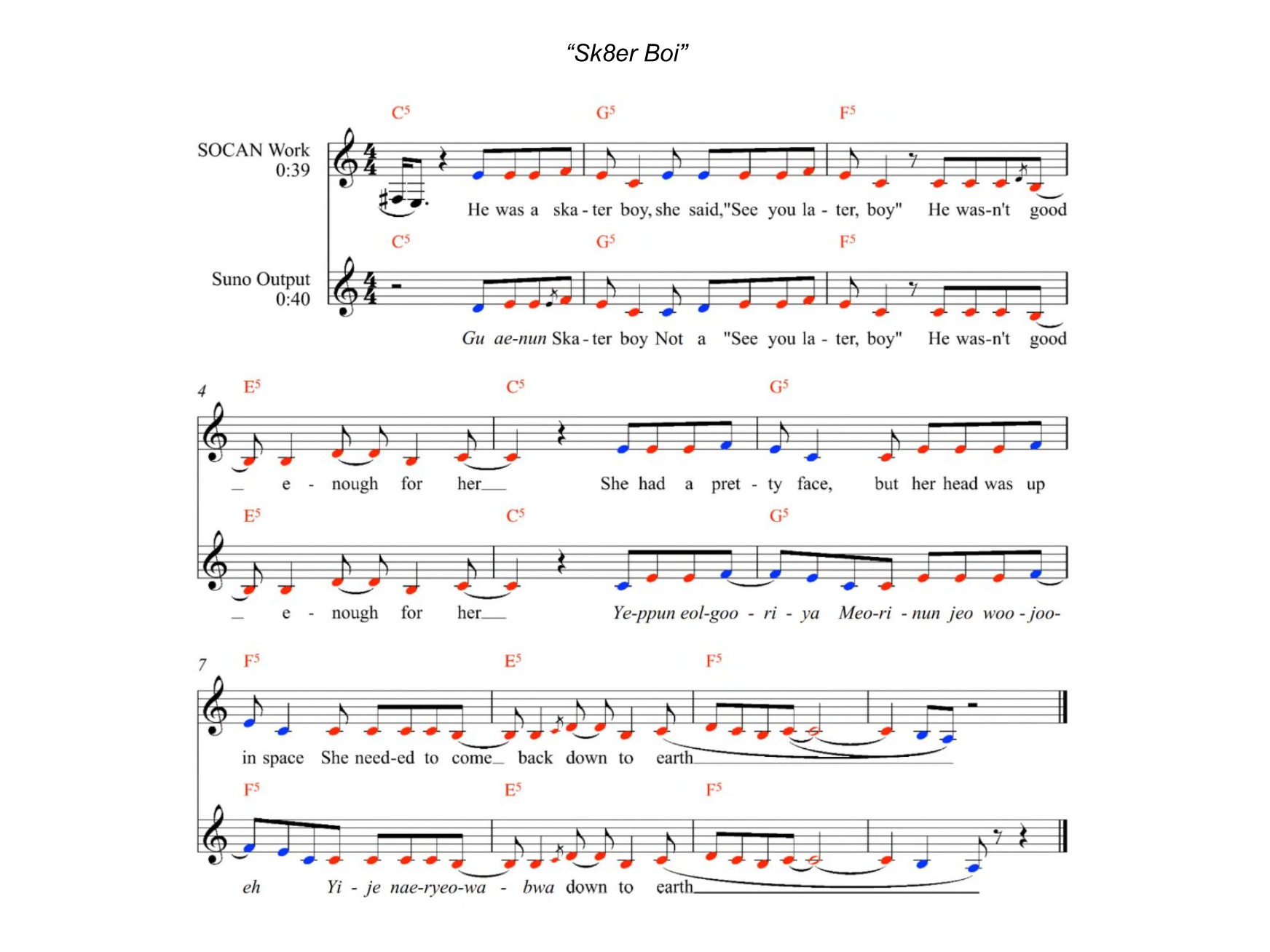
With Avril Lavigne‘s Sk8er Boi, SOCAN says Suno again turned out a track that was “virtually identical” to the original.
This time it swapped some of the lyrics for “their Korean equivalents.”
Suno‘s own apparent title for the track? Sk8er Boi (K-pop remix) (Avril Lavigne cover).
The phoneticized Korean lyrics are the words in italics.
SOCAN is demanding damages plus any profits Suno has made from the infringement, in a sum to be set at trial.
Alternatively, it seeks statutory damages of CAD $20,000 per song – the ceiling for commercial infringement in Canada.
Across Suno’s 150 cited outputs (which draw on 137 SOCAN-repped songs), that would come to CAD $2.74 million (approx USD $2m).
SOCAN is separately seeking punitive and exemplary damages of CAD $10 million, around USD $7.2m, for what it calls Suno‘s “wilful and knowing infringement” of its rights.
Neither figure operates as a cap, because SOCAN reserves the right to add further songs as the litigation proceeds.
Not everything on SOCAN’s cited song/output list is Canadian.
SOCAN also collects in Canada for songs written elsewhere, through deals with more than 100 societies in some 195 territories.
In addition, SOCAN is seeking two injunctions against Suno.
The first would permanently bar Suno from infringing its rights in the songs named in the lawsuit.
The second is what Canadian law calls a “wide injunction“, a remedy built for collecting societies.
It would cover not just those songs, but every song SOCAN represents now or comes to represent in future.
In SOCAN‘s case, that is a catalog the lawsuit describes as “virtually all copyright-protected musical works in current use in Canada.”
“SOCAN has a responsibility to act when the rights of music creators and publishers are put at risk,” said Jennifer Brown, CEO of SOCAN. “The evidence shows that the Suno platform has generated and streamed outputs that copy works in our repertoire, and that cannot go unchallenged.
“Innovation can’t come at the expense of human creativity. The future of music must belong to the people who make it.”
“The evidence shows that the Suno platform has generated and streamed outputs that copy works in our repertoire, and that cannot go unchallenged.”
Jennifer Brown, SOCAN
“Suno’s failure to meet its copyright obligations led us to pursue litigation,” said Andrea Kokonis, SOCAN‘s Chief Legal Officer and General Counsel. “Our evidence is clear, and so is our objective: to establish that AI companies must respect the rights of music creators and publishers.
“This case is fundamentally about ensuring that long-standing copyright principles continue to apply in the AI era.”
Asked on its own litigation page whether Suno pays it anything, SOCAN‘s answer is that it “has neither issued a licence nor received any royalty payments” from the company.
The claim cites Suno‘s own account of its training data, describing a model built on “virtually all music files of reasonable quality” available online.
SOCAN puts that at “at least hundreds of millions of audio files,” taken without permission.
SOCAN also turns Suno‘s content filters against it.
“Suno‘s recent introduction of so-called ‘guardrails’ that apply to the generation of new outputs – years after its launch – confirms both that it is aware of the infringing nature of its business model and that it could have taken steps much earlier to seek to prevent infringement,” the claim argues.
SOCAN is represented by Cassels Brock & Blackwell LLP, with Casey M. Chisick, Eric Mayzel, Andrew Skodyn, and Katherine Graham acting for the society.
SOCAN has proposed that the action be tried in Toronto, and says it will not comment beyond the court record.