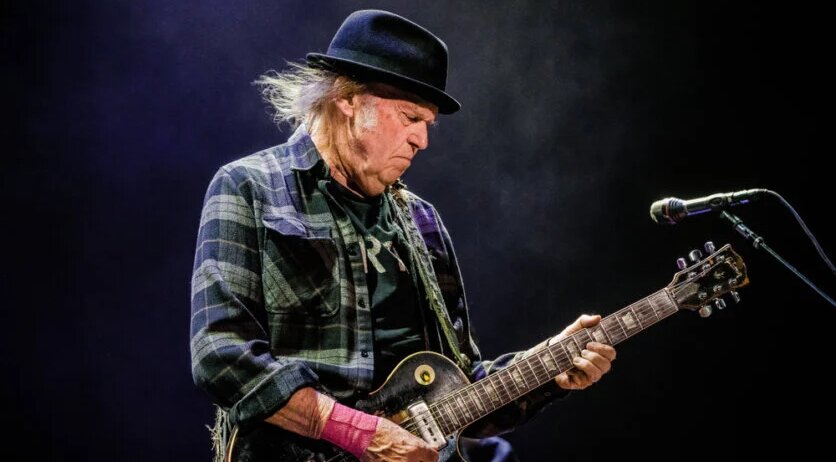
Neil Young is suing a Donald Trump fundraising committee for USD $10 million over the use of his song Rockin’ in the Free World at a political rally.
The complaint was filed against Trump 47 Committee, Inc. in the US District Court for the Eastern District of Virginia on Monday (October 26).
The five-page filing, obtained by MBW, can be read in full here.
The lawsuit alleges that the committee had the 1989 song played without a license just before Trump took the stage to speak at a rally in Youngstown, Ohio, on October 12.
Trump himself is not named as a defendant. The complaint also lists five unnamed “Doe” defendants, whom Young says he will name once they are identified.
The suit describes the committee as a Virginia corporation that funds and runs rallies urging people to vote for Republican candidates in the November 3 midterm elections.
Trump originally set up the committee with the Republican National Committee to raise money during the 2024 election cycle, according to Rolling Stone. A January 2025 filing with the Federal Election Commission lists Trump’s Save America PAC and the RNC among 53 joint fundraising participants, most of them state Republican parties.
It is the second time Young has gone to court over a Trump-linked group’s use of the song.
Young’s complaint states that the committee “does not now have, and did not at the time of the Youngstown Rally or any other rally financed and conducted by the Committee, have a license or Young’s permission to play the Song at any public political event.”
It also alleges that the committee “has caused the Song to be played numerous times at other rallies designed to encourage Republican votes in the upcoming mid-term elections.”
The complaint goes on to describe Young’s song: “Rockin’ in the Free World is a blistering anthem that contrasts the hollow promises of American political rhetoric with the harsh realities faced by the poor, homeless and forgotten.
“The lyrics paint vivid street-level portraits – a mother discarding her baby, addicts lost in despair, garbage piling in the shadows of prosperity – while the repeated chorus delivers a savage irony, celebrating freedom that clearly isn’t shared by all.
“In short, the Song is the opposite of everything that Donald J. Trump stands for.”
The filing adds that the song, first released in 1989, remains hugely popular, having been performed “even within the last few weeks by numerous famous musical artists such as Roger Daltrey, Lucinda Williams, Bruce Springsteen, Dave Grohl, Dave Matthews and Billy Strings, resulting in the Song being named Vintage Rock Song of 2026 by Rolling Stone Magazine.”
The lawsuit claims, on information and belief, that Trump “is now and at the time of all rallies this year was personally aware that a license would be required to play the Song at rallies and that Young has not, and would not, grant the required license.”
“… the Song is the opposite of everything that Donald J. Trump stands for.”
Neil Young‘s complaint
It accuses the Trump 47 Committee of having “willfully proceeded to cause the Song to be played despite its lack of a license and despite its knowledge that a license is required to do so.”
The suit points back to Young’s 2020 case against Donald J. Trump for President, Inc., Trump’s reelection campaign committee at the time.
According to the new filing, the Trump campaign “asserted no defense and immediately settled shortly after it was served, promising that it would never again use Rockin’ in the Free World without a license and permission from Young.”
The filing does not disclose any other terms of the 2020 settlement.
Young filed the earlier suit in Manhattan federal court in August 2020, over the campaign’s use of Rockin’ in the Free World and Devil’s Sidewalk at events including a rally in Tulsa, Oklahoma.
That suit sought the maximum statutory damages for willful infringement, which US copyright law caps at USD $150,000 per work.
Young ended that case in December 2020, stipulating to its dismissal with prejudice, which barred the claims from being brought again. At the time, neither side publicly confirmed that the case had been settled.
This time, Young is seeking USD $10 million in damages. The filing does not say how that figure was calculated.
Because the USD $150,000 statutory cap applies per work rather than per performance, a claim of that size over a single song would need to rest on actual damages or the committee’s profits.
He is also asking the court to bar the committee, both while the case is under way and permanently, from publicly performing the song or any other composition Young owns, and to award him costs and attorney’s fees.
On the harm alleged, the complaint says Young has suffered, and continues to suffer, “great injury,” including “damage to his reputation and brand as a result of the implication that he supports Donald J. Trump in any way.”
Young first objected to Trump’s use of the song in June 2015, after it was played at Trump Tower as Trump announced his first presidential campaign.
“Donald Trump was not authorized to use Rockin’ in the Free World in his presidential candidacy announcement,” Young’s management said in a statement at the time. “Neil Young, a Canadian citizen, is a supporter of Bernie Sanders for President of the United States of America.”
Young, who was born in Canada, became a US citizen in 2020.
In February, Trump and the estate of Isaac Hayes settled a copyright lawsuit over the use of Hold On, I’m Coming at Trump rallies.
The estate alleged that the song had been played at least 133 times between 2020 and 2024. The terms of that settlement were not disclosed.
A judge in that case found that BMI had told Trump’s campaign in June 2024 that the song’s owners objected to its use, which effectively removed it from the campaign’s blanket license.
ABBA and the White Stripes are among the dozens of acts that have objected to Trump’s campaigns using their music.
Young’s new lawsuit concerns his rights in the composition of Rockin’ in the Free World, rather than in any recording, and describes him as the song’s writer and co-owner of its copyright. It does not name any other owner.
In January 2021, Hipgnosis Songs Fund acquired a 50% stake in Young’s entire song catalog of 1,180 compositions.
Industry experts consulted by MBW at the time valued that deal at around USD $150 million.
Blackstone took Hipgnosis Songs Fund private in 2024 and, in 2025, consolidated it with its other Hipgnosis assets as Recognition Music Group. In July, Sony Music Publishing completed its acquisition of Recognition’s entire music rights portfolio, including the Young stake, in partnership with the music rights venture Sony Music Group launched with Singapore’s GIC.Music Business Worldwide