Live Nation held its annual investor presentation last Tuesday (November 10), during which the company’s leadership team, including President and CEO Michael Rapino, President and CFO Joe Berchtold, and Venue Nation Global President Jordan Zachary, outlined its growth plans through 2031.
Zachary said Live Nation is targeting USD $850 million of adjusted operating income (AOI) from its venue investments by 2031, up from $125 million this year.
That target includes a pipeline of 38 large venues (over 3,000 capacity) requiring a total of $5.6 billion in capital, $1.9 billion of which Live Nation will fund from its own cash.
Zachary said Live Nation’s venue strategy will draw 33 million fans by 2031, up from 11 million today.
A year ago, at its 2025 investor presentation, Live Nation put 48 large venues in its pipeline, at a capital cost of around $5.2 billion.
At the time, Zachary said those venues would deliver about 30 million fans and $600 million of AOI.
The presentation came five days after Live Nation reported Q3 revenues of $10.1 billion, up 19% YoY.
Beyond the venue numbers, here are five things to know from the session…
1. Rapino suggests live music is less exposed to AI than the labels
AI poses challenges for many companies, including record labels, Rapino told investors, but Live Nation wants to “embrace it.”
Later in the session, he said Live Nation is “not affected by AI” in the way other industries are, citing record labels as a possible example.
Every Live Nation division now briefs Rapino, in what he called a “bimonthly process,” on how it has reorganized around “AI-centric smart thinking.”
Omar Al-Joulani, Live Nation’s President of Touring, said the company is “building agents for all the different teams.”
Live Nation will not, however, hand its checkout or ticket inventory to AI platforms, according to Rapino. “We’re not going to give Chat our funnel,” he said.
Ticketmaster Global President Saumil Mehta, meanwhile, said the company is building its own AI “fan agent” to sit alongside its existing integrations with platforms including ChatGPT and Anthropic’s Claude.
He also said the share of Ticketmaster’s engineers using Anthropic‘s Claude Code daily had risen from about 4% when he joined a year ago to around 98%.
2. Rapino sees a subscription business in Live Nation’s 14-million-member ‘quiet little club’
Live Nation All Access, the company’s fan membership program, launched around a year ago, according to Al-Joulani.
“We already have 14 million members,” said Al-Joulani. “And those 14 million people went to 34% more shows than they went to over the last three years.”
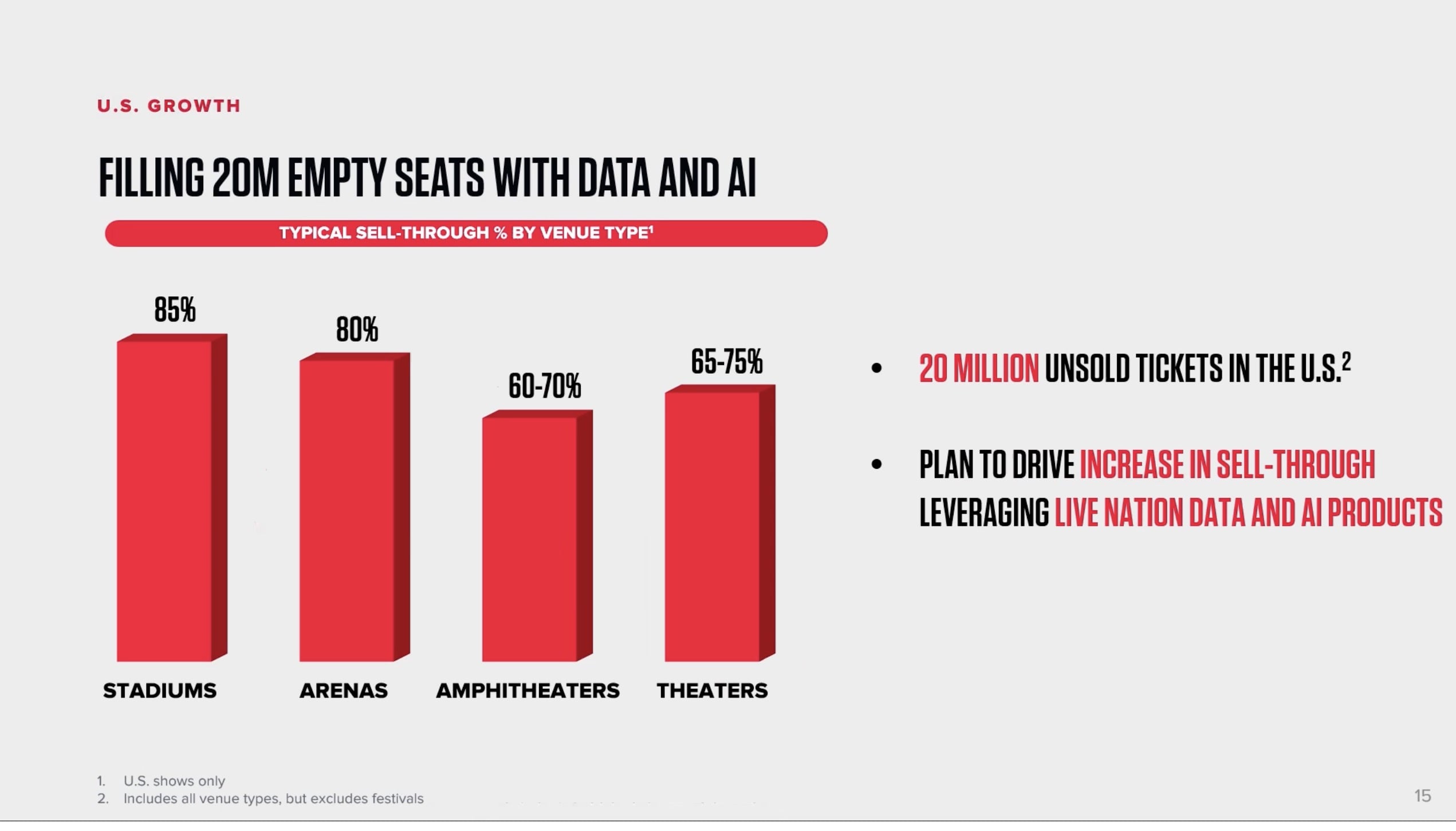
Al-Joulani said Live Nation is now using “our data and our AI approach” with All Access to sell more of its “20 million empty seats.”
All Access is free to join, and fans who sign up for artist presales for Live Nation’s US shows are automatically enrolled, according to Live Nation’s website.
It is separate from Veeps All Access, the paid concert-streaming subscription launched in 2023 by Live Nation-backed Veeps.
Asked by Oppenheimer analyst Jed Kelly about the potential for a subscription or membership offering, Rapino pointed to All Access.
He described All Access as a “work in progress” and “kind of a quiet little club we’re building.”
The Live Nation CEO added that the company thinks “there’s a big, big story there over time of building a membership subscription business with fans.”
In May, Spotify named Live Nation as the launch partner for Reserved, a feature that holds concert tickets for artists’ most dedicated Premium subscribers.
Russell Wallach, Live Nation’s Global President of Media & Sponsorship, told investors the Spotify partnership, which launched in the US this year, will expand to EMEA and Australia in 2027.
3. More artists can now afford to play stadiums, says Rapino
Asked by Goldman Sachs analyst Stephen Laszczyk about growth in stadium touring, Rapino said stadium shows had become “much more accessible to artists that you wouldn’t have thought were stadium acts.”
“These artists historically weren’t able to afford a Rolling Stones production. That was just kind of rare air, vintage wine,” said Rapino.
“Now if you’re Noah Kahan, you can sit with the lighting and production company and come up with your own show at a price that makes sense for you to travel for 10 or 15 shows. So that overall cost per show has come down, although the quality has gone dramatically up.”
Artists now weigh options such as “a 15-stadium run versus 35 arenas,” according to Rapino.
Live Nation has also become “so good at sharing costs” between acts, the company told investors.
“So you’ll see we’ll do six shows at MetLife Stadium with six different bands over eight days. There’s a lot of cost sharing that goes on there,” said a Live Nation executive.
In Q3, fan attendance at third-party stadiums rose more than 40% YoY, accounting for more than half of Live Nation’s global fan growth, according to the company’s results.
4. Live Nation says the live business is growing faster outside the US – but the arenas are missing
The global live business is growing by about 8% a year, according to Rapino, with international markets growing at around 10% to 12%-plus and the US at 6% to 7%.
Live Nation’s international markets overtook the US in fan attendance this year, according to the company’s Q3 results.
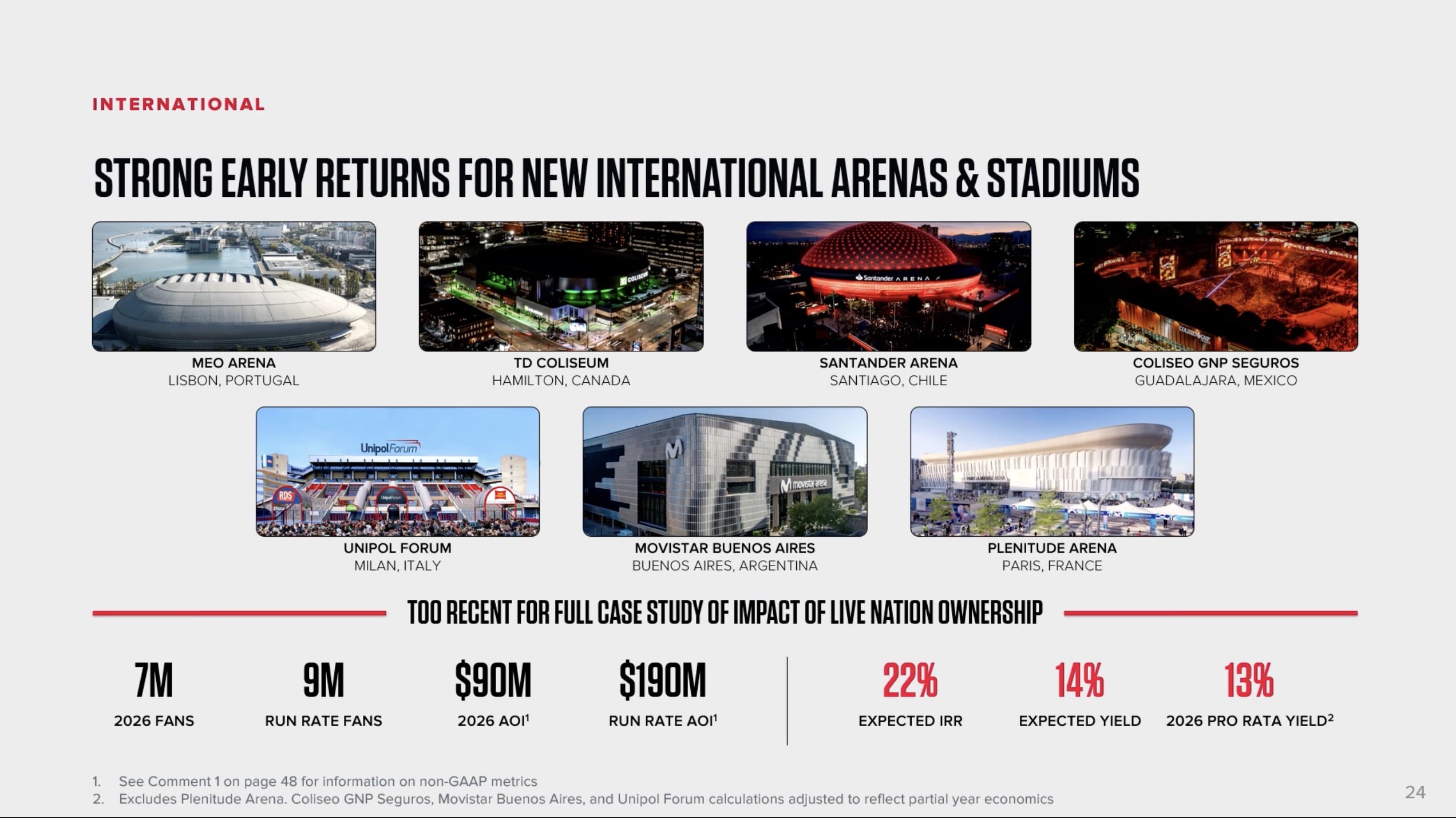
Zachary said Live Nation’s owned and operated venue portfolio is now “basically already 50-50” between international and domestic, and half of the 38 venues in its pipeline are outside the US.
The next wave of headliners is “younger and more global,” according to Al-Joulani, with artists now “coming out of the Middle East” and Southeast Asia.
Average box office grosses for a sample of AAA artists touring this year were comparable across Asia, Europe, Latin America, and North America, with Europe and Asia slightly ahead, Live Nation told investors.
The constraint, according to the company, is infrastructure: 46 of the top 75 international cities, or 61%, do not have adequate arena capacity.
In September, Berchtold put the figure at 47 of the top 75 markets outside the US.
The company also said its international markets outside the UK and Ireland are under-indexed on fans per head of population, and that bridging half of that gap would unlock 185 million tickets.
5. Ticketmaster is targeting 490 million fee-bearing tickets a year
Ticketmaster is on track to sell 360 million fee-bearing tickets in 2026, according to Mehta.
Its long-term target is 490 million, based on a compound annual growth rate of 6%.
He pointed to Brazil as the template for international growth.
The company launched there in 2023 to support Live Nation’s own concerts and festivals, and sold fewer than 1 million fee-bearing tickets that year, 76% of them for Live Nation shows.
In 2026, it expects to sell 9 million fee-bearing tickets in Brazil, with Live Nation concerts accounting for 26%.
Ticketmaster went live in Japan this month, following Live Nation’s acquisition of promoter Hayashi International Promotions in April 2025.
In Japan, the “vast majority” of tickets are picked up at 7-Eleven and other convenience stores and paid for in cash, according to Mehta. He added that “almost nothing is sold with a seat map, which is shocking for the average American consumer.”