
Dennis Hausammann was a rising rapper before setting out to build AI-powered tools for indie label founders.
As a young artist in Switzerland, Hausammann signed a record deal and quickly discovered what he describes as “the operational realities of the industry,” and especially, he says, “the lack of transparency around revenue and reporting.”
“I initially thought I would build a career as an artist, but I quickly realized my strengths were elsewhere,” he tells MBW. “What stayed with me was a clear understanding of the structural problems in the business and a strong desire to solve them.”
Alongside his bourgeoning music career, Hausammann had spent years managing software projects for Swiss banks and insurance companies, an environment where, as he puts it, “precision is not a feature, it is the product.”
That combination of Swiss engineering discipline and firsthand experience of the problems he’d encountered as an artist would eventually produce iGroove, a Swiss distribution and technology company he founded in 2012.
iGroove launched with what Hausammann, the firm’s CEO, describes as a simple premise: “Make selling music digitally as easy as selling CDs on the street.”
He built a system that let fans send a text message, receive a download link, and have the payment added to their mobile bill. No credit card, no sign-up.
A year later, iGroove was recognized in the ‘Newcomer’ category at the Swiss E-Commerce Awards. “That brought real attention from the music industry,” Hausammann recalls, “and the first question people asked was: who built this?“
That recognition led to previous partnerships with the likes of [PIAS] and, eventually, with current US partners including Mike Caren‘s APG (release.global) and Hitmaker Distro, both of which, according to Hausammann, used iGroove’s white-label infrastructure to “take meaningful market share” stateside.
Today, Switzerland-headquartered iGroove supports around 1,000 labels and artists on its own platform. The company also says that it remains entirely self-funded. “We have seen consistent growth over the years and have built a business that is both profitable and sustainable, without reliance on external venture capital,” Hausammann tells us.
Two years ago, rather than layering AI on top of what iGroove already had, Hausammann rebuilt the entire system from scratch, with AI at its core.
The result is Label OS: the infrastructure that now powers iGroove internally, and which the company is opening up to other labels. It’s designed to reduce the administrative burden on indie labels, which Hausammann describes as the “operations tax”.
“Tasks like scouting TikTok for artists, quality-checking releases, modeling deals, generating statements, processing payments, tracking recoupments,” he explains. “These are real costs that scale linearly with every new signing. The more successful a label becomes, the heavier the tax gets.”
In practice, the AI-driven Label OS platform handles the core operational work of running a label: distribution, royalty accounting, payments, splits, contracts, and recoupment; all automated.
On top of that sits an analytics layer that combines streaming revenue, audience data, and social media signals to surface opportunities across a label’s roster.
And underpinning the whole system are AI-powered agents that can take over routine tasks like modeling deals, generating financial reports, and identifying which tracks are breaking.
The agents can then present the results to the label founder rather than requiring them to navigate dashboards or spreadsheets to find the answers themselves.
Label OS is distribution-agnostic, meaning labels don’t need to move their distribution to iGroove to use it. By the end of the year, Hausammann says, it will function as “a complete intelligent experience” regardless of where a label distributes.
Hausammann estimates that roughly 6,500 professional independent labels globally generate between $100,000 and $5 million in annual revenue. He describes them as caught in a gap: “too complex for DIY tools and too small for enterprise solutions.” A typical label in that range, he argues, spends between $125,000 and $200,000 per year on work that should be automated.
“The next generation of labels will not accept this cost structure, they will replace it,” he argues.
Hausammann is candid about what that implies. “The reason nobody says this out loud is optics,” he says. “It implicates jobs, headcount, career paths. But it is true.”
His argument is that when the operational burden lifts, “what is left is the work that actually builds careers,” including “relationships, artist development [and] being present in the culture.”
He adds: “For the first time in the history of the music business, a five-person team with the right AI-powered infrastructure can outcompete a 50-person organization. The labels that recognize it first will define the next decade of independent music.”
Here, Hausammann explains how Label OS was designed to address the ‘operations tax’ in the music business, how he’s approaching the trust problem around AI in music, and what he thinks independent labels will look like in five years…
You rebuilt your entire technology stack from scratch two years ago. Why was a full rebuild necessary rather than bolting AI onto what you already had?
Since the company started, like most companies that have been around for many years, our tech stack kept layering new enhancements over old source code. Over time, this created a suboptimal infrastructure for AI to access, understand, and modify.
We had the chance to rethink everything from scratch. How would we rebuild everything we [had] learned, knowing from day one that AI needs to operate on it?
“Putting all of this on top of a legacy system would [have made] it significantly harder to reach the same quality.”
So we rebuilt the entire architecture. Infinitely scalable. Full observability with logging and monitoring across every layer. Every data pipeline and ETL process renewed. Every data field described with enough context for AI to fully understand the operations. We built guardrails and quality checks so that when AI takes over operational tasks, it can be monitored and verified at the highest level.
Putting all of this on top of a legacy system would [have made] it significantly harder to reach the same quality. At the velocity AI can operate, you need infrastructure that was designed for it.
Could you break down what Label OS actually does?
Label OS replaces the core operational infrastructure of a modern label across three areas.
[First is the] financial and operational backbone: distribution, payments, splits, contracts, and recoupment — fully automated with real-time accuracy.
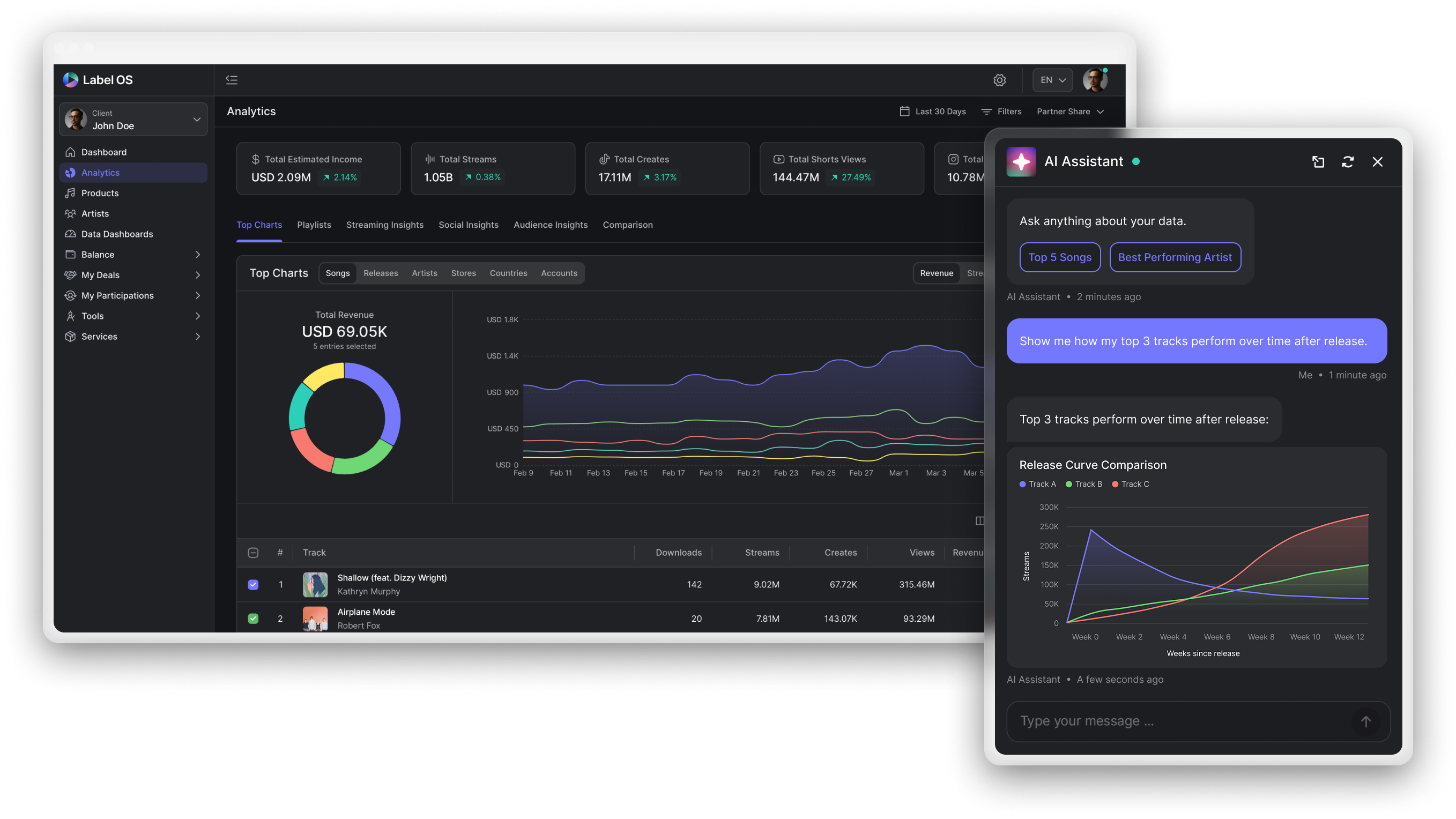
[Second is the] intelligence layer: deep analytics across your roster and the broader market, combining revenue, audience, and social data to guide decisions.
[Third is] agentic execution. Instead of navigating dashboards, you interact directly with your system. Over time, agents take over tasks like deal modeling, reporting, and opportunity identification, and present outcomes, not workflows.
This is not a new product. iGroove already runs on Label OS internally, alongside our white-label partners. Every part of the system has been shaped by real-world label operations, not theoretical product design.
“We built the entire tech stack around AI, transparency, and data accuracy. Others focused on growing their business. We were quiet. We grew by recommendation.”
Most companies in this space focus on distribution and try to add AI on top. What specifically differentiates iGroove and Label OS?
We are different because we come from being a software development company that also runs a record label. For us, AI is not an add-on. It is something we believe will change the entire way software works and how services are executed.
We are fundamentally an AI-native system.
“We are fundamentally an AI-native system.”
We saw the importance of data early. We invested massively in our data science department even in the early days. We started building real-time translation from streams into revenue calculations six years ago to provide absolute financial clarity to our customers.
That is what separates us. We built the entire tech stack around AI, transparency, and data accuracy. Others focused on growing their business. We were quiet. We did not run marketing. We grew by recommendation. Even when we had one person in sales and 15 in development, we were more like a Swiss engineering company than a sales-driven [one]. Focused on precision. Now we have reached a level where we can proudly start becoming louder.
Can you give us more insight into the AI software underpinning the platform?
AI is involved across all corners of the company. We have our own AI development engine, comparable to tools like Lovable or Replit. It is built specifically for our tech stack and allows us to ship products and features within days that used to take weeks or months.
We have an extensive testing framework built on AI, shaped by my banking background and how Swiss banks approach software testing. We have a complete framework for agentic operations: multi-agent orchestration with strict guardrails, validation layers, and monitoring into every workflow to ensure reliability and traceability.
The most advanced agent today is our Talk to Data agent. It analyzes your data, gives recommendations, and has a built-in UI engine that visualizes everything in easy-to-read charts and graphs. It does not just return some output like a generic language model. It applies knowledge from playbooks and presents data the way the music industry actually looks at it — for example, on a weekly aggregation.
The music industry has a trust problem with AI. How do you get a label founder to hand over their royalty accounting to an AI-powered system?
This is not just a music industry question. Any time you introduce AI into critical workflows, especially around financial data, trust becomes the central issue.
The way we approached this was not by asking people to trust AI upfront, but by building systems that earn that trust through how they operate.
“Any time you introduce AI into critical workflows, especially around financial data, trust becomes the central issue.”
That starts with structured data, where every field is clearly defined and contextualized, so AI is not interpreting ambiguous inputs. From there, we built validation layers, monitoring systems, and auditability into every workflow, so outputs can be checked, traced, and verified at any point in time.
Importantly, this is not new for us. iGroove has already been running on Label OS internally for years. That means these systems have been shaped, stress-tested, and refined through actual label operations, not controlled environments.
“Over time, the question will not be whether you trust AI. It will be how you operate competitively without it.”
The role of AI in this context is not to replace oversight. It is to handle execution at scale, while humans remain responsible for validation and decision-making.
Do labels need to move their distribution to iGroove to use Label OS?
Since we understand that switching a distributor requires a lot of trust, and sometimes it is not even desired because labels are happy with their current setup, we are building a system that does not require you to distribute with us.
First, data dashboards. We can pull analytics about any artist and give you the opportunity to deep-dive into those analytics. Second, forecasting and deal modeling. You can model what the profitability would look like based on a specific advance, distribution fee, or label share, and then streamline the creation and sending of offers.
Over time, this will expand to connecting other data sources, loading statements, doing royalty accounting using external statements, and much more directly on the platform. By the end of the year, it will be a complete intelligent experience that does not require distribution with us.
Even if you do distribute with us, you benefit from more granular data, which amplifies the intelligence layer. But it is not required.
You’ve said that the skill of the future isn’t doing the work — it’s teaching your systems how the work should be done. What does that actually look like for a label founder?
For a label founder, it means you define how your business operates, and the system continuously learns and supports your day-to-day work with built-in safeguards.
You wake up in the morning and your agent tells you: based on your search criteria, I found three new artists that fit your roster. I analyzed their distribution situation and saw they are currently distributing through DistroKid. I modeled some deals. Based on your preferences for advance sizes, you could offer a $500,000 advance for the next three songs including the catalog. I spotted three marketing opportunities to leverage the existing catalog. I found two people in your network who have a relationship with that artist. I drafted outreach messages in your inbox.
The label founder reviews the messages and fine-tunes the tone. The system already understands their voice from initial setup and prior interactions, and continuously adapts.
It feels similar to training an employee and giving instructions. The difference is that the system learns continuously and executes at scale, shifting your role from doing the work to directing and refining how it gets done.
What’s your prediction for how AI will reshape the independent music landscape over the next five to ten years, and what role do you see Label OS playing in that?
I don’t think anyone has a clear picture of what five to ten years will look like.
What we do know is that we’re building from first principles, with a clean foundation designed for an AI-driven future.
“The labels that embrace this shift will move faster, operate leaner, and ultimately create more impact.”
As operational complexity decreases, more time, energy, and capital will shift toward creativity, artist development, and brand building.
The people who learn to use AI effectively will massively outperform those who don’t.
The labels that embrace this shift will move faster, operate leaner, and ultimately create more impact.
What can’t AI do in label operations right now — and what will it be able to do in two or three years?
Three years is a very long time frame for AI. I think it will be able to handle the vast majority of what a human does today in label operations.
Where I still see a gap is around human relationships, taste, and trust. The music business is built on real relationships. Artists, managers, and partners still value sitting in a room together, building trust over time, and making decisions based on intuition and shared context. That is not something AI can fully replicate.
“Three years is a very long time frame for AI. I think it will be able to handle the vast majority of what a human does today in label operations.”
Taste is another layer. AI can generate and analyze, but knowing what feels right, what fits an artist, or what will resonate culturally still requires human judgment.
But on the operational side — things like accounting, reporting, deal modeling, and data processing — I expect AI to handle [that] almost entirely within the next few years.
Are you raising capital for Label OS, or keeping it self-funded?
We’re often approached by investors, and that remains an option. But we’ve built the company to be self-sustaining, which has allowed us to focus on long-term product development rather than short-term pressures.
We are proud to be self-funded with no VC investment. This puts us in a very comfortable position today. We do not need additional capital for further development.
If you could change one thing about the global music business, what would it be and why?
I would not change the creative side of the industry. That is already evolving in a very positive direction.
What I would change is the operational layer behind it. Today, too much of the music business still runs on fragmented systems, manual processes, and delayed financial visibility. That creates unnecessary friction for labels and artists who should be focused on building careers, not managing infrastructure.
” I would not change the creative side of the industry. That is already evolving in a very positive direction. What I would change is the operational layer behind it.”
The shift we are focused on is removing that operational burden entirely. When the administrative layer becomes automated and intelligent, decisions happen faster, and more time and resources can go toward creativity, artist development, and growth.
For me, that is the real opportunity. Not changing what the industry is, but enabling it to operate the way it should have all along.
Music Business Worldwide