
Ex-Warner execs Max Lousada and Julie Greenwald are joint owners of a pair of UK-registered companies.
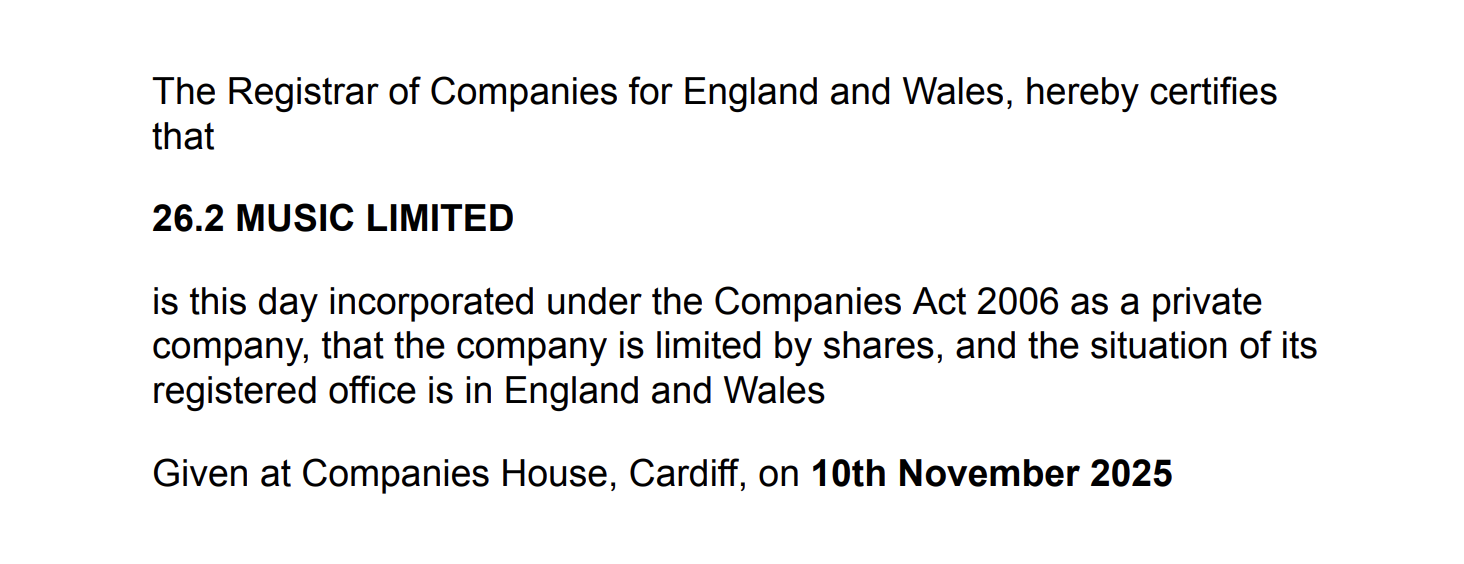
The two entities – 26.2 Music Ltd and 26.2 Services Ltd – were established in November, according to UK Companies House.
Lousada and Greenwald appear to be 50/50 stakeholders in both businesses. Companies House documents reveal that British exec Lousada and New Yorker Greenwald each own “more than 25% but not more than 50%” in the firms.
And that’s… pretty much all we know – for now.
The Times of London reported over the weekend that Lousada and Greenwald are “understood to be sounding out partners to help finance a joint venture”.
Yet in truth, the duo’s UK companies could just as easily be placeholders. The industry awaits confirmation of any more details.
Despite that lack of detail, the company names themselves might offer early hints at how Lousada and Greenwald are thinking.
For starters, 26.2 is the distance of a marathon in miles – perhaps a nod to the duo’s long-sighted approach to artist development (vs. a sprint).
But the clear distinction between ‘Music’ and ‘Services’ could hint at something even more significant.
The naming structure suggests that Lousada and Greenwald are considering a model that explicitly separates ownership/acquisition of music assets from their development and exploitation.
If MBW had to guess?
‘26.2 Music’ could acquire assets, both from established artists and rightsholders – but also from specialists in artist development.
And ‘26.2 Services’? That could (obviously) offer independent artists services – but could also develop music assets in tandem with those artists… which could then ultimately be acquired by ‘26.2 Music’.
As we say, just guesswork at this stage – but such a setup would play neatly into Greenwald and Lousada’s rich history of nurturing artists via patient A&R… before maximizing their potential with global hits.
Some argue that holding owned assets separately from an operating music exploitation company is beneficial to investors because the rights themselves might carry a stronger multiple when valued alone.
Lousada and Greenwald have likely considered this when holding talks with potential backers for their two companies.
Music’s two biggest public rights companies – Universal Music Group and Warner Music Group – are currently structured so that their owned rights and operational structures are combined, rather than ‘split out’ into separate entities.
That said, both UMG and WMG have recently launched sister ventures that focus exclusively on asset ownership.
Chord Music Partners is a joint venture between Dundee Partners and UMG, with Dundee the majority owner; Chord’s publishing and recorded music catalogs are typically serviced by UMG worldwide.
The assets of Chord – which include rights associated with major artists like The Weeknd, Lorde, David Guetta and more – were valued at USD $1.85 billion in 2024.
Chord has since significantly increased that value by raising over $2 billion, and spending nine-figure sums acquiring prized assets such as a stake in Morgan Wallen’s master recordings catalog.
Warner Music Group, meanwhile, launched a rights-acquisition-focused JV with Bain Capital last year, with $1.2 billion in spending power.
That venture, Beethoven JV 1 LLC, is 50/50 owned by Warner and Bain, with access to up to $700 million in debt funding.
Like Chord at UMG, Beethoven’s assets (once existing contracts with external industry partners have expired) are expected to be distributed and/or administered by WMG.
In recent years, other companies in the music industry have tested variations of ‘splitting’ the ownership and exploitation of music rights.
Downtown Music Holdings, for example, sold its owned catalog of 145,000 copyrights to Concord in 2021 for around USD $400 million, then forged ahead with a services-only model.
Downtown’s remaining services-only business is shortly expected to be acquired by Universal Music Group for around USD $775 million, so long as European regulators give it the green light. (The most likely scenario, we hear: Universal offloads Curve Royalty Systems to a willing buyer, alleviating EC competition concerns.)
Hipgnosis Songs Fund (HSF) was a rights-focused vehicle that largely outsourced administration and exploitation services to industry partners.
The rights portfolio of HSF, now owned by Blackstone/Recognition, was valued at USD $2.61 billion by Kroll Bond Rating Agency in March last year.
That’s some $400 million more than the $2.2 billion Hipgnosis founder Merck Mercuriadis spent to acquire the assets.
However, for large music companies, there are arguably potential downsides to separating their rights ownership ‘basket’ and their rights development/exploitation operation.
For one, steady cash flow from owned catalog helps today’s large music companies subsidize bets on new artist development – a safety net that could be diminished if catalog profits must first satisfy a separate group of shareholders.
There’s also the risk of added complexity: running two companies might require separate boards, reporting requirements, and contractual arrangements, adding unavoidable overhead and potential friction.
Both Max Lousada and Julie Greenwald exited WMG in 2024, with Lousada departing after 20 years at the company, including eight as CEO of Recorded Music.
Greenwald, who spent two decades at Atlantic Records, initially transitioned to the role of Chairman of Atlantic Music Group before exiting in January 2025.
Together, the duo’s track record includes working with artists such as Ed Sheeran, Coldplay, Dua Lipa, Bruno Mars, Cardi B, Lizzo and Megan Thee Stallion.
Lousada said in a statement at the time of his departure: “The music business has always been about evolution, and the time has come for me to build something new.”
Music Business Worldwide