On October 22, Spotify co-CEO Alex Norström did something unusual. He as-good-as-confirmed that the platform is currently negotiating renewals of its licensing agreements with Universal Music Group and Warner Music Group.
Guggenheim analyst Michael Morris noted on Spotify’s Q3 earnings call that SPOT’s current deals with UMG and WMG – announced in January and February 2025, respectively – reach their two-year mark in Q1 2027.
He then asked Norström about prospective renewal talks.
Remaining light on details, Norström said: “This is a recurring 2-year rhythm [to licensing deals] that we’ve more or less had forever in Spotify’s lifetime. And to your point, now we’re coming up on another one.”
Norström’s tone on these renegotiations was positive: “We’re excited; we’re working with our partners and the relationship is just improving… primarily because our interests are aligned.
“When our interests are aligned and growing even more aligned, then that makes it easier for us to create win-win situations.”
There is, however, a basic issue currently testing the mutual ability of Spotify and music’s biggest rightsholders to keep on growing “even more aligned.”
In short: Spotify’s gross margin.
In particular: the fact that labels, distributors, and artists now appear to be sacrificing over USD $700 million a year on Spotify’s ‘Marketplace’ tools – including Discovery Mode.
Spotify’s 40% gross margin target
First, let’s deal with the basics.
Spotify’s gross margin represents the share of revenue the company keeps after paying music rightsholders, plus audiobook and podcast rightsholders, plus payment processing fees.
It’s the key indication of how much of streaming’s revenue ‘pie’ is kept by Spotify vs. its content partners – with music the biggest partner by far.
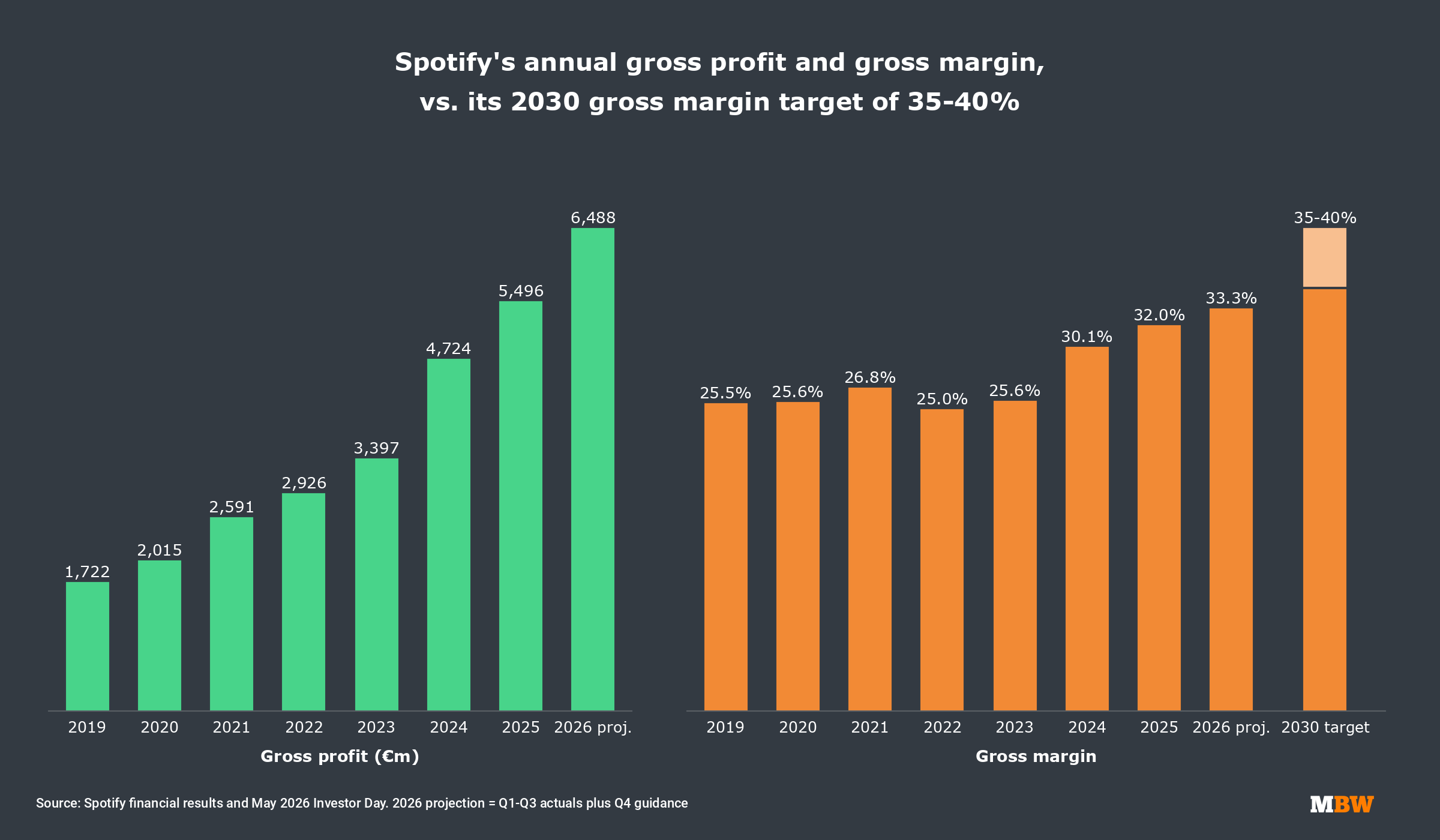
Between 2018 and 2023, Spotify’s gross margin consistently hovered between 25% and 27%.
In other words, roughly three-quarters of every euro Spotify brought in was then spent on its ‘cost of revenue’ – the bulk of it on music royalties.
This year, Spotify’s own guidance implies its gross margin will rise to roughly 33.3% – leaving around two-thirds of revenue for partners and other costs.
And Spotify has a vision of further improving its fortunes.
At its Investor Day in May, Spotify told Wall Street it’s targeting a gross margin of 35%–40% by 2030.
At the top of that range, the share of its revenue going on ‘cost of revenue’ – including the share paid out to music rightsholders – would obviously shrink to 60%.
Here’s another way of telling a similar story.
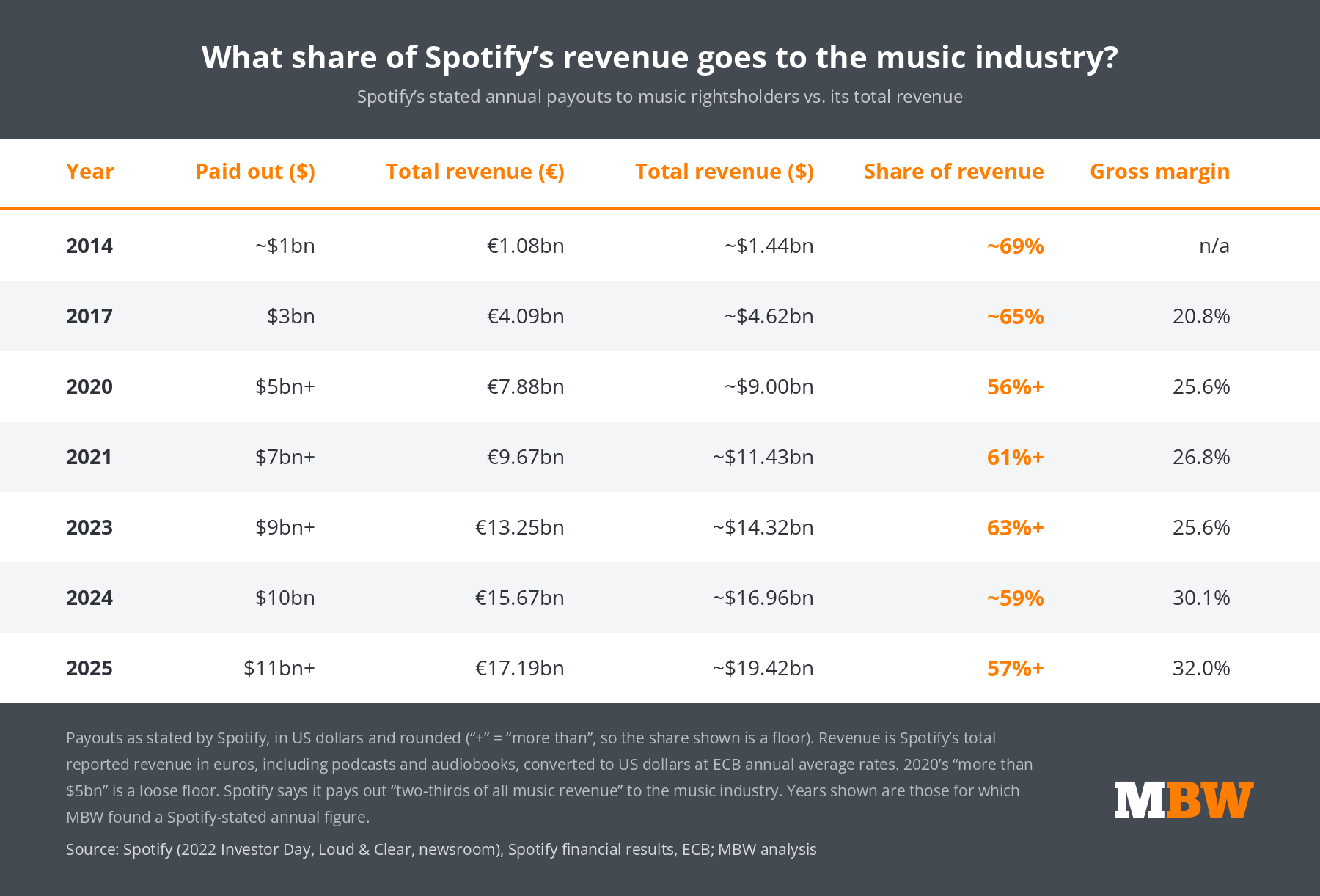
In 2023, Spotify said it paid the music industry “more than [USD] $9 billion” in royalties.
This was equivalent to roughly 63% of its total revenue that year.
In 2025, Spotify paid out “more than $11 billion” to music rightsholders.
That was equivalent to roughly 57% of its revenue.
Do you see the pattern?
Since 2023, music’s payout from Spotify has continued to grow in absolute terms – but, at the same time, it’s shrunk significantly as a share of the streamer’s total revenue pie (see below).
A big part of this story, of course, is due to the growth of Spotify’s non-music businesses, such as podcasts and audiobooks.
But there’s more at play, too.
Earlier today (November 19), Spotify’s CFO, Christian Luiga, spoke at Morgan Stanley’s European Technology, Media and Telecom Conference.
Analyst Sean Diffley asked him to name the biggest drivers that would carry Spotify’s gross margin to that 35%–40% target by 2030.
The very first thing Luiga named? ‘Marketplace’.
“[In] the future, our Marketplace is a fantastic lever for margin,” he said.
“That will, on top of our [music rightsholder] agreements, then help us to drive margin. And it still has room to improve the margin.”
When Luiga says “Marketplace,” what he really means is this: money that labels, distributors, managers, and artists hand back to Spotify – via lower royalties or marketing spend – in exchange for promotion on its platform.
Or, as a cynic might put it: money Spotify is now very successfully clawing back from the music industry. And increasingly so.
$700M per year? What ‘Marketplace’ actually costs
The best-known of Spotify’s ‘Marketplace’ tools is Discovery Mode.
Launched in 2020, it lets artists and labels opt in to accept a lower royalty rate on selected tracks, in return for those tracks being pushed by Spotify’s algorithm.
Spotify then takes a 30% commission on the recording royalties these tracks generate in various algorithmic contexts, such as Spotify Radio and Autoplay.
Discovery Mode’s critics call it ‘payola’; its supporters say it can give artists a lucrative edge over their competition.
‘Marketplace’ also includes paid promotional tools such as Marquee and Showcase, funded from labels’ marketing budgets.
Spotify has never hidden what Discovery Mode, Marquee, Showcase etc. do for its margins.
At its 2022 Investor Day, Charlie Hellman, then Spotify’s global head of music product, said: “These marketplace businesses have been the primary factor in growing our music gross margins.”
But it’s fair to say this impact has exploded in recent years, to a stunning degree.
Back at its 2022 Investor Day, Spotify showed the slide below.
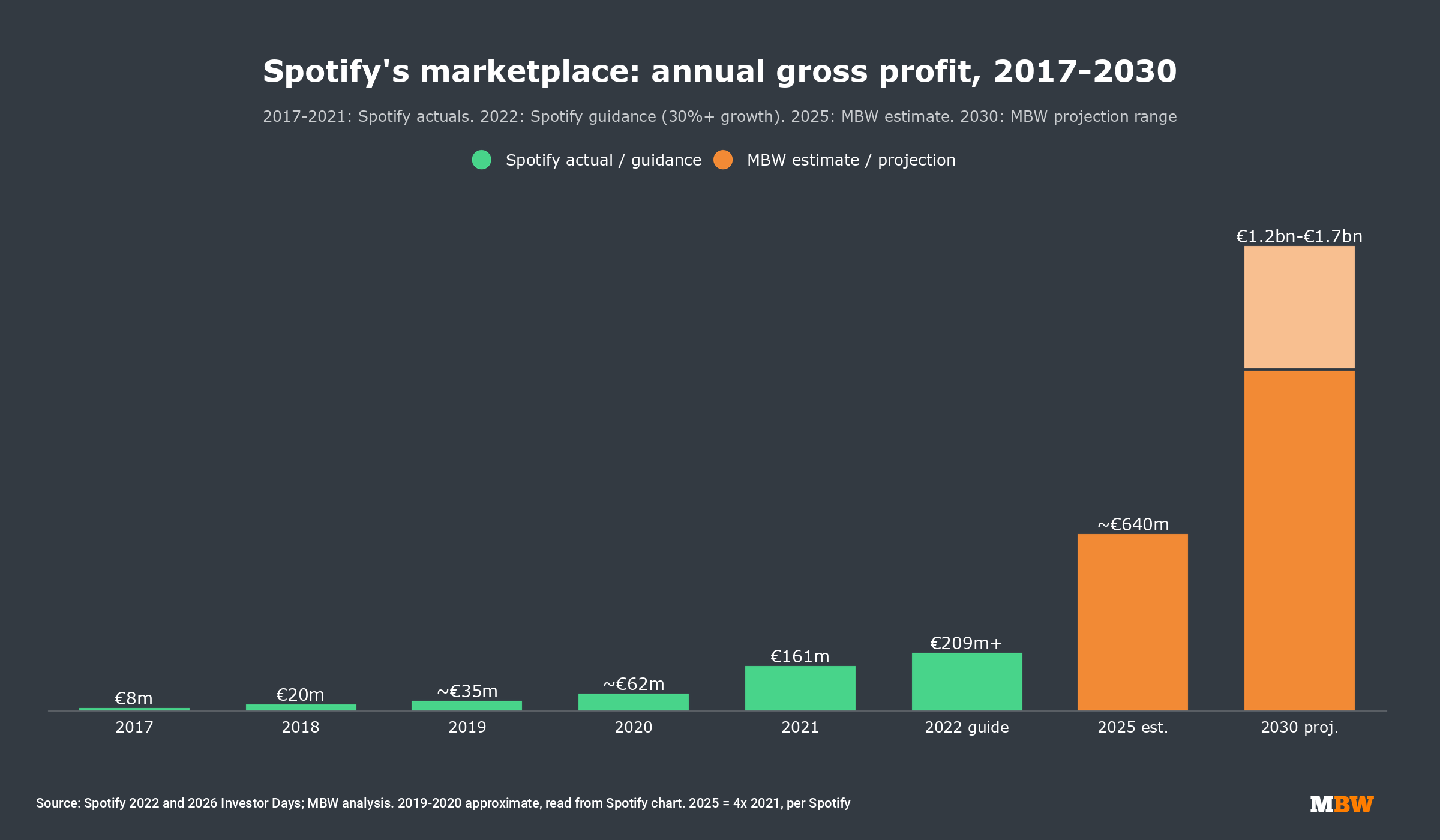
It charted the annual gross profit of ‘Marketplace’: just EUR €8 million in 2017, rising to €161 million in 2021. (Then-CEO Daniel Ek put the 2018 figure at €20 million.)
These weren’t huge numbers – although they represented eightfold growth in just three years.

Source: Spotify Investor Day, June 2022
But it’s only more recently that ‘Marketplace’ has truly gone gangbusters.
At Spotify’s most recent Investor Day, in May this year, CFO Christian Luiga revealed that the gross profit of ‘Marketplace’ had multiplied yet again – growing 4X between 2021 and 2025.
This gets us to the number I flagged at the top of the analysis:
- In 2025, Spotify’s ‘Marketplace’ generated around EUR €640 million (roughly USD $720 million) in gross profit – more than 30 times what it made in 2018.
- The math is simple: Spotify’s ‘4X‘ figure applies to the €161 million in gross profit it disclosed for 2021.

Source: Spotify Investor Day, May 2026
To put that €640 million further into context: it was equivalent to around 3.7% of Spotify’s total revenue in 2025 (€17.2 billion).
It was also worth around 12% of Spotify’s total gross profit figure (€5.5 billion) – and nearly four points of its 32% gross margin.
Now let’s project it forward.
Spotify has told investors it’s targeting a “mid-teens” annual revenue growth rate through 2030.
That would take its annual revenues from EUR €17.2 billion in 2025 to somewhere around €33 billion–€36 billion by 2030.
Let’s take that as read. If ‘Marketplace’ simply maintains a 3.7% share of Spotify’s annual revenue, it would therefore generate around €1.3 billion (roughly USD $1.5 billion) in gross profit by 2030.
If ‘Marketplace’ can instead hold its 12% share of Spotify’s gross profit (and Spotify hits the top of its 35%–40% gross margin target) that figure rises to as much as €1.7 billion (roughly $1.9 billion).
Let me run that by you again.
On those projections, the music industry – that is, labels, distributors, managers, artists, and the rest – could be paying* Spotify as much as USD $1.9 billion a year for ‘Marketplace’ tools by 2030, with Discovery Mode the best-known of them.
(*Yes, technically Discovery Mode isn’t a ‘payment’ – it’s a royalty reduction. But you know what I mean.)
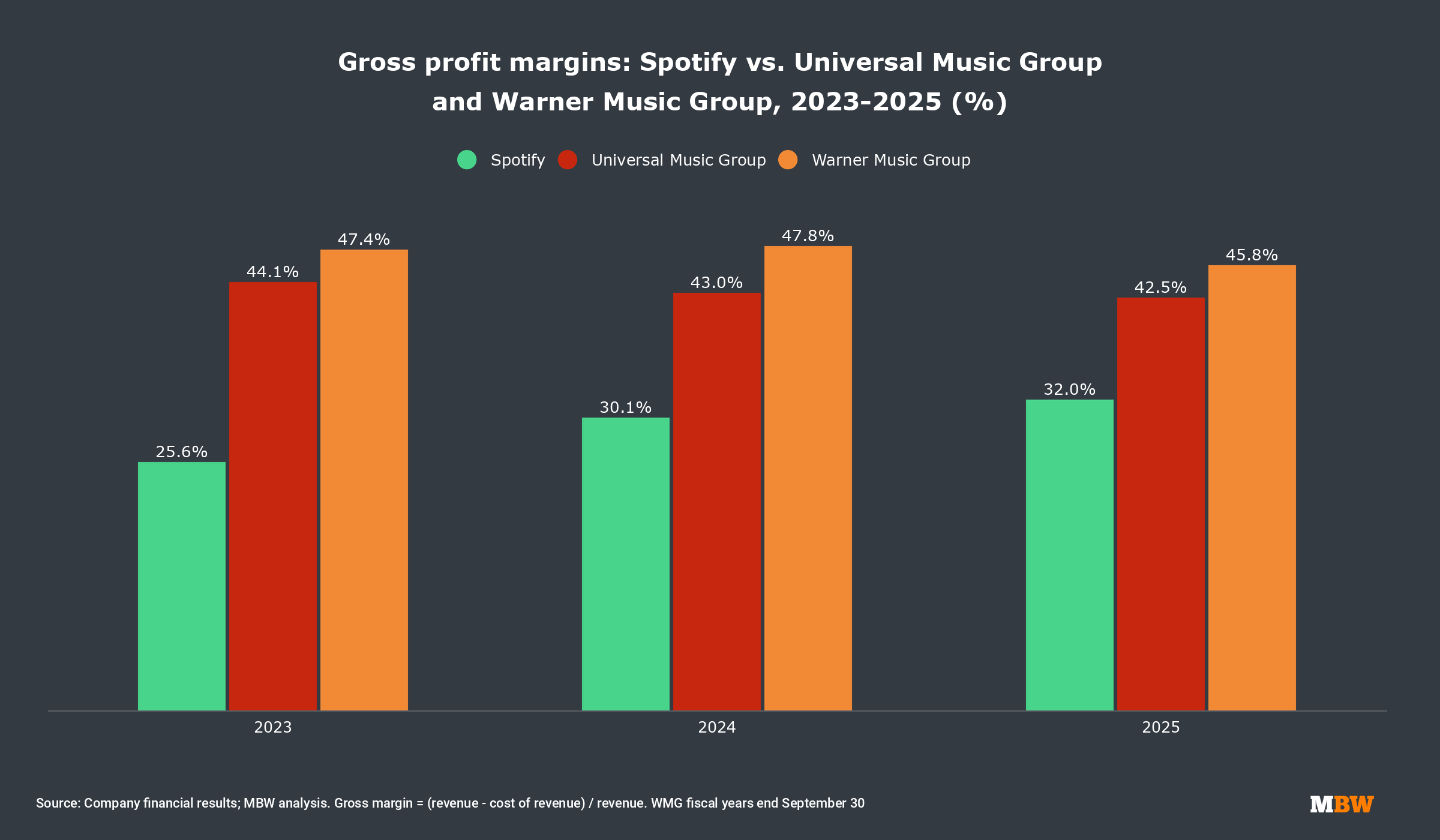
While Spotify’s ‘Marketplace’ business has boomed over recent years, the major music companies’ own gross margins have… not.
Universal Music Group’s gross margin dipped from 44.1% in 2023 to 42.5% in 2025. Warner Music Group’s fell from 47.4% in fiscal 2023 to 45.8% in fiscal 2025.
To be clear: ‘Marketplace’ isn’t to blame for this trend.
As I’ve written a few times now, UMG’s fast-growing indie services businesses – Virgin Music Group and, since February, Downtown – pay a higher share of revenue to artists and label partners by design. As a result, their success naturally tends to weigh down the major’s gross margins.
Still, the contrast with Spotify is worthy of pause.
Don’t forget: over the same 2023–2025 period, Spotify’s gross margin rose from 25.6% to 32.0%.
In fact, in 2025, for the first time, Spotify generated more gross profit (€5.5 billion) than UMG (€5.3 billion; in terms of revenue minus ‘cost of revenue’).
Align in the sand
Alex Norström wasn’t wrong that Spotify and its music rightsholder partners could grow “even more aligned” during their current negotiations.
There’s plenty in these talks that could grow the pie for everyone – especially new paid add-ons for music, modeled on the success of Spotify’s Audiobooks+.
These paid add-ons include Spotify’s upcoming AI covers-and-remixes tool, for which, of course, UMG was the O.G. launch partner.
But there are thornier topics to discuss, too.
Spotify’s payouts to and investment in audiobooks will undoubtedly come up – following the infamous ‘bundling’ shenanigans that preceded UMG and WMG’s last agreements with the streamer.
Then there’s AI: UMG Chairman and CEO Sir Lucian Grainge used the company’s Q3 call to declare that “the structure of our DSP agreements has to change,” arguing that “unethically generated AI tracks should never be compensated on the same basis as music that creates real and lasting demand.”
But ‘Marketplace’ will surely be a central topic in these discussions, too.
For me, the big question about Discovery Mode in particular isn’t really what it costs – it’s who’s using it.
When only a few players participate, Discovery Mode offers a clear competitive advantage.
But what happens when everyone participates?
In 2022, Spotify said “over 50 labels and distributors” were using it.
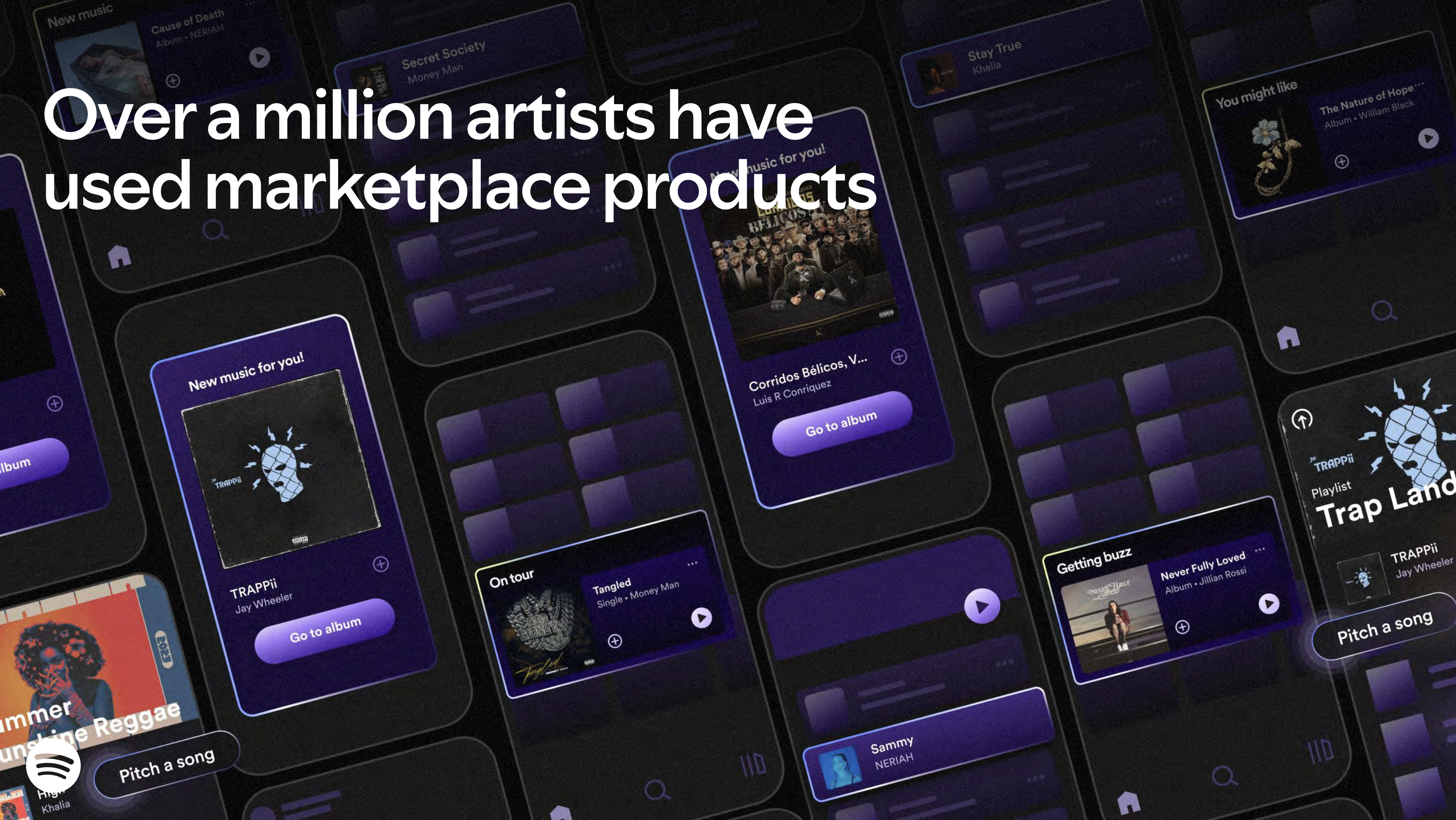
By the time of Spotify’s 2026 Investor Day in May, Charlie Hellman – Spotify’s global head of music – described the platform’s promotional tools as “the most relied upon marketing engine across the industry for both new releases and older catalog from the biggest labels in the world to the do-it-yourself artists.”
A slide at the same event declared: “Over a million artists have used [our] Marketplace products.”
Source: Spotify Investor Day, May 2026
So what happens when the industry’s biggest players – and its most ambitious artists – feel they can’t afford not to use Discovery Mode?
Once they’re all hooked, the best-known part of Spotify’s ‘Marketplace’ offering starts looking less like a competitive advantage – and more like the price of admission.Music Business Worldwide