Live Nation Entertainment and Ticketmaster have asked a federal judge to pause the upcoming Department of Justice antitrust trial while two legal questions are reviewed by an appeals court.

The companies argue that two key conclusions in last week’s summary judgment decision were legally wrong, and should be reviewed by an appeals court before any jury is seated.
The motion, filed on Sunday (February 22) in the Southern District of New York, seeks a so-called interlocutory appeal. That means Live Nation wants to challenge parts of the trial judge’s ruling before the case has concluded, rather than waiting until after a verdict to appeal.
In most federal cases, parties can only appeal after a final judgment; this route is reserved for situations where a legal question is significant enough to warrant immediate review by a higher court.
Jury selection is currently scheduled to begin on March 2.
The formal motion follows a public statement by Live Nation’s EVP of Corporate and Regulatory Affairs, Dan Wall, which took a markedly different approach but signaled a similar desire to avert the upcoming trial.
On Thursday (February 19), Wall published a post on the company’s newsroom titled ‘It’s Time to Move On,’ publicly calling on the DOJ to settle the case. The post was also emailed to press.
It was subsequently removed from Live Nation’s website without explanation; the Wayback Machine shows it was still accessible on February 20.
Sunday’s court filing, which you can read here, takes a different tack. Rather than calling for a settlement, it argues that the trial shouldn’t happen at all until the Second Circuit Court of Appeals has weighed in.
The ruling in question is Judge Arun Subramanian’s February 18 summary judgment order, which you can read here.
It narrowed the government’s case, dismissing claims that Live Nation monopolized the national concert promotion market, but allowed several major claims to proceed to trial, including allegations around Ticketmaster’s exclusive venue contracts and Live Nation’s practice of tying access to its amphitheaters to its promotion services.
Live Nation is not appealing the parts of the ruling it won. Instead, it is challenging two specific legal conclusions within the order that allowed the government’s remaining claims to survive:
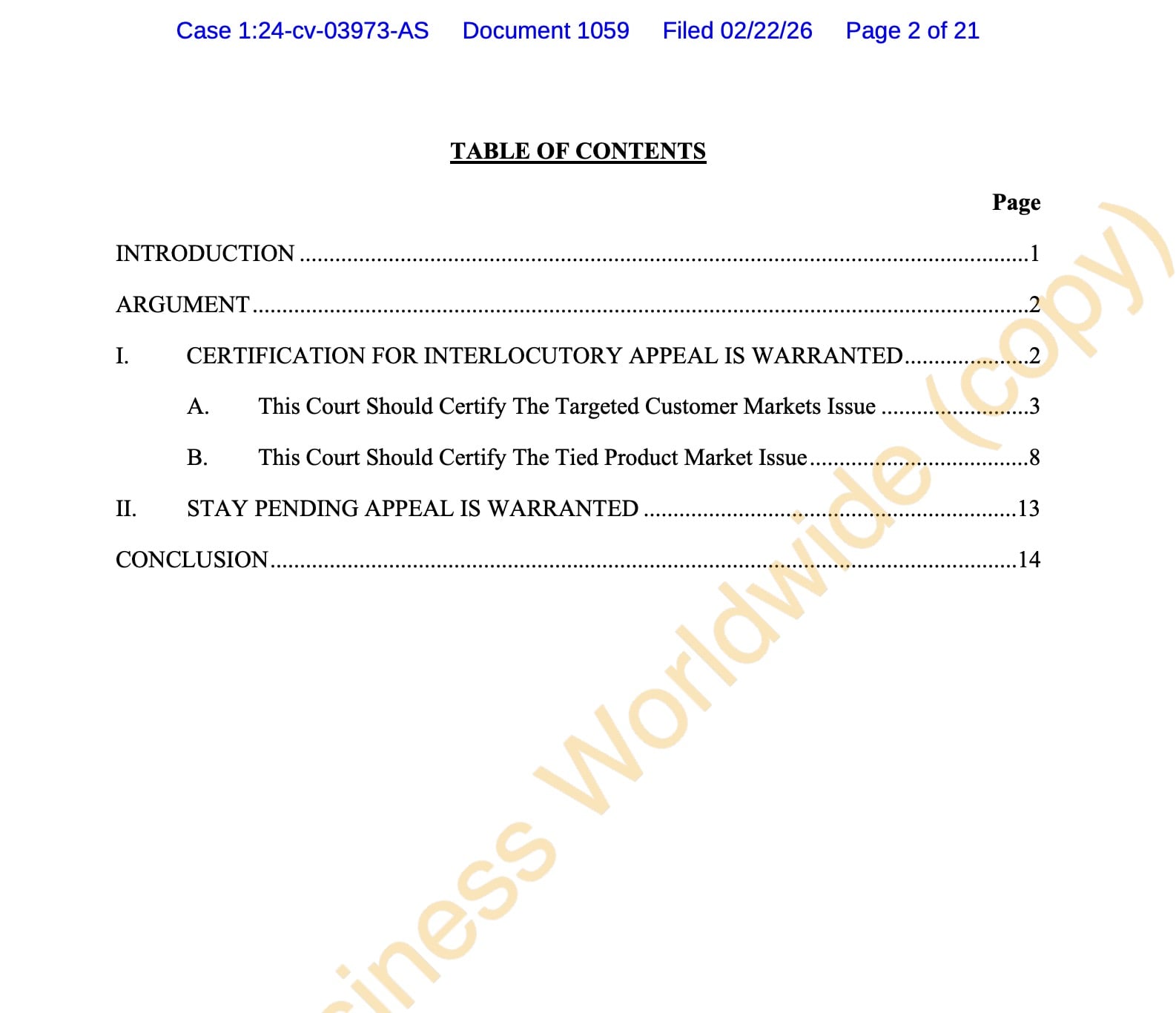
The first argument in the new filing concerns how the government defined its ticketing markets.
The government’s case focuses on a specific group of customers it calls ‘major concert venues.’ Live Nation argues that if you want to build a monopoly case around a specific group of customers, you need to show those customers are actually being charged differently. It says the government has “zero evidence of actual price discrimination” in those markets.
The company notes that the only other court to have ruled on this question in a monopolization case — in the FTC’s lawsuit against Meta Platforms last year — “agreed with Defendants’ view.”
Judge Subramanian reached the opposite conclusion, and Live Nation says the Second Circuit should resolve the disagreement.
If Live Nation prevails on that point, the government’s monopoly claims in the ticketing markets, its exclusive dealing claim, and the state attorneys general’s damages claims would all fall away.
The second argument concerns the ‘tying’ claim: the allegation that Live Nation forces artists who want to play its amphitheaters to also use its promotion services.
Live Nation points out that Judge Subramanian already found that the government’s proposed market for the tied product, promotion services at major concert venues, is not a valid antitrust market. Yet the court allowed the tying claim to proceed.
The company argues you can’t have a tying claim without a valid market for the tied product, and that “the Court’s decision deviated from” binding Second Circuit caselaw and rulings from courts across the country.
Live Nation argues that “if either or both legal questions were decided the other way, the nature and scope of the upcoming trial would fundamentally change: of the three sets of claims this Court identified as proceeding to trial after summary judgment, the first two would be effectively eliminated.”
If all federal claims fell away, Live Nation contends the court “could and should then decline to exercise supplemental jurisdiction over the State claims,” potentially ending the entire case.
The company argues that “the Court should not empanel a jury to try a complex, month-long case when that trial (at least as currently envisioned) may well prove wholly unnecessary,” and that a pause would “avoid wasting the resources of the parties, this Court, and jury members on a trial of claims that may well be deemed legally deficient on appeal.”
In his now-removed post, Wall had argued that Judge Subramanian’s summary judgment ruling effectively killed any prospect of a court-ordered breakup of Live Nation and Ticketmaster.
Wall wrote that the dismissal of the concert promotion monopoly claims “ends the narrative that concert promotion and ticketing are ‘mutually reinforcing monopolies,'” and that separating Live Nation from Ticketmaster “would not serve any remedial purpose, let alone be a legally permissible remedy.”
He wrote that the case was now limited to three issues: “long-term exclusive ticketing contracts, a discrete ticketing deal Ticketmaster has with Oakview Group, and Live Nation’s policy of not renting its amphitheaters to rival promoters.”
None of those, Wall argued, “nor even all three taken together, warrants more than standard injunctive relief.”
Wall also took aim at the origins of the case under the Biden administration, writing that former DOJ Antitrust Chief Jonathan Kanter “broke from usual DOJ practice and announced on Day One that ‘it was time to break up Live Nation and Ticketmaster.'”
He added: “He also told the American public that the merger and its attendant evils were responsible for high ticket prices and fees. Of course, none of this was true.”
Wall cited the Google Search antitrust case as precedent, noting that a federal judge had rejected the DOJ’s request to force Google to divest its Chrome browser, instead opting for more targeted remedies.
He argued that court-ordered breakups of monopolies are vanishingly rare, writing: “The last time it happened was in 1980, when AT&T agreed to be broken up to resolve a monopolization case that was in the late stages of trial.”
The DOJ, joined by attorneys general from 39 US states and the District of Columbia, sued Live Nation and Ticketmaster in May 2024, alleging monopolistic conduct across the live entertainment industry.
An additional 10 states later joined the lawsuit.
Live Nation reported record annual revenues of $25.2 billion for 2025 on the same day Wall’s now-removed post was published.
Music Business Worldwide