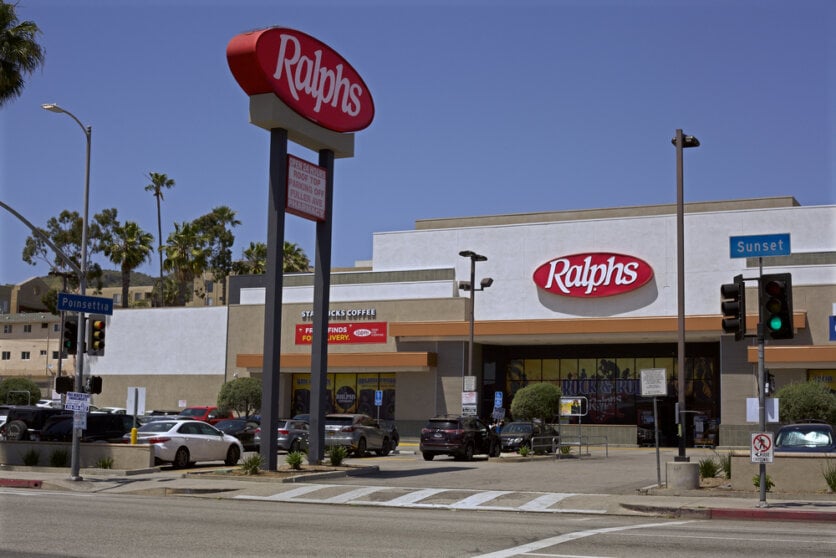
Kroger, the US supermarket giant behind chains including Ralphs, Harris Teeter, and Mariano’s, has asked a federal judge to dismiss Sony Music’s copyright infringement lawsuit over the alleged unlicensed use of Sony recordings in social media advertising.
The Kroger Co. and 17 affiliated companies filed the motion on Monday (November 2) in the US District Court for the Central District of California.
“This motion asks the Court to require what every pleading must supply: who is suing whom, and for what,” the Kroger filing states. “Ten Plaintiffs, pleading as one, accuse nineteen Defendants, also pleaded as one, of infringing hundreds of recordings listed in an exhibit that identifies no owner.”
You can read the filing here.
Sony Music Entertainment and nine affiliated labels sued Kroger in August, alleging at least 392 unauthorized uses of their recordings in videos posted by Kroger’s brands and by influencers it paid.
The motion is brought by every named defendant except Vitacost.com, the online retailer Kroger sold to iHerb in January.
It sets out “six independent reasons” for dismissal and, in the alternative, asks the court to order Sony to provide a more definite statement of its claims.
Eight of the moving defendants argue that they are not subject to personal jurisdiction in California, and that venue in the district is improper.
They include holding company Roundy’s, Inc., North Carolina-based Harris Teeter, and Murray’s LIC LLC, whose New York restaurant closed in September 2024.
The others are Roundy’s Illinois, which operates Mariano’s stores in Illinois, and four Wisconsin companies operating stores under the Metro Market and Pick ’n Save banners.
Harris Teeter’s alleged infringement “consists of reposting an Instagram Story that the Complaint says was available for twenty-four hours,” the motion notes.
Sony’s complaint alleges in part that the defendants’ products are “available for delivery to California consumers” through Kroger’s partnerships with DoorDash and Instacart.
“Same-day and next-day delivery of groceries from a store in Milwaukee or Chicago to Los Angeles would be highly unlikely,” the motion counters.
It adds that the California privacy notices cited by Sony appear on websites carrying 24 state-specific disclosures. “A disclosure that addresses residents of 24 states is not a choice to do business in any one of them,” the filing states.
In a separate Sony case in the same court, Magistrate Judge Jacqueline Chooljian found in November 2025 that Sony had established personal jurisdiction over DSW Shoe Warehouse, but not over its parent Designer Brands or footwear brand Topo Athletic, according to Bloomberg Law.
Sony and the DSW defendants told the court in August that they had reached a settlement in principle.
On ownership, Kroger argues that the 392-row exhibit attached to Sony’s complaint fails to identify which plaintiff owns each recording.
By Kroger’s count, 110 of those rows cite no sound recording registration, including 59 marked as pre-1972 recordings, 21 that invoke the Berne Convention, and five that list registrations as pending.
Kroger also relies on the US Supreme Court’s ruling in Cox v. Sony to challenge Sony’s contributory infringement claims.
The justices ruled unanimously in March that Cox Communications was not liable for its subscribers’ piracy, in a case where a jury had awarded the labels USD $1 billion in 2019.
The motion quotes Sony’s allegation that The Kroger Co. provides “campaign objectives, promotional themes, and other creative direction” through Kroger Precision Marketing and CB&S Advertising Agency.
“The Complaint alleges that Kroger could oversee advertising. It does not allege that Kroger did anything to bring about infringement,” it responds.
On Sony’s vicarious liability claims, the filing takes aim at the allegation that influencer posts “save[] the Kroger Parties the cost of a license.”
“But for posts an influencer made on its own initiative, no Defendant would ever have owed a license fee,” Kroger’s lawyers write. “The fee avoided, if any, was the influencer’s.
“That is not a benefit from infringement drawing customers to a Defendant. On that theory, every advertiser would be vicariously liable for any unlicensed music any promoter chose to use.”
The motion also challenges claims tied to a 2020 holiday campaign license that, according to Sony’s complaint, covered The Lovin’ Spoonful’s Do You Believe in Magic.
Among other grounds, Kroger argues those claims are time-barred under the Copyright Act’s three-year statute of limitations because any claim accrued when the license expired on December 31, 2020, “more than five years before Plaintiffs filed suit.”
It also asks the court to strike 40 of the 50 unnamed “Doe” defendants listed in the complaint, citing a local rule that caps such defendants at 10.
A hearing on the motion is scheduled for January 14, 2027, before Judge George H. Wu.
Kroger is represented by Larson LLP and Cushman Partners LLC, while Sony is represented by Proskauer Rose LLP.Music Business Worldwide