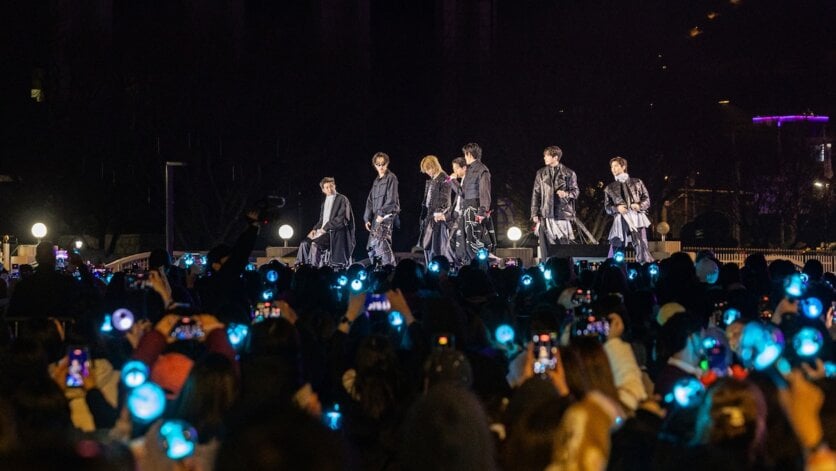
South Korea‘s government and the country’s four largest K-pop companies – HYBE, SM Entertainment, YG Entertainment, and JYP Entertainment – have unveiled plans for FANOMENON, a music festival launching in Seoul in December 2027.

The inaugural edition will run for 11 days, from December 2 to December 12, 2027, across Seoul Arena in the city’s Chang-dong district and the KINTEX exhibition center in nearby Goyang.
The event is a public-private project overseen by the Presidential Committee on Popular Culture Exchange and will be run by a joint venture that the four agencies – rivals across most of the K-pop business – are setting up together.
The committee is co-chaired by Culture, Sports and Tourism Minister Chae Hwi-young and JYP Entertainment founder J.Y. Park.
Park presented the plans at a press conference at Seoul‘s National Museum of Modern and Contemporary Art on July 27.
“It will clearly be an event that makes money,” said Park.
In a break from convention, FANOMENON will give its awards to fan communities rather than to individual artists.
“We will analyze, using quantified data, which fandom was the most passionately active over the year, and give awards accordingly. The award is then accepted by that fandom’s artist on its behalf.”
J.Y. Park, JYP Entertainment
The organizers say the 10 most active fandoms of the year will be selected using quantitative data, with each award accepted by that fandom’s artist on its behalf.
“We will analyze, using quantified data, which fandom was the most passionately active over the year, and give awards accordingly. The award is then accepted by that fandom’s artist on its behalf,” said Park.
Alongside the concerts and awards at Seoul Arena, the KINTEX venue will host music performances, an esports competition, film and drama soundtrack concerts, and exhibitions from K-culture companies across the run.
The four companies revealed plans for the joint venture in April, as previously reported by MBW.
The venture is being set up with equal stakes for each company, and their chief executives sit on the music subcommittee of the Presidential Committee on Popular Culture Exchange.
The joint venture is under review by South Korea‘s Fair Trade Commission as part of the formation process.
The Korea Culture & Tourism Institute estimates that the 2027 awards will draw around 520,000 visitors, including 200,000 inbound foreign tourists, and generate more than KRW 1 trillion (approximately USD $680 million) in economic impact.
“FANOMENON has a public-interest goal first and foremost, but that alone cannot draw the participation of world-class artists,” said Park. “It will clearly be able to turn a profit.”
The Ministry of Culture, Sports and Tourism will support promotion, inbound tourism and transport, while the venture is set to generate revenue through ticket sales and corporate sponsorship.
“This is a large-scale festival that concentrates the strength of K-culture,” said Chae. “We will build it into a new growth opportunity for content, tourism and related industries.”
The committee also set out longer-term plans to take FANOMENON overseas from May 2028, starting in Los Angeles, and to build “K-culture centers” featuring 20,000-seat venues in major cities.
Both of those plans remain at the discussion stage, the Presidential Committee on Popular Culture Exchange said.
“We chose it because it is the best city to promote K-culture abroad and to generate revenue,” Park said of Los Angeles, adding that the overseas festival would take a form closer to Coachella.
A K-pop festival in the United States would not be a first for the sector: CJ ENM has run its KCON festival in the country since 2012, when it launched in Irvine, California.
Some observers have questioned whether an event led by the four largest agencies could sideline smaller companies, and whether a government-driven festival fits a model that Coachella and Lollapalooza built through the private sector.
“The headliners will be top artists, but we will also create opportunities for new acts and emerging agencies,” said Park.
In June, the Ministry of Culture, Sports and Tourism and the Korea Creative Content Agency launched a fund for independent K-pop agencies, after government data showed the “Big Four” spent around 29 times as much on music production in 2023 as smaller agencies did.
Live music has become a growing revenue stream for K-pop’s largest companies, with HYBE reporting record concert revenues of KRW 763.9 billion ($537.5 million) in its 2025 fiscal year, up 69.4% year-over-year.Music Business Worldwide