
Jason Isbell is suing AI music company Suno over the alleged commercial use of his identity.
The six-time Grammy winner filed a proposed class action on Monday (August 31) in Boston federal court, alongside Cracker and Camper Van Beethoven frontman David Lowery, Texas blues musician Guy Forsyth, and Florida saxophonist Eduardo Calle.
Interestingly, the 84-page lawsuit contains no copyright claim.
The lawsuit instead accuses Suno of building a product that responds to a musician’s name by generating a song, a written description, and a cover image evoking that person.
It further accuses Suno of capturing and storing “voiceprints” – which the complaint defines as “the unique identifying characteristics of an individual’s voice that can be used to identify that person.”
The complaint opens by likening Suno to the Star Trek Borg, and returns to the comparison in its closing lines.
“A musician’s identity is their property, but Suno took it without consent,” it reads. “This lawsuit is how these musicians resist the premise that resistance is futile.”
The complaint against Suno, obtained by MBW, can be read in full here.
“Suno built and trained a model to index musicians by name,” the complaint states.
“It encoded musicians’ identities into its AI model to create its commercial product without consent, and now exploits those identities by publicly using musicians’ names to Suno’s considerable commercial benefit.”
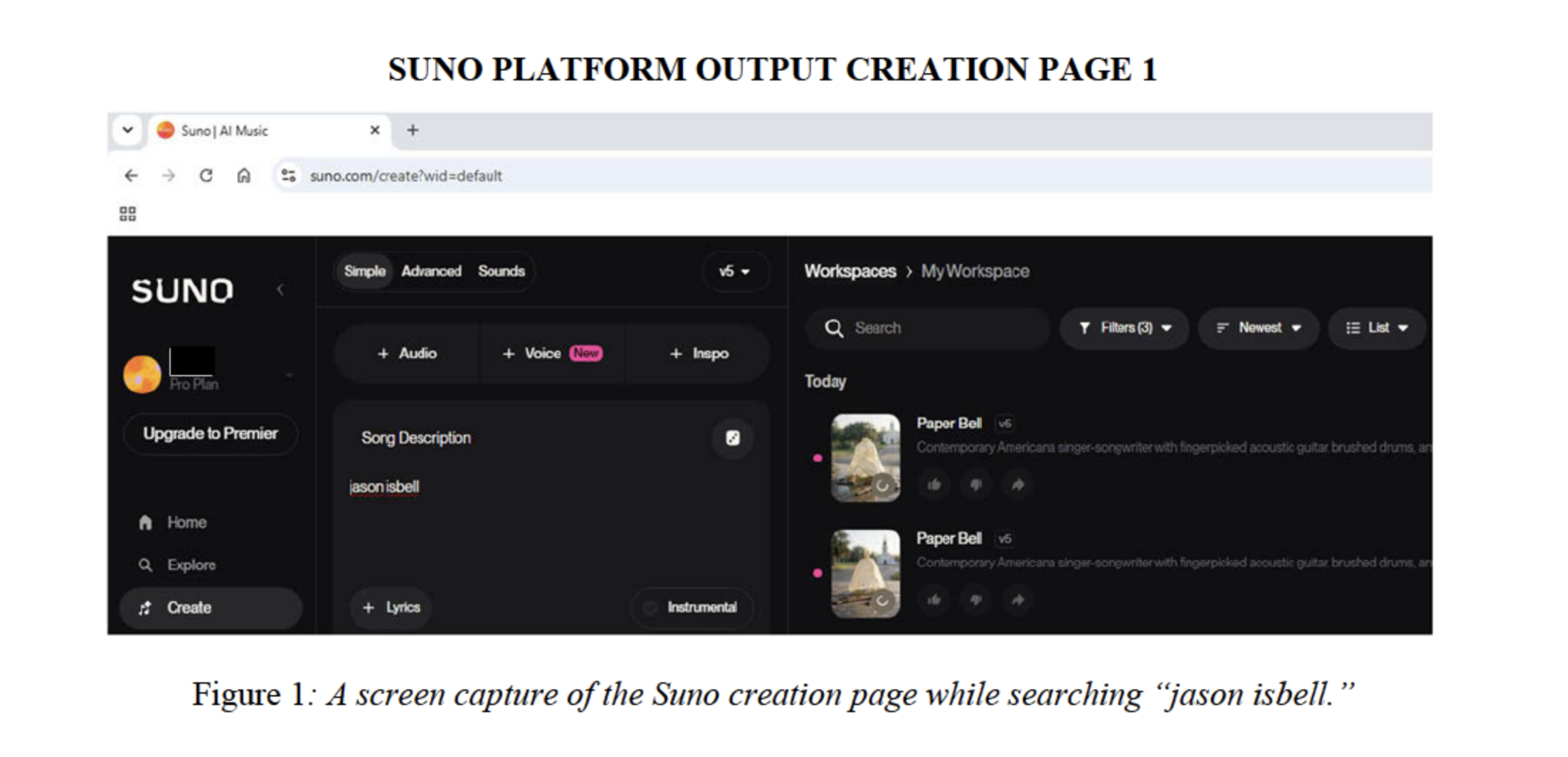
To demonstrate the point, the plaintiffs’ provide an example of what happened when “jason isbell” was typed into Suno’s v5 song generation model.
It returned an Americana track called Paper Bell, described by the platform as “contemporary Americana singer-songwriter with fingerpicked acoustic guitar,” alongside an image of a paper bell set against a church and trees.
The filing claims that the output imitated “Isbell’s characteristic clear male vocals and country twang”, while the image “evok[ed] a country scene”.
Entering “Camper Van Beethoven” into Suno’s v5.5 model produced Pull Over Where the Wheat, described as “[q]uirky late-1980s alternative rock with folk-rock” featuring “occasional accordion and fiddle flourishes.”
Prompts naming Forsyth and Calle returned a blues-rock track and two Latin jazz songs respectively, each titled after the musician entered.
The complaint runs through around 20 further examples of known artists being entered into Suno, among them Buddy Guy, Mavis Staples, Carly Simon, Tom Waits, The Chicks, and Israel Kamakawiwo’ole, and says counsel holds dozens more on file.
Suno, co-founded by its CEO Mikey Shulman, has said publicly that its platform blocks this.
In a statement quoted in the complaint, and reported by MBW in July, Suno said: “we intentionally do not use artist names as a category of training metadata because we want our models to help people create brand new songs, not music that replicates other artists’ existing work.
“It’s also why we built Suno with detection filters that block or prevent a user from using specific artist, song, or album names as prompts, and prevent users from uploading lyrics or sound recordings that match existing works.”
The plaintiffs dispute Suno’s account.
“Suno claims users are blocked from using a specific name as a prompt, but that claim is false,” the filing reads. “In reality, Suno not only accepts names but also responds to the name with an output based on that musician’s identity.”
“A musician’s identity is their property, but Suno took it without consent. This lawsuit is how these musicians resist the premise that resistance is futile.”
Isbell & Lowery class action complaint
The plaintiffs also allege the filter can be circumvented by putting spaces between the letters of a name, and point to tutorials published by Suno’s own paid affiliate marketers that teach subscribers how to work around it.
The complaint spreads its claims across 17 counts, but does not name a damages figure.
It says the total at stake across the proposed class tops $5 million, the threshold for bringing the case in federal court, and asks the judge to award damages set by state law, order Suno to hand over profits made from the alleged conduct, and add punitive damages where state law permits.
The plaintiffs also want a court order barring Suno from capturing, storing, or commercially exploiting musicians’ voices, names, and identifying attributes without consent.
On the potential scale of the class, the complaint alleges Suno trained on “tens of millions of recordings and distilled the identities of millions of musicians.”
The filing is clear about what Isbell and his co-plaintiffs are not asking for.
“Plaintiffs claim no ownership of country music, of Americana music, or of any genre, style, or musical idea, and nothing in this Complaint asserts a right to prevent anyone – human or machine – from making blues or any other style of music,” the complaint against Suno states.
“The claim is narrower and older than that: no one may commercially exploit another’s right of publicity in their name and identity.”
That distinction nods towards a potential consequence for the AI licensing deals now being struck by companies including Warner Music Group and BMG.
The complaint argues that a record company’s authority to license a recording does not, on its own, give Suno or any other AI firm the right to use the performer’s identity.
It cites Suno’s own agreements as evidence, noting that Warner Music Group’s November 2025 settlement and licensing deal gives artists and songwriters “full control over whether and how their names, images, likenesses, voices, and compositions are used in new AI-generated music.”
Those protections apply only to participating rightsholders and associated creators, the filing says, and not to musicians such as Isbell.
A second set of claims in the suit concerns voice data, brought under Illinois’ biometric privacy law, known as BIPA.
“In processing data to create its platform, Suno name-indexed a large quantity of voice data without consent. An AI model can use data at this scale to evaluate unidentified voices and associate them with the vocalist who spoke or sang them. Accordingly, this data constitutes “voiceprints” within the meaning of the Illinois Biometric Information Privacy Act.”
Isbell & Lowery class action complaint
The plaintiffs allege that Suno’s processing pipeline computed and stored measurements of individual singers’ voices – among them pitch contours, formant structure, and breath dynamics – which they say amount to “voiceprints” under that law.
“Suno never asked, never disclosed, never published a retention policy, and never obtained the written consent BIPA requires,” the complaint states. “It captured and stored the voiceprints anyway, and built a projected billion-dollar business on top of them.”
The complaint adds: “Suno admitted that it scraped the work of practically all of the musicians on the internet.
“It did so at an unfathomable stealth, speed, and scale in order to extract musicians’ identities. It operationalizes and monetizes that data through its name-indexed platform which dilutes the commercial value of musicians’ identities.”
Suno raised more than $400 million in June at a $5.4 billion valuation, and said in February that it had passed 2 million paid subscribers.
Citing Billboard, the complaint says the company projects $1 billion in revenue by 2028.
“Without judicial intervention, the musicians whose identities form the foundation of that billion dollars will receive none of it,” the filing states.
The case joins a list of lawsuits against the Cambridge, Massachusetts company.
Suno is defending copyright claims from Universal Music Group and Sony Music Entertainment, from independent artists, from Round Hill, and from European collecting societies including GEMA and Koda.
A separate group of independent musicians led by songwriter David Woulard brought biometric privacy and right-of-publicity claims against Suno in Illinois in October 2025, although those complaints also allege copyright infringement.
In July, hacked source code indicated that Suno had scraped YouTube Music, Deezer, and Genius to build its models, as reported by 404 Media.
Lowery has led a music industry class action before, suing Spotify for up to $150 million over unpaid mechanical royalties in December 2015.
The plaintiffs are represented by Rose Law Partners in Boston and class action firm Korein Tillery in Chicago.Music Business Worldwide