India’s paid music streaming market crossed INR ₹10.3 billion in subscription revenue for the first time in 2025.

That’s according to a joint report from EY and the Federation of Indian Chambers of Commerce and Industry, which you can read here. The figure translates to USD $118.2 million based on the average annual exchange rate published by the IRS for 2025.
The number of paid music subscriptions rose by nearly 4 million (or 37% YoY) to reach 14.4 million, the report said, attributing the growth to “measures by music streaming platforms to discourage free usage.”
The report showed that the total number of people who streamed music online in India last year grew to 178 million from 175 million in 2024.
However, the total number of audio streamers in India has fallen from around 210 million in 2022, even as the number of paid subscriptions has more than tripled over the same period, rising from 4.6 million to 14.4 million.
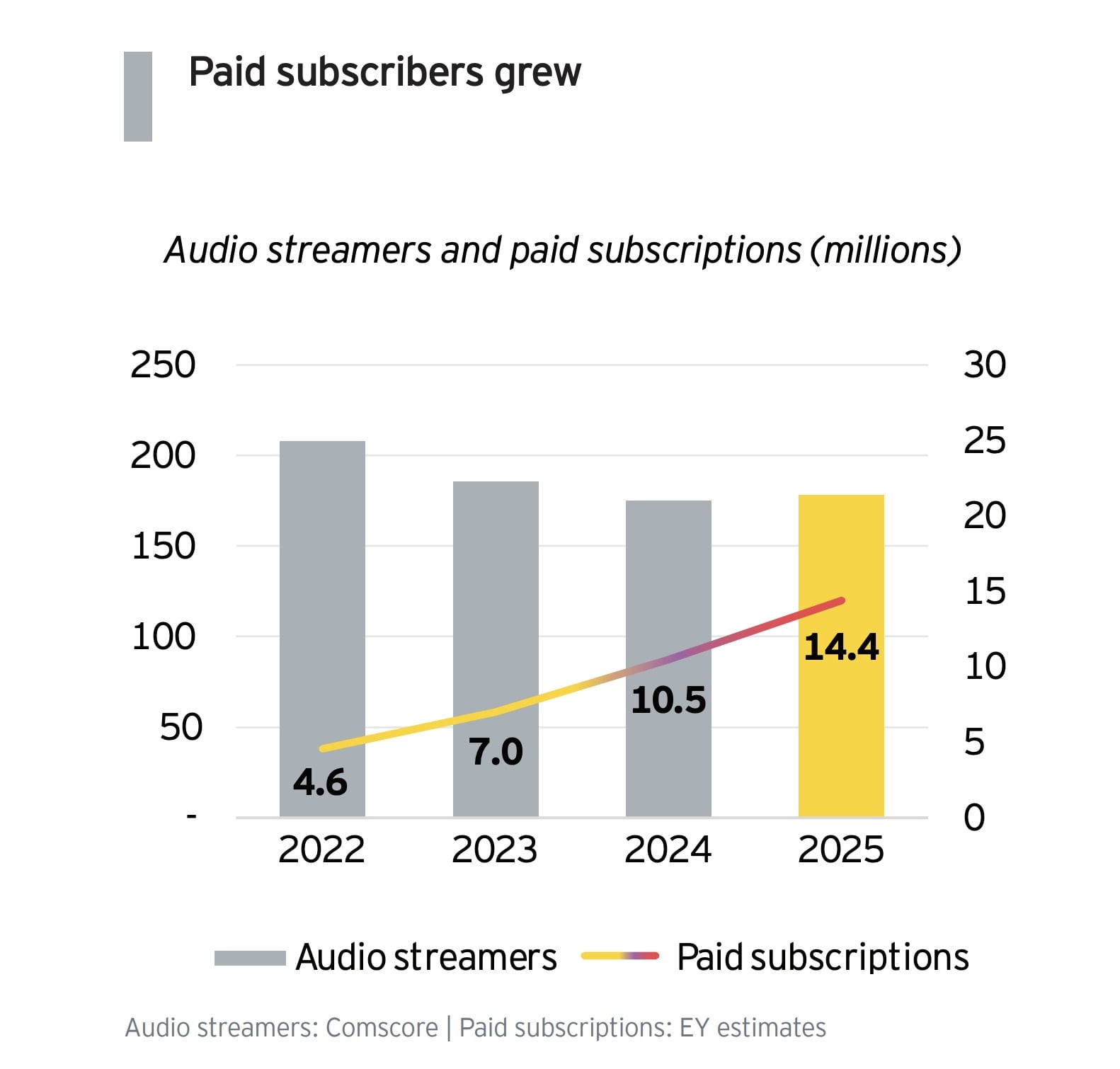
The study also highlighted the challenges of monetizing Indian listeners. Of the 178 million people who streamed music in 2025, only about 8% were paying for it.
Of the free music streamers surveyed, 64% said they were willing to pay if their preferred service eliminated its free tier entirely, but only under certain conditions. At least 42% said a low price point would bring them over, while 38% said they would pay if all other free options disappeared. Of those free streaming customers, 40% said they would pay to remove ads, 33% said they would pay for full playback control, while 31% said they would be willing to pay for lossless or high-quality audio.
However, 36% of free streamers said they would not pay even if their preferred service dropped its free tier. Of that group, 66% said they would shift to YouTube, 25% said they would turn to pirated sources, and 19% said they would stop listening on apps.
The report also showed that Indian music revenue grew to ₹59 billion ($677m) in 2025 from ₹53 billion ($633m) in 2024. The industry is forecast to reach ₹75 billion ($805m) by 2028, representing a compound annual growth rate of 9%.
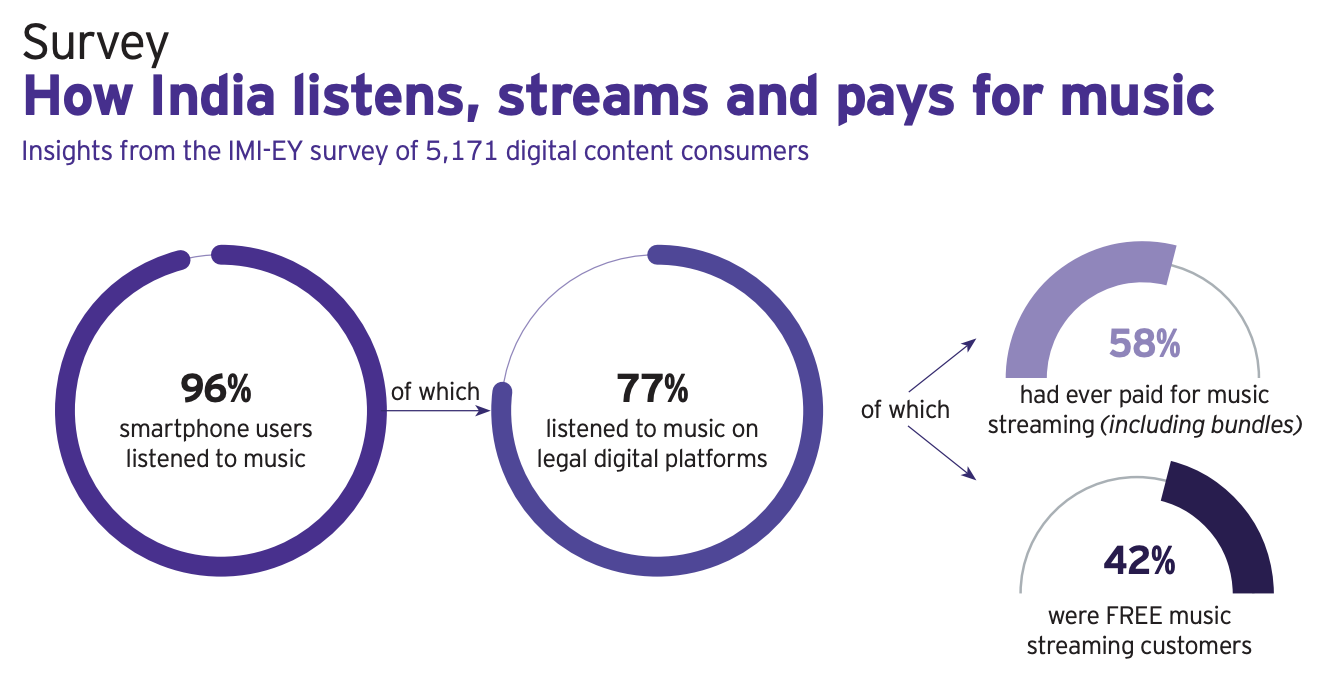
Elsewhere in the report, the survey of 5,171 digital content consumers found that 96% of smartphone users listen to music on their devices, with 77% doing so through legal platforms. Music listeners in India streamed roughly 6 trillion songs in 2025, up 15% YoY, with the vast majority of those streams being free or ad-supported. Paid streams accounted for only 164 billion, or less than 3% of the total.
The report noted that several platforms have cut free access in 2025, including Gaana, which stopped ad-supported music. Others like Spotify introduced new subscription tiers and features including lossless streaming.
Sony Music India’s Vinit Thakar said: “India’s music industry is pivoting from ad-supported growth to a subscription-led monetization model, anchored by premium differentiation. The scalable expansion of artist services will be essential to delivering sustained, long-term value for artists, fans, and stakeholders.”
“India’s music industry is pivoting from ad-supported growth to a subscription-led monetization model, anchored by premium differentiation. The scalable expansion of artist services will be essential to delivering sustained, long-term value for artists, fans, and stakeholders.”
Vinit Thakar, Sony Music India
Meanwhile, EY and FICCI noted in the report that Wynk, Resso and Hungama all ceased operations in India over the past 18 months, concentrating the market for Gaana, Spotify and other players like JioSaavn, which hit 500 million downloads in December.
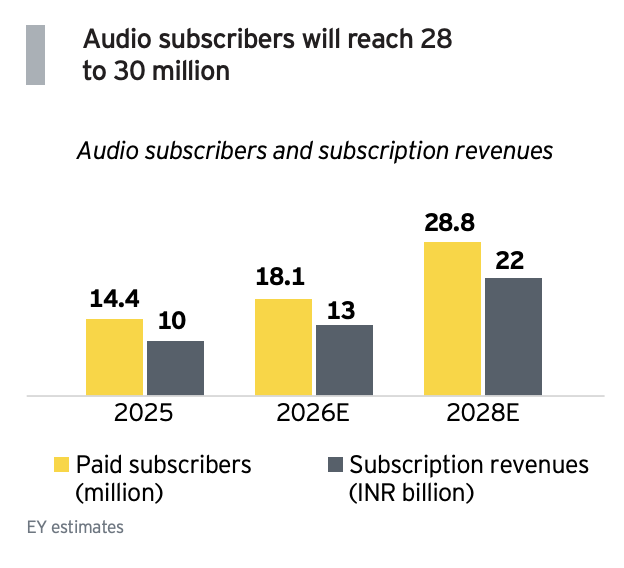
The report forecasts paid subscribers to reach 28 to 30 million by 2028, roughly double the 14.4 million base in 2025. Subscription revenues are forecast to more than double to ₹22 billion ($236m) by 2028.
JioSaavn’s Sahas Malhotra said: “India’s music streaming market has confidently pivoted towards paid subscriptions and is poised to triple in the next three years. With streaming now ubiquitous and curbing piracy, growth will be driven by accelerating subscription adoption, the right mix of subscription offerings, disciplined rationalization of free-tier economics and sharp, consumer-centric value propositions.”
The study also showed that 37% of media and entertainment companies in India are accelerating future AI investments due to positive past results.
However, some are still cautious. Saregama’s Vikram Mehra said: “The glut of AI generated music will further enhance the value of real-life artiste connections and premium music.”
Meanwhile, Devraj Sanyal of Universal Music Group, said superfans are becoming the industry’s growth engine, “fueling premium engagement, deeper artist connections, and new monetization across live, ticketing, merchandising, and fan experiences, while progressively unlocking the path to India’s premium subscription economy.”
“While playback music long dominated through cinema, we’re now seeing the rise of a playfront culture — where artists build direct relationships with audiences beyond film cycles. The artists who are winning are those building fanbases around a sound.”
Amarjit Batra, Spotify
Spotify’s Amarjit Batra added: “The most important signal in Indian music right now is coming from listeners. While playback music long dominated through cinema, we’re now seeing the rise of a playfront culture — where artists build direct relationships with audiences beyond film cycles. The artists who are winning are those building fanbases around a sound.”
The Indian Performing Right Society (IPRS) highlighted the need for a “robust rights framework” amid the digital transformation and AI adoption.”
IPRS’s Rakesh Nigam said: “[S]uccess will hinge on robust rights frameworks, where technology, transparency, rights recognition and fair remuneration together ensure creators and owners thrive in a rapidly scaling creative economy.”
Music Business Worldwide