MBW Explains is a series in which we dig behind the headlines, via data and context, to improve your understanding of key stories. Only MBW+ subscribers have unlimited access to these articles. MBW Explains is supported by Reservoir.
Spotify, Apple, Amazon, Pandora, and Google have filed their rate proposals in Phonorecords V, the US Copyright Royalty Board (CRB) proceeding that will set the mechanical royalty rates on-demand streaming services pay songwriters and music publishers for the five years starting January 1, 2028.
Four of the five services want to keep the current deal largely in place for another five years. Amazon wants lower rates, and the publishers want a lot more.
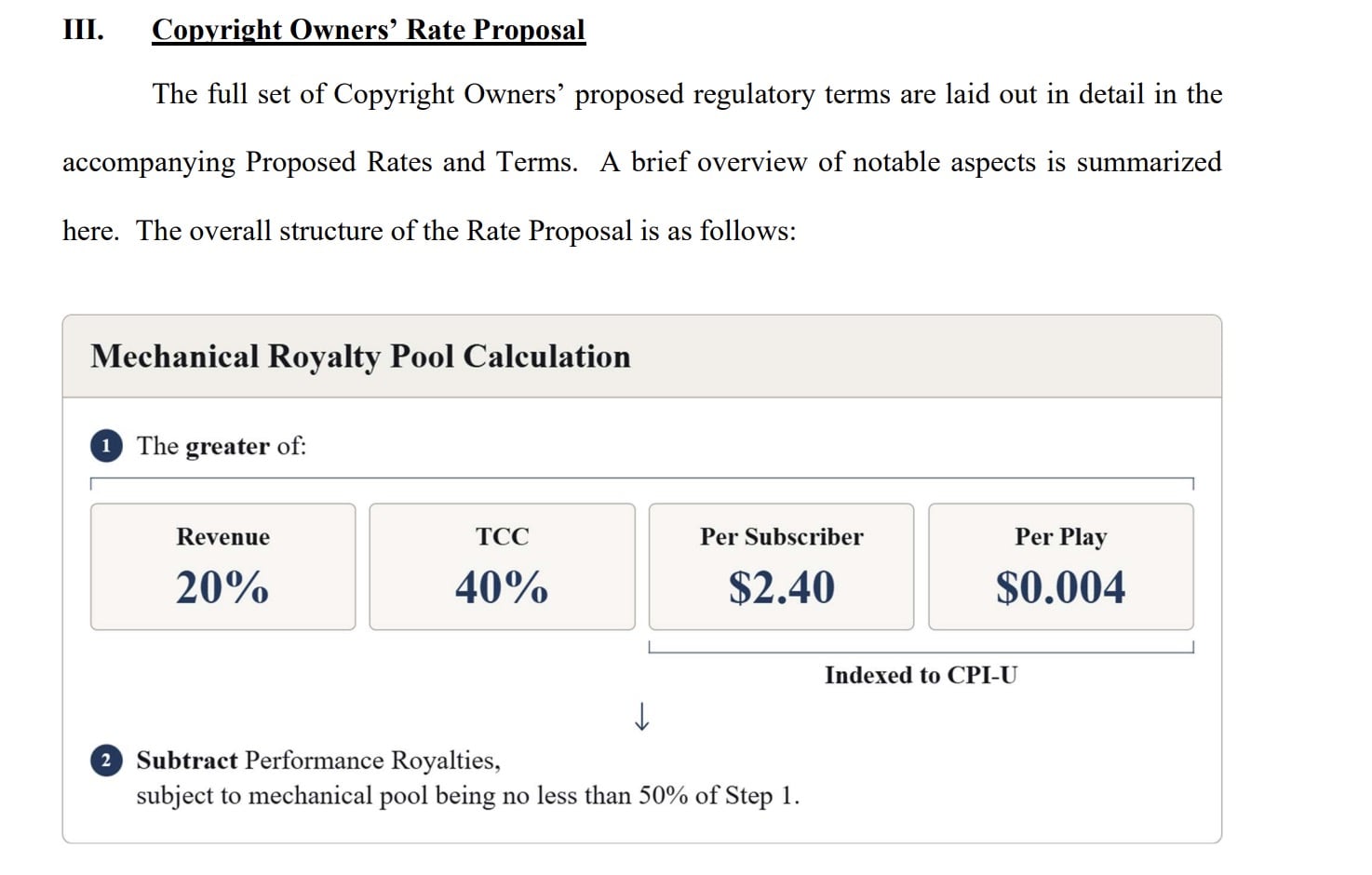
The National Music Publishers’ Association (NMPA) and the Nashville Songwriters Association International (NSAI), which represent publishers and songwriters in the proceeding, want services to pay the greatest of 20% of revenue, 40% of what they pay record labels, USD $2.40 per subscriber a month, or $0.004 per play.
The current headline rate is 15.3% of service revenue, rising to 15.35% in 2027. A 20% rate would be 4.65 percentage points above the 2027 level.
Spotify, Apple, Google, and Pandora want the 2027 rates, including the 15.35% headline rate, kept in place from 2028 to 2032. Amazon wants the headline rate cut to 13.4%.
NMPA President and CEO David Israelite said in a video posted on Instagram that songwriters “should have a minimum of at least 40% of what record labels and artists get paid, who get to negotiate their deals in a free market.”
Record labels license their recordings to streaming services through direct negotiations, while the mechanical royalties paid to songwriters and publishers are set by the CRB under a compulsory license that applies to any publisher without a direct deal.
The Digital Media Association (DIMA), which represents streaming services, said in a statement on October 6 that it looked forward to a “timely resolution” of the proceeding.
MBW has gone through each of the public filings. Here’s what the five services and the publishers want, in the plainest language possible.
The current rates
Under the Phonorecords IV settlement, which the CRB formally accepted in December 2022, the headline rate rises in annual steps from 15.1% in 2023 to 15.35% in 2027, and stands at 15.3% this year.
The headline rate is an “all-in” figure covering both mechanical and performance royalties: services subtract what they pay for performance rights, and what’s left is the mechanical royalty.
For standalone portable subscriptions (the standard paid tier), services pay the higher of that rate and a second calculation: the lower of 26.2% of what they pay record labels, known as Total Content Costs (TCC), or $1.10 per subscriber. The mechanical royalty alone also can’t fall below 60 cents per subscriber.
For bundles that combine music streaming with other products, the TCC rate is 24.5%, with a floor of 33 cents per active subscriber.
Phonorecords IV ended in a settlement between the services and the NMPA and NSAI in August 2022, around 10 months after the parties filed their opening proposals.
Those 2021 proposals, detailed by MBW at the time, included a 10.5% headline rate from Spotify and Pandora, 10.54% from Amazon, and 20% from the NMPA and NSAI. Google and Apple tied their proposals to the outcome of the then-unresolved Phonorecords III case.
Bundling
Bundling has been the biggest point of conflict between the services and the publishers since the Phonorecords IV settlement, and it comes up in most of the filings below. The publishers want the bundle rules tightened, Spotify and Apple say they were central to the 2022 deal, and Amazon wants the revenue-based calculation for bundles scrapped.
In March 2024, Spotify reclassified its US Premium tiers as bundles that include audiobooks, which cut the mechanical royalties it pays. Amazon followed with a similar music-and-audiobook bundle in November 2024.
The Mechanical Licensing Collective (MLC)sued Spotify over the reclassification in 2024. Judge Analisa Torres dismissed its original claims in January 2025 but reopened the case that March, and it is still going.
The publishers’ filing says Spotify has already taken “more than $500 million in mechanical royalties that should have been paid to songwriters and publishers.” Spotify’s latest quarterly filing says that if the MLC were “entirely successful,” its liability from March 2024 to June 2026 would be approximately EUR €473 million, plus potential penalties and interest, “partially offset by direct deals with publishers.”
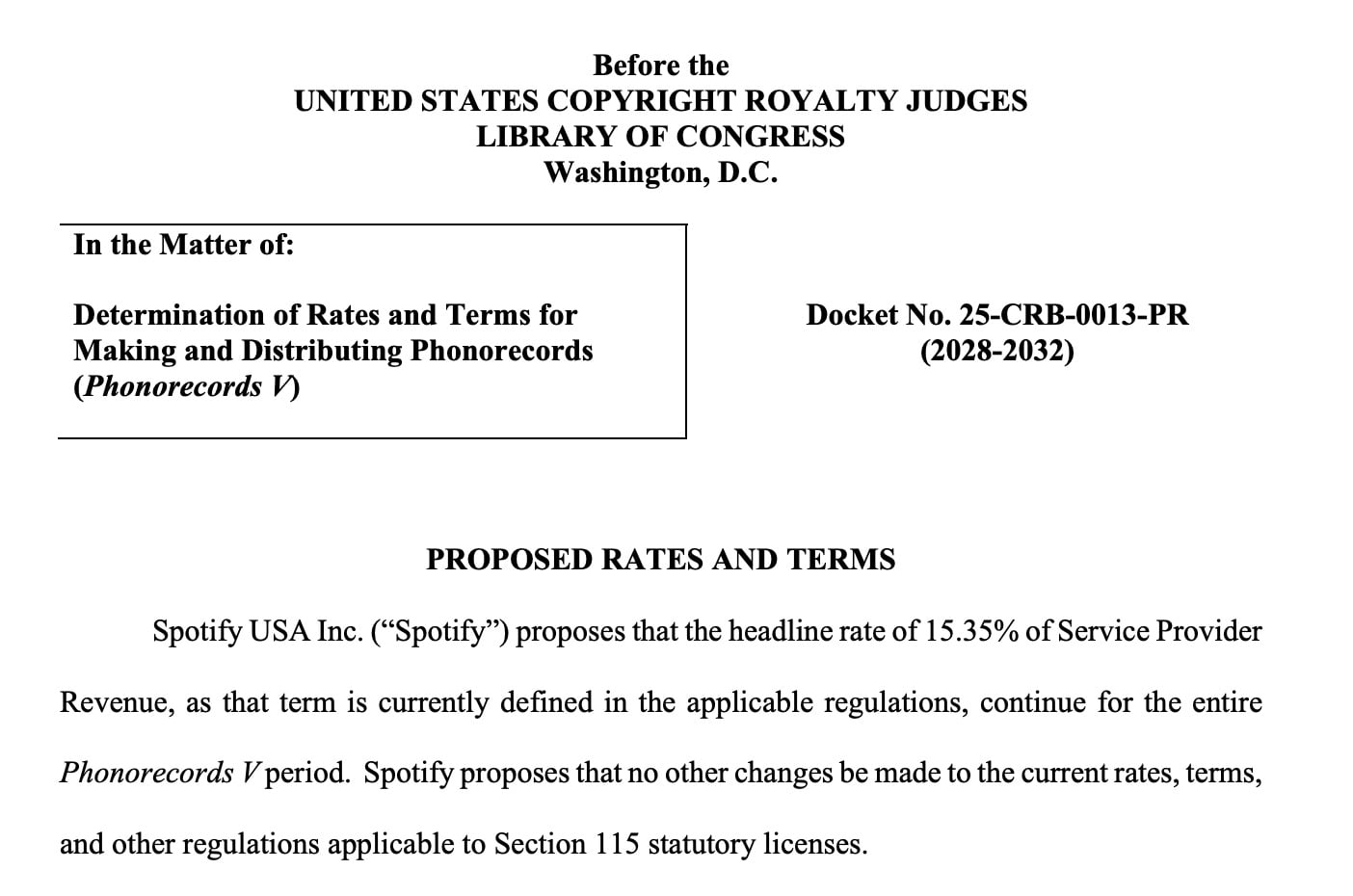
Spotifyproposes that the 15.35% headline rate continue for the entire Phonorecords V period, with no other changes to the current rules.
The company said in its filing: “The best evidence of what willing buyers and willing sellers would agree to is what they actually did agree to, just four years ago: the Phonorecords IV rates and terms.”
“The best evidence of what willing buyers and willing sellers would agree to is what they actually did agree to, just four years ago: the Phonorecords IV rates and terms.”
Spotify filing
Spotify’s economist, Steven R. Peterson of Econic Partners, says the Phonorecords IV agreement is the most appropriate benchmark for Phonorecords V, “with no need for adjustments.” His testimony puts US inflation from June 2022 to June 2026 at about 13%, and says streaming subscription price increases have outpaced it.
Spotify argues that the Phonorecords IV bundle terms, which it invoked in March 2024, were part of a package deal.
Sara Domeier, Senior Legal Counsel at Spotify, says in her testimony that changing any of the deal’s central terms would mean adjusting others to keep it balanced.
Spotify made a similar argument in 2021, when it proposed keeping the rates and rate structure of the earlier Phonorecords II settlement, according to Domeier’s testimony.
Google
Like Spotify, Google, which owns YouTube, proposes keeping the 2027 rates, including the 15.35% headline rate, for every year from 2028 to 2032, and isn’t proposing any changes to the bundling rules.
Google’s main proposed change is a new “Allocation” rule: it would pay these rates only on the share of plays that the license being set here actually covers, with revenue, per-subscriber amounts, and minimums scaled down to match. Google says the current rules already require services to separate licensed from unlicensed uses, but don’t say how to do it outside of bundles.
Of the six content categories Google lists on YouTube, it says only one qualifies: “Static-Image Art Tracks,” which are commercially released recordings played over a single still image. “The vast majority of content consumed on YouTube’s various services” falls outside the license, says Joanne Suk, Director and Global Head of Music Publishing at YouTube.
Google also wants app store commissions, carrier-billing charges, other partner fees, and certain taxes left out of the revenue it pays royalties on.
Google said in its filing: “Without allocation, Google would end up massively overpaying the music publishers and would not be able to pay publishers different rates for different types of uses of musical works.”
Apple
Apple, too, proposes that the CRB adopt the Phonorecords IV settlement as the rates and terms for Phonorecords V, with the 15.35% headline rate applying from 2028 to 2032.
Apple’s economist, Lisa M. George, an Associate Professor of Economics at Hunter College and the Graduate Center, City University of New York, argues in her testimony against adjusting rates for inflation, saying that “a percentage-of-revenue royalty already rises automatically when inflation contributes to higher subscription prices and service revenue.”
Elena Segal, Global Senior Director of Music Publishing at Apple, says the settlement raised the TCC rates, per-subscriber minimums, and floors on Apple’s standalone portable and bundled subscriptions by between 16.67% and 37.5% compared with the Phonorecords III rates, while the headline rate rose by 0.25 percentage points.
Segal says a reduced royalty rate for bundles was “absolutely essential” to Apple agreeing to those increases, adding: “Apple never would have done so without the bundle construct that has allowed it to add a substantial number of subscribers and attendant royalty payouts through sales of Apple One.”
Apple’s filing says US music publishing revenues reached $7.3 billion in 2025, approximately $1.69 billion more than in 2022.
Apple said in its filing: “The most reasonable resolution of this proceeding is to continue those rates and terms going forward.”
Pandora
SiriusXM-owned Pandora similarly proposes keeping the 2027 rates and terms, including the 15.35% headline rate, for 2028 to 2032.
Craig McFadden, Director of Music Licensing at SiriusXM, says in his testimony that nothing has changed at Pandora’s on-demand services that “would warrant an increase in rates.”
McFadden says the Phonorecords IV rates “were higher than Pandora had initially proposed and would have preferred to pay.” He says Pandora accepted them partly because services with more users were willing to sign, leaving it at risk of litigating alone, and out of “a desire for certainty after many years of litigation over Section 115 rates and terms.”
Pandora also wants four smaller changes: limiting late fees on services and adding a reciprocal late fee on overpayments, returning to services the money the MLC allocates to public-domain songs, not counting anyone engaged in fraud or stream manipulation as a user, and leaving app store commissions out of revenue. Amazon wants similar changes on all four.
Pandora says in its filing that its changes are either clarifications or fixes for “a handful of specific inequitable anomalies.”
Amazon
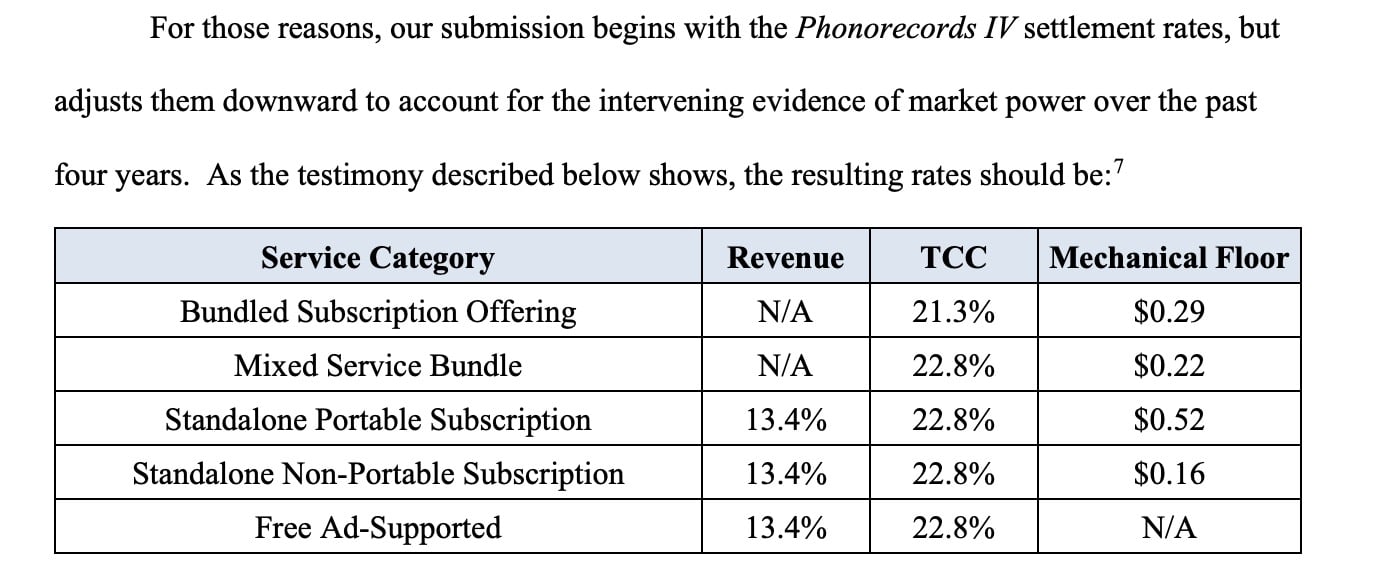
Unlike the other four services, Amazonproposes a rate cut: a headline rate of 13.4% of service revenue in each year from 2028 to 2032 for every type of service other than bundles, including standalone subscriptions and free, ad-supported services, down from 15.35% in 2027.
It also proposes cutting the TCC rate for those services from 26.2% to 22.8%, the per-subscriber figure for standalone portable subscriptions from $1.10 to 96 cents, and their 60-cent minimum to 52 cents.
For bundled subscriptions, Amazon wants to remove the percentage-of-revenue calculation altogether and pay 21.3% of TCC, down from 24.5%, with a floor of 29 cents per active subscriber, down from 33 cents.
Amazon Music Unlimited, which includes access to Audible audiobooks, falls into that bundle category, according to the filing.
Prime Music, the limited-functionality offering included with Amazon Prime, sits in a separate bundle category that already has no percentage-of-revenue prong. Amazon wants its TCC rate cut to 22.8%, down from 26.2%, with a floor of 22 cents, down from 25 cents.
Amazon says the Phonorecords IV settlement remains the best benchmark, but that its own economist, Duke University’s Leslie Marx, has adjusted those rates for “intervening evidence of market power” held by publishers and record labels. “Her calculations, in total, yield rates that are about 13% below Phonorecords IV levels,” the filing states.
“Amazon should not have to pay royalties on revenue that it never receives.”
Amazon filing
The company says publisher disputes over bundles since the settlement “robbed Amazon of a key benefit it expected to gain from the Phonorecords IV settlement,” and that the publishers have since “flexed their market power in new ways.”
Amazon also proposes excluding public-domain works, app store commissions, and revenue from fraudulent “artificial” accounts from royalty calculations, and changing the late-fee terms. Testimony supporting its proposal also comes from smaller services IDAGIO, Qobuz, and Beatport.
Amazon said in its filing: “Amazon should not have to pay royalties on revenue that it never receives.”
The Copyright Owners (NMPA and NSAI)
The NMPA and NSAI, which file jointly as the “Copyright Owners,” propose that services pay the greatest of four amounts: 20% of service revenue, 40% of TCC, $2.40 per subscriber, or $0.004 per play.
The per-subscriber and per-play rates would be adjusted for inflation each year. The per-play rate would apply to every type of service, including free, ad-supported tiers.
The $2.40 figure is 20% of a $12 monthly subscription price, according to the filing, which says the rate “should be calibrated to the undiscounted market price when the rate period begins.”
The proposal would also replace the current minimums with a cap on how much services can deduct for performance royalties, so that mechanical royalties make up at least half of the total royalty pool.
The publishers also want to remove the discounts for family and student plans, which currently count as 1.75 subscribers and half a subscriber, respectively. And they want each account or sub-account that can play music at the same time counted as a separate subscriber, and zero-rate free trials and promotions eliminated.
For bundles, each part would have to be sold separately at a genuine market price, and royalties would be based on what the music service costs on its own. Under the proposal, no subscriber could be moved into a bundle “where the effect is to reduce royalties.”
The filing also asks the CRB to require services to make listening data associated with each play available to the owner of the song on request, and to add an explicit duty of good faith and fair dealing.
Greg Prata, Global Chief Financial Officer of Sony Music Publishing, says the 15.3% rate generates about $1.99 a month in total royalties on Spotify’s $12.99 subscription, or roughly $1.00 in mechanical royalties if performance royalties take half, compared with a 60-cent minimum. “A supposed backstop that permits a roughly 40% reduction from the mechanical royalty produced by the percent-of-revenue prong is no backstop,” he says.
“A supposed backstop that permits a roughly 40% reduction from the mechanical royalty produced by the percent-of-revenue prong is no backstop.”
Greg Prata, Sony Music Publishing
The publishers’ filing also includes testimony from five songwriters, among them Trannie Anderson, who says that “even that level of success does not necessarily provide financial security,” referring to her No.1 hits and Grammy nomination.
Danielle Aguirre, Chief Legal Officer and Chief Operating Officer of the NMPA, said in her testimony: “There were characterizations at the time that the settlement rates were the highest ever, but those characterizations are far from the reality as we enter into this proceeding.”
Those characterizations included the NMPA’s own: Israelite said in December 2022 that songwriters would “enjoy the highest rates in the world and the highest rates in the history of digital streaming.” Aguirre says the services have since used the five-year term “to game the rates,” pointing to Spotify’s and Amazon’s bundle reporting.
What happens next
Under the CRB’srevised case schedule, issued on October 2, the parties can file amended written direct statements until December 21 and must respond to each other’s cases by February 1, 2027. A window for settlement talks runs from January 25 to February 15, 2027.
Unless the parties settle, the hearing is scheduled to run from March 22 to April 15, 2027, with the judges’ initial decision due by December 17, 2027.
Reservoir (Nasdaq: RSVR) is a publicly traded, global independent music company with operations across music publishing, recorded music, and artist management.Music Business Worldwide