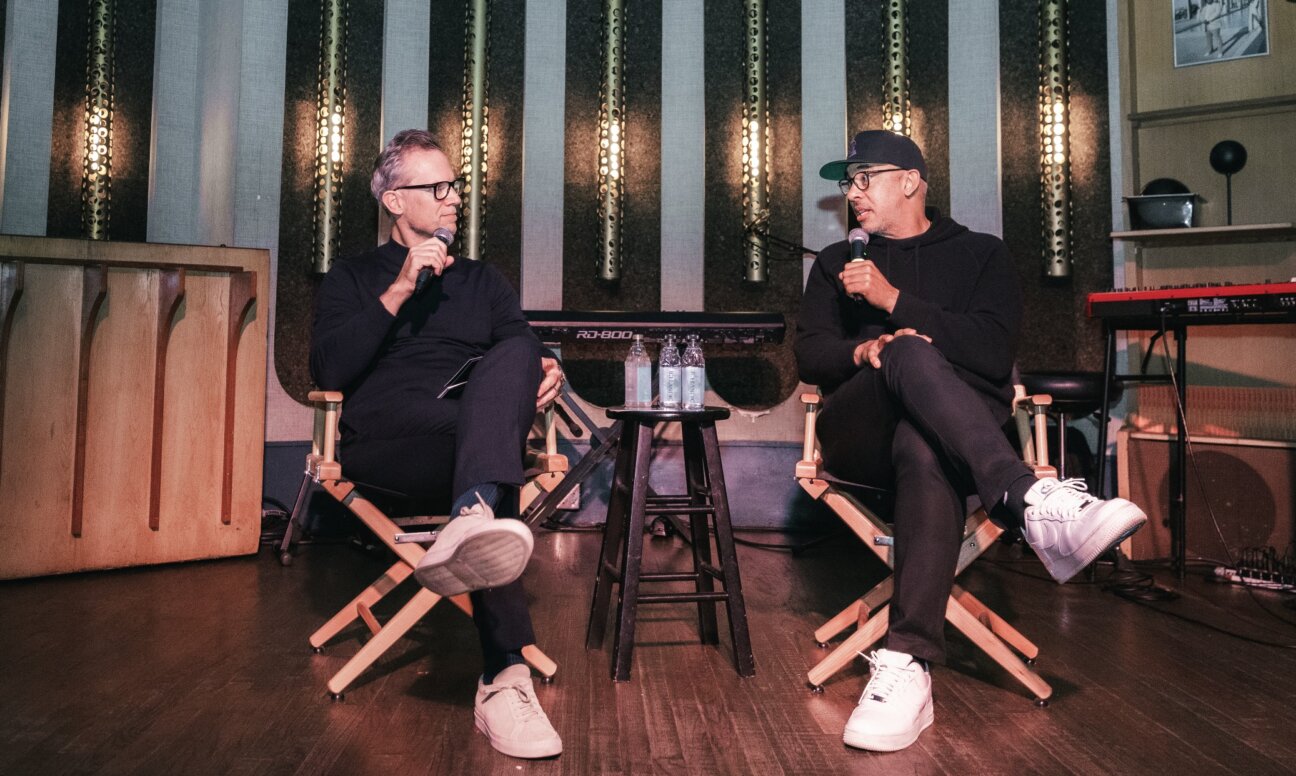
Recording Academy CEO Harvey Mason jr. sat down with Luminate CEO Rob Jonas during Grammy Week for a wide-ranging conversation on the forces reshaping the music industry — from algorithmic discovery to artificial intelligence.

Speaking at the Peppermint Club in West Hollywood last Thursday (January 29), Mason struck an optimistic yet cautious tone on AI’s role in music, framing it as the latest in a series of technological shifts that have historically expanded creative possibilities rather than diminished them.
“We believe in human creativity,” he said, adding, however, that “there’s a place for AI, and it is a tool,” Mason said. “It’s not unlike some of the other technological disruptions we’ve experienced in the past. Remember when painters were so mad when the camera came out? It’s not something that’s going to decimate us, but it will be disruptive.”
Mason noted that AI has already become ubiquitous in professional production environments, and suspects not all Grammy entrants are being fully transparent about its use.
“I’ve seen AI in every studio, in every session,” he said. “I’m not remembering a song that I’ve been around or a room that I’ve been in that was not using some form of AI.”
Rather than viewing this as cause for concern, Mason expressed enthusiasm about AI’s potential to enhance human creativity.
“There’s going to be some incredible flesh and blood human creativity that uses the technology in a way that we haven’t thought of,” he said. “It creates a sound we haven’t even imagined, and it allows us as champions of creativity to be even more prolific.”
On the question of Grammy eligibility, Mason clarified the Recording Academy’s position. “You can submit a song that has used AI,” he explained. “What we’re not going to do is give a Grammy to an AI artist for singing.”
He noted that 2023’s viral AI track Heart On My Sleeve — which featured vocals mimicking Drake and The Weeknd — would have been eligible for a songwriting award had it not been for rights issues, since a human wrote the track and lyrics. Similarly, a human vocalist performing over AI-generated instrumentation could be considered for a performance-related Grammy.
Mason was unequivocal, however, on voice cloning and deepfakes. “That’s not even debatable. No cloning,” he said.
“You can’t take someone’s voice, are you kidding me? Take someone’s singing, voice, and likeness and use it however you want? Absolutely not. I don’t think there’s anybody who disagrees with that.”
The Recording Academy continues to advocate for the NO FAKES Act, which would establish federal protections against unauthorized AI voice replication. Mason said he expects the legislation to pass in the current Congressional session.
His advice to artists navigating this shifting landscape: lean into the technology, but double down on what makes you irreplaceable.
“Get immersed, buy into the technology, understand it, integrate it into your [creative] process if you have an appetite for that,” Mason said. “But if you’re a creator and you want to be in this industry, you better have an authenticity, a voice, an honesty. No computer is going to do that for you.”
Mason also drew a parallel to past debates over what constitutes “real” musicianship, recalling how DJs were once dismissed by traditionalists — including his own father, a jazz musician.
“My dad used to tell me, ‘Oh, that’s not music, that’s hip hop, that’s just playing records,'” Mason said, in reference to the emergence of DJs. “And now think about how important that is, how incredible those musicians are, and how genius what they create is.”
But Mason acknowledged that a meaningful distinction will emerge between casual AI-assisted creation and the work of trained, experienced artists who understand both the craft and the culture of music. “That is a special talent that is going to always be valuable,” he said.
The conversation also touched on the Recording Academy’s efforts to better represent the global music landscape, with Mason crediting Luminate’s data for helping the organization identify emerging scenes and ensure its membership reflects music’s increasingly borderless nature.
The Grammy Awards, presented by the Recording Academy, took place on Sunday (February 1) in Los Angeles. Kendrick Lamar won five awards, including record of the year for Luther. He also won best rap album for GNX.
Album of the Year was won by Puerto Rican superstar Bad Bunny. See all the winners here.
Music Business Worldwide