Credit: Tribune Content Agency/AlamyTaylor Swift was IFPI’s biggest-selling recording artist globally in 2025 – for a record sixth time
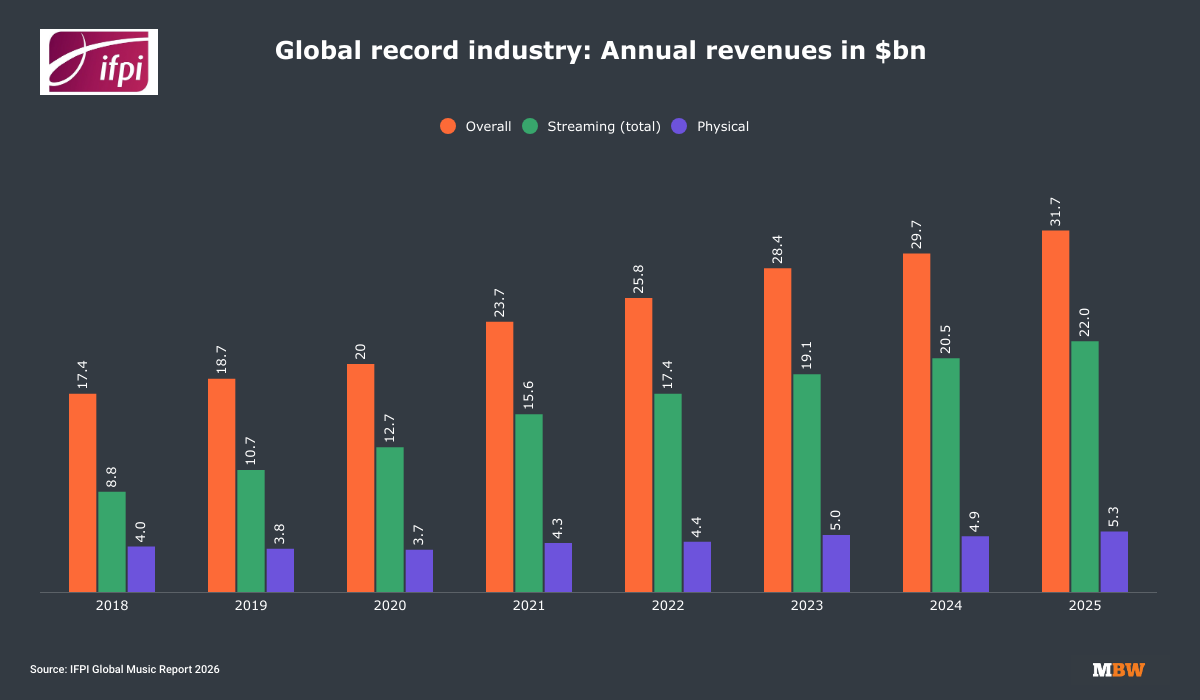
Global recorded music revenues reached USD $31.7 billion in 2025. That’s according to the IFPI, the organization that represents the recording industry worldwide.
Figures released today (March 18) in IFPI’s Global Music Report 2026 show that global recorded music revenues grew by6.4% YoY in 2025 – an improvement on the 4.7% rate of growth posted in 2024 — marking the global industry’s eleventh consecutive year of growth.
The report, which can be downloaded here, also shows that global recorded music revenues grew in every region, with double-digit growth in four regions, including Latin America, which was the fastest-growing region (17.1% YoY),the Middle East and North Africa (+15.2%), Sub-Saharan Africa (+15.2%), and Asia (+10.9%).
IFPI’s report identifies paid subscription streaming as the key driver of growth globally.
Paid subscription streaming revenues increased 8.8% YoY and accounted for more than half — 52.4% — of global revenues. IFPI reports that there are now 837 million users of paid streaming subscription accounts globally.
Total streaming revenues (including both paid subscription and advertising-supported) surpassed USD $22 billion in 2025, and accounted for 69.6% of total recorded music revenues.
Elsewhere, IFPI reports that global physical formats returned to growth in 2025, with revenues increasing 8.0% YoY — “driven by enduring fan demand for tangible music experiences”.
Vinyl revenues rose by 13.7% YoY, marking the format’s 19th consecutive year of growth.
IFPI notes that physical revenue growth outpaced that of digital for only the second time on record, driven by a return to growth for the world’s largest physical market, Japan, alongside strong performance in several other markets globally.
Performance rights revenues reached USD $2.9 billion in 2025, up by 0.3% YoY, marking the fifth successive year of revenue growth.
The IFPI’s numbers refer strictly to wholesale recorded music revenues (i.e. the money paid through to labels, distributors, and artists).
This chart has been updated to reflect adjusted retrospective annual figures from IFPI’s GMR 2026
According to IFPI data, as of 2025, the world’s Top 10 biggest recorded music markets are:
USA
Japan
UK
China (+1)
Germany (-1)
France
South Korea
Brazil (+1)
Canada (-1)
Mexico (+2)
You can find a more detailed geographic breakdown of global recorded music revenues in 2025 below.
USA & Canada
The world’s largest recorded music region increased revenues by 3.5% YoY in 2025, held a 38.7% share of global revenues, and added more than USD $400 million to global revenues.
The United States, the world’s single largest recorded music market, posted growth of 3.3% YoY according to IFPI’s figures — slightly higher than the RIAA‘s estimate of 3.1%published earlier this week.
Canada, which dropped down one ranking to become the ninth-largest market in 2025, saw revenue growth of 5.6%YoY.
Europe
Europe maintained its position as the second-largest region and grew revenues by5.6% YoY in 2025. The region added the second-highest revenue growth of all regions, contributing more than USD $500 million, and accounted for 30.4% of global revenues.
The region’s three largest markets all generated revenue growth in 2025: the UK (+4.8% YoY), Germany (+1.7% YoY), and France (+3.7% YoY).
Asia
Asia saw strong improvement in growth in 2025, with double-digit growth of 10.9% YoY. The region maintained its status as the largest for physical revenues and accounted for 45.1% of global physical revenues in 2025.
The world’s second-largest recorded music market, Japan, returned to growth in 2025 (+8.9% YoY), while China overtook Germany to become the fourth-largest global market, with revenue growth of 20.1% YoY — the fastest-growing market in the Top 20.
Latin America
Latin America was the fastest-growing region in the world and continued its double-digit growth trajectory in 2025, generating growth of 17.1% YoY, which marked a 16th consecutive year of growth for the region. Two Latin American markets now sit in the Global Top 10 (Brazil at No.8 and Mexico at No.10)
Streaming remained the key driver of growth and accounted for 88.1% of recorded music revenues in the region.
Brazil grew by 14.1% YoY, moving up a spot in the global rankings to No.8, while Mexico increased its recorded music revenues by 13.3% YoY and climbed to become the world’s 10th-largest recorded music market.
Australasia
In Australia, recorded music revenues increased1.2% YoY, but the market dropped two places in the global rankings to No.13.
New Zealandrecorded music revenues grew by3.0% YoY and accounted for 15.2% of the region’s total revenues.
Recorded music revenues in the wider Australasia region (Australia and New Zealand combined) reached USD $623 million and grew by 1.5% YoY in 2025.
Middle East and North Africa (MENA)
MENA was the joint second-fastest growing region (along with Sub-Saharan Africa) and saw recorded music revenues increase by 15.2% YoY in 2025.
The region remained dominated by streaming, with those revenues accounting for 97.5% of total recorded music revenues in the MENA region.
Sub-Saharan Africa
Sub-Saharan Africa, the joint-second-fastest-growing region alongside the Middle East and North Africa, saw recorded music revenue growth of 15.2% YoY, reaching USD $120 million.
South Africa remained the largest market in the region, accounting for 78.1% of the region’s revenues, following 12.9% YoYgrowth in 2025.
IFPI’s report also highlighted two key themes shaping the industry’s next chapter: AI innovation and streaming fraud.
On AI, IFPI says record companies are at the forefront of the next generation of AI innovation, actively engaging in the development of music licensing models to generate revenue opportunities for artists — aiming to build an ecosystem where AI and human artistry thrive together.
On streaming fraud, IFPI warns that the industry faces an increasing threat from bad actors artificially generating plays for manipulated or fake content, siphoning vital revenues away from artists and others who power the music economy. IFPI is calling for organisations at every stage of the streaming value chain to take proactive steps to prevent, detect and act on fraudulent activity.
“Great music from incredible artists, aided by record company partnerships and investment, is driving global growth — with more people than ever before paying to engage with it on paid streaming services worldwide.”
Victoria Oakley, CEO, IFPI
Commenting on the release of the Global Music Report, Victoria Oakley, CEO, IFPI said: “Great music from incredible artists, aided by record company partnerships and investment, is driving global growth — with more people than ever before paying to engage with it on paid streaming services worldwide.
“Importantly, this growth means even greater financial returns for artists and reinvestment into an increasingly broad range of music communities worldwide.
“Music is embracing the future, demonstrated by record company partnerships with generative AI developers who respect the rights of creators. They are partners that explore how technology can be harnessed to support and enhance creativity, not replace it. We are asking policymakers to support this work by upholding the copyright laws that are the bedrock for this progress.
“The entire music community must take action to tackle the threats facing our industry. Streaming fraud is theft, plain and simple. The organisations with the data, scale and leverage to prevent this fraudulent activity, including streaming services, content aggregators and distributors, must take decisive action.”
The report also featured commentary from the heads of the three major music companies, as well as a prominent independent executive.
Credit: Sony Music Group
“Music has never moved faster — or further. Our role is constant: champion talent, strengthen fan connections and safeguard rights.”
Rob Stringer CBE, Chairman, Sony Music Group, said: “Music has never moved faster — or further. Our role is constant: champion talent, strengthen fan connections and safeguard rights. We’ll embrace technology that serves musicians, confront streaming fraud, and ensure AI augments human creativity.
“The next wave of paid listening will follow from that approach — fairness, innovation and long-term commitment to the people who make the music.”
“Our core mission as music companies is to build enduring legacies for our artists. Not only do we launch careers; we cultivate the cultural icons of tomorrow.”
Robert Kyncl, CEO, Warner Music Group, said: “Our core mission as music companies is to build enduring legacies for our artists. Not only do we launch careers; we cultivate the cultural icons of tomorrow. In a landscape rocked by rapid disruption, we provide the strategic compass and commercial scale necessary for talent to break through.
“And as we work to increase the global value of music, we ensure the whole ecosystem remains vibrant, giving the next generation of artists a pathway to success.”
Photo: Austin Hargrave
“We’re building a new era in music, where boundless creativity meets innovation, unlocking greater opportunity for artists, songwriters, entrepreneurs, and fans.”
Sir Lucian Grainge CBE, Chairman & CEO, Universal Music Group, said: “We’re building a new era in music, where boundless creativity meets innovation, unlocking greater opportunity for artists, songwriters, entrepreneurs, and fans.
“Through our long-term investment in artist development, we’re driving stronger partnerships, better products, and more powerful direct-to-fan experiences. The result is an open, connected, artist-centric ecosystem and a responsible approach to AI.”
“Through technological adoption, we’ve seen over a decade of sustained global expansion, with growth this year stemming from every continent, from both digital and physical formats, and from labels of all sizes.”
Glen Barros, Exceleration Music Partners
Glen Barros, Managing Partner, Exceleration Music Partners, said: “Through technological adoption, we’ve seen over a decade of sustained global expansion, with growth this year stemming from every continent, from both digital and physical formats, and from labels of all sizes.
“Beyond this growth, both artists and music fans now have more access and options than ever. We’ve reached a point where access is no longer the hurdle. Now, the goal is intentionality. Our mission must be to guide emerging trends so that they empower the creator, deepen the fan experience, and protect the independent and entrepreneurial spirit that has always driven this industry.”Music Business Worldwide