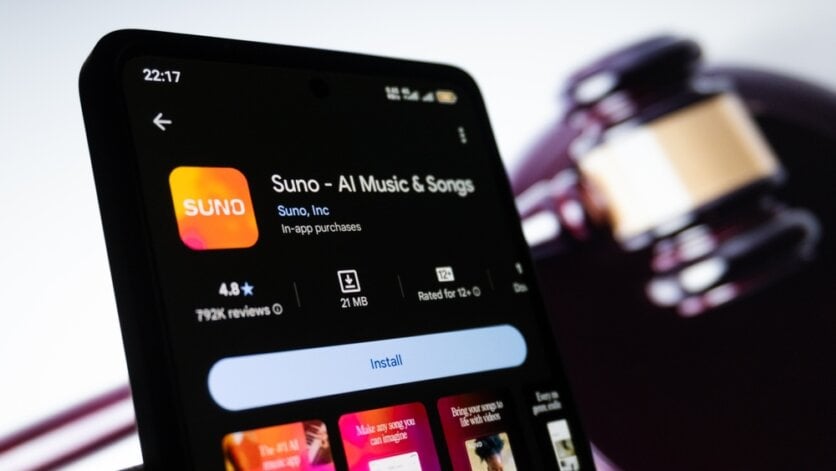
A packed courtroom in Munich on Monday (March 9) heard oral proceedings in the copyright case brought by Germany’s GEMA against AI music generator Suno.
The collecting society alleges that Suno used, stored and reproduced copyrighted recordings of world-famous songs to train its AI tool.
The hearing ended without a ruling. A decision date has been set for June 12, 2026.
GEMA, which represents the copyrights of more than 100,000 members in Germany (composers, lyricists and music publishers) as well as over two million rightsholders worldwide, filed its lawsuit against the US-headquartered AI company on January 21, 2025. The hearing was originally scheduled for January 26, 2026, and was later postponed to today.
The case centers on GEMA’s evidence that Suno’s music tool, which enables users to generate playable audio content using simple text prompts, produces outputs that are, in the collecting society’s words, “misleadingly similar” to original songs.
GEMA presented evidence that AI-generated content closely matched the original compositions in melody, harmony and rhythm.
The case marks a significant escalation in GEMA’s legal campaign against AI providers. In November 2025, the same court, the 42nd Civil Chamber of the Munich Regional Court, ruled largely in GEMA’s favor in a separate lawsuit against OpenAI, finding that ChatGPT had reproduced copyright-protected song lyrics without obtaining the relevant licenses or paying remuneration to the authors.
While the OpenAI case concerned the reproduction of song lyrics, today’s proceedings against Suno deal with what GEMA describes as its “core business”: the licensing of playable music tracks — compositions rather than text.
“The business models of generative AI providers are based on human creativity, such as that of our members. Appropriate remuneration, transparency, and respect for authors are indispensable, even in the age of AI.”
Dr. Tobias Holzmüller, GEMA
“Europe must shape its own digital future,” said Dr. Tobias Holzmüller, CEO of GEMA, in a statement accompanying today’s hearing. “We must not limit ourselves to adopting regulations that originate elsewhere. Only by developing our own clear standards for the use of AI can we safeguard the rights of our creative professionals and strengthen Europe’s cultural, digital, and economic sovereignty.”
Holzmüller added: “The business models of generative AI providers are based on human creativity, such as that of our members.”
“Appropriate remuneration, transparency, and respect for authors are indispensable, even in the age of AI.”
GEMA’s General Counsel, Dr. Kai Welp, emphasized that the copyright obligations should apply regardless of where AI systems are trained.
“Like everyone else, providers of generative AI must respect copyright and remunerate authors for their creative work. This was made clear in today’s hearing,” said Welp. “This must also apply if the systems are trained outside the European Union and offered on the European market.”
He added: “We must prevent European authors from being left empty-handed and European AI companies from suffering a competitive disadvantage. Only in this way will we succeed in establishing a sustainable licensing market in the interests of people in the AI age.”
Today’s hearing adds another front to Suno’s expanding legal battles worldwide.
Warner Music Group reached a settlement with Suno in November 2025, but the AI company remains locked in legal battles with Universal Music Group and Sony Music Entertainment.
Udio, meanwhile, has settled with both UMG and WMG.
Suno, which closed a $250 million Series C funding round in November 2025 at a $2.45 billion post-money valuation, reported in February that it has reached 2 million paid subscribers and $300 million in annual recurring revenue. The company says over 100 million people have used its platform.
Despite its legal challenges, Suno has been investing heavily in music industry relationships. The company has hired former Warner Music Group executive Paul Sinclair as Chief Music Officer, former Merlin CEO Jeremy Sirota as Chief Commercial Officer, and former Spotify executive Sam Berger as Senior Director of Artist Partnerships.
Those hires have not shielded Suno from criticism. Last month, a coalition of artist representatives launched a ‘Say No to Suno’ campaign, describing the company as a “brazen smash and grab” platform. And a public PR battle had previously broken out between Suno and Universal Music Group over the question of “walled gardens” in AI music.Music Business Worldwide