
France‘s recorded music market grew 3.5% year-over-year to EUR €449 million (USD $524 million) in the first half of 2026.

Subscription streaming drove that growth in the world’s sixth-largest recorded music market, with revenues up 7.5% YoY to €291.5 million ($340 million).
That is according to the half-year market report published on Tuesday (September 8) by SNEP, the National Syndicate of Phonographic Publishing.
France‘s growth rate was below those reported by other major markets for the same period.
Spain‘s recorded music market grew 11.6% YoY to €181.4 million ($212 million) in the half, with subscription streaming revenues up 15.1% to €121 million, as MBW reported on September 7.
Both markets are measured at wholesale value.
Germany‘s trade revenues grew 5.4% YoY to €670 million ($782 million) in the period, according to trade body BVMI, while the RIAA reported on September 1 that US wholesale revenues rose 6.9% YoY to $5.97 billion.
The half-year figures cover physical and digital revenues in France. They exclude the sync and neighboring rights income counted in SNEP‘s annual reports, which put the market at €1.071 billion in 2025, as previously reported by MBW.
Digital revenues rose 5.2% YoY to €363.9 million ($425 million), a slower rate that SNEP attributed to a decline in advertising income from video platforms.
Video streaming revenues fell 11.9% YoY to €27.9 million, while ad-supported audio streaming grew 5.1% to €40.8 million and downloads fell 11.0% to €3.7 million.
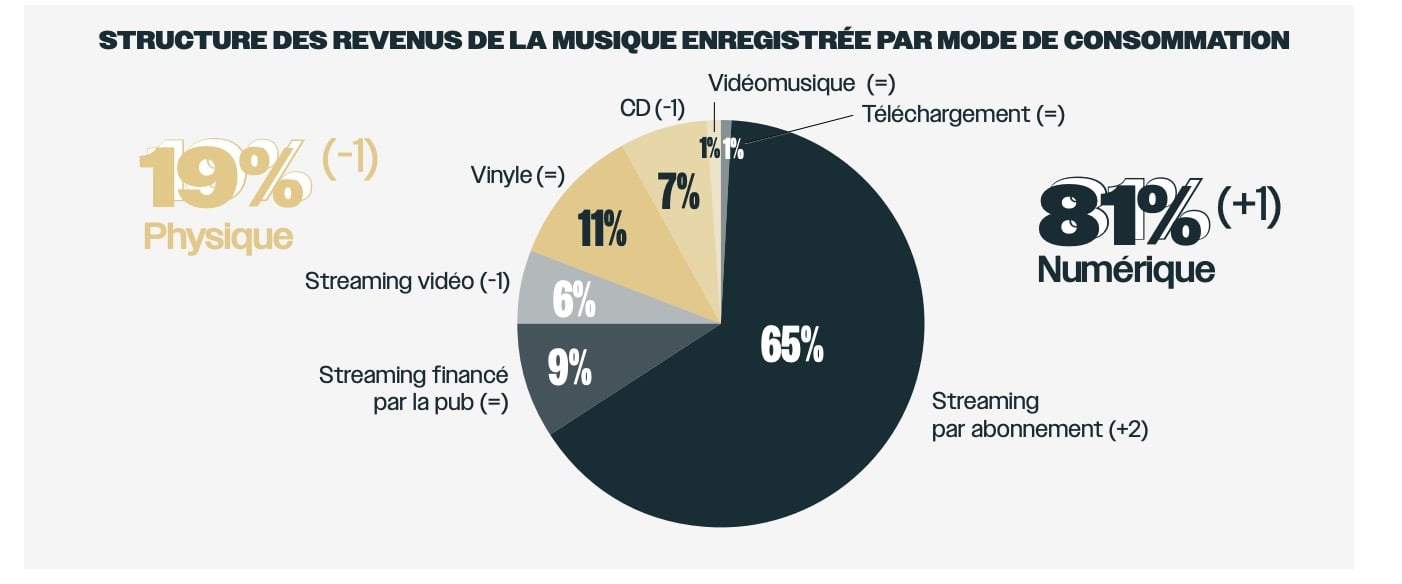
Subscription streaming now accounts for 65% of France’s combined physical and digital revenues, up 2.5 percentage points YoY, with digital as a whole on 81%.
The physical market fell 3.4% YoY to €85 million ($99 million).
CD revenues fell 14.4% to €32.7 million, while vinyl revenues grew 5.8% to €49.3 million and stayed the biggest physical format by value.
France generated 81 billion audio streams in the half, 79% of them from subscriptions, SNEP said.
The 3.5% growth rate compares with the 3.4% increase SNEP reported for the first half of 2025.
SNEP has also revised that comparison upward, putting H1 2025 at €433.8 million against the €432 million it published last September.
SNEP said the half marked a sixth straight year of growth for the period, with H1 revenues up 68% since 2020, when they stood at €268 million.
Alexandre Lasch, Managing Director of SNEP, said in the report, which was published in French: “The results of this first half of 2026 reflect the good health of the French recorded music market, but also its development potential, particularly in subscription streaming. Consolidating this model is essential to allow labels and producers to keep investing, supporting talent, and sustaining a diverse musical output.”
Local repertoire continued to lead the market, with French productions taking 72% of the Top 200 Albums chart for the half and the top four places on it, SNEP said.
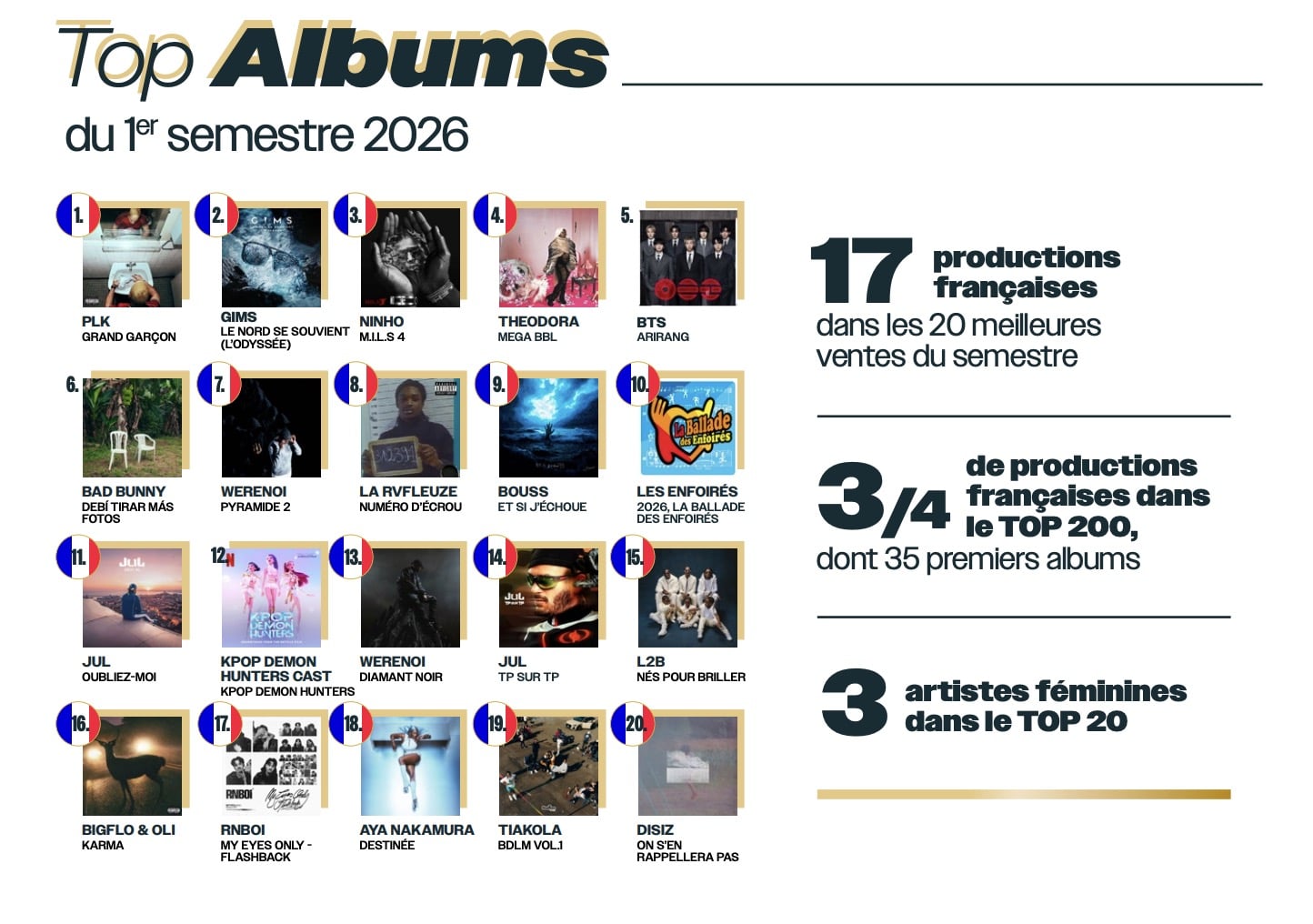
French productions accounted for 76% of listening on the Top 200 Streaming chart, up three points YoY, while 15 French-language tracks made the half-year Top 20 singles chart.
melodrama, by Disiz and Theodora, has spent 28 weeks at No. 1 on the Top Singles chart since its release in September 2025, 23 of them consecutive, which SNEP said is the longest run at the top in the chart’s history.
BTS delivered what SNEP called the best international performance of the six months, with ARIRANG entering the Top Albums chart at No. 1 and finishing the half at No. 5, plus No. 1 on the physical albums chart.
SNEP also used the H1 report to set out its position on AI-generated music.
The trade body has been applying criteria since May 2026 that determine when a recording developed with generative AI can qualify for France‘s official charts.
A recording generated entirely by artificial intelligence does not qualify under those criteria, according to SNEP.
SNEP‘s framework first separates recordings made with AI assistance that came out of a human-led creative process from those generated entirely by artificial intelligence.
To qualify for the official French charts, a recording developed using AI models has to meet three criteria, SNEP said.
The first is that the recording is the result of substantial human involvement.
The second is that the use of generative AI is disclosed to the public clearly and transparently.
The third is that the AI service used is authorized and complies with the regulatory and legal framework applicable in France.
Beyond those criteria, SNEP said, the recording must comply with copyright, related rights, and personality rights, must raise no suspicion of stream or chart manipulation, and must not breach the terms of the AI service used.
SNEP said the principles have been running for several weeks across the charts it publishes with its partners, and are now fully operational in France.
The criteria were developed through international cooperation with IFPI and SNEP‘s counterparts abroad, the trade body said.
They also draw on a July 2026 report on the status of AI productions by Professor Alexandra Bensamoun for the Conseil supérieur de la propriété littéraire et artistique, an advisory body to France’s culture ministry.
A coalition including the three majors, Believe, BMG, Concord, and HYBE proposed that framework in July, and IFPI began rolling it out across its own network of official charts on July 30.
IFPI said at the time that it was working to extend the program to more than 20 further chart programs, among them France‘s SNEP Charts.
“OUR CHARTS MUST REMAIN A REFLECTION OF CREATION DRIVEN BY ARTISTS, WITHIN A TRANSPARENT FRAMEWORK THAT GUARANTEES RESPECT FOR RIGHTS AND IS OPEN TO RESPONSIBLE INNOVATION.”
ALEXANDRE LASCH, SNEP
Lasch also said: “Artificial intelligence is obviously at the heart of what is at stake for us. We defend an ethical AI that respects intellectual property and European rules. The bill brought by Senator Laure Darcos provides necessary answers, which must urgently be debated by the National Assembly.
“Innovation and creation will only prosper in a framework that is transparent and respectful of rights.
“The integrity of listening and the prevention of all forms of fraud underpin the lasting development of our market. That requirement also guides the rules we apply to recordings entirely or partly generated by artificial intelligence in the industry’s charts.
“The standards we are unveiling today make it possible to distinguish AI used as a tool in the service of a human creative process from synthetic content, or content coming from unauthorized models. Our charts must remain a reflection of creation driven by artists, within a transparent framework that guarantees respect for rights and is open to responsible innovation.”
The Darcos bill would create a legal presumption that AI companies have used copyrighted works to train their systems, reversing the burden of proof in copyright disputes in France.
It was passed unanimously by the French Senate in April, as previously reported by MBW, and was adopted without amendment by the National Assembly‘s culture committee on June 2.
Its examination in the chamber on June 11 was then blocked by the filing of 110 amendments, most of them from Ensemble pour la République, the National Assembly group chaired by Gabriel Attal. The text has yet to return to the chamber.
“Official Charts is proud to support SNEP in producing the official French charts and in implementing the eligibility criteria for AI-generated recordings,” said Chris Austin and Becca Monahan, Co-Managing Directors of Official Charts, which compiles the charts for SNEP. “Our priority remains to guarantee charts compiled with accuracy and consistency, in line with the methodology defined by the industry.”
“Tracks generated by artificial intelligence are still rare on radio, but it is important for Yacast to work alongside SNEP from today so that these new standards apply to all French Airplay charts,” said Ali Mouhoub, Deputy Managing Director of Yacast, which supplies France’s airplay data to the trade body.
EUR-to-USD conversions are made at the average EUR/USD rate across the first half of 2026 of 1.167, per ValutaFX monthly averages.Music Business Worldwide