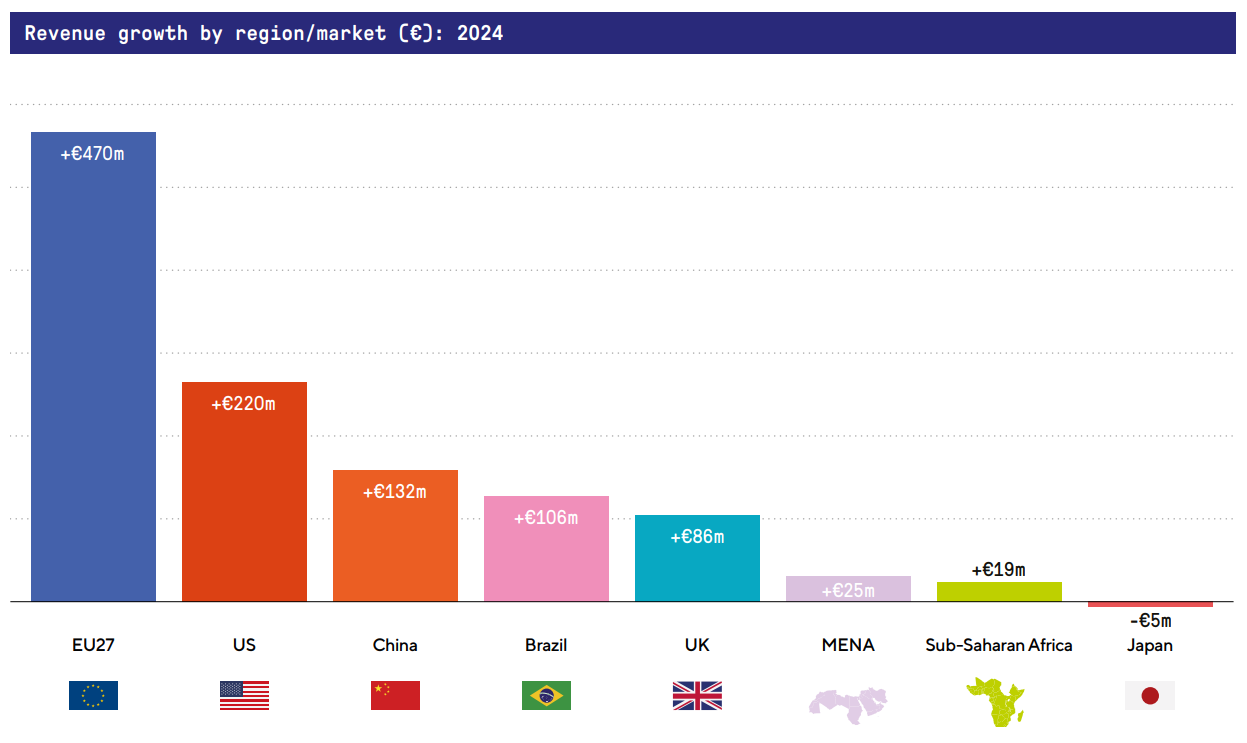
The European Union added EUR €470 million in recorded music revenues in 2024 – the largest absolute growth of any region worldwide – reaching EUR €5.7 billion (USD $6.2 billion), up 9.1% YoY.

The growth was driven by “a strong rise in subscribers and price increases by streaming platforms,” according to a new IFPI report, and “was more than double that of the United States (+€220m) and surpassed the combined revenue growth [in dollar terms] of the United States, China (+€132m), and Brazil (+€106m),” said IFPI.
While the EU added the most revenue in dollar terms last year, as reported in March when the IFPI published its Global Music Report, the world’s fastest growing region in percentage terms last year was the Middle East & North Africa, which was up +22.8% YoY, followed by Sub-Saharan Africa (+22.6% YoY) and Latin America (+22.5% YoY).
According to the second edition of the Music in the EU report from the IFPI, the fastest revenue growth in Europe was seen in Sweden, up 30.2% YoY, followed by Romania (up 26.9%), Hungary (23.9%), and Poland (22.3%). You can read the full report here.
However, Sweden’s revenue jump was due to a one-off payment on a private copying levy covering multiple years, the report noted. Excluding that levy, its growth was around 6.5%.
“The fastest growing markets tended to be those in Central, Eastern and South-Eastern Europe,” the report said.
The slowest-growing markets were Germany (up 4.1%), the UK (which is not in the EU but was included in some of the report’s metrics, up 4.9%) and Denmark (5.6%).
The report noted that the EU now accounts for more than a fifth of global recorded music revenues, powered in part by a “surge in homegrown talent.”
As other research has shown, Europe is among the leading regions where local talent has made major inroads in the age of streaming. On average, domestic artists had 50.9% of the spots on countrywide year-end top 10 lists, while another 7.7% were from artists from other EU countries. Globally, local artists averaged 47.2% of the spots on year-end top 10 lists.
In Finland, Hungary and Italy, all of the year-end top 10 tracks were from domestic artists, the report noted.
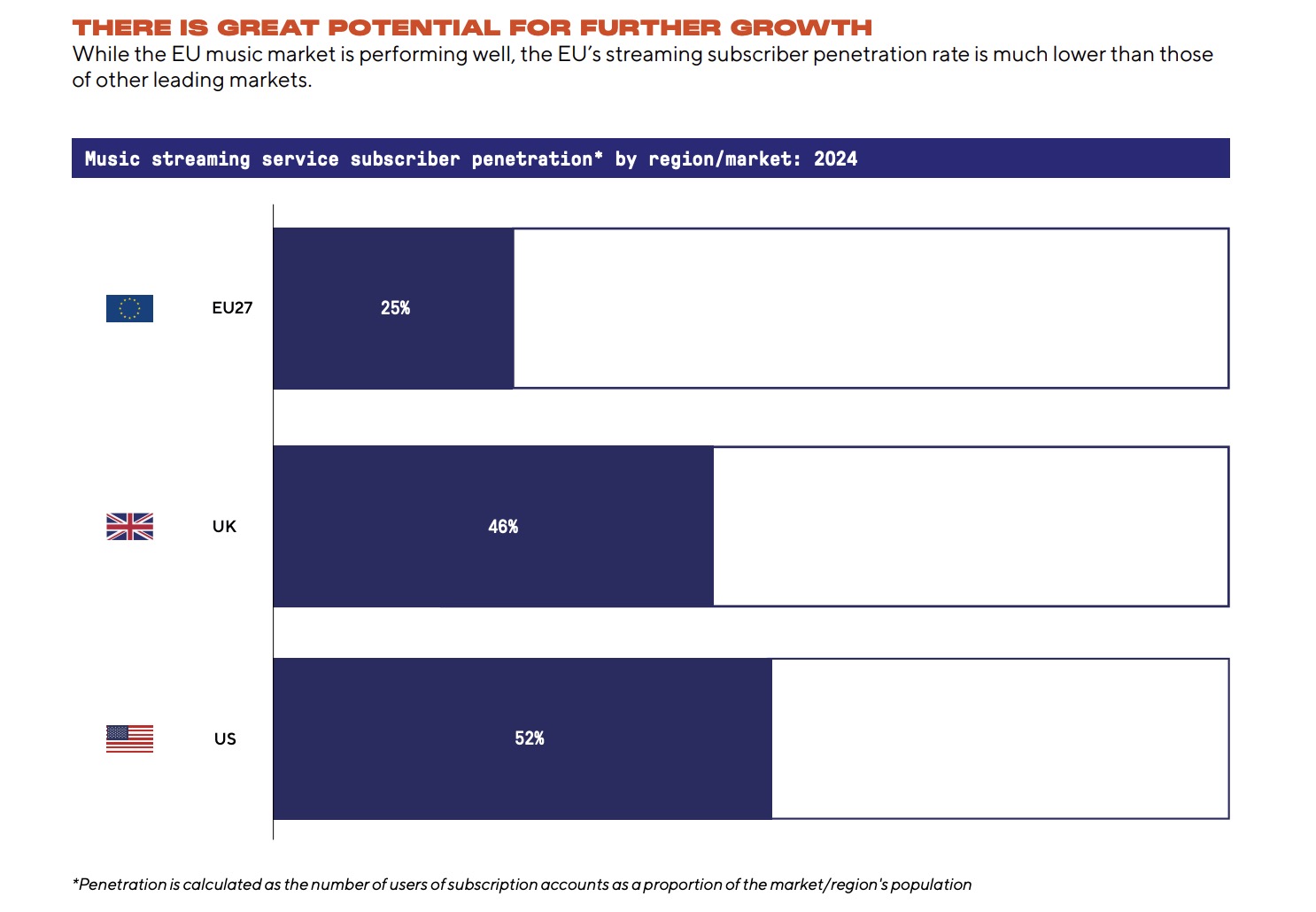
Despite the EU market’s strength, the IFPI noted that Europe is lagging behind other developed markets on a key metric: music streaming subscriber penetration.
While streaming contributed 77.4% of recorded music revenues in the EU, the number of streaming subscriptions, as a percentage of total population, was well behind other markets at 25%. That compares to 46% in the UK and 52% in the US.
That means there is “great potential for further growth,” the report said.
The IFPI‘s latest EU-focused report for 2024 follows recent H1 2025 stats published for three key European markets, including Germany, France, and Spain.
New data published by Promusicae earlier this month revealed that Spain’s recorded music industry maintained robust growth in the first half of 2025, with wholesale revenues reaching EUR €162.6 million (USD $178 million), up 10.4% YoY.
The German Music Industry Association (BVMI) reported in July that recorded music sales in the first half of 2025 hit EUR €1.157 billion (USD $1.36bn at the average exchange rate for Q2 2025), on a retail basis. That’s up just 1.4% from the same period a year earlier.
France, meanwhile, recorded a 3.4% YoY increase in H1, according to data from industry group SNEP.
Commenting on the contents of the new report, IFPI CEO Victoria Oakley said: “Europe is a powerhouse of musical creativity and cultural diversity. This success is no accident – it’s the result of years of investment, innovation, and an unwavering commitment to artists.”
“To stay ahead, we need strong, forward-looking policies that protect human creativity and make AI work in the service of music, not the other way around.”
Victoria Oakley, IFPI
Added Oakley: “Record labels have played a central role in building this thriving ecosystem, helping artists grow at home and reach fans around the world. But to stay ahead, we need strong, forward-looking policies that protect human creativity and make AI work in the service of music, not the other way around.”
AI is a key theme in the IFPI report, with the trade group urging governments to implement the European Union’s AI Act strictly. The law includes the ability of rights holders to opt out of having their works used to train AI, and mandates transparency requirements for AI developers in the materials they use to train their models. Some rights holders’ groups, including IFPI, have argued that the law’s implementation has been weaker than expected.
“It is now essential that the European Commission takes active and effective steps to ensure truly meaningful compliance with the AI Act – consistent with the spirit and letter of the law enacted by the EU,” Oakley wrote in the preamble to the Music in the EU report.
Artists taking a bigger share of the revenue pie
The report also included some global data, most notably a breakdown of the share of recorded music revenues that has been going to artists. It found there has been a steady increase in artists’ share of revenue over the past decade – at least for artists with the three recording majors (Sony Music Entertainment, Universal Music Group and Warner Music Group).
In 2024, artists took 35.5% of digital, physical and synch revenues at the recording majors, up from 31% in 2016.
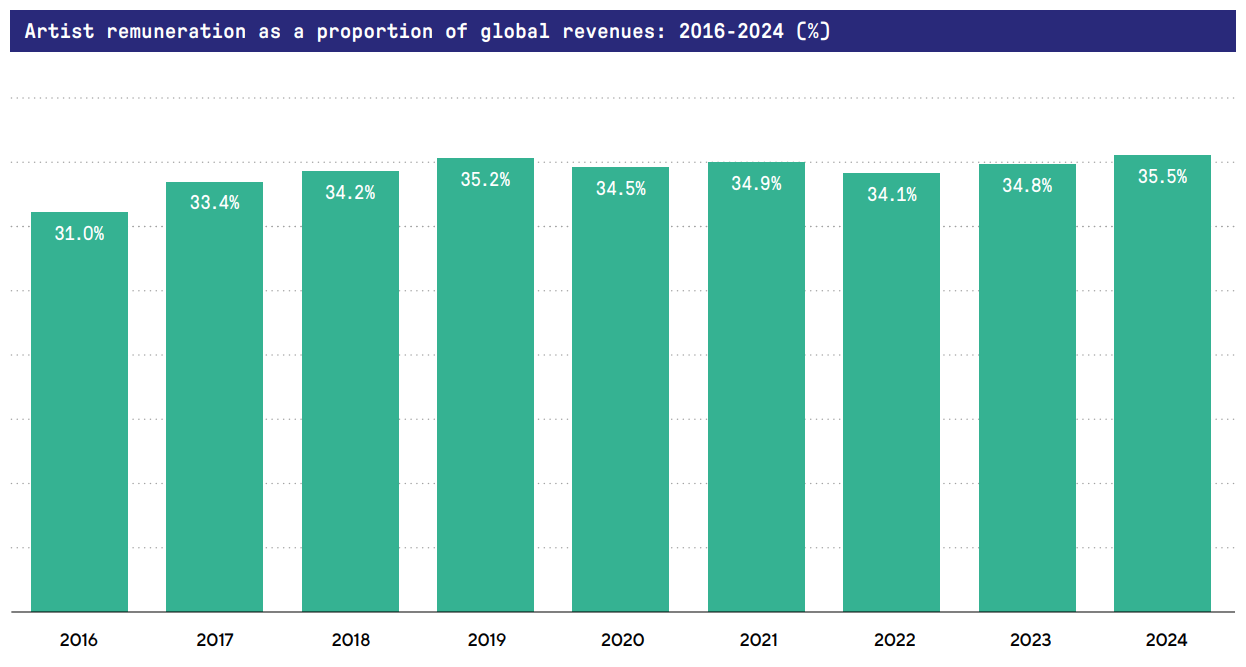
“Remuneration… is growing at a higher rate than the respective recorded music revenues of those companies,” the report said.
“Between 2016 and 2024, artist remuneration from recorded music increased globally by 121%, ahead of the record companies’ respective global revenues which increased by 92% over the same period.”
The report also said that, worldwide, record companies invested $8.1 billion in A&R and marketing in 2024, representing around 30% of their revenues for the year.Music Business Worldwide