
Deezer swung to a net profit of €6.7 million ($7.6 million) in the first half of 2026, reversing a net loss of €7.6 million ($8.6 million) in the same period a year earlier.

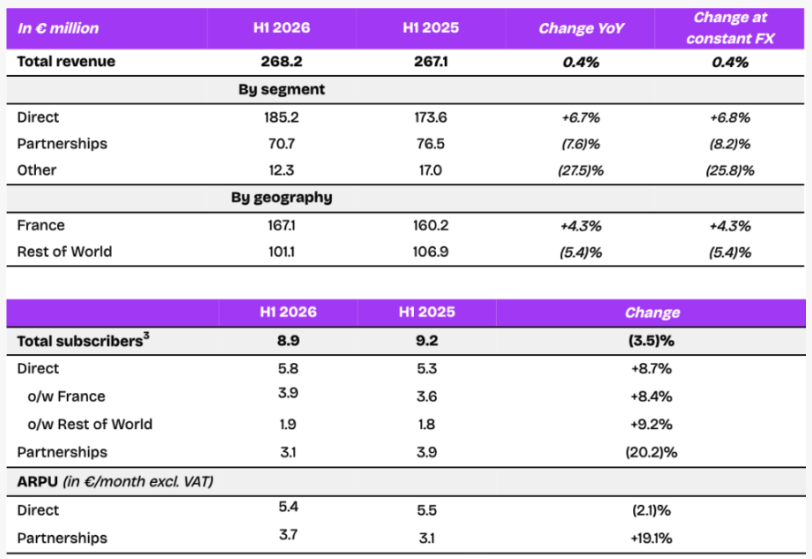
Revenue at the Paris-based streaming company rose 0.4% year-over-year to €268.2 million ($305 million), according to results reported on Tuesday (July 28).
The profit came as Deezer’s Direct business – subscriptions sold straight to consumers – grew revenue 6.7% YoY to €185.2 million ($210.6 million).
Even so, the company’s total subscriber base fell 3.5% YoY to 8.9 million, down from 9.2 million a year earlier, as gains in Direct were outweighed by a shrinking Partnerships base.
Direct subscribers rose 8.7% YoY to 5.8 million.
That growth came from two markets: France, where the base rose 8.4% to 3.9 million, and the Rest of World, where subscribers grew 9.2% to 1.9 million.
The pace of that Rest of World growth marks a turnaround from a year ago.
In H1 2025, that same base had grown just 0.5%.
The Rest of World rate then accelerated to 8.7% in Q1 2026 before reaching 9.2% in the latest half.
In France, the growth rate was 8.2% a year ago, 9.1% in Q1 2026, and 8.4% across H1 2026.
That took the French base from 3.6 million a year earlier to 3.9 million at the end of June.
Direct revenue growth has followed a similar upward path, rising from 1.2% in H1 2025 to 6.1% in Q1 2026 and 6.7% in the first half of this year.
Deezer’s Partnerships business, which distributes its service through telcos and other brands, moved the other way.
Partnerships revenue fell 7.6% YoY to €70.7 million ($80.4 million), which Deezer attributed mainly to its Mercado Libre partnership in Brazil winding down.
Average revenue per user in the segment rose 19.1% to €3.7 ($4.20), and Deezer said the business stabilized sequentially in the second quarter after several quarters of decline.
Partnerships subscribers fell 20.2% YoY to 3.1 million, extending a decline MBW reported in April.
Other revenue, made up of advertising and ancillary income, fell 27.5% to €12.3 million ($14 million), which Deezer linked to the expiry of a content licensing deal at the end of 2025.
Adjusted EBITDA reached €8.5 million ($9.7 million) in H1 2026, up from €2.1 million ($2.4 million) a year earlier.
Deezer said the €6.3 million ($7.2 million) improvement mainly reflected a €6.1 million ($6.9 million) cut in SG&A and marketing costs, plus a slight rise in adjusted gross profit.
Adjusted gross profit was €65.8 million ($74.8 million), with the margin steady at 24.5%, while the Partnerships gross margin widened to 22.6% from 19.8%.
Operating income turned positive at €6.5 million ($7.4 million), against an operating loss of €7.0 million ($7.9 million) in H1 2025.
Free cash flow jumped to €37.4 million ($42.5 million) from €1.0 million ($1.1 million), which Deezer said was helped by a one-off advance payment received under a partnership agreement.
The company ended June with €99.8 million ($113.5 million) in cash and cash equivalents, up from €65.4 million ($73.8 million) at the end of 2025.
“The first half of the year demonstrates that our strategy is delivering,” said Alexis Lanternier, CEO of Deezer.
“Our Direct business continues to grow, profitability has become sustainable, and our strong financial position allows us to invest confidently in future growth.”
Alexis Lanternier, Deezer
“Our Direct business continues to grow, profitability has become sustainable, and our strong financial position allows us to invest confidently in future growth.”
“In Partnerships, revenue stabilized sequentially in Q2 after several quarters of decline, as new commercial initiatives gained traction and the Mercado Libre headwind is fading.”
“We also continued to strengthen Deezer‘s leadership in AI music, advancing fairness and transparency for the music ecosystem, while creating selective new monetization opportunities.”
“We also continued to strengthen Deezer‘s leadership in AI music, advancing fairness and transparency for the music ecosystem, while creating selective new monetization opportunities.”
Alexis Lanternier, Deezer
“Looking ahead, we remain focused on disciplined execution,” Lanternier added.
“Our financial strength gives us the flexibility to increase selective investments in the second half while remaining fully on track to deliver our FY26 guidance.”
The half-year result extends a turnaround that saw Deezer post its first-ever annual net profit in 2025, reversing a €26 million ($28 million) loss the year before.
The AI theme that runs through Lanternier‘s comments has been building across recent quarters.
Deezer said that in June, fully AI-generated tracks made up more than half of daily uploads to its platform for the first time, at nearly 90,000 tracks a day at peak.
The company, which launched an AI music detector during the half, said Hungary‘s EJI and the Netherlands‘ BumaStemra have both licensed its AI detection technology.
On July 1, Deezer also struck a white-label deal with Winamp, supplying its technology and catalog so the American-founded, now Belgium-based brand can launch its own subscription service.
Deezer confirmed its full-year 2026 guidance, targeting revenue in line with 2025, positive adjusted EBITDA, and positive free cash flow for a third consecutive year.
It said it will file its half-year report with France‘s market regulator, the AMF, on July 29, and will report third-quarter revenue on October 27.
USD conversions use the rate for each figure’s period: H1 2026 figures at €1 = $1.137 (spot rate on the July 28, 2026 reporting date), 2025 comparatives at the 2025 IRS yearly-average rate of €1 = $1.129, and the 2024 figure at the 2024 IRS average of €1 = $1.082.Music Business Worldwide