France-headquartered music streaming service Deezer has published its Q1 2026 results, covering the three months ended March 31.
Deezer reports its subscriber base in two categories: ‘Direct’ subscribers, who sign up and pay for the service themselves, and ‘Partnerships’ subscribers, who access Deezer through third-party bundles — typically with telcos such as Orange and Bouygues, or through commercial tie-ups like its deal with German broadcaster RTL+.
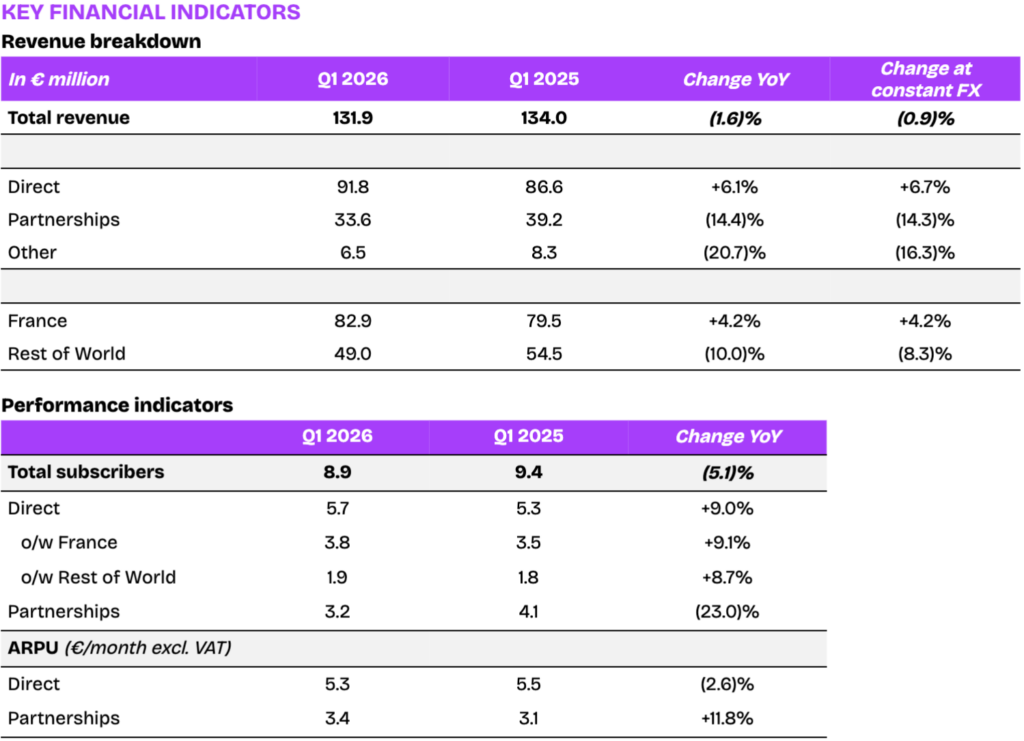
Total Direct subscribers across France and the rest of the world grew 9% YoY to 5.7 million in Q1 2026.
The platform’s Direct subscriber base in its home market of France, meanwhile, grew 9.1% YoYto 3.8 million, driven, according to the platform, “by a well-balanced combination of strong brand positioning, targeted promotional offers and sustained marketing investments”.
Direct subscribers in the rest of the world increased by 8.7% YoYto 1.9 million, reflecting “solid organic traction and selected profitable marketing investments in key markets”.
However, the platform’s total subscribers globally across both Partnerships and Direct fell 5.1%YoY to 8.9 million in Q1, as subs from its Partnerships segment plunged 23% YoYto 3.2 million. Deezer attributed the decline in the number of Partnership subscribers to what it described as the “expected run-off” of its deal with Brazilian marketplace Mercado Libre.
Total revenue for the quarter fell 0.9% YoYat constant currency to EUR €131.9 million (USD $154.3m), attributed to “the expected run-off of the Mercado Libre deal.”
As a result, Partnerships revenue in Q1 slumped14.4% YoY to €33.6 million ($39m), while Other revenue — encompassing advertising, ancillary income, and white-label solutions — plunged 20.7% YoY to €6.5 million ($7.6m), which Deezer attributed to “a high comparison base, including the end of one content licensing deal in Q4 2025.”
Excluding the Mercado Libre transition effect, Deezer said its Q1 revenue was “broadly stable.” Deezer also said its recently signed deals with Telenor, Molotov, Norlys, FitnessPark, Chippu and EDF are still in the “ramp up phase.”
In its home market of France alone, Deezer’s revenue grew4.2% YoY to €82.9 million ($97m), offsetting the 10% YoY drop in revenue in the rest of the world to €49 million ($57m).
In terms of ARPU (Average revenue per user), Partnerships ARPU in Q1 rose 11.8% YoY to €3.4 ($3.98), the company said, driven by an improved partner mix.
ARPU within the company’s direct segment fell 2.6% YoY to €5.3 ($6.2).
“we are executing on our strategic priorities, including the repositioning of our partnerships segment, where we are making encouraging progress through new deals and the launch of our revamped Deezer for Business offering.”
Alexis Lanternier, deezer
Alexis Lanternier, CEO of Deezer, said: “In the first quarter of 2026, we continued to see strong momentum in our Direct subscriber base, both in France and the Rest of the World. At the same time, we are executing on our strategic priorities, including the repositioning of our partnerships segment, where we are making encouraging progress through new deals and the launch of our revamped Deezer for Business offering.”
“We also took a step in monetizing our innovation capabilities with the signing of an agreement to license our AI detection tool. Overall, we remain firmly on track to deliver our full-year guidance, with positive adjusted EBITDA and Free Cash Flow, while maintaining revenue broadly in line with 2025 levels.”
The quarterly figures follow a landmark 2025 for Deezer when the company reported its first-ever annual net profit of€8.5 million, reversing the €26 million loss it posted in 2024. That turnaround came even as Deezer’s revenue fell 1.4% YoY, also due to a12.1% YoY drop in revenue in the Partnerships segment.
In Q1 2026, Deezer said it made progress in the “repositioning” of its Partnerships segment, the development of new AI-driven revenue streams, and its ongoing product innovation to improve user experience.
Also during the quarter, Deezer renewed its partnership with SonosRadio, a deal that the streaming platform says drives “tens of millions of monthly listening hours across millions of households globally.”
In February, Deezer launched ‘Flow Tuner,’ an update to its flagship Flow product that now lets users activate or deactivate specific genres and subgenres. The company explained that Flow Tuner adjusts recommendations in real time instead of relying on likes, dislikes or skips.
In March, the company struck a deal with Hungary-based music rights organization, the Bureau for the Protection of Performers’ Rights (EJI), to license its AI detection technology. The development came after Deezer revealed in January that it was planning to license its AI-detection tech to the wider music industry and made it available via its revamped Deezer for Business unit earlier in March.
Deezer revealed last week that its proprietary detection tool to tag AI-generated content across its catalog has detected nearly 75,000 synthetic tracks uploaded to the company’s platform every day. That translates to over 2 million AI tracks hitting the platform each month, and it means fully AI-generated music now accounts for more than 44% of all new tracks delivered to Deezer daily, according to the company.
For fiscal year 2026, Deezer said it aims to accelerate its direct subscriber growth through continued brand differentiation, leverage its “partnerships DNA” to continue to expand distribution and build a new profitable B2B segment through white-labeling business models, and to continue to lead on AI through transparency while monetizing its detection technology and exploring AI products to benefit real artists.
Deezer expects to book positive adjusted EBITDA and positive free cash flow for FY 2026. It also expects to maintain its FY 2026 revenue in line with FY 2025.