
Deezer posts first-ever annual profit – despite total subscriber base declining in 2025

Deezer has achieved profitability for the first time in its history, reporting net income of EUR €8.5 million for fiscal year 2025 — a sharp reversal from the €26 million loss it posted in 2024.
The Paris-headquartered streaming platform published its full-year results on Wednesday (March 18), calling the milestone the start of “a cycle of sustainable profitability“.
The result is all the more striking given that Deezer’s total subscriber count fell significantly over the course of the year.
Deezer reports its subscriber base in two categories: ‘Direct’ subscribers, who sign up and pay for the service themselves, and ‘Partnerships’ subscribers, who access Deezer through third-party bundles — typically with telcos such as Orange and Bouygues, or through commercial tie-ups like its deal with German broadcaster RTL+.
By the end of H1 2025, Deezer’s total paying subscribers had dropped to 9.2 million — down from 10 million a year earlier on a like-for-like basis. (Worth noting that Deezer originally reported its H1 2024 subscriber base at 10.5 million; this figure was subsequently restated downward to approximately 10 million after the company removed around 500,000 inactive family accounts from its count.)
The drop in overall subscribers was concentrated in Deezer’s partnerships segment, where subscribers contracted sharply as promotional cohorts from its Meli+ arrangement with Brazilian marketplace Mercado Libre were converted to premium offers or churned off the platform entirely.
Partnerships revenue fell -12.1% YoY for the full year to €147.8 million as a result. Excluding the Mercado Libre effect, the company said partnership revenue was broadly stable year-over-year.
Deezer’s direct subscriber base, however, grew in the opposite direction — and it is this higher-value segment that underpinned the path to profitability.
In France, the platform’s core market, direct subscribers rose +8.6% YoY to 3.8 million. The firm’s rest-of-world direct subscriber base also returned to growth at +7.7% YoY for the full year, after several quarters of decline.
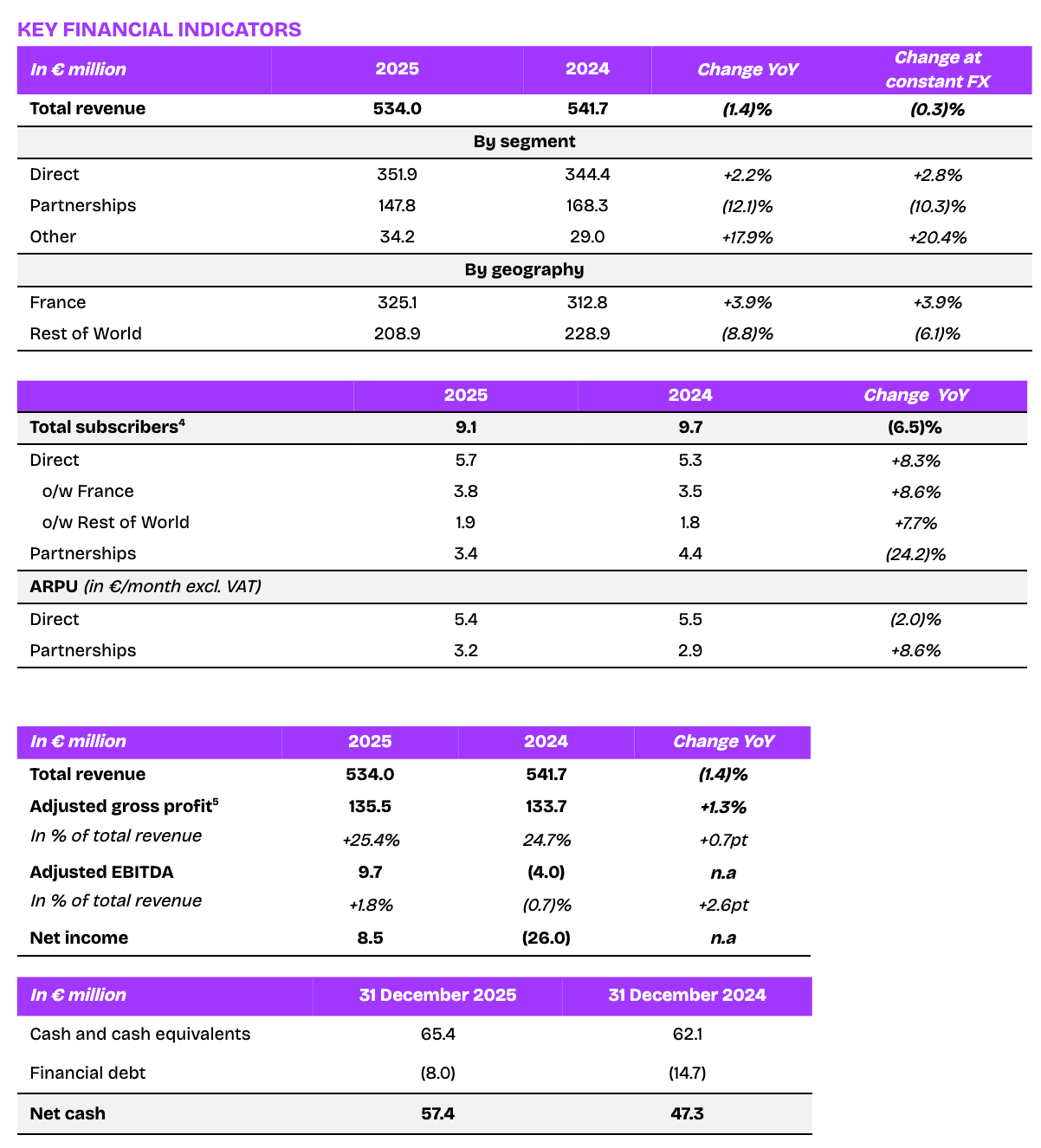
Alongside the shift in subscriber mix, aggressive cost-cutting proved equally critical. Deezer reduced operating expenses by €12 million year-over-year across marketing, staffing, and general administrative costs, which the company described as a result of “disciplined cost management.”
Adjusted EBITDA reached €9.7 million for the full year — up from negative €4 million in 2024 — marking the first time the Euronext-listed company has delivered a positive annual figure on this measure. Free cash flow came in at €10 million, and Deezer closed the year with a cash position of €65 million and net cash of €57.4 million, up from €47.3 million at the end of 2024.
Consolidated revenue was €534 million, a marginal -1.4% YoY decline at current exchange rates but broadly flat at constant currency — in line with the company’s guidance. Adjusted gross profit rose slightly to €135.5 million, yielding a 25.4% margin.
Deezer’s ‘other’ revenue segment — encompassing advertising, ancillary income, and white-label solutions — was a notable contributor to the improved margin picture, climbing +17.9% YoY to €34.2 million.
The company attributed this largely to the performance of Sonos Radio and the expansion of its white-labeling business for hardware and media partners.
The platform renewed 10 major partnership agreements during the year, including with TIM and Sonos, and expanded into new verticals with clients such as Fitness Park, EDF, and Molotov TV.
Alexis Lanternier, CEO of Deezer, said the results validated the company’s strategic direction. “For the first time in our history, we delivered positive net income, alongside sustained positive free cash flow and double-digit adjusted EBITDA,” stated Lanternier. “We met or exceeded all of our financial commitments.”
Deezer’s positioning on AI-generated content has become a defining feature of its brand.
In January 2026, the company disclosed that it was receiving approximately 60,000 fully AI-generated tracks per day — around 39% of all daily deliveries to the platform.
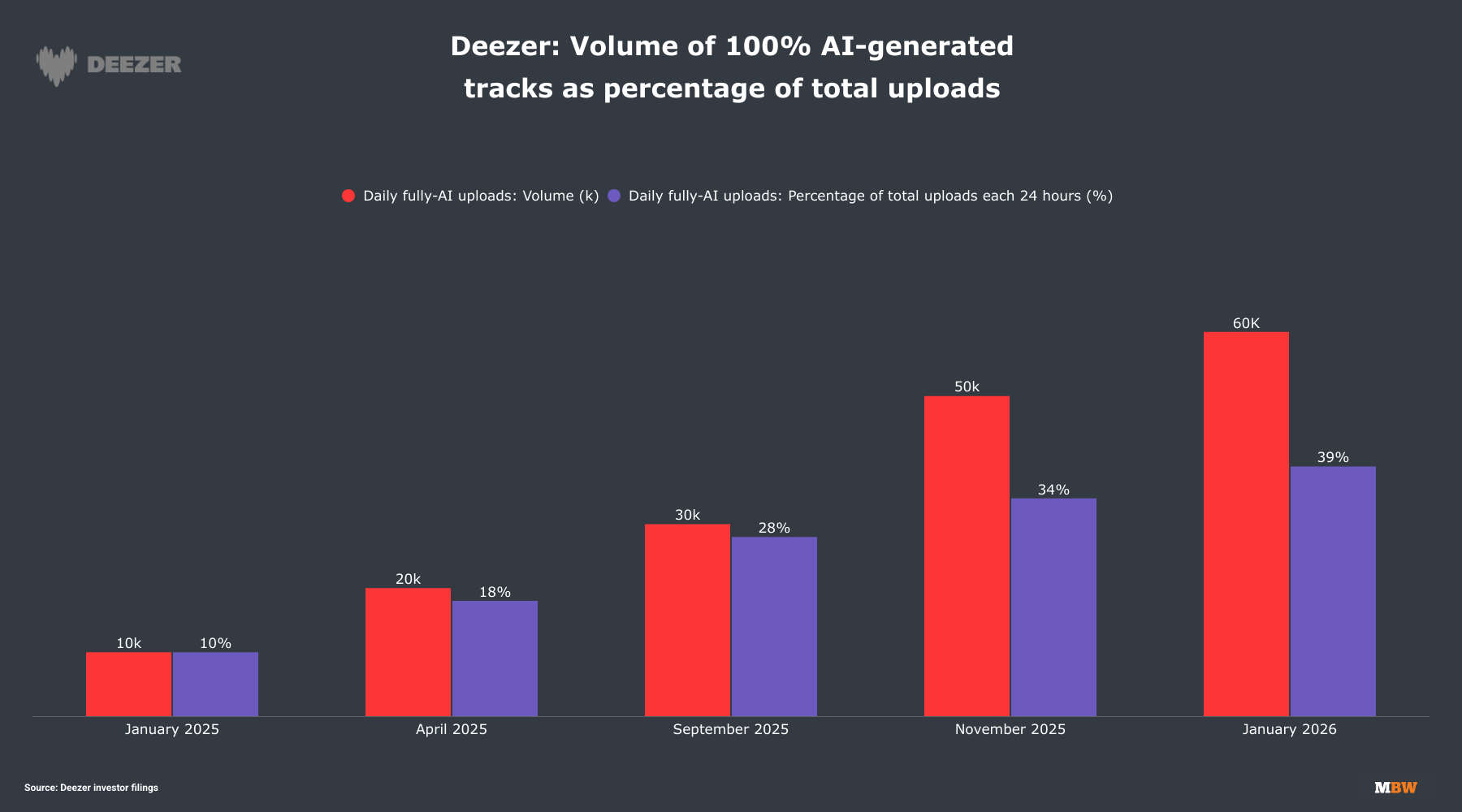
Up to 85% of streams on that AI-generated content were detected as fraudulent, demonetized and removed from the royalty pool. Deezer has begun commercially licensing its proprietary detection technology to partners, including French collecting society Sacem.
The company said 85% of its partners are now on its artist-centric payment system, which it pioneered with Universal Music Group in 2023 before expanding it through deals with Warner Music Group, Merlin, and Sacem.
For 2026, Deezer said it expects revenue in line with FY25 while maintaining positive adjusted EBITDA and free cash flow. Strategic priorities include accelerating direct subscriber growth, scaling a new B2B offering called ‘Deezer for Professionals,’ and monetizing its AI detection capabilities through licensing. Q1 2026 revenue is due April 23.Music Business Worldwide