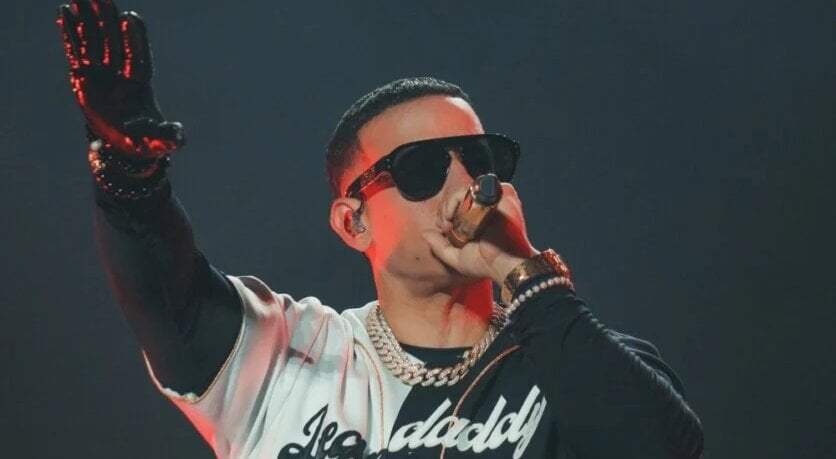
Ramón Luis Ayala Rodríguez, better known as Puerto Rican rapper and singer Daddy Yankee, has sued his ex-wife and his former manager over an alleged two-decade scheme to siphon revenue from music royalties.
The complaint against Daddy Yankee’s former manager Rafael Pina-Nieves, or Raphy Pina, the rapper’s ex-wife, Mireddys González-Castellanos, and others (which you can read here), was filed on Saturday (November 29) at the US District Court for the District of Puerto Rico.
Daddy Yankee’s lawyers claimed that Pina inserted himself as a songwriter on tracks he never wrote.
The former manager allegedly engaged in a “coordinated operation” to manipulate publishing documents and divert revenue. The lawsuit cited incidents of racketeering as far back as 2004.
Also named in the lawsuit are Daddy Yankee’s ex-wife Mireddys González-Castellanos, lawyer Edwin Prado-Galarza, music industry figure Andrés Coll-Fernández, and several publishing entities.
The 107-page lawsuit is seeking at least $3 million in damages under the federal Racketeer Influenced and Corrupt Organizations Act, commonly known as RICO, and requests a jury trial. It alleges wire fraud, interference with interstate commerce through extortion, and violations of Puerto Rico’s organized crime act.
In addition to $3 million in damages, Daddy Yankee is also seeking a court order for the defendants to take all steps to “correct and restore” accurate authorship of the 15 tracks identified in the complaint with PROs like ASCAP, BMI and SESAC, as well as with the US Copyright Office.
Daddy Yankee alleged in the lawsuit that Pina exploited his positions as manager and label executive to gain control over financial documents. The lawsuit claims he worked with González Castellanos and others to alter split sheets — which are documents that allocate songwriting credits and royalty percentages — without the artist’s knowledge or consent.
“What began as unauthorized insertions into email-circulated split sheets matured into a coordinated operation that corrupted copyright records, undermined the integrity of the music-publishing system, and caused losses.”
Daddy Yankee’s lawsuit
The “falsified split sheets” were then used to file copyright registrations with the US Copyright Office listing Pina as a co-author, according to the complaint.
Once embedded in official records, the fabricated claims enabled royalty payments to flow to publishing companies controlled by Pina, including Los Magnifikos and Mafer Music Publishing.
The lawsuit read: “What began as unauthorized insertions into email-circulated split sheets matured into a coordinated operation that corrupted copyright records, undermined the integrity of the music-publishing system, and caused losses.”
The complaint noted that while some legitimate agreements granted Pina royalty shares on certain songs, none of the 15 Daddy Yankee tracks cited in the complaint were covered by such deals.
Daddy Yankee’s lawyers said the 15 tracks that Pina “had falsely claimed co-authorship” include Runaway, Bella Y Sensual, El Desorden, Inolvidable (Remix), La Rompe Corazones, Vuelve, Mayor Que Yo 3, Llevo Tras De Ti, Otra Cosa, Toda Comienza En La Disco, and more.
The rapper’s lawyers wrote: “Any reduction of Plaintiffs’ publishing shares required the express approval of Ayala-Rodríguez as the original author or co-author of the songs, which was not given for any of the songs that are the subject of this Complaint.”
They added: “Nor could Pina-Nieves plausibly claim the mantle of co-authorship. Co-authorship requires mutual intent to be co-authors and a creative contribution to the work; Pina-Nieves had neither. His asserted allocations were unearned and unauthorized, the product of misrepresentation and concealed manipulation rather than authorship, agreement, or right.”
While Pina was accused of being the central architect in the alleged scheme, González-Castellanos allegedly served as “the enterprise’s administrative coordinator.” The complaint accused of her “repeatedly preparing and circulating split sheets and publishing allocations that falsely inflated Pina-Nieves’ shares while reducing [Daddy Yankee’s] interests.”
“Any reduction of Plaintiffs’ publishing shares required the express approval of Ayala-Rodríguez as the original author or co-author of the songs, which was not given for any of the songs that are the subject of this Complaint.”
Daddy Yankee’s lawsuit
González-Castellanos served as president and director of Daddy Yankee’s companies El Cartel Records and Los Cangris until December 2024. They were married for 29 years before announcing their separation in December 2024.
Daddy Yankee’s lawyers wrote: “In these positions, however, she lacked any authority to assign ownership interests in the musical compositions to Pina-Nieves, who has never been a co-author of any song created in whole or in part by Ayala-Rodríguez.”
Meanwhile, Andres Coll-Fernández, described in the lawsuit as Pina’s “principal aide and mentor,” allegedly played a role in “legitimizing and disseminating fraudulent publishing claims,” while Orlando-based lawyer Edwin Prado-Galarza allegedly acted as a “contractual gatekeeper” and “an enabler of the enterprise by executing agreements and transmitting documents.”
One 2019 email chain allegedly confirmed Pina received a 22.5% share in the song Te Lo Dije, exceeding Daddy Yankee’s own 15% stake.
The alleged scheme came to light after Ayala regained control of his companies Los Cangris and El Cartel Records in December 2024. The lawsuit said Daddy Yankee found “severe gaps” in financial transparency and governance in the management of his companies by late 2024.
The artist allegedly found that his ex-wife attempted to transfer $100 million from corporate accounts into personal accounts, which he was able to stop.
Upon review, attorneys say they discovered discrepancies in publishing ownership records and found that hundreds of emails had been deleted from business accounts spanning July 2020 through December 2024. These deletions allegedly included negotiations for the multi-million dollar sale of Daddy Yankee’s music catalog and the La Última Vuelta World Tour, which generated an estimated $198 million in 2022.
Meanwhile, the lawsuit also accuses Pina of positioning himself as “the sole ‘bank’ for artists,” distributing advances and payments and withholding funds at will.
The complaint alleges he provided cars and housing under his own name, later reclaiming them as punishment when artists questioned his authority.
Additionally, the lawsuit claims Pina maintained control through intimidation. The complaint described incidents where firearms were displayed during meetings and claims artists faced physical threats or financial retaliation when resisting his directives.
The complaint cites a 2004 incident involving artist Juan Ortiz García, also known as Sir Speedy, who allegedly faced armed threats after requesting payment for album distribution handled by Pina.
Last year, MBW broke the news that Concord had acquired a mystery catalog from a Latin Music artist and songwriter for $217.3 million. The artist in question was later revealed as Daddy Yankee.
Daddy Yankee has already sued González-Castellanos earlier this year in a separate suit for $12 million, citing “a deep betrayal of trust and a deliberate campaign to undermine the integrity of a business from within.”
Music Business Worldwide