
The companies behind Coachella have sued Walmart for trademark infringement.
Coachella Music Festival, LLC and Goldenvoice, LLC, which produces the festival, allege that the retailer has repeatedly sold merchandise bearing Coachella’s trademarks without a license, despite demands dating back to 2017 that it stop. (Goldenvoice, which owns Coachella, is a subsidiary of AEG.)
The complaint, obtained and first reported by MBW, was filed on Tuesday (November 24) in the US District Court for the Central District of California.
It names Walmart Inc. and Wal-Mart.com USA, LLC as defendants, and brings claims of trademark infringement and false designation of origin under the federal Lanham Act, as well as claims of unfair competition and misleading advertising under California law.
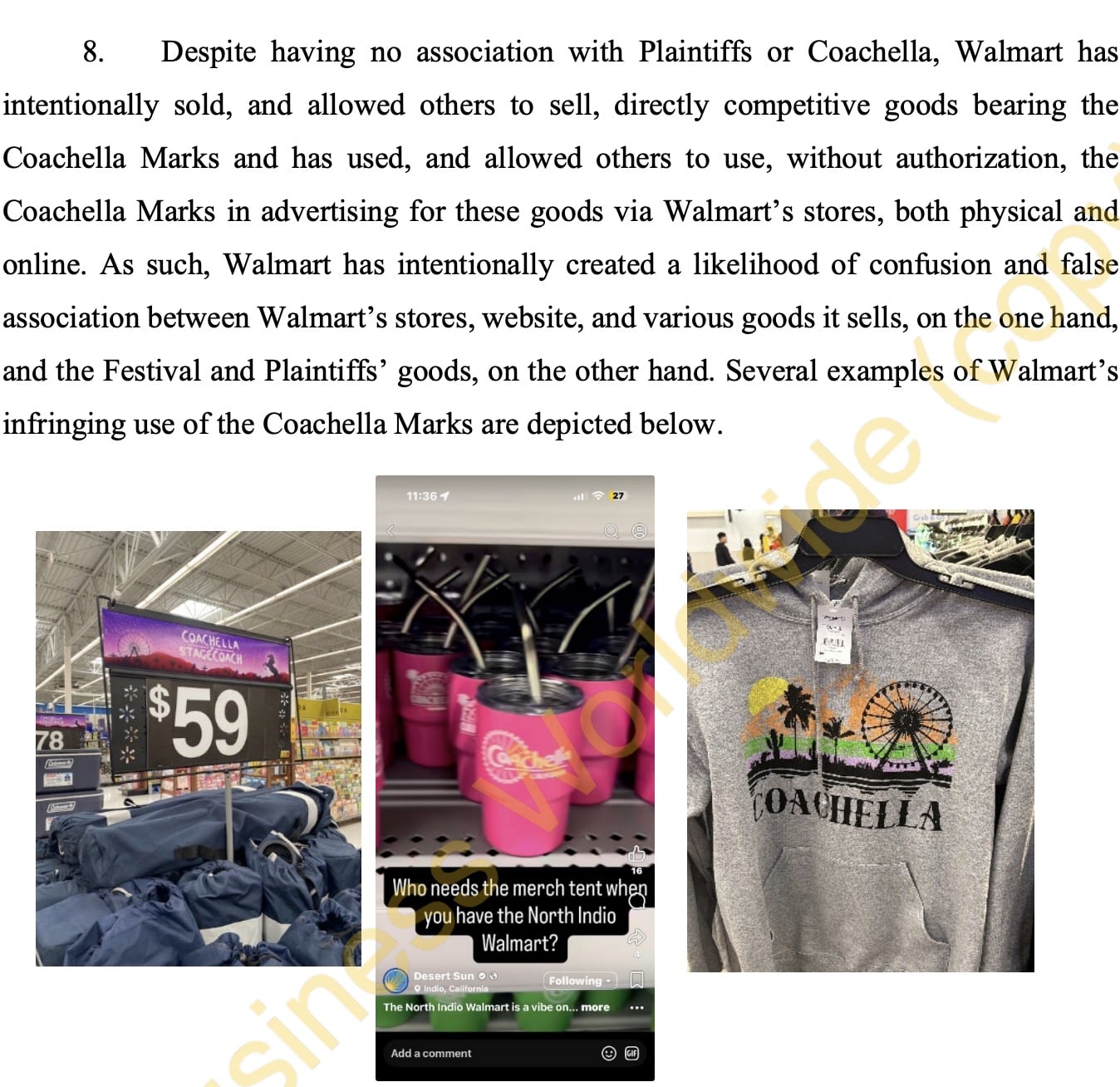
“Despite having no association with Plaintiffs or Coachella, Walmart has intentionally sold, and allowed others to sell, directly competitive goods bearing the Coachella Marks and has used, and allowed others to use, without authorization, the Coachella Marks in advertising for these goods via Walmart’s stores, both physical and online,” the complaint alleges.
“During the past several years, Plaintiffs have made repeated requests and demands for Walmart to cease selling and advertising infringing goods (both online and in its stores), and to remove or alter its advertising, signage, products, and promotional materials,” it adds. “Plaintiffs’ requests have been of minimal benefit; Walmart typically stops for a period of time, but then resumes its infringing conduct.
“As a result, Plaintiffs have no choice but to bring this lawsuit against Defendants.”
The complaint, which you can read in full here, describes Walmart, which it says has more than 4,600 US locations, as “the world’s largest retailer.”
One section of the filing is headed with the claim that Walmart is a “serial infringer,” and lists intellectual property disputes involving the retailer stretching back to the late 1990s.
Among them, according to the complaint, is a USD $6.4 million settlement that Walmart paid to resolve a lawsuit brought by Tommy Hilfiger, which alleged that Walmart sold counterfeit Hilfiger-brand T-shirts.
The complaint also cites claims brought against the retailer by Nike, Yeti Coolers, Crocs, Vans, and Deckers, which owns the Hoka, Teva, and Ugg brands.
It alleges that Walmart “typically responds to these infringement complaints” with a statement such as: “We respect intellectual property rights and take these allegations seriously. We will review the complaint once we have been served with it and will respond as appropriate with the court.”
The earliest incident detailed in the complaint took place in June 2017, when Walmart advertised at least 28 apparel items displaying the Coachella mark on its website.
“After initially resisting Plaintiffs’ takedown efforts, Walmart eventually removed the infringing products from the Walmart Website,” the complaint states.
In April 2019, the complaint alleges, Walmart’s North Indio store in California began selling apparel bearing the Coachella marks, before removing it following another demand from the plaintiffs.
When the festival returned in April 2022 after a two-year break during the COVID-19 pandemic, Walmart used photographs taken on the festival grounds, showing Coachella’s Ferris wheel, in what the complaint describes as advertising for its Dr. Thunder soft drink.
The post reproduced in the filing, from Walmart’s account on X (then Twitter), shows a woman in a Dr. Thunder T-shirt, with the caption: “Want to spice up your festival ‘fit? Try this.”
The plaintiffs say they own the copyright to all images and video recordings made at Coachella under the festival’s ticket terms, and argue that Walmart either breached that contract or induced someone else to breach it.
In April 2023, the complaint alleges, Walmart’s store in La Quinta, California, used signage “copied directly from Plaintiffs’ line-up posters from prior festivals” to promote items including beverage coolers and folding chairs.
The signage was removed after the plaintiffs sent another cease-and-desist letter to Walmart‘s General Counsel, according to the complaint.
“Walmart typically stops for a period of time, but then resumes its infringing conduct.”
Coachella’s complaint
“In April 2026, undeterred by knowledge at the highest corporate levels that its sale of unlicensed goods bearing the Coachella Marks is wrongful, Walmart again disregarded Plaintiffs’ rights and resumed offering the sale of products at the La Quinta Walmart that displayed the Coachella Marks without Plaintiffs’ approval, license, or authorization,” the complaint alleges.
The filing claims that the store used a point-of-sale Ferris wheel sign produced by festival sponsor Absolut Vodka, “suggesting that the goods were authentic Coachella items and/or that Walmart was affiliated with Plaintiffs or the Festival.”
The complaint also cites Instagram videos posted around this year’s festival by The Desert Sun, a Palm Springs news outlet, showing tumblers, bottles, wine glasses, tank tops, and other merchandise bearing the Coachella marks at Walmart’s North Indio store.
The videos carried the caption: “Who needs the merch tent [at Coachella] when you have the North Indio Walmart?”
The lawsuit asserts rights in 12 US trademark registrations, covering marks including Coachella, Coachella Valley Music and Arts Festival, and Chella, as well as the festival’s palm tree logo.
The plaintiffs also claim trade dress rights in combinations of visual elements associated with Coachella, including “a Ferris wheel, silhouettes or images of palm trees, images of the mountains surrounding the Coachella Valley, grass, and a gradient background.”
The plaintiffs are seeking a temporary restraining order, as well as preliminary and permanent injunctions barring Walmart from selling or advertising goods in connection with the Coachella marks.
They are also seeking damages, trebled due to what they allege is Walmart’s willfulness, along with Walmart‘s profits from the alleged infringement, the cost of any corrective advertising, and attorneys’ fees.
The complaint argues that the plaintiffs are entitled to punitive damages under California law “in an amount appropriate to punish Walmart and to make an example of it to the community.”
The plaintiffs, represented by Tucker Ellis LLP, have demanded a jury trial.
The complaint puts Coachella’s annual attendance at nearly 750,000, a figure it says is “aggregated over the multi-day event.”
In September, YouTube, which the complaint lists among Coachella’s sponsors, renewed its exclusive livestream deal with Goldenvoice, the AEG-owned promoter behind Coachella and Stagecoach, through 2030.
In March 2017, Coachella and Goldenvoice sued Urban Outfitters and its Free People subsidiary over apparel sold under the Coachella name, including a “Coachella Valley Tunic.” The case was dismissed in September 2017 after the parties filed a notice of settlement.
In December 2021, Goldenvoice sued Live Nation for alleged contributory trademark infringement over an event called Coachella Day One 22, which was being advertised by Ticketmaster.
That complaint alleged that the event’s organizers had copied Coachella‘s promotional materials, including design elements such as a Ferris wheel and palm tree silhouettes.
The Coachella lawsuit is the latest in a wave of litigation across the music business over unlicensed merchandise, though most of those cases have targeted anonymous sellers rather than a major retailer.
At concert venues, Live Nation‘s Merch Traffic sued John Doe bootleggers on behalf of Bruce Springsteen & The E Street Band in April, the same month that HYBE moved to crack down on bootleg BTS merch ahead of US tour dates. In June, UMG‘s Bravado obtained a seizure order targeting counterfeiters at A$AP Rocky‘s shows.
Online, Merch Traffic sued anonymous e-commerce sellers in August over counterfeit Nirvana and Bruno Mars merch, asking the court to order platforms including Amazon, eBay, Temu, and Walmart to stop displaying the sellers’ listings.
As MBW has previously reported, the rise in such cases reflects both merch’s growing importance to artists’ income and the ease with which knock-offs can now be produced and sold.Music Business Worldwide