Are you noticing fewer new hits ‘sticking’ in the public’s consciousness these days?
This was on my mind last week when I read that Miley Cyrus’ latest album, Bass Persuades, had fallen 156 places on the Billboard 200 – from No.1 to No.157 – in its second week: the biggest-ever drop for a No.1 debut.
There’s no doubt that we still witness generational smash hits from fresh artists.
For evidence, consider Ella Langley’s Choosin’ Texas (760M+ Spotify streams), Olivia Dean’s Man I Need (1.4B+), and other big breakthroughs by the likes of Don Toliver, RAYE, Noah Kahan, and sombr.
And of course, there are the established modern-day giants – including Drake, Taylor Swift, Olivia Rodrigo, BTS, Bad Bunny, and Bruno Mars – who continue to dominate the streaming charts on a regular basis.
Yet what I’m interested in is the full tiered cake of the mainstream ‘hit’ rankings – including its second and third layers – and to what extent new ‘frontline’ tracks are ceding ground to ‘catalog’ mainstays.
With all of this in mind, MBW decided to run a timely experiment: we’ve analyzed every weekly Spotify Top 200 chart – both in the US and globally – published in the first nine months of this year.
We’ve also done the same for the equivalent 39-week periods of 2025 and 2024, to see if any particular results stood out.
(And yes, after meticulously running the numbers with our human brains, we checked the data against multiple AI models. Considering this work spans more than 2,400 different songs, encompassing tens of thousands of individual data points, we wanted to be sure we were right.)
We’ve compiled our findings in a new 26-page special report, available exclusively to MBW+ subscribers.
Tellingly, it’s called Catalog’s Unprecedented Surge on Spotify’s Charts in 2026 – and you can read/download it here.
The results are worth your attention.
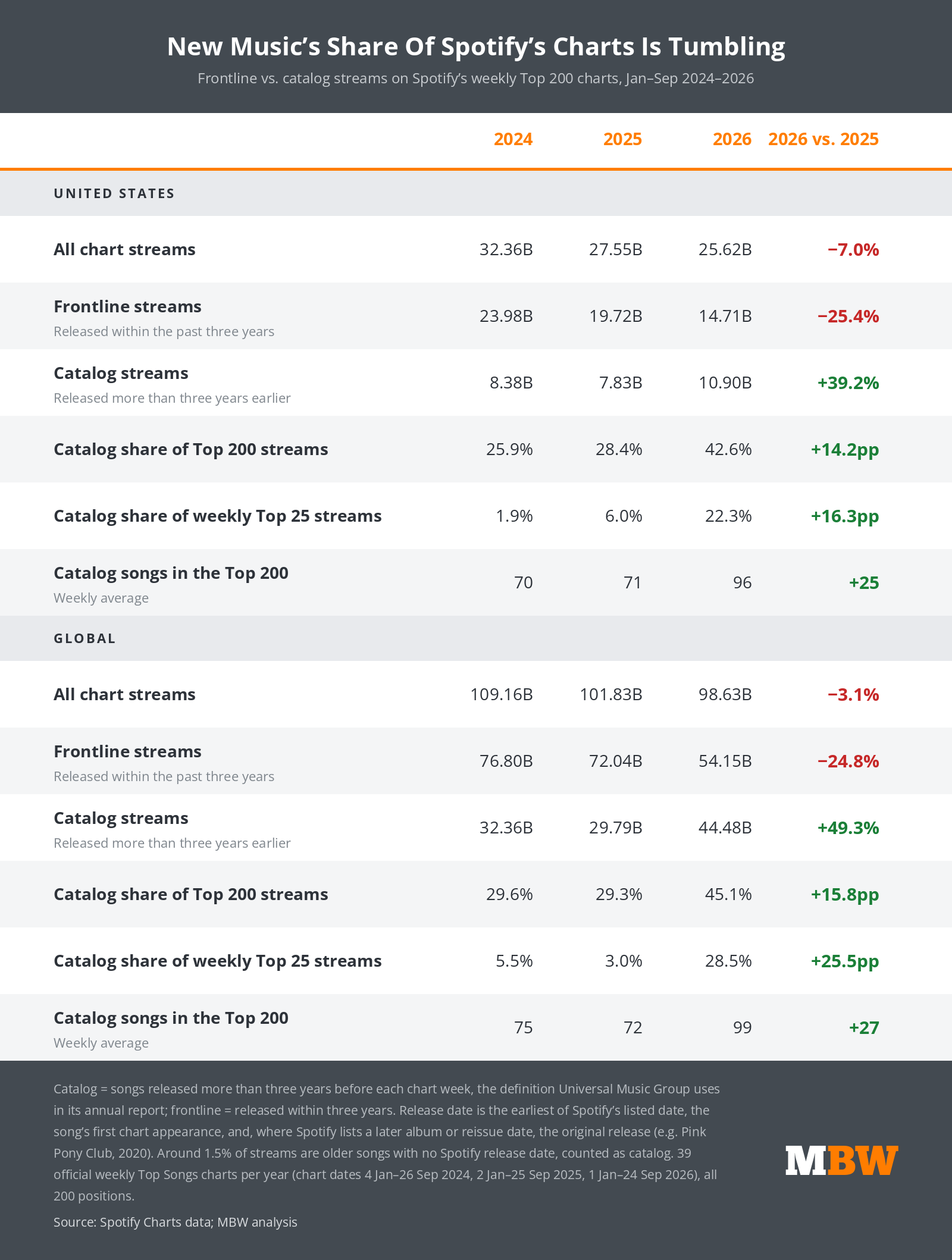
Across the 25.6 billion streams registered on Spotify’s US Top 200 weekly charts in the first 39 weeks of this year, ‘frontline’ music claimed the majority, with 57.4%.
Globally, frontline took 54.9% of 98.6 billion chart streams.
However, the total number of chart streams generated by frontline music has plummeted: down 25.4% YoY in the US, and 24.8% YoY globally.
To put it in simple terms: frontline music’s total Spotify chart streams in Jan–Sept this year were down by 5 billion plays YoY in the US, and by 17.9 billion plays YoY around the world.
(MBW has mirrored Universal Music Group’s investor-facing definition of ‘catalog’ for this analysis – songs released more than three years before each chart week.)
“frontline music’s total Spotify chart streams in Jan–Sept this year were down by 5 billion plays YoY in the US, and by 17.9 billion plays YoY around the world.”
Catalog has filled the space.
Catalog streams on Spotify’s US Top 200 weekly charts rose 39.2% YoY to 10.90 billion in the first nine months of 2026 – an increase of 3.07 billion plays.
Globally, catalog music registered 44.48 billion Spotify chart plays in the Jan–Sept 2026 period. That was up by a whopping 49.3% YoY, or by 14.70 billion plays.
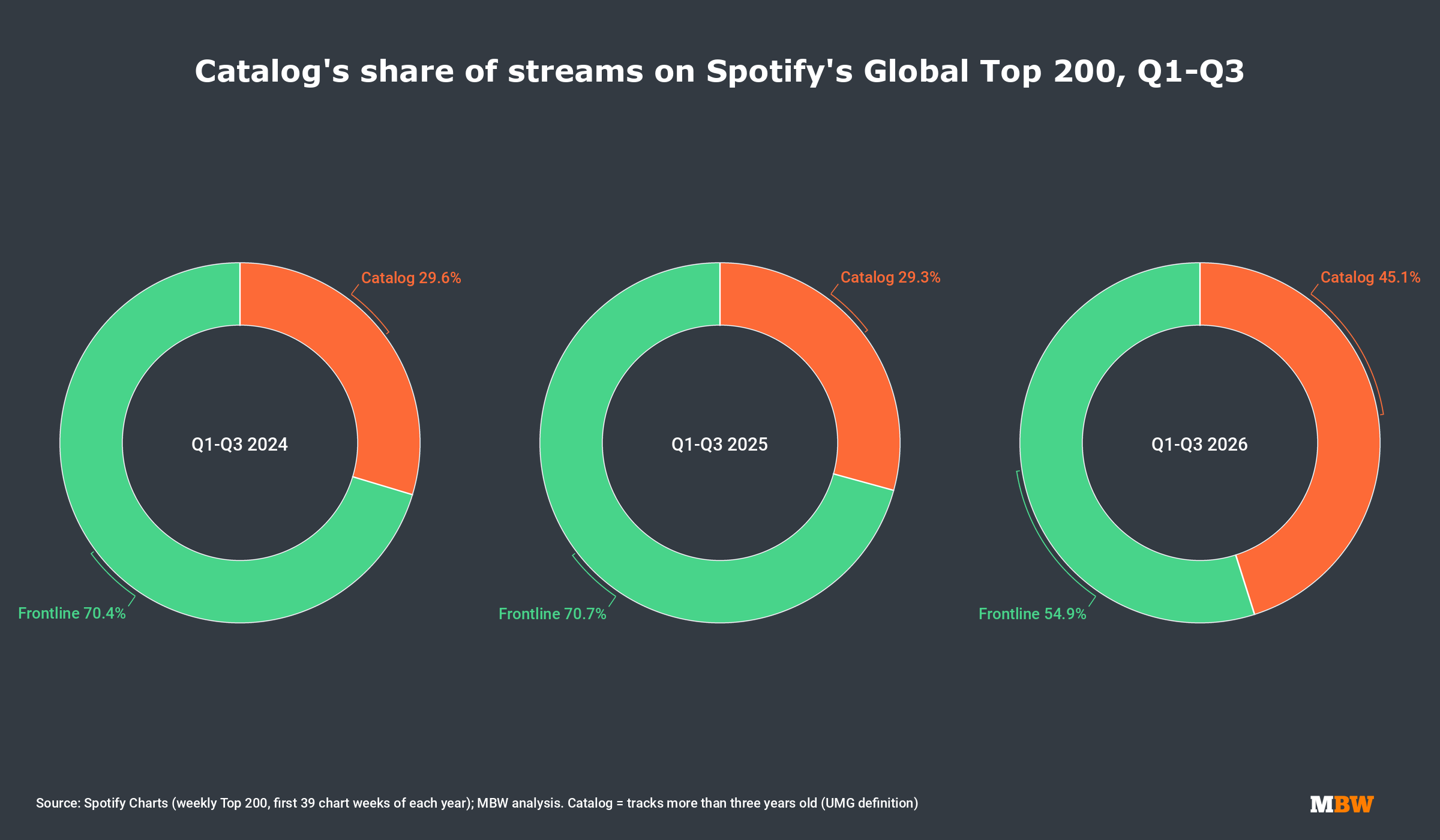
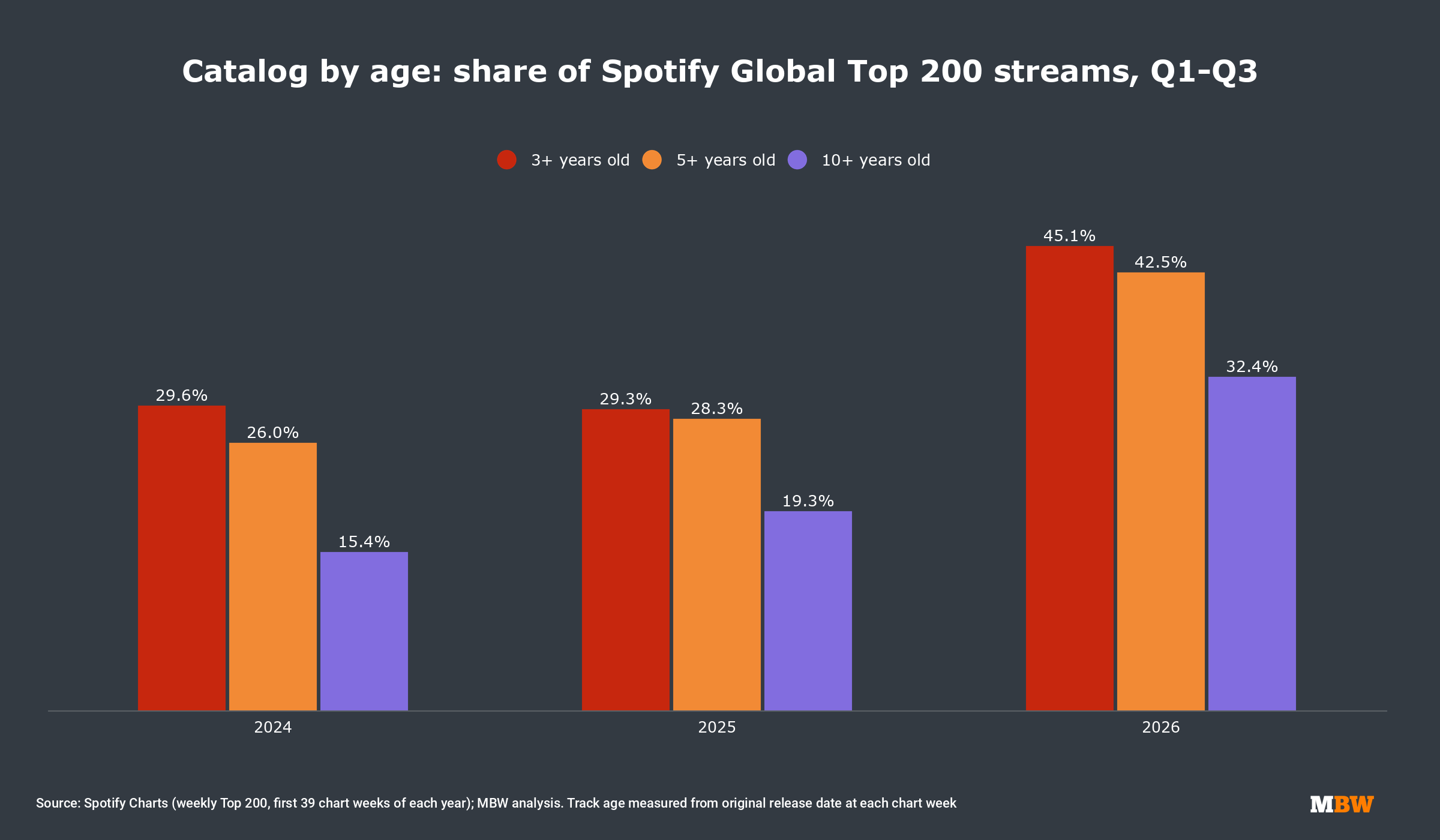
A key indicator of the sea change: in both 2024 and 2025, frontline music claimed just over 70% of Spotify’s global Top 200 weekly chart plays in the first nine months of the year.
In 2026, that was down to 54.9% globally – with catalog’s share rising to 45.1%.
‘Catalog’ can be a slippery term, of course: even by applying a three-year threshold, it sometimes feels odd to label reasonably modern songs (such as Djo’s smash End of Beginning) as ‘catalog’ under industry definitions.
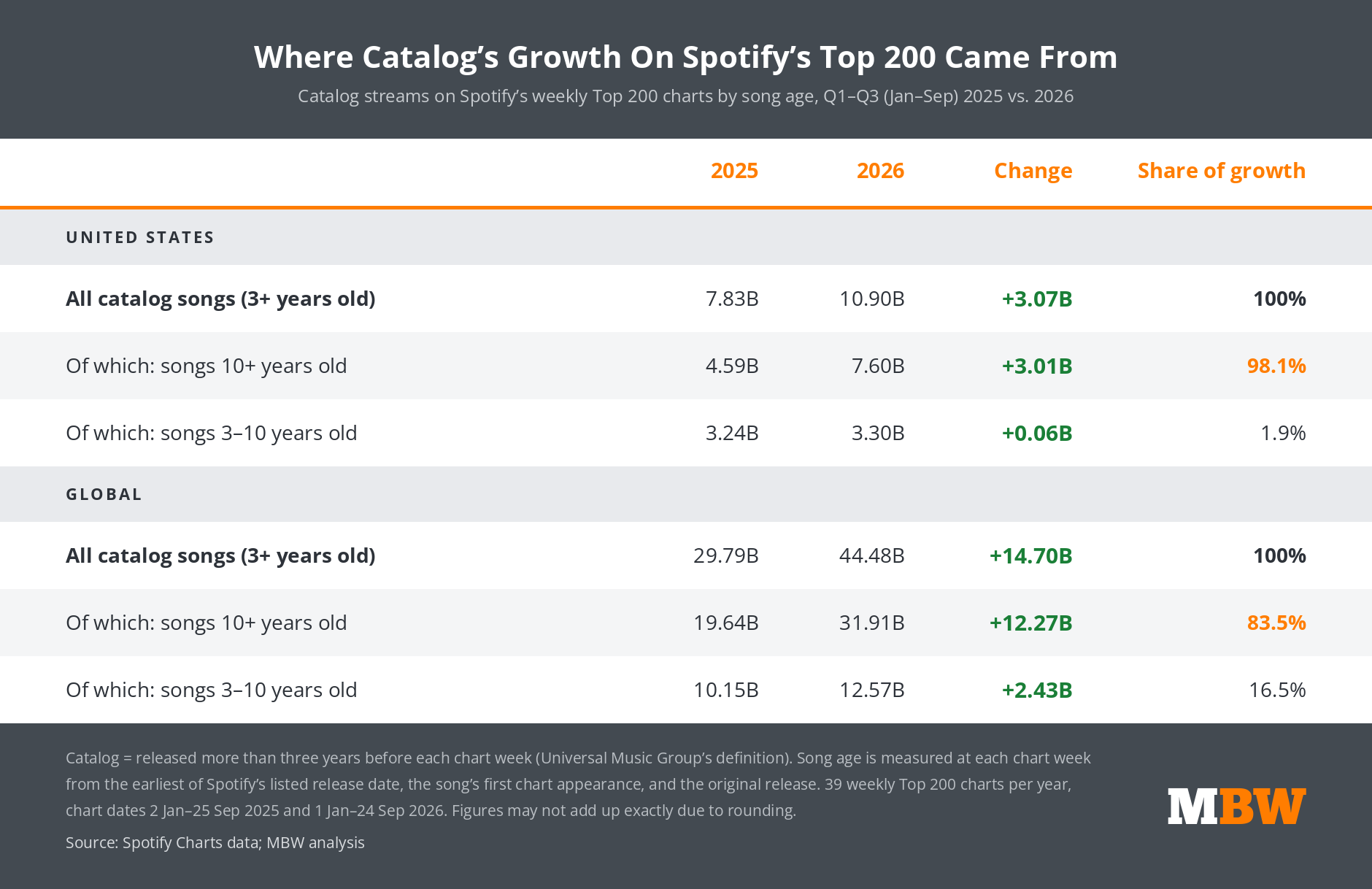
However, MBW’s analysis shows that catalog’s growth isn’t a quirk of the definition: it’s coming overwhelmingly from ‘deep’ catalog.
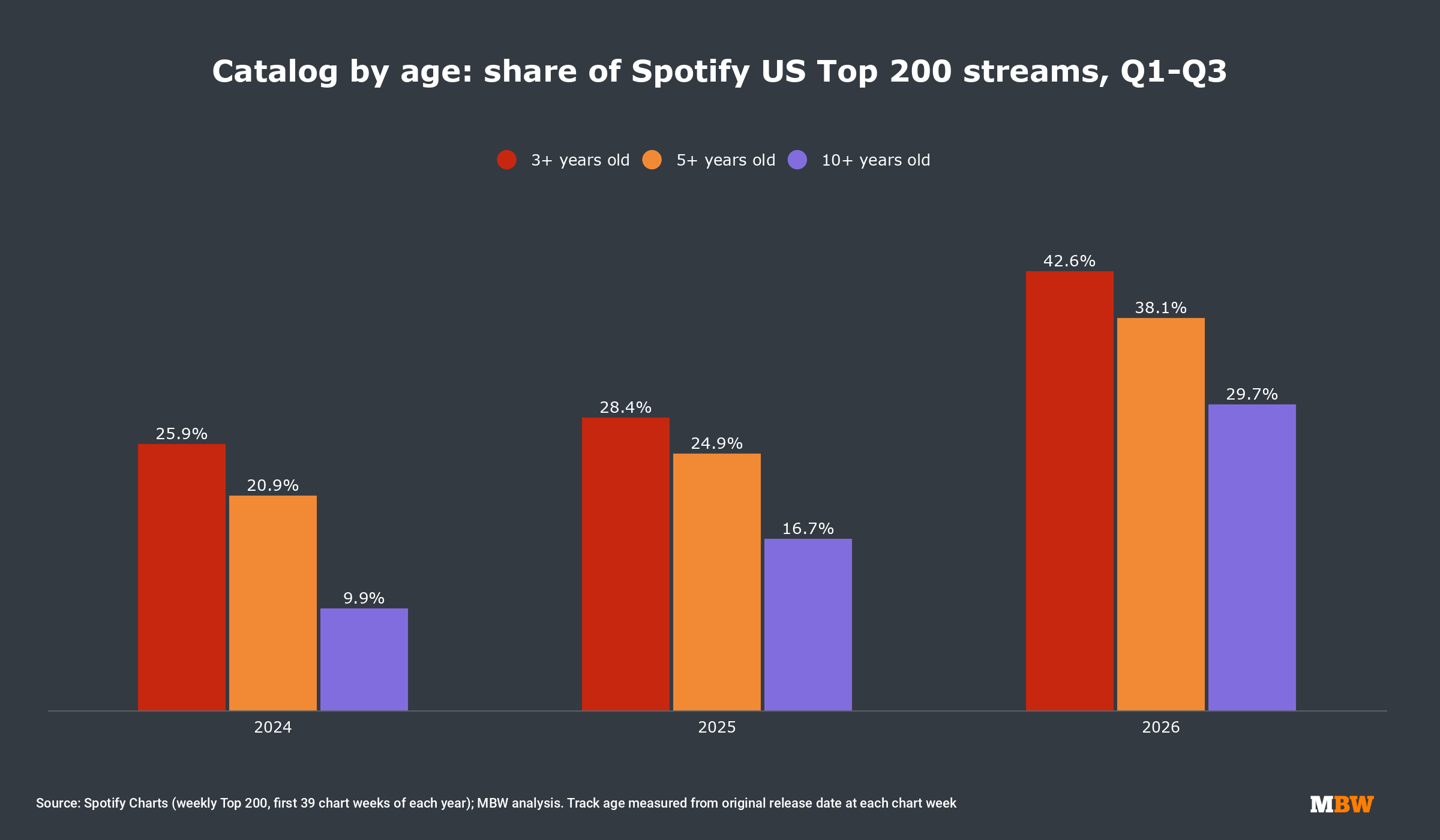
Of the +3.07 billion extra catalog plays on Spotify’s US Top 200 weekly charts in the first nine months of 2026, 3.01 billion came from songs at least 10 years old.
Songs at least 10 years old therefore accounted for 98% of the YoY increase in US catalog chart streams in the first nine months of 2026, and 83% of the increase globally.
Indeed, songs with a vintage of 10+ years accounted for 29.7% of all streams on Spotify’s US Top 200 weekly charts in Q1-Q3 2026 – three times their share in 2024.
And it’s an even more obvious picture globally, where tracks older than 10 years comprised nearly a third (32.4%) of all streams on Spotify’s worldwide Top 200 charts in the Jan-Sept 2026 period.
Recently I’ve noticed, often through the eyes (and ears) of my kids, an interesting pattern: largely forgotten ‘old’ songs surging to unprecedented heights of popularity.
The very best example: Michael Jackson’s Chicago.
Recorded in 1999, it appeared on the King of Pop’s posthumous Xscape album in 2014, and was only ever released as a promotional single.
It’s now on the verge of a billion Spotify streams, despite not appearing in any form in the record-breaking Michael biopic.
“No fewer than 15 Michael Jackson songs landed on Spotify’s Global Top 200 weekly charts in the first nine months of 2026, generating 3.02 billion chart streams between them.”
People in the catalog world often tell me that “familiarity” is a valuable attribute of triple-A catalog music. We know the songs; we know the artists; we know we’ll like it before we press play.
But “familiarity” doesn’t explain why my seven-year-old wants MJ on the stereo all the time. (He hasn’t even seen the Michael biopic – he discovered Jackson’s music via a combination of Roblox and chatter in the school playground.)
“Familiarity” certainly doesn’t explain why his favorite song is Chicago, a posthumous promo single that (checks Wikipedia) didn’t make the Hot 100 on release, and only recently surged into it after featuring in an online animated video.
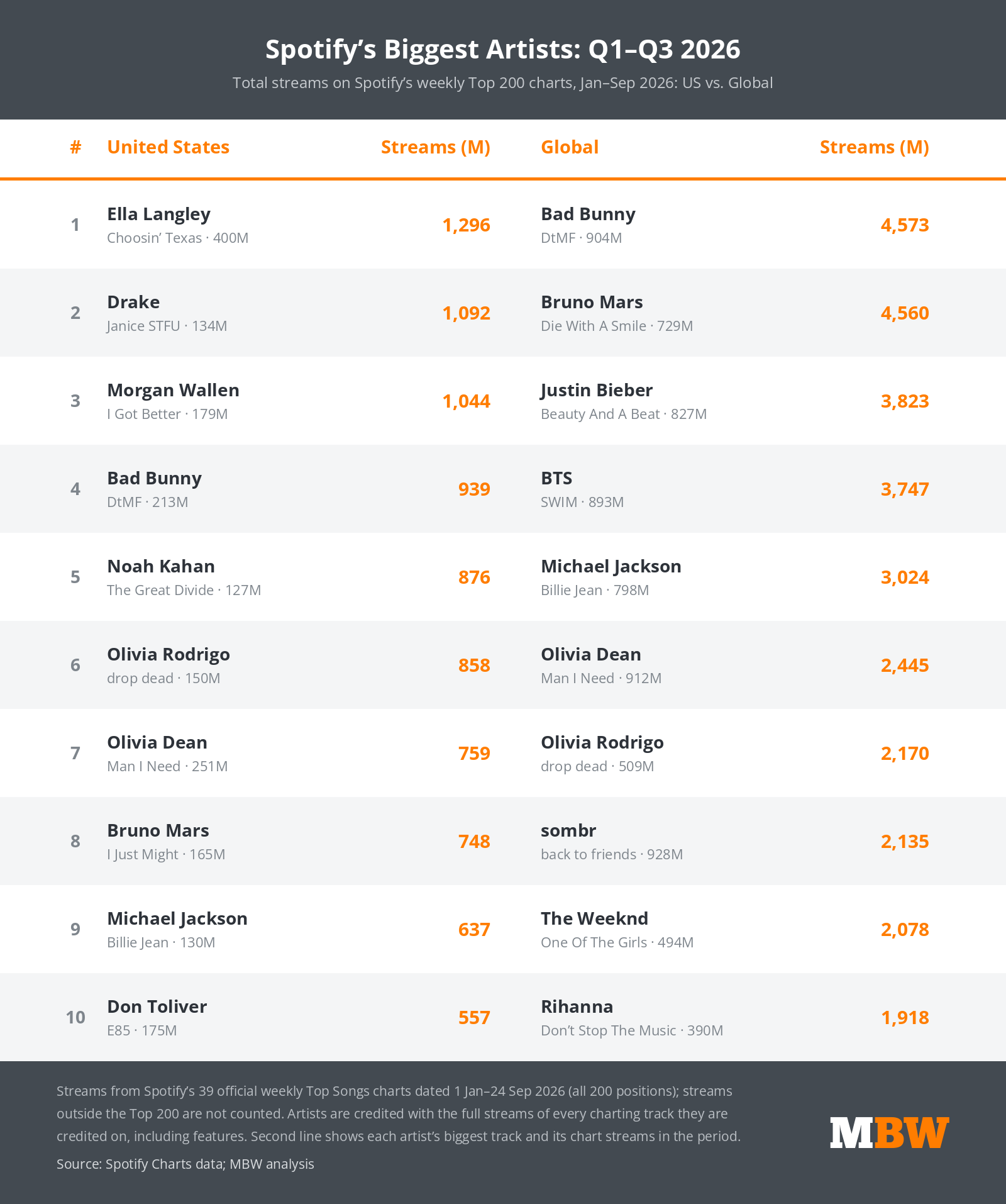
No fewer than 15 Michael Jackson songs landed on Spotify’s Global Top 200 weekly charts in the first nine months of 2026, generating 3.02 billion chart streams between them.
That made Jackson the fifth-biggest artist on Spotify’s Global chart this year, behind only Bad Bunny, Bruno Mars, Justin Bieber, and BTS.
In many ways, Michael Jackson is the ultimate catalog story of 2026 – and a very welcome one for Sony Music Group, which reportedly paid over USD $600 million in 2024 for a 50% stake in Jackson’s recorded music and publishing catalog.
A whole other article could be written on the fact that, when catalog and frontline are combined, total streams within Spotify’s Top 200 weekly charts have declined YoY in both 2025 and 2026 (down 14.9% in 2025, then 7.0% in 2026, in the US).
Yet Luminate reports that the total volume of US on-demand audio streams grew 4.8% YoY in the first half of this year (global streams were up 9.8% YoY).
This suggests an increasing share of listening is now happening outside of Spotify’s Top 200: i.e. the ‘long tail’ is munching into the market share of the 200 most popular tracks each week.
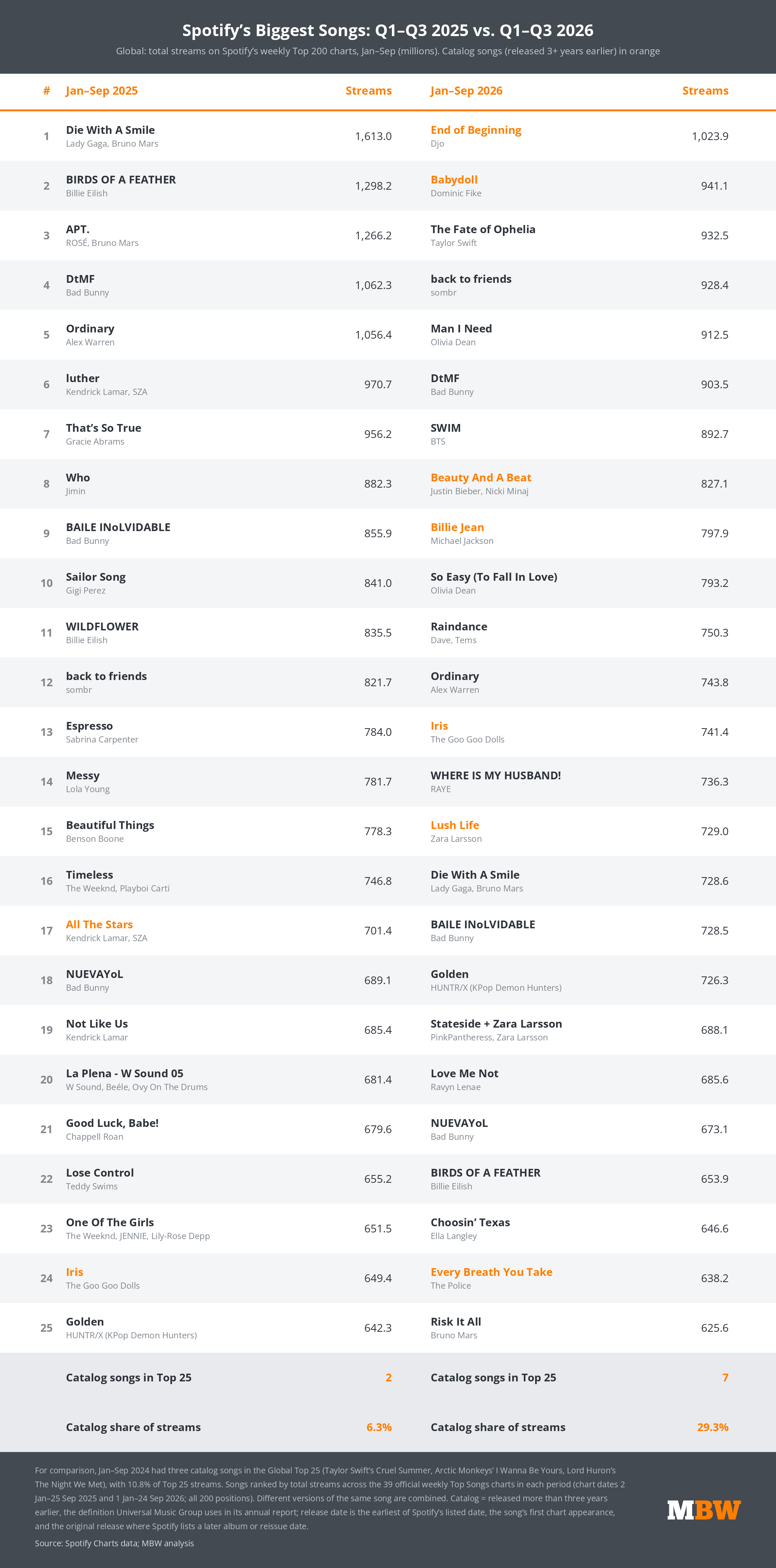
Anyway, back to our report: here’s how the 25 biggest songs on Spotify’s Top 200 Global charts compare across the past two years (with catalog tracks in orange):
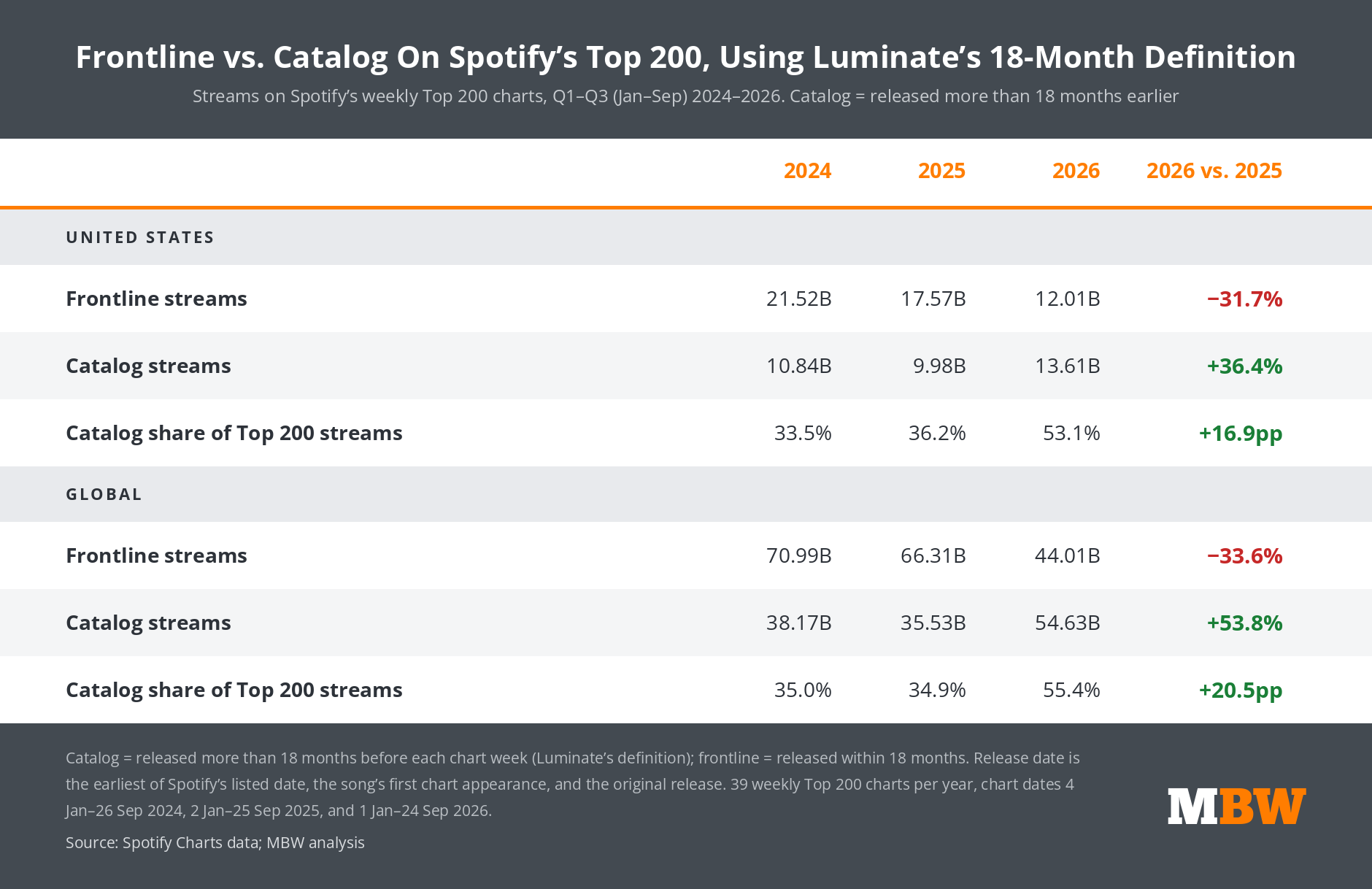
Finally, here’s a table that’s not in the MBW+ report – just for Tim’s Take readers.
It shortens the definition of catalog from ‘three years or older’ to the threshold that Luminate and Billboard use to separate ‘current’ from ‘catalog’ music: tracks that are 18 months (i.e., 1.5 years) or older.
Under this measure, catalog music claimed the majority of streams on Spotify’s Top 200 weekly charts in the first nine months of 2026, both globally (a 55.4% share) and in the United States (a 53.1% share).
This is a first: as you can see below, catalog’s share under this definition was just north of 30% in both 2024 and 2025.
Frontline streams, under the 18-month definition, fell by roughly a third YoY in the first nine months of 2026: down 31.7% YoY in the US and 33.6% YoY globally.
Remember, these stats only reflect what’s happening on Spotify – though we are talking about the world’s biggest music streaming platform, with 300 million subscribers and 777 million monthly active users.
What’s more, these stats are based solely on Spotify’s chart-eligible streams, which are widely understood to be capped per listener within a 24-hour period.
And, of course, we’re only measuring hit tracks here.
Frontline artists like Rosalía, Geese, and many others are predominantly recognized as purveyors of albums – with vast fanbases happy to lose themselves in complete bodies of work, rather than hitting the repeat button on a sole hit.
Still, MBW’s findings raise big questions for our industry, especially as Grammy chatter grows louder, with first-round voting now underway.
We still have a strong frontline business. But breakthrough records that truly break through – on a mainstream, global level – appear to be getting rarer.
Meanwhile, the songs that broke through years, or decades, ago are taking up more and more space at the top.
Music Business Worldwide