Sony‘s combined revenues from recorded music and music publishing topped USD $3 billion for a second consecutive quarter in calendar Q1 2026 (January–March), generating an estimated $3.03 billion in the period.

That’s according to MBW’s calculations based on Sony Group Corp‘s calendar Q1 2026 (fiscal Q4, FY2025) results, as announced by the Japanese conglomerate today (Friday, May 8). The calendar Q1 2026 quarter also marks the end of Sony‘s fiscal year (which runs April 2025 to March 2026), meaning full-year figures are also available for the first time.
The $3.03 billion quarterly combined total was up 19.5% YoY at US dollar-converted consistent currency, compared to $2.54 billion in calendar Q1 2025.
That means Sony‘s recorded music and publishing operations generated approximately $495 million more in calendar Q1 2026 than in the prior-year quarter.
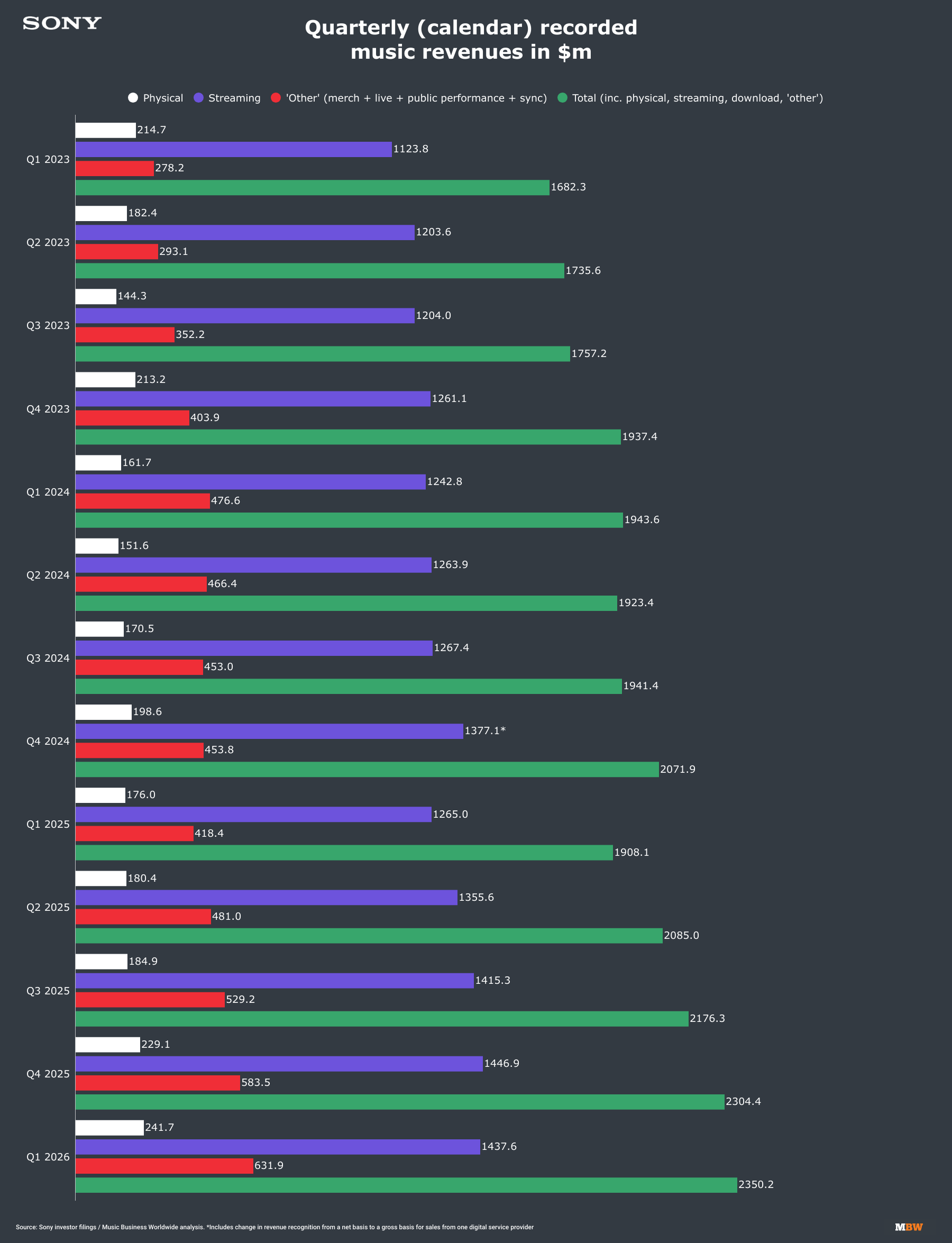
Standout commercial performers for Sony in calendar Q1 included recorded music streaming (up 13.6% YoY to $1.44 billion), and the company’s ‘Other’ category – covering revenues from merch, live, and licensing – which generated over $630 million in the quarter.
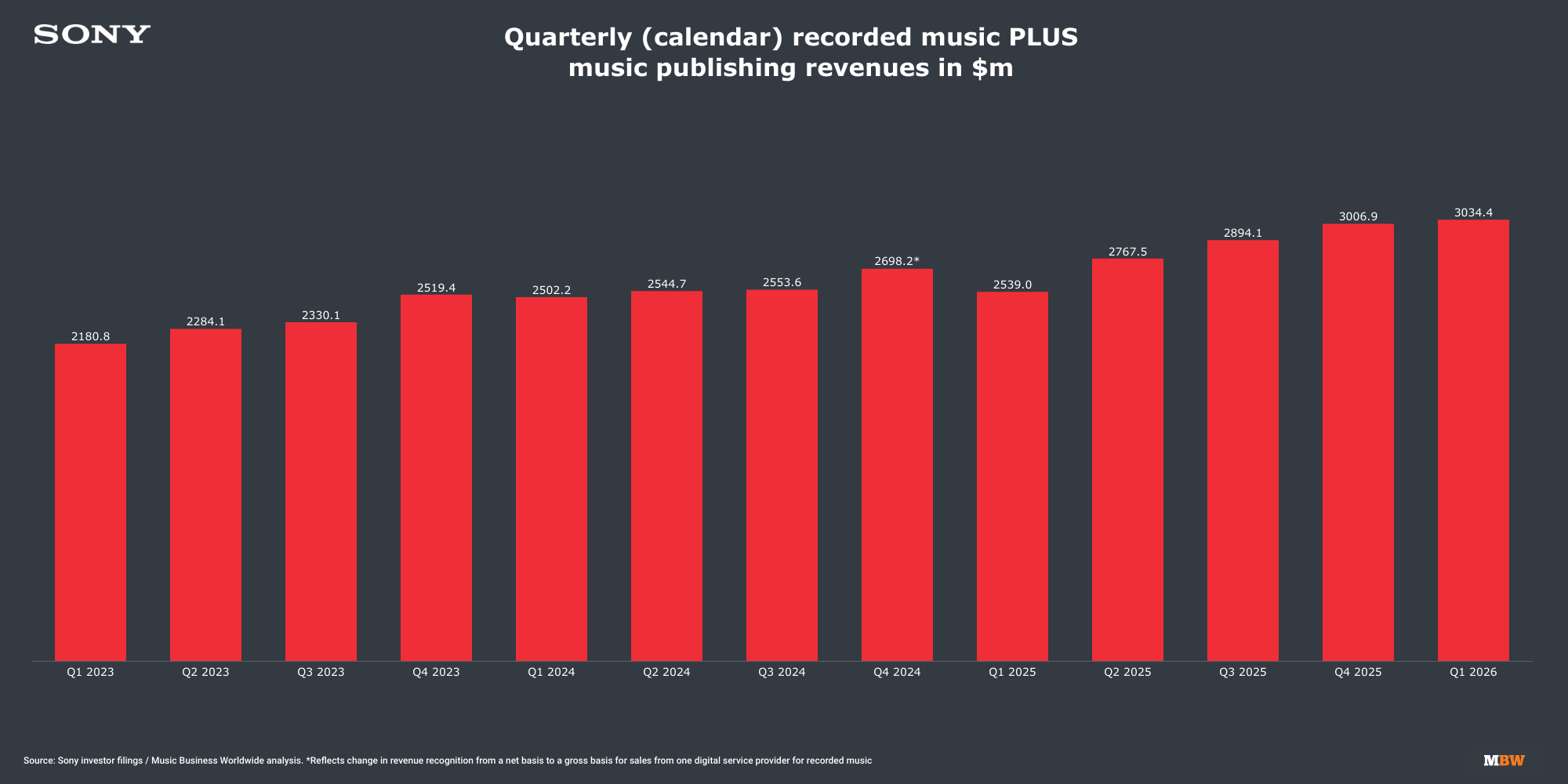
Note: Corporately speaking, Sony Group’s global music operation includes recorded music, plus music publishing, plus ‘Visual Media & Platform’. The final category primarily covers mobile games and animation projects, and has been omitted from MBW’s revenue calculations in the above chart.
MBW calculates Sony’s music revenues in USD, based on average quarterly exchange rates provided by Sony. This gives a more accurate picture of Sony’s worldwide performance than the Japanese firm’s reported Yen figures. US-headquartered Sony Music Entertainment and Sony Music Publishing both aggregate the results of their worldwide subsidiaries on a USD basis. However, this global USD conversion risks a degree of FX distortion by converting revenues from Tokyo-based Sony Music Entertainment Japan, which reports revenues in its ‘root’ currency of Yen.
Recorded music revenue breakdown
Sony Music Entertainment‘s total recorded music revenue in calendar Q1 2026 was an estimated $2.35 billion, up 23.2% YoY versus $1.91 billion in calendar Q1 2025.
Of that total, streaming revenue (combining subscription and ad-funded streaming) was approximately $1.44 billion, up 13.6% YoY.
Physical music sales came in at an estimated $241.7 million, up a striking 37.3% YoY from $176.0 million in calendar Q1 2025.
But the most notable movement was in the ‘Other’ category – which includes license revenue (public performance, broadcast, and sync), merchandising, and live performance income.
This ‘Other’ segment generated an estimated $631.9 million in calendar Q1 2026, surging 51.0% YoY from $418.4 million in calendar Q1 2025.
That approximately $213 million YoY increase in ‘Other’ revenue alone accounted for nearly half of the total dollar increase in recorded music revenue during the quarter.
Meanwhile, download revenue continued its decline, falling to an estimated $38.9 million, down 20.1% YoY.
Top-selling projects globally
The following were the top 10 best-selling recorded music projects for Sony Music Entertainment (excluding Japan-signed artists) in calendar Q1 2026 (the quarter ended March 31, 2026), in order of revenue contribution:
- Bad Bunny (Rimas Entertainment), DeBÍ TiRAR MáS FOToS
- Harry Styles, Kiss All The Time. Disco, Occasionally.
- ATEEZ, GOLDEN HOUR : Part.4
- Bad Bunny (Rimas Entertainment), Un Verano Sin Ti
- BLACKPINK, BLACKPINK The 3rd MINI ALBUM [DEADLINE]
- Tate McRae, So Close To What
- ROSALÍA, LUX
- SZA, SOS
- Megan Moroney, Cloud 9
- A$AP Rocky, Don’t Be Dumb
As the quarter also marks the end of Sony‘s fiscal year, the company also disclosed its top 10 best-selling recorded music projects for the full fiscal year ended March 31, 2026 (i.e. the 12 months April 2025–March 2026):
- Bad Bunny (Rimas Entertainment), DeBÍ TiRAR MáS FOToS
- SZA, SOS
- Tate McRae, So Close To What
- Harry Styles, Kiss All The Time. Disco, Occasionally.
- Bad Bunny (Rimas Entertainment), Un Verano Sin Ti
- Michael Jackson, Thriller
- PARTYNEXTDOOR, $ome $exy $ongs 4 U
- Fuerza Regida, 111XPANTIA
- Tyler, The Creator, CHROMAKOPIA
- ROSALÍA, LUX
Music publishing performance
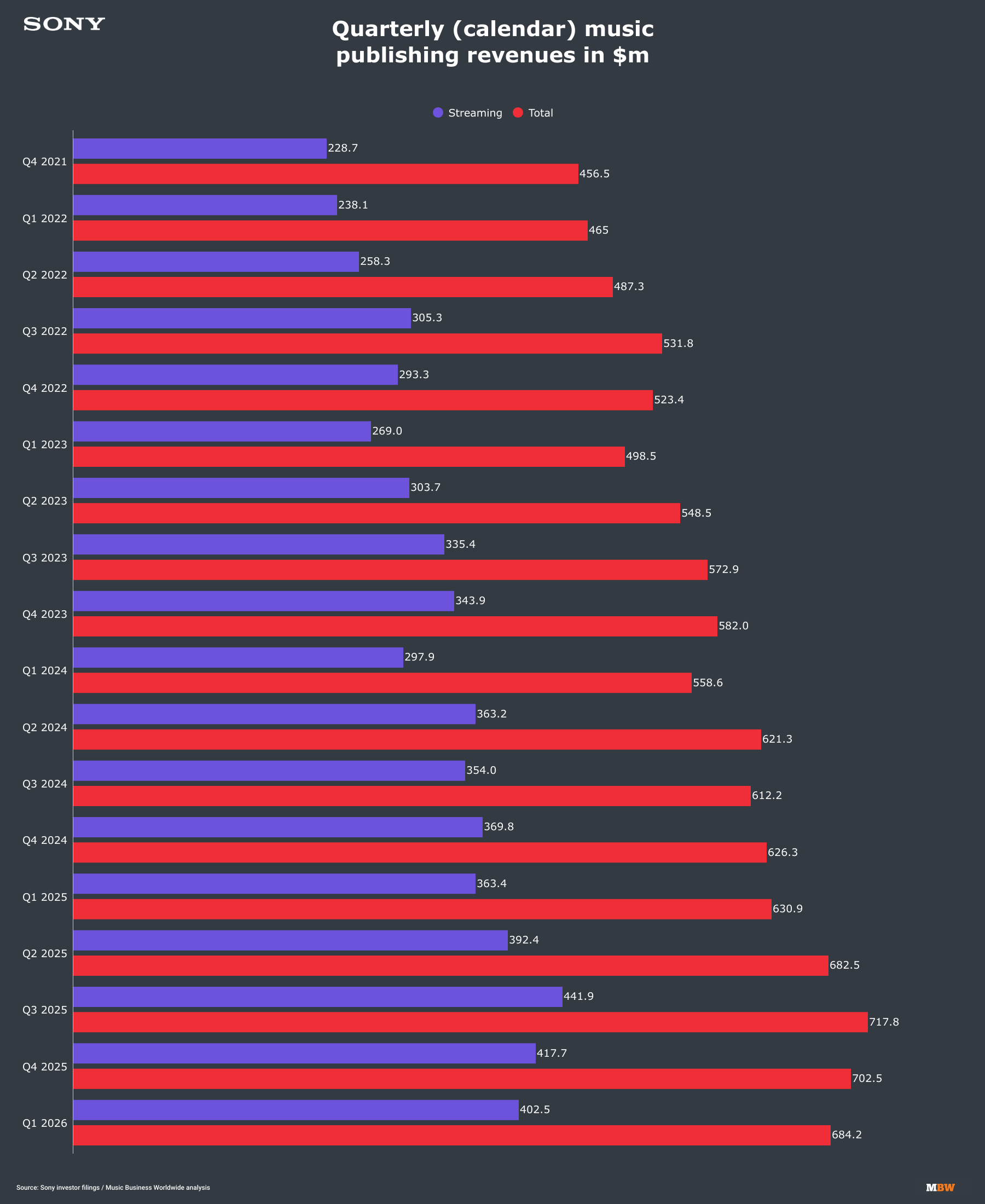
Sony Music Publishing‘s total revenue in calendar Q1 2026 was an estimated $684.2 million, up 8.4% YoY versus $630.9 million in calendar Q1 2025.
Within that, streaming revenue at Sony Music Publishing was approximately $402.5 million, up 10.8% YoY from $363.4 million.
Quarterly profits
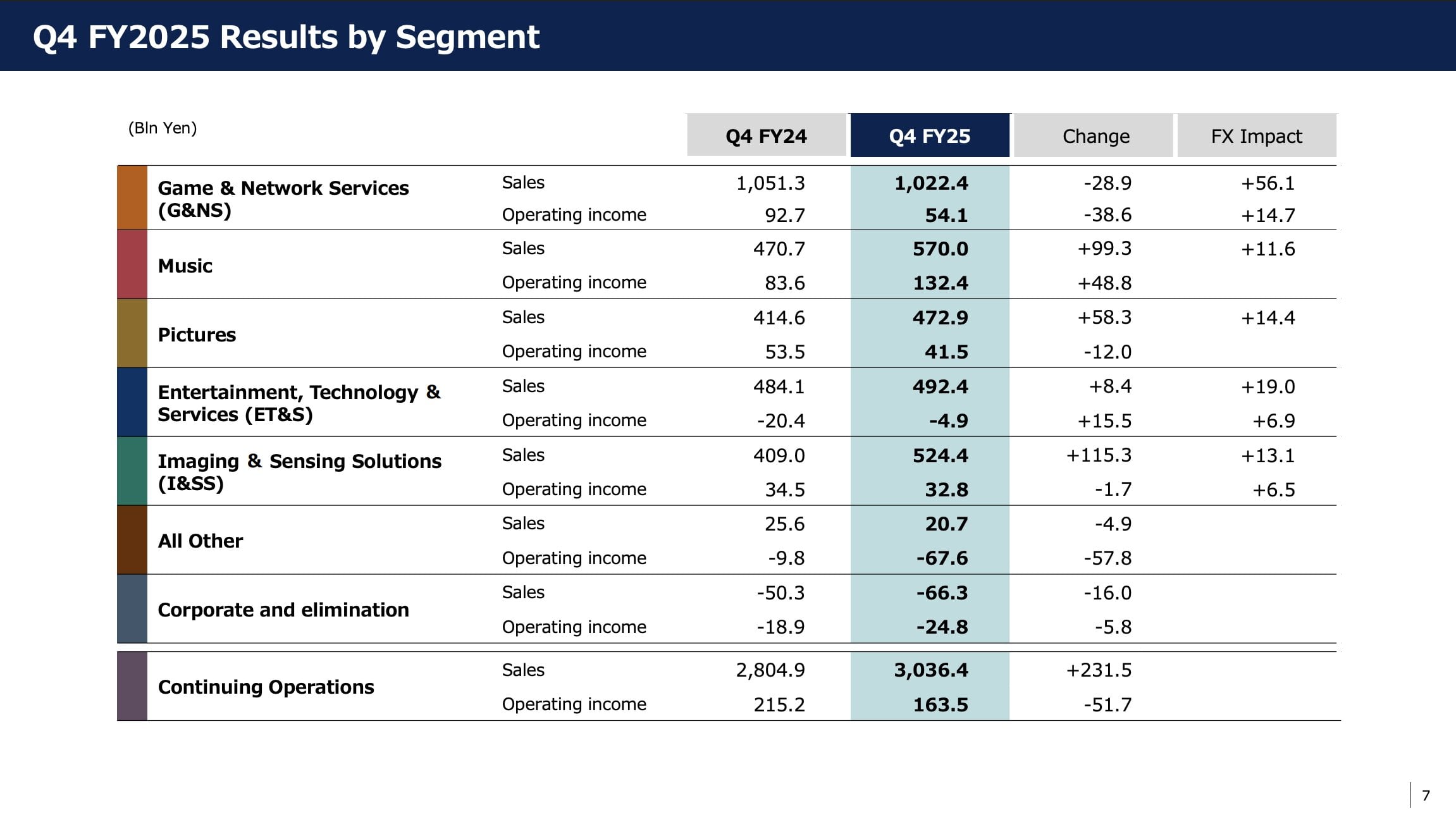
Note: Profit figures cover Sony‘s full corporate Music division, which encompasses recorded music, music publishing, and Visual Media & Platform (animation and mobile games). Visual Media & Platform is excluded from MBW’s revenue calculations above, but is included in the profit metrics below.
Sony‘s Music division generated operating income of 132.4 billion Yen (approximately $844.9 million) in calendar Q1 2026, versus 83.6 billion Yen ($547.8 million) in calendar Q1 2025.
However, the quarterly operating income figure included a one-time remeasurement gain of 34.7 billion Yen from the acquisition of additional equity interest in Peanuts Holdings LLC. Excluding this item, operating income for the quarter was approximately 97.7 billion Yen ($623.5 million).
Total divisional revenue for the quarter (including Visual Media & Platform) was 570.0 billion Yen (approximately $3.64 billion), giving an operating margin of 23.2%.
Full fiscal year results
For the full fiscal year (April 2025–March 2026), Sony‘s combined revenues from recorded music and music publishing totaled an estimated $11.71 billion, up 13.4% YoY from $10.33 billion in the prior fiscal year – a difference of approximately $1.38 billion.
Within that, total recorded music revenue for the full fiscal year was an estimated $8.93 billion, up 13.8% YoY, while music publishing revenue was an estimated $2.79 billion, up 11.9% YoY.
Sony‘s own investor presentation stated that full-year streaming revenue growth rates on a US dollar basis were +9% YoY for Recorded Music and +14% YoY for Music Publishing. (MBW’s calculations, which may differ marginally from Sony’s internal figures due to rounding, produced broadly consistent results.)
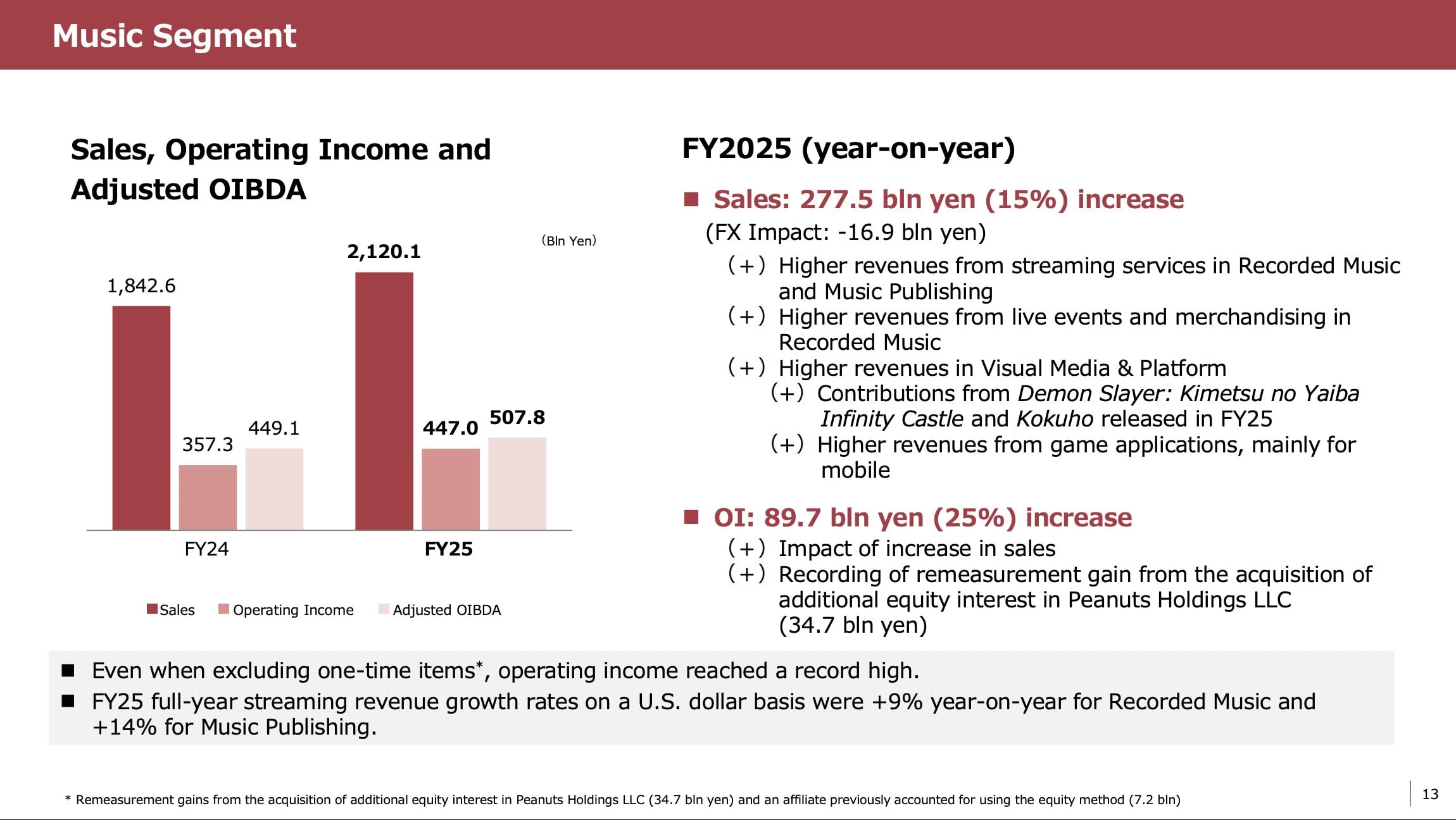
Turning to profits: Sony‘s full-year Music division operating income was 447.0 billion Yen (approximately $2.97 billion), up from 357.3 billion Yen ($2.34 billion) in the prior fiscal year – an increase of 25% YoY per Sony‘s own calculations. Sony noted that even when excluding the one-time Peanuts Holdings LLC remeasurement gain (34.7 billion Yen), operating income reached a record high.
Full-year Music division Adjusted OIBDA – a metric also used by Warner Music Group – was 507.8 billion Yen (approximately $3.37 billion), up from 449.1 billion Yen ($2.94 billion) in the prior fiscal year, an increase of 14.4% YoY at the USD-converted level.
Total full-year divisional revenue (including Visual Media & Platform) was 2,120.1 billion Yen (approximately $14.07 billion), giving a full-year operating margin of 21.1% and an Adjusted OIBDA margin of 24.0%.
Sony attributed the year-on-year increase in revenue to higher revenues from streaming services in both Recorded Music and Music Publishing, higher revenues from live events and merchandising in Recorded Music, and higher revenues in Visual Media & Platform – including contributions from Demon Slayer: Kimetsu no Yaiba Infinity Castle and Kokuho released in FY25, plus higher revenues from mobile game applications.
Note: Sony Music Group – the US-headquartered umbrella group for Sony Music Entertainment and Sony Music Publishing, run by Chairman Rob Stringer – is distinct from Sony‘s corporate Music division, which also encompasses Sony Music Japan operations and Visual Media & Platform.
Methodology note
Note: All YoY percentage rises/falls published in this story are calculated at constant currency at the US dollar-converted level. MBW uses Sony’s own quarterly average currency rates for these calculations.
[SCREENSHOT: Music Segment Supplemental Information chart from Sony filings]
For this analysis, MBW has calculated Sony’s financials from Japanese Yen into US dollars at the following prevailing exchange rates in each quarter, as provided by Sony Corp:
- Calendar Q1 2020: 109.0 Yen per USD
- Calendar Q2 2020: 107.6 Yen per USD
- Calendar Q3 2020: 106.2 Yen per USD
- Calendar Q4 2020: 104.5 Yen per USD
- Calendar Q1 2021: 105.9 Yen per USD
- Calendar Q2 2021: 109.5 Yen per USD
- Calendar Q3 2021: 110.1 Yen per USD
- Calendar Q4 2021: 113.7 Yen per USD
- Calendar Q1 2022: 116.1 Yen per USD
- Calendar Q2 2022: 129.4 Yen per USD
- Calendar Q3 2022: 138.2 Yen per USD
- Calendar Q4 2022: 132.3 Yen per USD
- Calendar Q1 2023: 135.4 Yen per USD
- Calendar Q2 2023: 137.0 Yen per USD
- Calendar Q3 2023: 144.4 Yen per USD
- Calendar Q4 2023: 147.9 Yen per USD
- Calendar Q1 2024: 148.2 Yen per USD
- Calendar Q2 2024: 155.6 Yen per USD
- Calendar Q3 2024: 149.5 Yen per USD
- Calendar Q4 2024: 152.2 Yen per USD
- Calendar Q1 2025: 152.6 Yen per USD
- Calendar Q2 2025: 144.6 Yen per USD
- Calendar Q3 2025: 147.37 Yen per USD
- Calendar Q4 2025: 153.99 Yen per USD
- Calendar Q1 2026: 156.7 Yen per USD
By applying these exchange figures to each applicable period, we effectively get a US-leaning constant currency picture of Sony Music’s performance.
This isn’t a perfect system; it risks overplaying Sony Music Entertainment’s global business slightly by converting a chunk of revenues from Sony Music Entertainment Japan (which would usually be straight-reported in Yen) into US dollars.
But it provides us with a cleaner reflection of the performance of New York-based Sony Music Entertainment outside of FX distortion, because the company had to convert its US currency into Yen in the first place for Sony Corp’s results. The same is true for US-based Sony Music Publishing.
MBW believes this currency exchange system is the yardstick used internally at Sony Music Group’s HQ in New York.
Sony’s own description of its three corporate music divisions is as follows:
- Recorded Music – Streaming includes the distribution of digital recorded music by streaming; Recorded Music – Others includes the distribution of recorded music by physical media and digital download as well as revenue derived from artists’ live performances;
- Music Publishing includes the management and licensing of the words and music of songs;
- Visual Media and Platform includes the production and distribution of animation titles, including game applications based on the animation titles, and various service offerings for music and visual products.
Within / covering the first two divisions listed above:
Sony Music Publishing, run by CEO & Chairman Jon Platt, is Sony’s US-headquartered music publishing operation. Sony Music Entertainment, run by CEO Rob Stringer, is Sony’s US-headquartered recorded music operation.
And Sony Music Group – also run by Rob Stringer, as Chairman – is Sony’s US-headquartered umbrella group for both Sony Music Entertainment and Sony Music Publishing.Music Business Worldwide